
CNHL Baterai Lipo
CNHL bertujuan menyediakan baterai Li-Po berkualitas tinggi dan produk RC kepada semua penggemar hobi dengan layanan pelanggan yang luar biasa dan harga yang kompetitif

The new paint scheme gets your attention first. The black spine, dark tail and oversized eagle give the Freewing Eurofighter Typhoon V2 90mm EDF Jet a more aggressive look than the earlier release. Once the model is out of the box, however, the most useful changes are not the ones visible in a product photo.
The wings now come off without working through a row of screws. The battery can move through a wider fore-and-aft range. The gyro and canard coordination are already handled inside the aircraft. Formation lights stretch from the front fuselage to the tail and wingtips. These changes do not turn the Eurofighter into a new airframe, but they remove several small frustrations that owners would otherwise meet every time the jet went into the car or onto the flight line.
Freewing offers the V2 with a 6S system and an 8S High Performance system. The two versions are the same size and carry the same V2 airframe features. The choice comes down to power delivery, battery management and how much complexity the pilot is willing to accept for the higher-voltage setup.

The original Freewing Eurofighter developed a following because it could do more than fast straight passes. It had the nose-high, power-supported slow-flight character pilots expect from a canard-delta jet, yet it was still comfortable being driven around the circuit at speed.
Freewing has not replaced that foundation. The V2 still measures 1030mm across the wings and 1450mm from nose to tail, with an approximate empty weight of 3230g. It retains the 90mm 12-blade fan, working airbrake, retractable landing gear, sequenced doors, auxiliary air inlets and full external-store package.
This continuity is important. A major aerodynamic redesign could have created a different-looking specification sheet while losing the behavior that made the first model popular. Instead, Freewing concentrated on how the aircraft is assembled, transported, balanced and controlled.
| Specification | Eurofighter V2 |
|---|---|
| Wingspan | 1030mm / 40.5in |
| Length | 1450mm / 57in |
| Approximate Empty Weight | 3230g |
| EDF Unit | 12-blade 90mm EDF |
| ESC | 120A with 8A UBEC and thrust reverse |
| Gyro | Factory-installed EG01 6-axis gyro |
| CG Reference | 215mm behind the wing-root leading edge |
| Radio | 7 or more channels listed; 8 channels are more practical for the complete function set |
The V2 update makes the most sense when the aircraft is viewed in three places: inside the car, on the assembly stand and at the runway.
The old wing arrangement asked the owner to remove and reinstall several screws. The new wings slide onto the carbon spar, connect through the existing multi-function plugs and lock through the quick-release mechanism. Once the aircraft has completed its first build, regular field assembly becomes much less tedious.
The drop tanks are also easier to remove instead of being permanently committed to the model with adhesive. That sounds like a minor change until a protruding tank catches the edge of a car seat or storage rack. For owners who transport the jet frequently, removable details can matter as much as another electronic feature.

The canard coordination is already handled through the aircraft control system, so the transmitter setup does not begin with the pilot building a complicated Eurofighter mix from a blank page. That simplifies the radio side, but the first physical assembly still requires care.
The vertical tail carries a rudder-servo lead and separate lighting connections. If the fin will not sit down without pressure, the problem is likely underneath it. Pull it back up, settle the wires into the available space and try again. Tightening the screws against a trapped cable is an easy way to damage a connector or leave the tail sitting unevenly.
The illuminated wingtips also need a little patience. The lighting board takes up some of the internal space that would otherwise accept loose wire. Match the left and right parts, connect the lighting leads and feed the wiring into the channel before pushing the wingtip fully into place.
The CG reference points are now placed on the wings, where they are easier to use during a field check. The battery area also allows more movement along the length of the fuselage, helping the pilot balance packs with different capacities and shapes.
The new formation lights are spread across the front fuselage, tail and wingtips. They do not replace proper orientation awareness, but they make the aircraft easier to recognize as it turns onto final and give the grey-and-black scheme more presence in lower light.

The 6S Eurofighter uses a 3668-1980Kv inrunner with the same 12-blade 90mm fan. On the runway it does not behave like a model waiting for an 8S conversion. A modest amount of back pressure gets it away cleanly, and once the gear is up the jet carries enough energy for low passes, climbing turns and repeated nose-high runs.
The most revealing part of the flight is not the fastest pass. It is the moment the nose comes up and the aircraft stays controllable at a much lower speed. The Eurofighter can be held in a convincing high-alpha attitude without losing the sense that it is still flying forward rather than hanging vertically on fan thrust.
A direct crosswind makes the limits easier to see. With around 10 mph crossing the runway, the aircraft remains settled but has to crab into the wind. The gyro reduces the nervous movement that can make a foam jet look untidy, yet the pilot still has to manage heading, bank and power. That is exactly the right division of responsibility for an advanced model: the electronics calm the airframe, while the pilot continues flying it.

The EG01 is most useful when the aircraft is moving between very different parts of its speed range. Fast passes look cleaner, slow turns carry less unwanted rocking, and the approach feels less busy when the wind is not perfectly aligned with the runway.
That does not make the Eurofighter suitable for a new EDF pilot. The gyro cannot replace an approach plan, recover energy that has already been bled away or cancel a crosswind. It also cannot compensate for an incorrectly balanced aircraft or a control surface moving in the wrong direction.
Before the first flight, the model should be moved by hand while every gyro correction is watched. The canards, rear elevons, rudder and nose steering must all respond in the correct direction. Thrust reverse should also be assigned in a way that prevents accidental operation in the air.
First-flight rule: a factory-installed gyro reduces installation work, not preflight responsibility.
The V2 canards no longer follow normal roll commands. They now move with pitch while the rear surfaces handle the rolling work. On the model, this produces a cleaner visual response and removes the constant opposite movement that some owners disliked on the earlier setup.
Describing this as completely identical to the full-size Eurofighter would be too simple. The real aircraft uses a digital flight-control system that coordinates its surfaces according to conditions and maneuver demands. The model change is better understood as a tidier and more convincing control presentation for normal RC inputs.
The rear surfaces are where the community remains divided. Several experienced EDF followers wanted full-span elevons, both for closer scale appearance and for the possibility of greater pitch authority. Freewing retained the existing surface layout.
That decision does not prevent the V2 from flying high alpha or making a controlled approach. The 6S aircraft already shows that the current surfaces have usable authority. The criticism is still fair, though. Freewing improved many ownership details while leaving the most frequently requested wing change untouched.
The Eurofighter does not want to be treated like a conventional sport model with the throttle closed early and the rest left to glide. The nose attitude establishes the approach, and power regulates how quickly the aircraft comes down.
The airbrake is useful because it adds drag without asking the pilot to throw away the stable approach attitude. Once the wheels are on the runway, thrust reverse can reduce the rollout. Neither feature is a shortcut for arriving too fast or too steep, but together they make the landing sequence easier to manage on a suitable hard surface.
The lights are particularly effective on final. With the gear down and the aircraft coming toward the pilot, the formation and landing lights help define the shape of an otherwise dark grey jet.
The 6S and 8S versions share the same dimensions, airframe and major scale equipment. The motor and battery arrangement create the real separation.
| Comparison | 6S Eurofighter V2 | 8S High Performance V2 |
|---|---|---|
| Motor | 3668-1980Kv inrunner | 4075-1350Kv inrunner |
| Normal Battery Setup | One 6S EC5 battery | Two matching 4S EC5 batteries in series |
| Factory Capacity Reference | 5000 to 6000mAh | Two 4S 5000mAh packs |
| Pack Management | One pack to charge, install and monitor | Two matched packs and a series connection |
| Best Reason to Choose It | Strong performance with simple battery handling | Higher-voltage power system and greater performance ceiling |
The 6S version is the natural all-rounder. It already has enough power to use the Eurofighter airframe properly, and a single battery makes charging and field preparation easier.
The 8S version is for the pilot who wants the highest-performance configuration from the start. It should not be presented as the only version with serious power. It is the version that asks for more battery hardware and rewards that extra commitment with the higher-voltage system.
The battery-area revision may be less exciting than the new lights, but it opens up more useful choices. The pack can move farther forward or rearward, and the wing-mounted CG marks make it easier to see whether a different battery has taken the model outside the intended balance range.
This matters because capacity alone is a poor way to judge an EDF battery. Two packs with the same capacity can have very different weights and dimensions. A high-capacity pack that stays within a lighter size class may be more useful than a lower-capacity battery built with a heavier conventional layout.
That is where the CNHL Lightning LiHV range creates a different battery strategy for this model.

The headline option for the 6S Eurofighter. In our comparison, its dimensions and weight sit close to the commonly used 6000mAh class, but the pack carries 7800mAh of rated capacity. That creates more energy reserve without the usual jump into an oversized and much heavier battery.
A smaller step beyond the factory range. It suits pilots who want extra reserve while keeping a familiar standard-voltage LiPo setup and a more conservative installed weight.
The closest match to the basic capacity reference. This is the uncomplicated choice for pilots who prefer lower pack mass and do not need the largest available energy reserve.
The CNHL Lightning LiHV 7800mAh 6S battery for the Freewing Eurofighter V2 is particularly interesting because it changes the usual endurance trade-off. More capacity normally means a clearly heavier jet. Here, the capacity increase arrives in approximately the same size-and-weight neighborhood as the 6000mAh pack commonly paired with the model.
It is still important to avoid promising a fixed flight-time gain. A high-alpha session with frequent throttle changes will use the battery differently from wide circuits and moderate passes. Wind, external stores, landing reserve and battery condition all affect the result. The reliable claim is that the 7800mAh pack gives the pilot more stored energy to work with.
The 8S model normally uses two matching 4S EC5 packs connected in series. The voltages add together, while the capacity does not.
Two 4S 7200mAh packs in series produce an 8S 7200mAh system, not an 8S 14400mAh system.
This pair creates an 8S 6000mAh system. It moves beyond the standard 5000mAh reference without immediately taking the aircraft to the largest dual-pack configuration.
The stronger endurance-focused recommendation. The Lightning construction allows the pair to reach a higher capacity without entering the weight class normally expected from conventional 7200mAh packs.
The most endurance-focused dual-pack option. Combined weight, secure retention, cable clearance and final CG become especially important at this end of the capacity range.
The conservative starting point for pilots who want to remain close to the original dual-5000mAh specification before exploring the lighter high-capacity Lightning combinations.
Both batteries in a series pair should be the same model, capacity and approximate age. They should be charged to closely matched voltages and used as a dedicated pair. A weak pack in the pair limits the complete 8S system.
A single 8S pack removes the need to manage a matched pair, but it is not a direct plug-in replacement for the factory arrangement. The aircraft uses EC5, while the single 8S batteries in this collection use QS8.
A single-pack setup therefore needs a properly rated QS8-to-EC5 connection, enough space for the larger battery body, safe lead routing and a fresh CG check. The adapter should not become the narrowest electrical point in a high-current EDF system.
For most owners, two matched 4S EC5 packs remain the cleaner 8S solution. A single 8S QS8 battery is better treated as an experienced-user alternative rather than the default recommendation.
CNHL Lightning LiHV batteries can be charged to 4.35V per cell, but the connector and cell count alone do not confirm that the stock power system accepts the higher full-charge voltage.
| Battery System | 4.20V Per Cell | 4.35V Per Cell |
|---|---|---|
| 6S | 25.2V full charge | 26.1V full charge |
| 8S | 33.6V full charge | 34.8V full charge |
Use LiHV charge mode only after confirming the maximum voltage accepted by the complete power system. Where that confirmation is unavailable, a LiHV pack can still be charged through the standard LiPo program at 4.20V per cell.
A V1 owner with a well-sorted aircraft will not receive a completely different flying machine. The V2 makes more sense when the inconvenience around the original model has become more noticeable than the desire for a new airframe.
The EG01 may make the aircraft look calmer, but the Eurofighter remains an advanced EDF jet. A suitable pilot should already be comfortable with retracts, fast orientation changes, powered approaches and the way a delta wing uses throttle during landing.
The model is a strong fit for someone who wants a jet with two distinct personalities. It can make clean, fast passes with the gear hidden, then slow down and carry the nose high in a way that a conventional swept-wing sport jet cannot easily copy.
A hard runway is the preferred environment. Short, well-maintained grass may work, but increasing battery mass makes the takeoff and landing surface more important. The higher-capacity setup should always be judged as a complete aircraft configuration, not as an isolated battery upgrade.
The Freewing Eurofighter Typhoon V2 is a careful update to an airframe that did not need rescuing. The original strengths are still present: the silhouette is unmistakable, the speed range is broad and high-alpha flight remains part of the experience rather than a marketing line.
The quick-release wings are the change owners will appreciate most often. The revised battery area may become the change that matters most over time. Formation lights and the anniversary scheme improve the visual side, while the EG01 and revised canard behavior make the model feel more complete before the owner begins personal setup work.
Freewing did leave one obvious request unanswered. The retained rear control surfaces will disappoint pilots who expected full-span elevons. That prevents the V2 from feeling like a complete aerodynamic revision, but it does not erase the quality of the platform underneath it.
For most pilots, the 6S version offers the better balance of performance and simplicity. Its power is already convincing, and the lightweight CNHL Lightning 7800mAh 6S option gives it an endurance angle that a conventional 6000mAh setup cannot match as easily.
The 8S version makes sense for pilots deliberately choosing the higher-performance system. Paired Lightning 4S LiHV batteries allow the 8S model to move beyond the basic dual-5000mAh setup while controlling the weight penalty normally attached to larger capacities.
Best batteries for the Freewing Eurofighter Typhoon V2 6S and 8S
LiPo batteries for RC EDF jets
CNHL 6S LiPo batteries
CNHL 4S LiPo batteries
CNHL 8S LiPo batteries
Yes. Both versions have a 1030mm wingspan and 1450mm length. They also share the same V2 airframe, lighting, retracts, airbrake and gyro. The main difference is the motor and flight-battery system.
No. The 6S version has enough power for fast passes, climbing maneuvers and sustained high-alpha flight. The 8S model adds a higher performance ceiling rather than solving a lack of power in the 6S aircraft.
The CNHL Lightning LiHV 7800mAh 6S EC5 pack is included as an extended-flight option because it remains close to the commonly recommended 6000mAh battery class in our size and weight comparison. Secure the pack correctly and confirm the final CG before flight.
Two matching 4S batteries are connected in series through an EC5 series adapter. Their voltages combine to create an 8S system, while the capacity remains the same as one battery.
No. Freewing retained the earlier rear control-surface layout. Full-span elevons remain a common community request, although the existing arrangement has enough control authority for the high-alpha and landing behavior shown by the V2.
No. The gyro helps the aircraft look and feel more settled, but the pilot still needs experience with EDF speed, delta-wing energy management, retracts, crosswinds and powered approaches.
CNHL bertujuan menyediakan baterai Li-Po berkualitas tinggi dan produk RC kepada semua penggemar hobi dengan layanan pelanggan yang luar biasa dan harga yang kompetitif

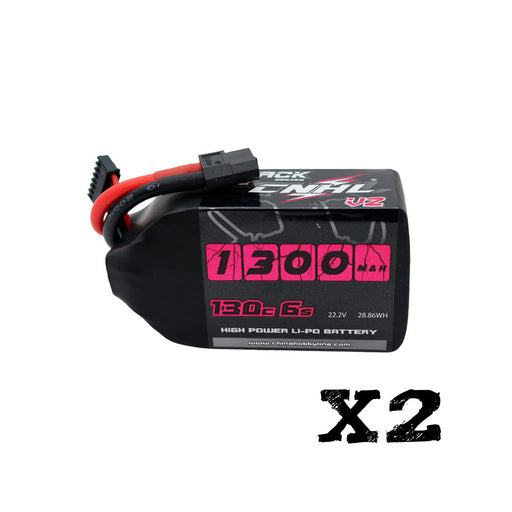
Pemeriksaan Kesesuaian Cepat 2 Packs CNHL Black Series V2.0 1300mAh 22.2V 6S 130C LiPo Battery dengan Colokan XT60 sangat cocok untuk pilot FPV yan...
Lihat detail lengkapSuku Cadang & Dukungan Jangka Panjang Kami memahami bahwa bagi pilot RC, dukungan suku cadang yang andal merupakan bagian penting untuk m...
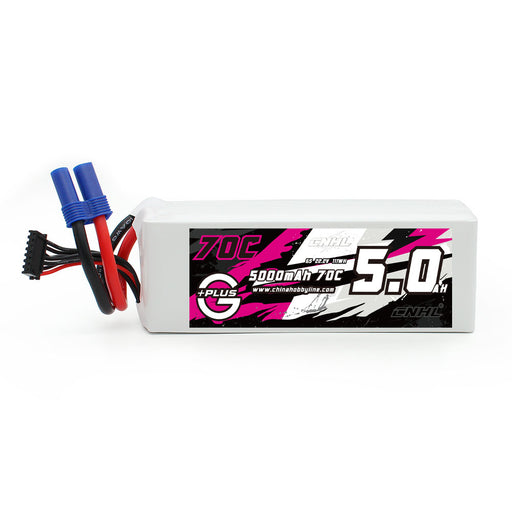
Lihat detail lengkapSpesifikasi: Nomor Stok: 500706EC5 Kapasitas: 5000mAh Voltase: 22.2V / 6-Sel / 6S1P Tingkat Discharge: 70C Kontinu / 140C Ledakan Tingkat Pengisi...
Lihat detail lengkap
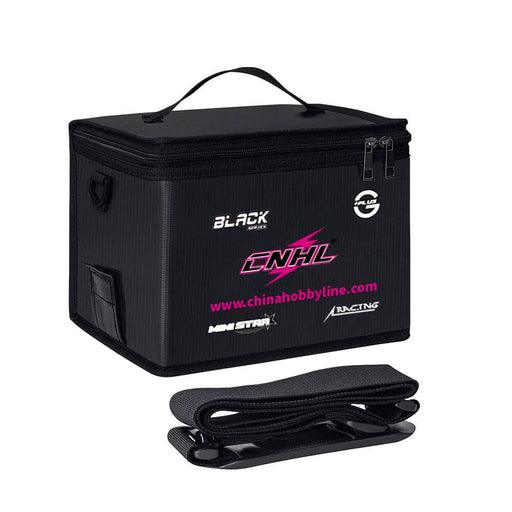
Tas Baterai LiPo CNHL dirancang untuk pengisian, transportasi, dan penyimpanan LiPo yang lebih aman di rumah atau di lapangan. Tas ini menambahkan ...
Lihat detail lengkap

Pemeriksaan Pemasangan Cepat 2 Paket CNHL Speedy Pizza Series Pro 1350mAh 6S 150C LiPo Battery dengan colokan XT60 dibuat untuk pilot FPV 5 inc...
Lihat detail lengkap

Quick Fit Check The CNHL Speedy Pizza Series 2200mAh 22.2V 6S 120C LiPo Battery with XT60 Plug combines the familiar 2200mAh 6S format with a ligh...
Lihat detail lengkap

Quick Fit Check The CNHL Speedy Pizza Series 2200mAh 14.8V 4S 120C LiPo Battery with XT60 Plug combines a widely used 2200mAh 4S format with a sli...
Lihat detail lengkap

Quick Fit Check The CNHL Speedy Pizza Series 2200mAh 11.1V 3S 120C LiPo Battery with XT60 Plug takes the familiar 3S 2200mAh aircraft battery form...
Lihat detail lengkapThe CNHL Long Range Series BAK 65E 6350mAh 21700 Li-ion battery cell is built around one clear priority: maximum stored energy from a lightweight c...
Lihat detail lengkap

The CNHL Long Range Series BAK 50D 5000mAh 21700 Li-ion battery cell is designed for custom high-energy battery packs that need a strong balance be...
Lihat detail lengkap




Tinggalkan komentar