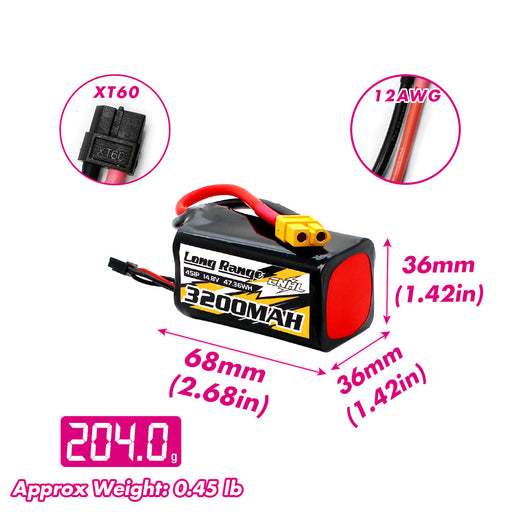
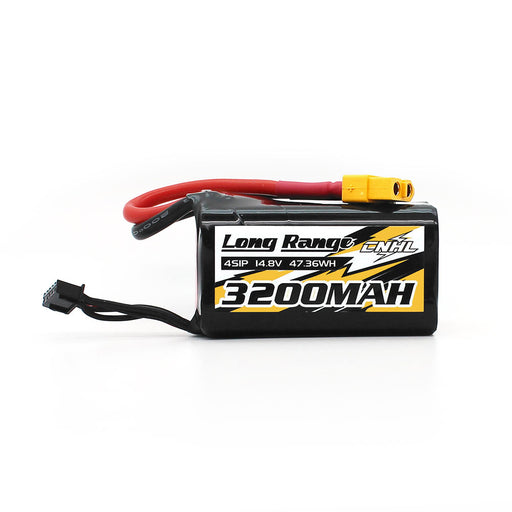
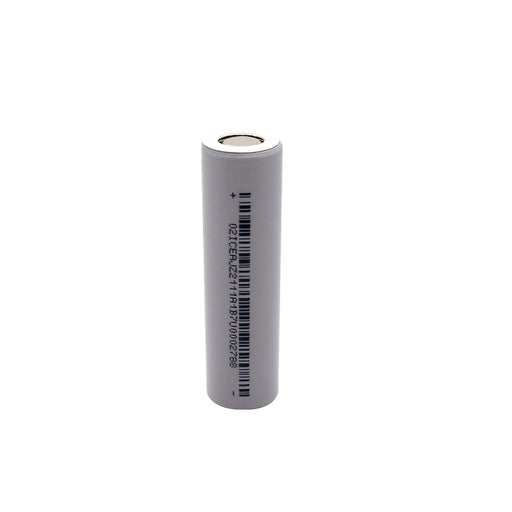
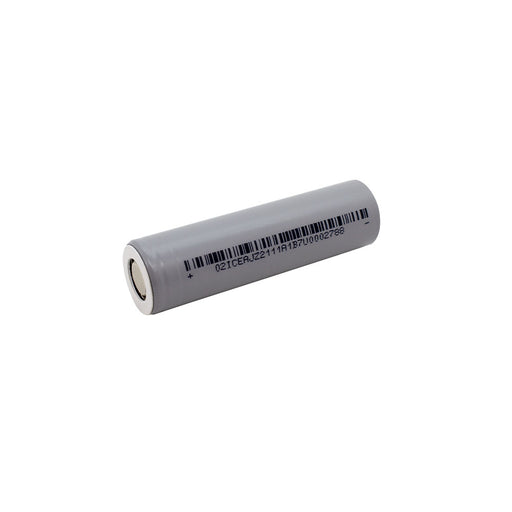
Why Use Li-ion Batteries for Long-Range FPV?
Long-range FPV flying places very different demands on a battery than racing or aggressive freestyle. A well-designed long-range aircraft spends much of its flight operating at efficient cruise power rather than repeatedly demanding maximum thrust.
This is where a Li-ion FPV battery can be especially useful. Modern cylindrical lithium ion cells can provide a strong amount of stored energy relative to their weight, allowing an efficient aircraft to carry more usable flight energy without designing the battery primarily around extreme burst current.
The trade-off is that current capability must be checked more carefully than with many high-C LiPo packs. Motors, propellers, aircraft weight and flying style all need to keep the electrical and thermal load within the limits of the finished Li-ion battery.
18650 vs 21700 Long Range FPV Batteries
Both 18650 and 21700 cylindrical Li-ion cells are widely associated with long-range FPV battery systems. The difference is not simply that one format is newer or automatically better.
| Cell Format | General Direction | FPV Consideration |
| 18650 | Smaller cylindrical format with an established long-range FPV history | Useful where compact dimensions and lower cell mass are important |
| 21700 | Larger cylindrical format with modern high-capacity and power-balanced cell options | Useful when the aircraft can benefit from greater cell-level energy or current capability |
Cell format alone does not determine which battery will fly longer. Actual cell capacity, cell weight, discharge capability and the number of cells required by the pack must all be considered.
Pilots interested in the established compact platform can browse our 18650 long range Li-ion batteries, while the newer 21700 long range FPV batteries provide additional high-capacity and pack-configuration options.
Why 21700 Cells Are Important for Modern Long-Range FPV
The larger 21700 format gives cell manufacturers more internal volume to optimize different combinations of capacity, energy density and current capability. This has made 21700 particularly interesting for modern long-range FPV packs where both endurance and usable propulsion current matter.
CNHL's 21700 range follows two different directions. The 5000mAh 50D platform balances stored energy with greater usable power headroom, while the 6350mAh 65E platform places greater emphasis on stored energy and maximum-endurance operation.
These differences mean that a 6350mAh cell is not automatically the better FPV choice simply because its capacity is higher. An aircraft with greater current demand may benefit more from the power-and-energy balance of the 50D, while an especially efficient cruising platform may make better use of the additional energy available from the 65E.
4S Li-ion Batteries for Long-Range FPV
A 4S Li-ion FPV battery can be a practical option for long-range aircraft designed around a four-series-cell power system. Within the new CNHL 21700 range, 4S options extend from compact 1P configurations to larger 2P batteries for airframes capable of carrying additional stored energy.
The 5000mAh 50D 4S1P XT60 direction is especially relevant when keeping battery weight controlled while retaining useful current headroom. The 6350mAh 65E 4S1P direction shifts more strongly toward energy-first endurance for efficient lower-current systems.
For larger FPV wings and other endurance platforms, 10000mAh and 12700mAh 4S2P configurations provide substantially more stored energy. Compare the complete 4S 21700 Li-ion battery range according to capacity, cell platform and aircraft requirements.
6S Li-ion Batteries for Long-Range FPV
6S Li-ion batteries are an important part of the modern long-range FPV ecosystem. A higher series count allows compatible propulsion systems to operate at a higher voltage, while the correct cylindrical-cell pack can provide the stored energy needed for extended cruising.
Within the CNHL 21700 family, the 5000mAh 6S1P XT60 is the core long-range FPV configuration. Its six-cell architecture keeps the pack relatively compact while using the more power-balanced 50D platform. The 6350mAh 65E 6S1P direction prioritizes more stored energy for efficient systems with suitable current demand.
Larger 6S2P packs move toward bigger long-range or cinematic platforms, while 6S3P batteries are specialized solutions for substantially larger airframes rather than default upgrades for a typical FPV quad.
Browse the full 6S 21700 Li-ion battery range to compare 1P, 2P and 3P battery configurations.
1P vs 2P Li-ion Batteries for Long-Range FPV
Parallel count can have a major effect on long-range battery performance because it changes both stored energy and pack weight.
| Pack Type | Main Advantage | FPV Direction |
| 1P | Lowest cell count and lighter pack architecture | Weight-sensitive long-range multirotors and wings |
| 2P | More stored energy and current sharing between parallel cells | Larger wings, cinematic platforms and airframes able to carry more battery mass |
| 3P | Very high stored energy and greater load sharing | Specialized large-airframe FPV or UAV systems rather than typical long-range quads |
More capacity does not guarantee proportionally more flight time. As battery mass increases, the aircraft needs additional power simply to carry the pack. The most efficient setup is therefore often the battery that provides the best usable-energy-to-weight balance for the specific airframe rather than the highest available mAh.
50D vs 65E for Long-Range FPV
| FPV Priority | 50D Platform | 65E Platform |
| Power Headroom | Stronger direction | Not the primary priority |
| Maximum Capacity | 5000mAh per 1P group | 6350mAh per 1P group |
| Mixed Cruise + Higher Load | More natural starting point | Requires closer current matching |
| Energy-First Cruising | Balanced choice | Primary direction |
This comparison describes the positioning of the two CNHL 21700 cell platforms. It does not replace the electrical specification of the finished battery. Actual continuous and conditional current limits, battery temperature and the current demand of the aircraft must still be checked.
XT60 and Long-Range FPV Li-ion Batteries
XT60 is one of the most common connector formats in long-range FPV Li-ion battery systems. Both modern 18650 and 21700 long-range packs are widely offered with XT60, particularly in 4S and 6S configurations intended for efficient multirotors and FPV aircraft.
For this reason, the XT60 versions of CNHL's compact 21700 packs are positioned most strongly toward long-range FPV. The 5000mAh 4S and 6S 50D XT60 packs represent the most direct power-and-energy-balanced FPV direction, while the corresponding 6350mAh 65E packs target more energy-focused cruising.
Connector choice still does not determine whether a battery can safely power a particular drone. Actual propulsion current, pack construction, cell limits, wire gauge and thermal conditions remain the primary electrical considerations.
Long-Range FPV Multirotor vs FPV Wing Battery Selection
A long-range multirotor and a fixed-wing FPV aircraft can have very different battery requirements even when both prioritize endurance.
| Aircraft Type | Battery Priority | Important Checks |
| Long-Range Multirotor | Energy-to-weight balance with enough current for hover, climb and maneuvering | Hover current, climb current, all-up weight, motor/prop efficiency and battery temperature |
| FPV Wing | High stored energy for efficient cruise | Cruise current, launch/climb current, CG, battery bay size and total aircraft weight |
Because many fixed-wing aircraft can cruise at relatively modest power, they can sometimes make especially effective use of high-energy Li-ion cells. Multirotors must continuously produce lift, so pack weight and sustained current capability often have a stronger influence on the final battery choice.
Li-ion vs LiPo for Long-Range FPV
| Priority | Li-ion | LiPo |
| Efficient Cruise / Endurance | Strong direction | Depends on capacity and weight |
| Repeated High-Current Maneuvers | Usually not the main strength | Generally stronger direction |
| Battery Selection Focus | Wh, Wh/kg, actual amps, cell model and weight | Capacity, C-rating, voltage, dimensions and weight |
For a cruising-focused long-range build, Li-ion can offer a compelling energy solution. For aggressive freestyle, racing or a propulsion system that regularly demands very high current, a suitable high-discharge LiPo may remain the better battery chemistry.
How to Choose a Li-ion Long Range FPV Battery
Before choosing a Li-ion FPV battery, check the complete aircraft setup:
- 18650 or 21700: compare cell size, capacity, weight and electrical capability rather than choosing by format alone.
- 4S or 6S: match the actual battery voltage range to the ESC, motors and complete propulsion system.
- Cell platform: for CNHL 21700 packs, choose between the power-and-energy-balanced 50D and the energy-first 65E direction.
- 1P, 2P or 3P: balance additional stored energy and current sharing against increased pack weight.
- Watt-hours: compare total stored energy rather than relying only on mAh.
- Actual current draw: measure or estimate cruise, hover, climb and higher-load conditions.
- Battery weight: account for its effect on hover power, cruise efficiency and all-up weight.
- Dimensions: confirm pack fit and leave enough clearance for wiring and airflow.
- Connector: match the installed power connector and verify polarity and wire clearance.
- Temperature: monitor battery temperature and remain within the finished pack's specified limits.
For the wider cylindrical battery family beyond FPV-specific applications, browse the 21700 Li-ion battery range or the complete CNHL Long Range Series.
Li-ion FPV Battery Charging and Safety
Use a charger and charging mode suitable for the exact Li-ion battery. Follow the maximum charging voltage and recommended charge current specified for the finished pack rather than assuming that all lithium batteries use the same settings.
Low-voltage settings also deserve attention when moving between battery chemistries. A flight controller or ESC setup developed around LiPo behavior should not automatically be assumed to provide the ideal warning or cutoff strategy for every Li-ion cell.
Inspect the pack, wiring and connectors before charging or flight. Do not use a battery that is physically damaged, excessively hot or electrically abnormal, and never exceed its specified voltage, current or temperature limits.
FAQ: Li-ion Long Range FPV Batteries
Are Li-ion batteries good for long-range FPV?
Yes, they can be an excellent option for efficient long-range aircraft because cylindrical Li-ion cells can provide high stored energy relative to battery weight. The propulsion system must still remain within the finished pack's current and thermal limits.
Is 18650 or 21700 better for long-range FPV?
Neither format is automatically better. 18650 provides a smaller cylindrical platform, while modern 21700 cells can offer greater capacity or different power-to-energy characteristics. Compare the actual cell, pack weight, watt-hours and current requirement of the aircraft.
Which CNHL 21700 battery is the main long-range FPV option?
The 5000mAh 50D XT60 platform is the core power-and-energy-balanced FPV direction, especially in compact 4S1P and 6S1P configurations. The 6350mAh 65E XT60 direction emphasizes greater stored energy for highly efficient endurance-focused systems.
Is 4S or 6S better for long-range FPV?
The correct S count depends on the motors, ESC, propellers and complete aircraft design. A 6S battery is not automatically more efficient or longer-flying than 4S; the propulsion system must be designed around the selected voltage platform.
Does more mAh always mean longer FPV flight time?
No. Higher capacity adds stored energy but normally also adds battery weight. Actual flight time depends on watt-hours, pack weight, aircraft efficiency, propulsion setup, wind and flying style.
Why is XT60 common on long-range FPV Li-ion batteries?
XT60 is widely used across FPV power systems and is common on both 18650 and 21700 long-range packs. It provides a familiar connection ecosystem, but the connector itself does not determine the battery's discharge capability.
Can I use a Li-ion battery for freestyle FPV?
Only when the specific battery can safely support the required current. Li-ion packs in this collection are primarily positioned for cruising, cinematic and long-range endurance use rather than repeated high-current freestyle or racing operation.
Should I choose 1P or 2P for long-range FPV?
A 1P pack keeps cell count and battery mass lower, while 2P provides more stored energy and load sharing at the cost of additional weight. The better option depends on the size and efficiency of the aircraft and how much extra battery mass it can carry productively.