
The Freewing MiG-29 V2 Red Star is more than a new paint scheme for an already imposing twin-80mm EDF jet. The basic MiG-29 formula remains intact—a huge lifting-body airframe, twin electric retracts, large flaps and two 6S-powered EDF systems—but V2 brings together a faster 12-blade power system, integrated thrust vectoring, dedicated stabilization, stronger landing gear, brighter lighting and a genuinely more practical wing attachment system.
The result is interesting because Freewing has not tried to turn the MiG-29 into a completely different aircraft. Instead, V2 addresses several areas that matter after the excitement of the first few flights wears off: low-speed authority, field assembly, landing-gear durability, visibility and the way a very large EDF jet carries its battery weight.
For pilots considering the Red Star version, that last point deserves particular attention. This is a dual-6S aircraft carrying two full-size flight batteries. Choosing between 5000mAh, 5200mAh, 6000mAh or still larger packs changes more than expected flight duration—it changes the finished weight of the airplane twice over.
Quick Take: The MiG-29 V2 Red Star is best understood as a refinement of one of Freewing's largest EDF platforms. Thrust vectoring gives the V2 a new low-speed dimension, while the 5000–5200mAh dual-6S battery class remains the strongest all-around starting point. For this aircraft, battery weight is part of the flight setup, not just a specification on the label.

A Familiar MiG-29, but a Very Different V2 Package
The scale of the Freewing MiG-29 remains one of its defining features. With a wingspan of approximately 1257mm and a length of 1878mm, the model has the long, wide lifting-body proportions that make the full-size Fulcrum instantly recognizable.
The thrust-vectoring V2 is listed at approximately 4700g without its flight batteries. That figure immediately explains why battery selection deserves more thought than it might on a lighter single-EDF model. Once two large 6S packs are installed, the ready-to-fly mass moves well beyond six kilograms depending on the batteries chosen.
V2 also keeps the features that made the original MiG-29 such an ambitious foam EDF: large flaps, full-flying horizontal stabilizers, twin rudders, twist-and-turn electric retracts, removable scale ordnance and a large internal equipment area beneath the canopy.
The meaningful changes are underneath that familiar outline.
| Area | Original MiG-29 | MiG-29 V2 Red Star |
|---|---|---|
| EDF System | Twin 80mm, 9-blade | Twin 80mm, 12-blade |
| Motors | 2 × 3658-1920Kv inrunner | 2 × 3658-2150Kv inrunner |
| ESC Class | 2 × 100A | Dual 100A system with 8A UBEC |
| Thrust Vectoring | Originally introduced without the V2 integrated system | Redesigned vectoring nozzles with up to 25° deflection |
| Stabilization | Setup depended on version and pilot equipment | Two EG01 gyros on the Red Star TV version |
| Main Wings | Carbon spar with screw-secured wing panels | Screw-less quick-release locking system |
| Landing Gear | Suspension retract system | Revised nose gear plus additional main-retract reinforcement |
| Lighting | Scale navigation lighting | Expanded and brighter navigation-light package |
| Battery Architecture | Two 6S packs | Two 6S packs |
The important point is that V2 is evolutionary rather than cosmetic. The airframe concept has stayed recognizable, but the systems around it have become more developed.

Thrust Vectoring Changes More Than the Stunt Capability
Thrust vectoring is the feature most likely to attract attention on the Red Star V2, but its usefulness should not be reduced to dramatic post-stall maneuvers.
The redesigned nozzles provide up to 25 degrees of movement, allowing the power system to contribute directly to pitch and directional authority. On a conventional EDF jet, aerodynamic controls become progressively less effective as airflow over the surfaces falls away. Vectoring adds another control mechanism precisely in the part of the envelope where the MiG-29's large lifting body is capable of flying nose-high at relatively low forward speed.
That gives the V2 a more interesting relationship with high-alpha flight. The airplane can use its broad fuselage and wing area to carry the load while the vectoring system helps manage nose position. The system is therefore useful not only for extreme maneuvers but also for shaping slow passes, recovering the nose from high angles of attack and making the aircraft feel more controllable when airflow alone is doing less of the work.
Freewing also separates the stabilization task on the Red Star version. One EG01 gyro handles the conventional flight-control surfaces while another is dedicated to the thrust-vectoring system. That separation makes sense on a model where the movable exhaust nozzles are effectively another set of flight controls rather than a simple mechanical accessory.

The Power System Has Also Moved Forward
One of the less visually obvious differences between the original MiG-29 and V2 is inside the nacelles.
The early MiG-29 used twin 80mm nine-blade fans driven by 3658-1920Kv inrunner motors. V2 moves to 12-blade EDF units with 3658-2150Kv inrunners.
That is not a minor specification change. More blades and a higher motor Kv change the acoustic character and the operating point of the power system, while the updated setup remains firmly inside the same basic battery architecture: one 6S-class power system for each 80mm EDF side.
Published V2 motor data places one EDF unit at approximately 95A and 2100W at 22.2V under the stated test conditions. With two systems installed, the aircraft is working in a power class of roughly 4.2kW when both sides are considered together at that test point.
That should not be treated as a guaranteed in-flight current figure—the actual load changes with battery voltage, airflow, installation, temperature and throttle position—but it explains why battery quality and voltage stability matter on the MiG-29 even when the nominal C-rating requirement does not look extreme.
Is the Freewing MiG-29 a 6S or 12S Jet?
This is one of the easiest things to misunderstand about the MiG-29.
It is best described as a dual-6S twin-EDF aircraft, not as a conventional 12S aircraft.
The airplane carries two 6S batteries, but each propulsion side operates at approximately 6S voltage. The EDF motor specification itself is based on 22.2V operation, which is nominal 6S voltage.
Dual-6S layout:
6S Battery #1 → ESC #1 → 80mm EDF #1
6S Battery #2 → ESC #2 → 80mm EDF #2
A true 12S installation would place twelve cells in series so the power system sees approximately 44.4V nominal. That is not the operating voltage of the MiG-29's individual EDF systems.
There is an interesting energy comparison. Two 6S 5000mAh packs contain approximately the same total nominal energy as one 12S 5000mAh pack:
2 × 22.2V × 5Ah = approximately 222Wh
But equal total energy does not mean equal electrical architecture. The MiG-29 still needs two matched 6S packs rather than one conventional 12S flight battery.
Why 5000–5200mAh Is Such an Important Range
The MiG-29 has a large battery area, so physical space is not the only question. The more useful question is how much battery the airplane should carry.
For the V2, the 5000–5200mAh range sits in a particularly useful place. It provides substantial energy for the two 80mm EDF systems while keeping pair weight reasonably controlled. A reference 5000mAh installation is approximately 1420g for both packs together, placing a 4700g thrust-vectoring airframe at roughly 6.12kg before allowing for normal production variation or any optional equipment.
This is where the MiG-29 differs from an EDF where one larger battery simply adds another 100g or 150g. On the MiG-29, the same battery change happens twice.
A 50g increase per pack adds 100g to the aircraft. A 150g increase per pack adds 300g.
That additional mass affects takeoff acceleration, inertia in maneuvering, landing energy and the effort required to hold the aircraft at lower speeds. It can also change how far the two batteries need to move to reach the specified 140mm CG.
For pilots attracted to the V2 specifically because of high-alpha and thrust-vectoring flight, keeping the airplane reasonably light is therefore not simply a convenience. It helps preserve the very part of the flight envelope that makes the V2 interesting.
Three CNHL Battery Setups That Make Sense
The dedicated CNHL battery collection for the Freewing MiG-29 includes several EC5-equipped 6S options, but three packs illustrate the most useful setup directions particularly well.
| Battery | Dimensions (L × W × H) | Weight / Pack | Pair Weight | Approx. V2 Airframe + Pair | Setup Direction |
|---|---|---|---|---|---|
| CNHL G+Plus 5000mAh 6S 70C EC5 | 149 × 51 × 49mm | 714g | 1428g | 6128g | Best all-around baseline |
| CNHL Racing 5200mAh 6S 90C EC5 | 161 × 49 × 46mm | 763g | 1526g | 6226g | Performance standard LiPo |
| CNHL Lightning LiHV 6000mAh 6S 120C EC5 | 147 × 48 × 48mm | 693g | 1386g | 6086g | Lightweight high-capacity direction |
Approximate combined figures use the listed 4700g V2 thrust-vectoring airframe weight and published battery weights. Actual aircraft and battery weights can vary.
Best Overall: CNHL G+Plus 5000mAh 6S 70C EC5
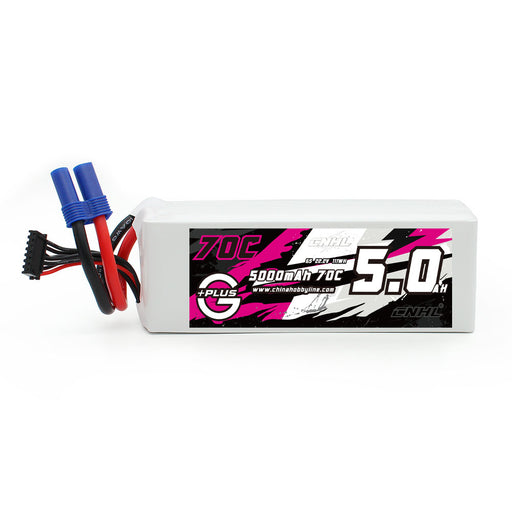
The CNHL G+Plus 5000mAh 22.2V 6S 70C LiPo Battery with EC5 Plug is the clearest all-around starting point.
There is a useful numerical reason for that recommendation. One pack weighs approximately 714g, so a matched pair is approximately 1428g—only around 8g away from the 1420g twin-5000 battery reference used for the V2 setup.
That is a much stronger fitment argument than capacity alone. It means the G+Plus pair remains extremely close to the battery mass around which the aircraft's normal 5000mAh setup is established, while its 70C rating provides plenty of stated discharge capability for a high-current 6S EDF application.
Performance Standard LiPo: CNHL Racing 5200mAh 6S 90C EC5
The CNHL Racing Series 5200mAh 22.2V 6S 90C LiPo Battery with EC5 Plug stays inside the core 5000–5200mAh range but moves toward a more performance-oriented pack.
A pair weighs approximately 1526g, about 98g more than the G+Plus pair. On a six-kilogram-class aircraft that is not an enormous change, but it is enough to illustrate why pair weight should always be calculated rather than looking at one battery in isolation.
The appeal here is straightforward: the airplane stays within the preferred capacity class while gaining a higher stated discharge platform for pilots who use full-power acceleration and vertical performance more aggressively.
Lightweight Capacity Option: CNHL Lightning LiHV 6000mAh 6S 120C EC5
The CNHL Lightning LiHV 6000mAh 22.8V 6S 120C HV LiPo Battery with EC5 Plug is the more unusual option.
Its advantage is not simply that it has 6000mAh of rated capacity. At approximately 693g, it is actually lighter than the G+Plus 5000 and substantially lighter than the Racing 5200.
Two Lightning 6000 packs come to approximately 1386g. On paper, that places the V2 at roughly 6086g with the pair—about 42g lighter than the G+Plus 5000 configuration while carrying 1000mAh more rated capacity per battery.
For a twin-battery EDF, that capacity-to-weight relationship is much more interesting than simply choosing a larger number on the label.
Important LiHV note: The Lightning 6000mAh is a LiHV battery. A fully charged 6S LiHV pack can reach 26.1V, compared with 25.2V for a fully charged standard 6S LiPo.
Do not assume that a factory ESC supports full 4.35V-per-cell LiHV charging simply because it is described as 6S compatible. Confirm the maximum input voltage of the exact ESC installation first. If full LiHV voltage support cannot be confirmed, use a conservative charging strategy that does not exceed standard LiPo voltage limits.
The Bigger-Battery Question Is Really a Weight Question
The MiG-29's large internal battery area makes 6200mAh, 6700mAh, 7200mAh and even 7800mAh-class packs realistic candidates when their individual dimensions and connector configuration suit the installation.
But once a battery physically fits, the discussion changes.
The limiting factor becomes the kind of MiG-29 the pilot wants to fly.
A lightweight 5000–5200mAh pair favors the V2's agile side: easier energy management, less landing mass and less unnecessary load during slow, nose-high flight. A carefully chosen 6000mAh pack can move toward additional reserve without necessarily making the aircraft heavier. Larger packs move the setup further toward energy capacity and endurance.
There is no reason to treat that as a simple ladder where 7800mAh must be better than 7200mAh, 7200mAh must be better than 6000mAh, and so on. Battery construction matters. A modern high-capacity pack can sometimes carry significantly more energy without following the weight curve expected from an older conventional design.
For the MiG-29, the useful comparison is therefore:
- How much rated capacity is being added?
- How much pair weight is being added?
- Can both packs still be positioned to reach the 140mm CG?
- Does the added mass suit the preferred takeoff and landing environment?
- Is the objective aggressive high-alpha flying or longer energy reserve?
That approach gives larger batteries a legitimate role without pretending that maximum capacity is automatically the ideal setup.
Quick-Release Wings May Be One of the Most Useful V2 Changes
Thrust vectoring gets the attention in flight, but the new wing system may make a larger difference during normal ownership.
The original MiG-29 used removable wing panels supported by a carbon spar and secured with screws. That worked, but this is a 1.878m-long aircraft. Transport and field setup are not minor concerns.
V2 replaces that process with a screw-less locking mechanism. The wing panels slide onto the carbon support structure and are secured by dedicated quick-release switches. The design allows a pilot to arrive at the field, install the wings and lock them without working through the previous screw-retention process.
That does not make the MiG-29 small, but it does make owning a large EDF easier.

Landing Gear Upgrades Matter on a Six-Kilogram EDF
The MiG-29's landing gear has always carried a demanding job. A model of this size builds substantial energy on approach, and grass operation adds another layer of load to the retracts and mounts.
V2 strengthens that area rather than simply changing the external appearance. The nose-gear strut and wheel arrangement have been revised, the main electric retracts gain additional CNC metal protection, and the wing spar and landing-gear mounting area receive further reinforcement.
These changes fit the overall V2 philosophy. The aircraft is not being reinvented; parts of the airframe that experience repeated real-world loading are being made more robust.
The larger lesson is still relevant to battery selection. Adding several hundred grams through oversized twin packs does not affect only the flight controls. That mass must also be accelerated during takeoff and absorbed by the landing gear every time the aircraft returns to the runway.

What About the Hobbywing SkyWalker 100A V2 ESC?
The MiG-29 uses two 100A-class 6S ESCs, which also makes the Hobbywing SkyWalker 100A V2 relevant when planning a repair, replacement or custom power-system rebuild.
The SkyWalker 100A V2 supports 3–6S LiPo, is rated for 100A continuous and 120A peak current, and includes a 5V / 7A switch-mode BEC. That places it in the correct broad voltage and current class for a 6S 100A EDF installation.
It should still be treated as a replacement-class candidate rather than an automatic drop-in replacement. The MiG-29 is more complex than matching “6S” and “100A” on two specification sheets.
Before changing the factory ESC system, the complete installation should be checked for motor current, cooling, motor timing, connector installation, BEC arrangement, receiver-side voltage, gyro and control-board behavior, and any desired reverse-thrust functionality.
This is particularly important because the V2 onboard electronics are designed around a specific receiver-power environment. Two BEC outputs should not simply be paralleled unless the chosen electrical architecture specifically supports that arrangement.
Who Is the Freewing MiG-29 V2 Red Star Really For?
The V2 Red Star makes the strongest case for itself with pilots who already understand large EDF operation and want something beyond conventional fast passes.
It remains a large, heavy, advanced aircraft. The twin power system, retracts, full-flying tails, flaps, twin rudders, multiple gyros and thrust-vectoring controls create more setup responsibility than a simple sport EDF.
But that complexity also gives the model its identity.
Pilots who want a large scale jet with strong visual presence will appreciate the 1/9-scale proportions and twin-EDF sound. Pilots interested in high-alpha and post-stall maneuvering gain a much more developed factory thrust-vectoring system. Pilots transporting the aircraft regularly benefit from the revised wing retention. Grass-field flyers gain useful structural attention around the landing gear.
V1 owners face a different decision. The basic MiG-29 airframe did not suddenly become obsolete. The original already had the large lifting body, twin 80mm layout and generous battery space that define the platform. V2 is most compelling when the added thrust-vectoring integration, updated EDF system and ownership refinements matter enough to justify moving to the newer version.
Freewing MiG-29 V2 Battery Checklist
- Battery quantity: Two matching packs.
- Voltage: 6S per pack.
- Best starting capacity: Approximately 5000–5200mAh.
- Connector: EC5 for the battery options discussed here.
- Discharge capability: Suitable for a high-current twin 80mm EDF application.
- Weight: Compare pair weight, not only single-pack weight.
- CG: Recheck the specified 140mm position whenever changing battery model or capacity.
- Battery matching: Use the same model, capacity and similar age, condition and state of charge.
- LiHV: Confirm maximum ESC input voltage before charging above standard LiPo voltage.
- Installation: Check retention, wire routing, canopy clearance and cooling before flight.
FAQ
Is the Freewing MiG-29 V2 a 6S or 12S airplane?
It is best described as a dual-6S twin-EDF airplane. It carries two 6S batteries, with each EDF power system operating at approximately 6S voltage. It is not a conventional single 12S power system.
How many batteries does the Freewing MiG-29 V2 need?
Two matching 6S flight batteries are required.
What battery capacity is best for the MiG-29 V2?
For most pilots, 5000–5200mAh per pack is the strongest starting range because it balances usable energy with the aircraft's substantial twin-battery weight. Lightweight 6000mAh options can also be particularly attractive.
Can the MiG-29 V2 use two 6000mAh batteries?
Yes, suitable 6000mAh packs can be considered when their dimensions, connector, combined weight and final CG work correctly. The battery model matters as much as the capacity because some 6000mAh packs are considerably lighter than others.
Can larger 6200mAh, 7200mAh or 7800mAh batteries be used?
Larger suitable packs can be considered when they fit securely and allow the aircraft to reach the correct CG. Their advantage is additional stored energy; the trade-off is usually increased pair weight. They are best selected around a specific flight objective rather than assumed to be automatic upgrades.
Can a LiHV battery be used in the Freewing MiG-29?
A suitably sized 6S LiHV pack can be considered, but full 4.35V-per-cell charging should only be used after confirming that the exact ESC installation supports the higher fully charged voltage. If that support cannot be confirmed, do not exceed standard LiPo charging voltage.
Can V1 MiG-29 batteries be used in the V2?
Both generations use the same fundamental two-6S battery architecture, so many suitable V1 battery formats remain relevant. Final fit, connector type, battery weight and CG should still be checked for the exact pack and aircraft version.
What is the main difference between the original MiG-29 and V2?
V2 combines several changes rather than relying on one headline feature: updated 12-blade 2150Kv EDF power, integrated thrust vectoring on the Red Star version, dedicated gyro control, quick-release wings, stronger landing-gear-related structure and improved lighting.
Can the Hobbywing SkyWalker 100A V2 replace a MiG-29 ESC?
It is a relevant 6S 100A replacement-class ESC candidate, but it should not be assumed to be a direct plug-and-play substitute. Motor load, connectors, cooling, BEC wiring, receiver voltage, control electronics and reverse-thrust requirements must all be checked first.
More Battery Options for EDF Jets and RC Airplanes
MiG-29 owners can compare all selected options in the CNHL Freewing MiG-29 battery collection.
For other electric aircraft, the CNHL Airplane Batteries collection covers a wider range of fixed-wing power systems, while the LiPo Batteries for EDF Jets collection focuses specifically on high-current ducted-fan applications.
Pilots comparing additional 22.2V packs can also browse the CNHL 6S LiPo Battery collection.
Final Take: V2 Makes the MiG-29 More Complete, Not Simply More Powerful
The Freewing MiG-29 V2 Red Star works because its changes are concentrated in areas that suit the aircraft rather than trying to replace the character of the original.
The updated twin-80mm power system gives the model a more modern EDF package. The thrust-vectoring nozzles make high-alpha flying more controllable and more useful. Dual gyro control gives that system a more integrated feel. Quick-release wings make a very large aircraft easier to transport, while the landing-gear and lighting changes address everyday use rather than specification-sheet excitement.
Battery choice completes the picture.
The MiG-29 has enough room to carry large packs, but the V2 does not automatically become better as battery capacity rises. With two packs installed, battery weight becomes a genuine aircraft-setup variable. A well-chosen 5000–5200mAh pair remains the safest all-around direction; a lightweight 6000mAh pack can offer an unusually attractive capacity-to-weight alternative; larger packs make sense when additional energy is worth the resulting changes in aircraft loading.
That balance between power, energy and weight is ultimately what makes the MiG-29 V2 more interesting than simply calling it a faster V1. The Red Star version gives pilots more control over the slow end of the envelope while still preserving the speed, scale presence and twin-EDF character that made the original MiG-29 stand out in the first place.






Tinggalkan komentar