
CNHL Baterai Lipo
CNHL bertujuan menyediakan baterai Li-Po berkualitas tinggi dan produk RC kepada semua penggemar hobi dengan layanan pelanggan yang luar biasa dan harga yang kompetitif
The iFlight Taurus X8 Pro Max is the kind of drone that makes ordinary FPV battery logic feel too small. This is not a 5-inch freestyle quad, not a long-range cruiser, and not a casual camera drone. It is a large 8S HD cinelifter built for cinema cameras, professional gimbals, heavy payloads, and on-set aerial filming work.
That is why the battery conversation around the Taurus X8 Pro Max is more complicated than simply asking, “What 8S pack fits?” The original Taurus X8 Pro Max and the newer Taurus X8 Pro Max V2 share the same broad power direction: dual 8S, high-load, professional cinema drone use. But the way pilots think about Li-Ion and LiPo batteries can be very different.
This guide breaks down what the Taurus X8 Pro Max platform is built for, how the V2 improves the workflow, why the dual 8S system matters, and where Taurus X8 Pro Max 8S LiPo batteries fit into the picture.

The iFlight Taurus X8 Pro Max is a large X8-style HD cinelifter platform designed for professional aerial filming. Instead of using four motors like a normal quad, the Taurus uses an eight-motor layout to support heavier camera payloads, larger propellers, and more stable flight under load.
The Taurus X8 Pro Max V2 continues that direction with a 610mm wheelbase, 11-inch propellers, eight XING2 3616 760KV motors, BLITZ H7 Pro flight controller, BLITZ E80 ESCs, DJI O4 Air Unit Pro video transmission, and a dual 8S battery system. The official V2 specification lists a maximum payload of 4.5kg, a recommended payload around 3kg, and compatibility with professional camera setups such as Sony FX6, RED Komodo, and gimbal systems.
In other words, this is not a drone built around minimum weight. It is built around production capability: carrying real cameras, swapping setups quickly, flying with confidence, and giving film crews a practical aerial platform for demanding shots.

The original Taurus X8 Pro Max already established the basic idea: a powerful 8S HD cinelifter for heavy camera work. The V2 does not change the identity of the aircraft. Instead, it refines the workflow around professional filming.
The most important V2 upgrades are not just about speed or power. They are about cleaner integration, faster setup, and better on-set efficiency. The redesigned PDB layout reduces exposed wiring. The dual-voltage BEC system gives pilots 12V and 15V power options for different camera and gimbal setups. The quick-release top and bottom gimbal mount makes it easier to switch filming angles. The quick-release battery rail system also supports faster battery swaps between takes.
The V2 is also heavily presented around a long-endurance battery concept, using dual 8S 10000mAh 21700 packs for extended hover and cruising time. That is important, but it also creates a key distinction: the V2’s long-flight setup is more Li-Ion oriented, while many pilots may still want LiPo power for shorter, stronger, higher-discharge flights.

A large cinelifter does not use batteries the same way a small FPV quad does. With the Taurus X8 Pro Max, the batteries are not just powering a lightweight frame and a tiny action camera. They are supporting eight motors, large props, a heavy carbon structure, onboard electronics, camera accessories, and often a professional cinema camera on a gimbal.
That is why the Taurus platform uses a dual 8S battery setup. Two packs give the aircraft the energy and current support needed for heavy-lift flying. They also make battery planning more important. Pilots should think in matched pairs: same voltage, same capacity, same chemistry, same connector, same age, same charge level, and similar condition.
Mixing batteries is a bad idea on a large cinelifter. A mismatched pair can create uneven voltage behavior, unpredictable sag, or poor remaining-capacity judgment. On a drone carrying expensive camera equipment, predictable power is far more important than squeezing one more random battery into the setup.
The V2 is often shown with dual 8S 10000mAh 21700 batteries. That points toward a Li-Ion-style endurance setup. Li-Ion batteries are attractive for long flight time because they can offer high energy density. For steady cruising, unloaded hover, and efficient production work, that makes sense.
LiPo batteries serve a different purpose. A LiPo pack usually gives stronger discharge performance, sharper throttle response, and better high-load behavior. On the Taurus X8 Pro Max, this makes 8S LiPo useful for shorter filming runs, test flights, tuning, camera balancing, lighter payload work, and pilots who prefer the traditional high-discharge feel of LiPo power.
The important point is that a 5000mAh, 5500mAh, or 6000mAh 8S LiPo should not be described as a direct long-flight replacement for a 10000mAh Li-Ion pack. They are different tools. The Li-Ion direction is about endurance. The LiPo direction is about discharge performance and response.
For the original Taurus X8 Pro Max, the battery concept was closer to the 5600mAh class. That is why 5000mAh, 5500mAh, and 6000mAh 8S LiPo packs make more sense than they might seem at first glance. They are not trying to copy the V2 long-endurance Li-Ion package. They sit closer to the original high-discharge cinelifter power style.
For pilots using the Taurus X8 Pro Max or Taurus X8 Pro Max V2 in LiPo mode, the logic is simple. A 5000mAh 8S LiPo is lighter and more responsive. A 6000mAh 8S LiPo adds more capacity while staying in a similar LiPo category. A 5500mAh 8S LiHV pack can provide a higher-voltage, higher-discharge option for pilots who want a stronger HV LiPo setup.
These are practical packs for short cinematic passes, controlled test flights, camera setup checks, and situations where high discharge behavior matters more than maximum endurance.
For the Taurus X8 Pro Max series, the battery should be selected by purpose, not just by voltage. The three practical LiPo directions are lightweight, balanced capacity, and high-discharge LiHV.
The CNHL G+Plus 29.6V 8S Lipo Battery 5000mAh 70C with XT90 Plug is the lighter option. It is best used for shorter flights, setup checks, lighter payloads, and pilots who want to reduce battery weight while staying within an 8S XT90 LiPo setup.
The CNHL G+Plus 6000mAh 29.6V 8S Lipo Battery 70C with XT90 Plug gives more capacity than the 5000mAh option while keeping the same standard 8S LiPo voltage direction. It is the more balanced choice for pilots who want a little more runtime without moving into a large Li-Ion endurance setup.
The CNHL Lightning LiHV 5500mAh 30.4V 8S 120C HV Lipo Battery with XT90 Plug is the high-discharge option. It is best suited for pilots who want stronger current capability and sharper response. Because it is a LiHV pack, conservative pilots may choose to charge it as a standard LiPo first unless their aircraft setup has confirmed full LiHV charge support.
You can find these options in our Taurus X8 Pro Max 8S LiPo battery collection.
Yes, the Taurus X8 Pro Max V2 can be understood as the same broad 8S voltage platform, but the battery choice should be framed correctly. If a pilot uses 8S LiPo packs on the V2, those packs should be treated as a high-discharge LiPo setup rather than a direct replacement for the V2’s long-endurance 10000mAh 21700 battery concept.
That difference matters for expectations. With 8S LiPo packs in the 5000mAh to 6000mAh range, flight time will generally be shorter than with large 10000mAh Li-Ion packs. But the aircraft may feel more responsive, and the pack may be better suited to shorter high-demand flights.
For filming, that can still be very useful. Not every shot requires maximum endurance. Some shots are short, repeated, and power-hungry. Some days involve more setup work than long cruising. In those cases, a matched pair of 8S LiPo packs can make sense.
LiHV batteries have a higher nominal voltage than standard LiPo batteries. A standard 8S LiPo is 29.6V nominal, while an 8S LiHV pack is 30.4V nominal. Fully charged, the difference is also higher because LiHV cells can be charged above the normal 4.20V per-cell LiPo limit when the charger and setup support it.
Before using full LiHV charge, always consider the entire aircraft system: ESCs, BEC, wiring, onboard accessories, camera power, gimbal power, and voltage limits. A cinelifter is more than just motors and batteries.
The Taurus X8 Pro Max battery setup uses XT90-style high-current connections. All three CNHL battery options discussed here use XT90 plugs, which makes them suitable from a connector direction. However, connector compatibility is not the same as complete fitment.
Before flying, pilots should check battery dimensions, cable exit direction, strap clearance, battery rail positioning, and center of gravity. This is especially important on a drone with top and bottom gimbal mounting options because payload position can change the balance of the aircraft.
Battery security also matters. On a small quad, a loose battery is already dangerous. On a heavy cinelifter carrying a cinema camera, it is unacceptable. Always confirm that both packs are firmly secured and that cables cannot move into props, arms, gimbals, or hot components.

8S LiPo is a good direction for pilots who understand that they are trading some endurance for stronger discharge behavior and a more responsive power feel. It is especially suitable for users who already manage LiPo packs carefully, understand matched-pair charging, and plan conservative flight times.
LiPo makes sense if you are doing short takes, setup flights, light payload tests, tuning work, or high-response cinematic moves. It also makes sense if your goal is to use the Taurus platform in a way that feels closer to the original 5600mAh-class battery concept instead of the V2’s long-endurance 10000mAh Li-Ion direction.
LiPo is not the best choice if your only goal is maximum flight time. For long hover duration, efficient cruising, or endurance-focused production work, large Li-Ion packs remain the more natural concept. The right battery depends on the job.
The iFlight Taurus X8 Pro Max series is a serious 8S HD cinelifter platform, and its battery setup deserves more thought than a normal FPV build. The V2 highlights long-endurance dual 8S 10000mAh 21700 power, while the original Taurus X8 Pro Max battery direction sits closer to the 5600mAh class.
That makes 5000mAh, 5500mAh LiHV, and 6000mAh 8S LiPo packs a practical option for pilots who want high-discharge LiPo power instead of maximum Li-Ion endurance. The key is to frame them correctly: they are not direct long-flight replacements for 10000mAh Li-Ion packs, but they are useful 8S XT90 LiPo options for shorter flights, stronger response, test work, and selected filming setups.
For compatible options, visit our iFlight Taurus X8 Pro Max 8S LiPo battery collection.
The Taurus X8 Pro Max platform uses a dual 8S battery setup. Depending on the version and flying style, pilots may use high-capacity 8S Li-Ion packs for endurance or 8S LiPo/LiHV packs for higher-discharge, shorter-duration flights.
Yes. The Taurus X8 Pro Max V2 can use 8S LiPo batteries with the correct XT90 connection and secure fitment. However, 5000mAh to 6000mAh LiPo packs should be treated as high-discharge alternatives, not as direct long-flight replacements for 10000mAh Li-Ion packs.
Yes, 8S LiHV batteries can be used as HV LiPo options when voltage, connector, and fitment are suitable. For conservative use, charge the LiHV pack to standard LiPo voltage unless your setup has confirmed full LiHV charge support.
The Taurus X8 Pro Max platform is designed around a dual 8S battery setup. Batteries should be used in matched pairs with the same voltage, capacity, chemistry, connector, condition, and charge level.
Choose the CNHL G+Plus 5000mAh 8S LiPo for a lighter setup, the CNHL G+Plus 6000mAh 8S LiPo for more capacity, or the CNHL Lightning 5500mAh 8S LiHV for higher discharge performance. All should be used as matched pairs for the Taurus X8 Pro Max platform.
CNHL bertujuan menyediakan baterai Li-Po berkualitas tinggi dan produk RC kepada semua penggemar hobi dengan layanan pelanggan yang luar biasa dan harga yang kompetitif
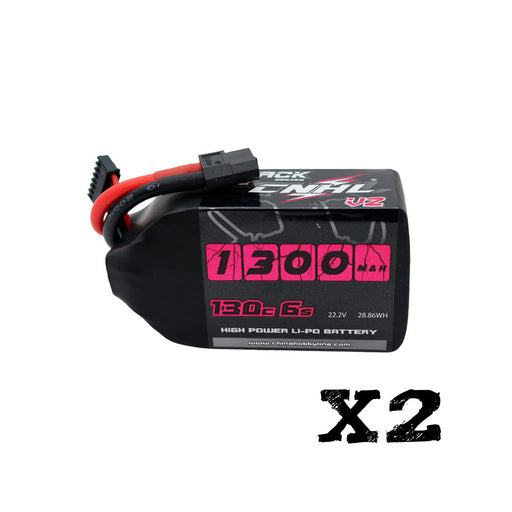
Pemeriksaan Kesesuaian Cepat 2 Packs CNHL Black Series V2.0 1300mAh 22.2V 6S 130C LiPo Battery dengan Colokan XT60 sangat cocok untuk pilot FPV yan...
Lihat detail lengkapSuku Cadang & Dukungan Jangka Panjang Kami memahami bahwa bagi pilot RC, dukungan suku cadang yang andal merupakan bagian penting untuk m...
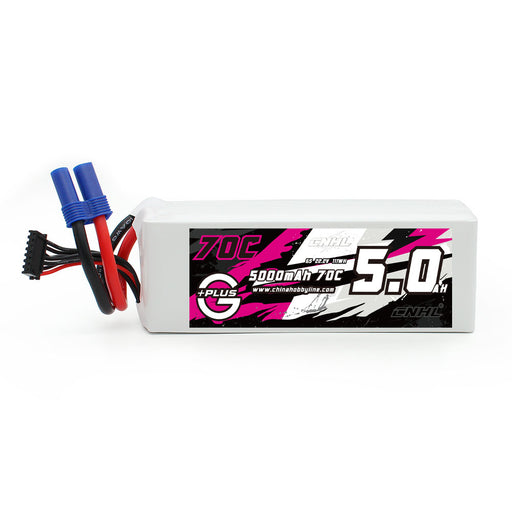
Lihat detail lengkapSpesifikasi: Nomor Stok: 500706EC5 Kapasitas: 5000mAh Voltase: 22.2V / 6-Sel / 6S1P Tingkat Discharge: 70C Kontinu / 140C Ledakan Tingkat Pengisi...
Lihat detail lengkap
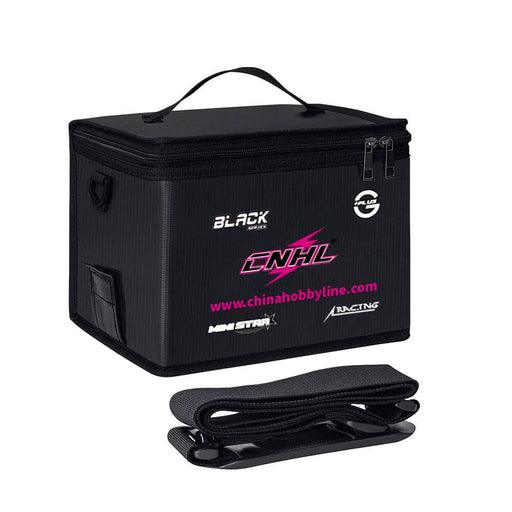
Tas Baterai LiPo CNHL dirancang untuk pengisian, transportasi, dan penyimpanan LiPo yang lebih aman di rumah atau di lapangan. Tas ini menambahkan ...
Lihat detail lengkapPemeriksaan Pemasangan Cepat 2 Paket CNHL Speedy Pizza Series Pro 1350mAh 6S 150C LiPo Battery dengan colokan XT60 dibuat untuk pilot FPV 5 inc...
Lihat detail lengkap

The CNHL Long Range Series BAK 65E 6350mAh 21700 Li-ion battery cell is built around one clear priority: maximum stored energy from a lightweight c...
Lihat detail lengkap

The CNHL Long Range Series BAK 50D 5000mAh 21700 Li-ion battery cell is designed for custom high-energy battery packs that need a strong balance be...
Lihat detail lengkap

The ISDT C4 EVO is a versatile smart battery charger built for AA, AAA and cylindrical rechargeable cells from compact 10440 batteries all the way ...
Lihat detail lengkap

The CNHL Long Range Series 6350mAh 21.6V 6S1P 21700 Li-ion battery combines six BAK 65E high-energy cells into a 137.16Wh pack designed for ultra-e...
Lihat detail lengkap

The CNHL Long Range Series 5000mAh 21.6V 6S1P 21700 Li-ion battery combines six BAK 50D cells into a compact 108Wh pack designed around long-range ...
Lihat detail lengkap




Tinggalkan komentar