
סוללות CNHL ליפו
CNHL שואפת לספק סוללות Li-Po באיכות גבוהה ומוצרי RC לכל חובבי התחביב עם שירות לקוחות מצוין ומחירים תחרותיים

Higher C rating looks impressive on a battery label, but the real answer is more complicated than “higher is always better.” In theory, a higher C-rated LiPo battery should be able to deliver more current with less voltage sag. In real RC use, that can absolutely matter. But it only matters when the model, motor system, and driving or flying style are actually demanding enough to use that extra discharge capability.
That is why two hobbyists can look at the same 50C, 100C, and 130C batteries and come away with completely different opinions. One may feel a clear difference in punch, throttle response, or consistency under load. The other may feel almost no difference at all. Neither one is necessarily wrong. The missing variable is usually the setup itself.
Quick answer: yes, a higher C rating can matter, but only when the battery is honestly rated and the RC setup truly demands more current. If the model is mild, efficient, or already well-supported by a moderate-C pack, a higher number may add cost without delivering much real benefit. If the setup is aggressive and current-hungry, a better-performing high-C battery can absolutely feel stronger and sag less under load.
If you want the foundation first, start with LiPo C Rating Explained: What 30C, 100C, and 130C Really Mean. If you want the bigger cluster view, continue into the LiPo C Rating and Battery Performance Guide.
The appeal is obvious. A higher C rating suggests more punch, less sag, and stronger power delivery. On paper, that sounds like exactly what RC users want. If one battery says 50C and another says 100C, it is easy to assume the 100C pack must be the better battery in every case.
That assumption is understandable, but incomplete. A battery label only tells part of the story. What really matters is whether the pack can support the actual current draw of the model with good voltage stability, acceptable heat, and consistent performance throughout the usable part of the run or flight.
Higher C rating matters most when the RC model is genuinely demanding. That usually means hard acceleration, repeated punch-outs, aggressive throttle changes, high prop or fan load, or heavy vehicles that ask a lot from the battery. In those situations, a stronger pack can feel noticeably different. Throttle response may feel cleaner, the system may sag less under load, and the model may stay more consistent deeper into the run or flight.
FPV freestyle is a good example. A battery that feels fine in smooth cruising can suddenly feel soft during repeated hard punch-outs or fast recovery moves. The same logic applies to high-performance RC cars and some EDF jets, where strong current demand exposes the difference between a battery that merely works and a battery that still feels confident when pushed.
| Situation | Does higher C rating usually matter? | Why |
|---|---|---|
| FPV freestyle or racing | Yes, often | High punch demand makes sag easier to notice |
| High-performance RC car | Yes, often | Hard launches and load spikes expose weaker packs |
| EDF jet | Often | Sustained load makes pack quality and sag important |
| Trainer plane | Not usually | The setup often does not demand extreme discharge |
| Crawler / trail truck | Often not much | Smooth low-speed use usually does not need huge punch |
If the softer feel you notice is really about loaded voltage drop, the next useful read is What Is Voltage Sag? Causes, Effects, and How to Reduce It.
Higher C rating matters much less when the setup is moderate, efficient, or simply not asking for violent current spikes. In those cases, a battery with a more moderate rating may already be enough. The model may fly or drive just fine, and the difference between a higher-C pack and a moderate-C pack may be too small to justify the extra cost.
This is why many beginners and casual users feel disappointed after paying extra for a battery with a huge label and then noticing little real improvement. The battery may be stronger on paper, but if the system never pushes the old battery close to its limits, there may be very little to gain in practice.
The biggest mistake is assuming the printed C rating is the whole truth. It is not. Two batteries with the same advertised rating can perform very differently. A 100C pack from one brand may feel cleaner and stronger than a 130C pack from another if the cell quality, internal resistance, and real discharge behavior are better.
This is why experienced users care so much about voltage sag, internal resistance, and brand consistency. A battery is not good just because the wrapper says 120C or 130C. It is good when it stays stable under load and does not collapse when the model asks for real power.
The graphic below is a simplified example showing how labeled C rating and actual voltage sag do not always line up perfectly in real use.
If you want to understand why the biggest number on the label is not always the most useful one, continue into Burst C Rating vs Continuous C Rating: What Actually Matters in a LiPo Battery?.

When users say one battery feels stronger than another, they are usually noticing a combination of things: less voltage sag, lower internal resistance, better cell matching, lower heat buildup, and more stable output as the battery drains. Those factors often matter more than the label alone.

Temperature also matters. A battery that feels strong in warm conditions may feel much weaker in cold weather. Age matters too. A new battery with healthy cells will often feel cleaner than an older pack with the same printed C rating. This is why C rating has to be interpreted in the context of battery condition and actual use, not just marketing language.
If you want the deeper explanation for why one battery feels cleaner or weaker under load, read How Internal Resistance Affects LiPo Performance.
In practical use, 50C often represents a moderate but workable level for many mainstream setups. 100C is where many hobbyists start to feel more confidence under heavier load, especially in performance RC cars and FPV use. 130C usually targets more demanding use cases where hard punch and reduced sag genuinely matter.
That does not mean 130C wins automatically. A mild model may see very little benefit. But in a demanding setup, the difference can be easier to notice. The key question is not “Which number is bigger?” It is “Which battery actually makes this setup feel better under the kind of load I use?”
| C rating level | Typical real-world impression | Best fit |
|---|---|---|
| 50C | Moderate, workable, often enough for many setups | General RC use where demand is not extreme |
| 100C | Stronger, cleaner under load, common sweet spot | Performance RC cars, FPV, stronger general use |
| 130C | More aggressive, best when the setup can use it | Demanding performance use and competitive edge |
Yes, sometimes. Not every higher-C claim translates into meaningfully better real-world performance. Some Amazon brands rate aggressively, and some users end up paying for a number that the battery never really delivers under actual RC load. That does not mean all high-C batteries are fake. It just means the label alone is not enough to judge them.
The honest answer is that higher C rating can be real, useful, and important, but only when the claim is honest and the setup can truly benefit from it.
If your current battery sags badly, feels soft on hard throttle, gets excessively hot, or leaves the model feeling weak when pushed, a better-performing higher-C pack may help. If the setup already feels stable, responsive, and well matched, moving to a much higher rating may not change much.
In other words, the need for higher C rating usually reveals itself in use. If the current battery is not obviously struggling, the benefit may be small. If the battery clearly feels like the weak point in the system, then a stronger pack can absolutely matter.
C rating is only one part of battery performance. You should also consider internal resistance, voltage sag behavior, cell consistency, temperature sensitivity, capacity, fit, and connector choice. A battery can have an impressive label and still be the wrong choice if it is poorly matched to the setup or simply not very good in real use.
This is why the best battery decisions happen in layers. First choose the right voltage and size. Then choose a C rating that actually suits the application. Then judge the battery by real performance, not just wrapper language. If you want that broader framework, the best next stop is the LiPo C Rating and Battery Performance Guide.
For the core definition page, continue into LiPo C Rating Explained: What 30C, 100C, and 130C Really Mean. If you want to understand why the biggest printed number is not always the most useful one, the next step is Burst C Rating vs Continuous C Rating: What Actually Matters in a LiPo Battery?. If your real question is why one pack feels cleaner or stronger than another under load, continue into How Internal Resistance Affects LiPo Performance. For real-world testing and performance comparison, see Real LiPo Battery C-Rating Test and Performance Comparison. If you want to check battery IR for yourself later, the practical follow-up is How to Measure the Internal Resistance of a LiPo Battery.
Does higher C rating always mean more power?
Not automatically. It means the battery is rated to provide more current, but whether that creates more useful power depends on the setup and the honesty of the battery’s real performance.
Is 100C always better than 50C?
No. In demanding setups it may feel better, but in mild or moderate setups the difference can be small. It depends on whether the model actually needs that extra discharge capability.
Can a 130C battery still feel weak?
Yes. A flashy rating does not guarantee strong real-world output. Internal resistance, sag, age, temperature, and pack quality still matter.
When does higher C rating matter the most?
Usually in aggressive, current-hungry setups such as freestyle FPV, high-performance RC cars, and some EDF or heavily loaded systems where sag becomes noticeable.
When does higher C rating matter the least?
Usually in lower-demand setups where the battery is already not being pushed very hard, such as mild trainer models or many casual-use systems.
Should I always buy the highest C rating I can afford?
No. Buy the C rating that honestly fits the setup. Paying for a much higher label only makes sense when the model can genuinely benefit from it.
CNHL שואפת לספק סוללות Li-Po באיכות גבוהה ומוצרי RC לכל חובבי התחביב עם שירות לקוחות מצוין ומחירים תחרותיים
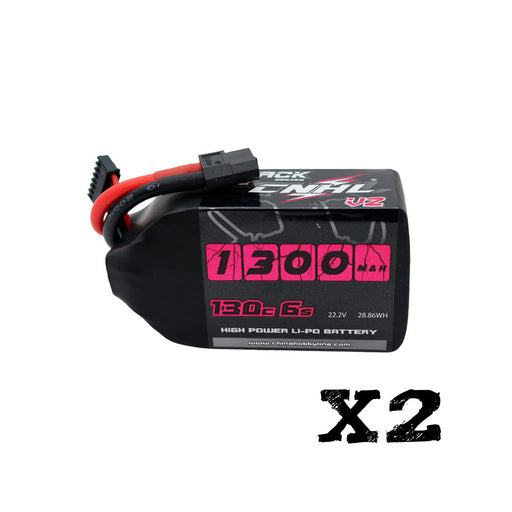
בדיקת התאמה מהירה ה2 Packs CNHL Black Series V2.0 1300mAh 22.2V 6S 130C LiPo Battery with XT60 Plug מתאים היטב למטיסי FPV שרוצים סוללת 6S 1300mAh X...
הצג פרטים מלאיםחלקי חילוף ותמיכה לטווח ארוך אנו יודעים שעבור טייסי RC, תמיכה אמינה בחלקי חילוף היא חלק חשוב בשמירה על מטוס כשיר לטיסה במשך שנים. לכן CNHL מת...
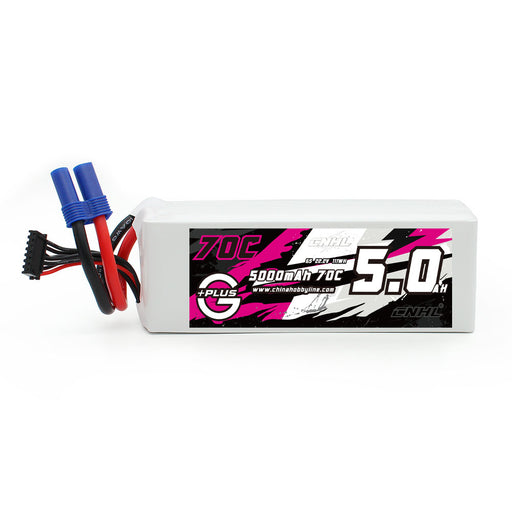
הצג פרטים מלאיםמפרטים: מספר מלאי: 500706EC5 קיבולת: 5000mAh מתח: 22.2V / 6 תאים / 6S1P קצב פריקה: 70C רציף / 140C פיצוץ קצב טעינה: 5C מקסימום גודל (הבדל של 1-5 ...
הצג פרטים מלאים
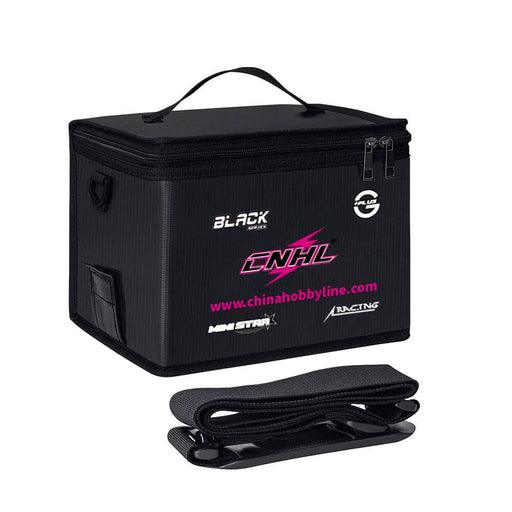
תיק סוללות LiPo של CNHL מיועד לטעינה, הובלה ואחסון בטוחים יותר של סוללות LiPo בבית או בשדה. הוא מוסיף שכבת הגנה פרקטית על ידי סיוע במניעת התפשטות ח...
הצג פרטים מלאיםבדיקת התאמה מהירה חבילת 2 CNHL Speedy Pizza Series Pro 1350mAh 6S 150C LiPo עם תקע XT60 מיועדת לטייסי FPV בגודל 5 אינץ' שרוצים מערכת 6S חופשית ...
הצג פרטים מלאים

The CNHL Long Range Series BAK 65E 6350mAh 21700 Li-ion battery cell is built around one clear priority: maximum stored energy from a lightweight c...
הצג פרטים מלאים

The CNHL Long Range Series BAK 50D 5000mAh 21700 Li-ion battery cell is designed for custom high-energy battery packs that need a strong balance be...
הצג פרטים מלאים

The ISDT C4 EVO is a versatile smart battery charger built for AA, AAA and cylindrical rechargeable cells from compact 10440 batteries all the way ...
הצג פרטים מלאים

The CNHL Long Range Series 6350mAh 21.6V 6S1P 21700 Li-ion battery combines six BAK 65E high-energy cells into a 137.16Wh pack designed for ultra-e...
הצג פרטים מלאים

The CNHL Long Range Series 5000mAh 21.6V 6S1P 21700 Li-ion battery combines six BAK 50D cells into a compact 108Wh pack designed around long-range ...
הצג פרטים מלאים




Leave a comment