
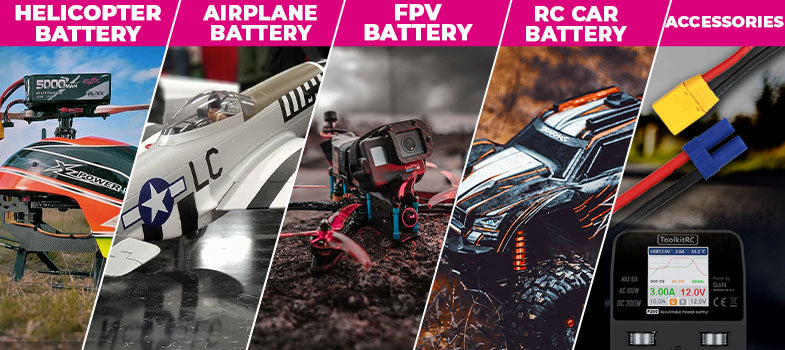
CNHL Baterai Lipo
CNHL bertujuan menyediakan baterai Li-Po berkualitas tinggi dan produk RC kepada semua penggemar hobi dengan layanan pelanggan yang luar biasa dan harga yang kompetitif
A 4S LiPo battery contains four lithium-polymer cells connected in series. A standard 4S LiPo is rated at 14.8V nominal and reaches approximately 16.8V when fully charged. It is one of the most versatile higher-performance battery formats in RC, with common applications in FPV drones, airplanes, RC cars, boats and helicopters.
Compared with 3S, a 4S battery gives the power system more voltage to work with. In a properly matched setup, that can translate into stronger acceleration, higher motor RPM potential or more power without relying entirely on higher current. But 4S is not automatically an upgrade. The ESC, motor, gearing, propeller, fan, drivetrain and other electronics must all be designed for the voltage.

| Cell Count | 4 cells connected in series |
| Standard Nominal Voltage | 14.8V |
| Approx. Full Voltage | 16.8V total / 4.20V per cell |
| Typical Storage Range | About 15.2–15.4V total, depending on charger target |
| Common Applications | FPV drones, RC airplanes, performance RC cars, boats and helicopters |
| Common Case Styles | Softcase and hardcase |
| Typical Charging Mode | LiPo Balance Charge |
The S stands for series. A 4S LiPo therefore contains four cell groups connected in series.
Standard LiPo cells are commonly rated at approximately 3.7V nominal:
3.7V × 4 = 14.8V nominal
When fully charged, a standard LiPo cell reaches approximately 4.20V:
4.20V × 4 = approximately 16.8V fully charged
This is why 4S LiPo and 14.8V LiPo battery normally describe the same standard voltage class.
To see how 4S fits into the full voltage ladder, read the LiPo Battery Voltage Guide: 1S to 8S Explained for RC Models.
| Battery State | Approx. Per Cell | Approx. 4S Pack Voltage |
|---|---|---|
| Fully charged | 4.20V | 16.80V |
| Nominal rating | 3.70V | 14.80V |
| Typical storage target | About 3.80–3.85V | About 15.20–15.40V |
Actual voltage while the model is operating will move continuously and can sag under heavy load. The amount of sag depends on current draw, battery condition, internal resistance, temperature and the overall power system.

4S is one of the broadest high-performance LiPo voltage classes in the RC hobby. It sits above the familiar 3S level but below the heavier and more demanding 6S class, which makes it a practical middle ground for many models.
4S has long been an important voltage platform for FPV, especially 5-inch freestyle and racing quads designed around 4S motors and electronics.
Compared with a comparable 6S setup, a 4S battery can often be lighter and may give the quad a direct, energetic throttle character. Whether 4S or 6S feels better depends on motor KV, propeller choice, battery weight and the way the pilot wants the quad to respond.
Smaller 4S FPV batteries may sit around 650–1800mAh, while larger capacities are used on long-range or specialized platforms.
4S is also very common in fixed-wing aircraft where 3S no longer provides enough power but 6S would add unnecessary battery weight or voltage.
Common applications include:
Battery weight and physical dimensions are especially important in airplanes because the pack position directly affects center of gravity.
4S is a common performance level for larger RC cars and trucks. It can provide significantly more power than 2S or 3S while remaining easier to package than many 6S or 8S systems.
Typical 4S surface applications include:
Hardcase construction is common where the battery is exposed to impacts, debris or chassis movement.
Performance boats often use 4S because it provides a useful balance between voltage, battery weight and current demand.
As boat size and power requirements increase, many setups move to 6S or dual-battery configurations, but 4S remains an important platform for medium-size sport boats.
4S packs are also used in electric helicopters, particularly where the model and motor system are designed specifically around this voltage class.
Helicopter battery choice is particularly sensitive to:
If your model is already designed around 4S, you can browse the CNHL 14.8V 4S LiPo Batteries collection to compare capacities, discharge ratings, case styles and connector options.
4S has enough voltage to support genuinely high-performance RC setups while still avoiding some of the extra battery weight and system complexity associated with 6S and 8S.
For many hobbyists, this makes 4S a useful long-term voltage rather than merely a stepping stone.
A well-matched 4S setup can provide:
The important phrase is well matched. A properly designed 4S system can perform better than a poorly matched 6S system, even though the 6S battery carries a larger voltage number.
| Feature | 4S Hardcase | 4S Softcase |
|---|---|---|
| External Protection | Higher | Lower |
| Typical Weight | Usually heavier | Usually lighter |
| Common Applications | RC cars and protected chassis installations | FPV, airplanes, helicopters and many boats |
| Packaging | Rigid fixed dimensions | Usually more weight-efficient |
Neither style is automatically electrically superior. Case construction should be chosen according to the physical demands of the model.
There is no single correct capacity for a 4S battery because the same voltage class covers everything from lightweight FPV drones to large RC cars.
Examples of commonly encountered capacities include:
The capacity changes how much energy the battery stores, but larger packs also generally become heavier and physically larger.
Battery energy can be estimated using nominal voltage:
Watt-hours ≈ nominal voltage × capacity in Ah
| 4S Capacity | Approx. Nominal Energy |
|---|---|
| 1300mAh | About 19.2Wh |
| 2200mAh | About 32.6Wh |
| 5000mAh | About 74Wh |
| 6000mAh | About 88.8Wh |
More energy can increase potential runtime, but the heavier battery can also change handling, acceleration, aircraft center of gravity and overall efficiency. Capacity should therefore be selected within the model’s practical size and weight range.
The C rating does not determine whether a battery is 4S.
These specifications describe different things:
Two batteries can both be 4S 5000mAh but differ significantly in discharge rating, internal resistance, wire gauge, connector, dimensions, case construction and weight.
A higher C rating does not increase the battery from 14.8V to a higher voltage class.
This distinction becomes increasingly important because many modern FPV, airplane and performance battery ranges include both conventional LiPo and LiHV options.
| Specification | Standard 4S LiPo | 4S LiHV |
|---|---|---|
| Typical Nominal Voltage | 14.8V | 15.2V |
| Typical Full Voltage | 16.8V | Up to approximately 17.4V when specified |
| Correct Charger Mode | LiPo | LiHV |
Do not charge a standard 14.8V LiPo to 17.4V. LiHV charging should only be used when the battery is specifically designed and labeled for the higher voltage.
The RC model must also tolerate the LiHV pack’s higher fully charged voltage.
A conventional 4S LiPo should normally be charged using a balance charger with both the main power lead and balance connector attached.
| 4S Battery | Approx. 1C Charge Current |
|---|---|
| 1300mAh | 1.3A |
| 2200mAh | 2.2A |
| 5000mAh | 5.0A |
| 6000mAh | 6.0A |
Approximately 1C is a conservative general starting point unless the battery specifies another permitted charge rate.
For the complete process, see the LiPo Battery Charging Guide.
4S is where charger wattage becomes much more important, especially with larger RC car and boat batteries.
A 4S 2200mAh battery charged at approximately 1C requires near full voltage:
16.8V × 2.2A ≈ 37W
A 4S 5000mAh battery at approximately 1C requires:
16.8V × 5A = approximately 84W
A 4S 6000mAh battery at approximately 1C requires:
16.8V × 6A ≈ 101W
This means a charger that feels powerful when charging small FPV packs may reach its output limit when charging a large 4S car or boat battery.
For a more complete calculation, see How Many Watts Does My LiPo Charger Need?.
There is no universal connector for 4S.
Common examples include:
Small FPV batteries may use relatively compact connectors, while high-capacity 4S car or boat packs may require larger connectors and heavier wire.
The connector should be selected according to the complete system rather than voltage alone.
Moving from 3S to 4S raises standard nominal voltage from 11.1V to 14.8V and full-charge voltage from 12.6V to 16.8V.
| Specification | 3S | 4S |
|---|---|---|
| Nominal voltage | 11.1V | 14.8V |
| Full voltage | 12.6V | 16.8V |
| Typical character | Moderate performance and easier system demand | Stronger performance potential |
| System requirement | Electronics must support 3S | Electronics must explicitly support 4S |
The extra cell does more than add 3.7V to the nominal specification. It can change motor RPM, heat, current behavior and the overall feel of the model.
Read 3S or 4S? A Guide to Choosing the Right Battery Without Frying Your Gear for the full comparison.
Moving from 4S to 6S is a larger jump:
6S can provide more voltage headroom and, for a given power target, may allow the system to produce that power with less current. This can be useful in larger aircraft, EDF jets, powerful RC cars and demanding FPV setups.
However, 6S batteries are usually heavier and the supporting electronics must be designed for the higher voltage.
A model that already performs properly on 4S does not automatically improve simply because a 6S battery can physically fit.
For the full decision process, read 4S vs 6S LiPo Battery: Which One Makes More Sense for RC Models?.
Only when the complete power system is designed to support 4S.
A fully charged 3S pack reaches approximately 12.6V, while a fully charged 4S pack reaches approximately 16.8V. That is a substantial increase.
A 3S-only ESC, motor or other component may be damaged by 4S voltage.
Do not use connector compatibility as proof of voltage compatibility.
Sometimes, if the model and electronics support both voltage levels.
Compared with 6S, a 4S pack may reduce maximum motor RPM and performance potential. It may also be lighter and easier to fit.
Whether this produces a useful setup depends on:
A platform designed specifically around 6S may feel underpowered on 4S even if the electronics technically operate at the lower voltage.
A pack marked 4S1P contains four series cell groups with one parallel path.
A 4S2P battery can have a different internal cell arrangement and larger total capacity, but it remains a 4S voltage system because the series count is still four.
The best 4S battery is therefore not simply the highest-capacity or highest-C pack. It is the battery whose voltage, size, weight, connector and electrical capability match the actual model.
Once you have confirmed that your model is designed for 4S, browse the 4S LiPo battery collection to compare practical capacities, connectors, case styles and discharge options.
4S means the battery contains four lithium-polymer cell groups connected in series.
A standard 4S LiPo is rated at 14.8V nominal and reaches approximately 16.8V when fully charged.
Both numbers describe the same standard battery at different states of charge. 14.8V is the nominal rating, while approximately 16.8V is the fully charged voltage.
Many chargers use approximately 3.8–3.85V per cell, giving a typical 4S storage range of about 15.2–15.4V.
4S batteries are widely used in FPV drones, RC airplanes, performance RC cars, boats and electric helicopters.
Yes. 4S remains an important FPV voltage platform, especially for quads designed around 4S motor KV and battery weight.
Yes. A conventional 4S pack has four series cell groups, so Balance Charge allows the charger to monitor and balance the four individual cell voltages.
At approximately 1C, the charge current is 2.2A.
At approximately 1C, the charge current is 5A.
Near full voltage, approximately 16.8V × 5A = 84W of ideal battery-side charging power is required.
A standard 4S LiPo is typically 14.8V nominal and 16.8V fully charged. A 4S LiHV is commonly rated around 15.2V nominal and may charge to approximately 17.4V when the battery specifically permits it.
Only if the complete power system explicitly supports 4S voltage.
Not automatically. 6S provides higher voltage and more headroom, while 4S often offers lower battery weight, easier fit and simpler system requirements. The correct choice depends on the platform.
Choose capacity according to the model’s battery compartment, weight limit, current demand and desired runtime. A larger mAh number is not automatically a better battery choice.
A standard 4S LiPo battery contains four series-connected cell groups, is rated at 14.8V nominal and reaches approximately 16.8V when fully charged.
Its biggest strength is versatility. 4S can power everything from compact FPV drones and RC airplanes to performance cars, boats and helicopters. But that versatility does not mean every 4S pack is interchangeable.
Start by confirming that the model genuinely supports 4S. Then match capacity, dimensions, weight, connector, case construction and discharge capability to the application.
If you are deciding whether to move up from 3S, read 3S or 4S? A Guide to Choosing the Right Battery Without Frying Your Gear. If you are considering moving beyond 4S, continue with 4S vs 6S LiPo Battery: Which One Makes More Sense for RC Models?.
For the full voltage picture, return to the LiPo Battery Voltage Guide: 1S to 8S Explained for RC Models.
CNHL bertujuan menyediakan baterai Li-Po berkualitas tinggi dan produk RC kepada semua penggemar hobi dengan layanan pelanggan yang luar biasa dan harga yang kompetitif
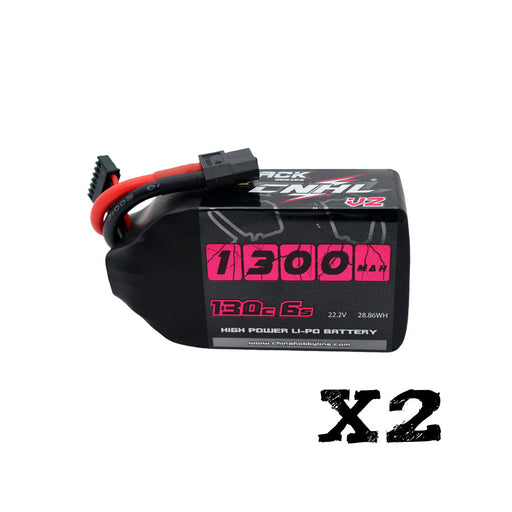
Pemeriksaan Kesesuaian Cepat 2 Packs CNHL Black Series V2.0 1300mAh 22.2V 6S 130C LiPo Battery dengan Colokan XT60 sangat cocok untuk pilot FPV yan...
Lihat detail lengkapSuku Cadang & Dukungan Jangka Panjang Kami memahami bahwa bagi pilot RC, dukungan suku cadang yang andal merupakan bagian penting untuk m...
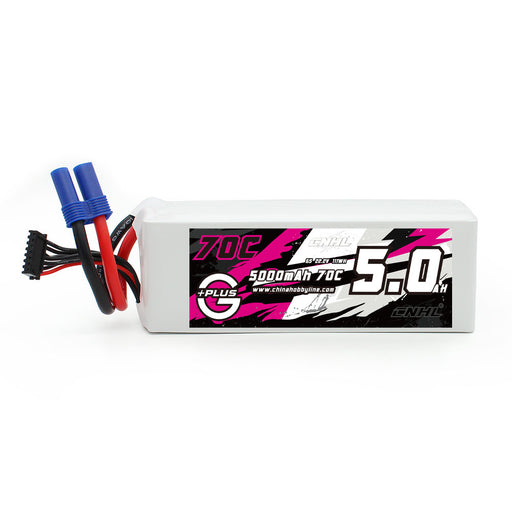
Lihat detail lengkapSpesifikasi: Nomor Stok: 500706EC5 Kapasitas: 5000mAh Voltase: 22.2V / 6-Sel / 6S1P Tingkat Discharge: 70C Kontinu / 140C Ledakan Tingkat Pengisi...
Lihat detail lengkap
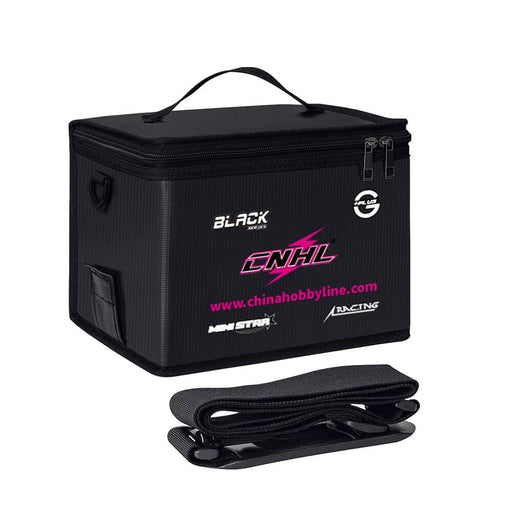
Tas Baterai LiPo CNHL dirancang untuk pengisian, transportasi, dan penyimpanan LiPo yang lebih aman di rumah atau di lapangan. Tas ini menambahkan ...
Lihat detail lengkap

Pemeriksaan Pemasangan Cepat 2 Paket CNHL Speedy Pizza Series Pro 1350mAh 6S 150C LiPo Battery dengan colokan XT60 dibuat untuk pilot FPV 5 inc...
Lihat detail lengkap

Quick Fit Check The CNHL Speedy Pizza Series 2200mAh 22.2V 6S 120C LiPo Battery with XT60 Plug combines the familiar 2200mAh 6S format with a ligh...
Lihat detail lengkap

Quick Fit Check The CNHL Speedy Pizza Series 2200mAh 14.8V 4S 120C LiPo Battery with XT60 Plug combines a widely used 2200mAh 4S format with a sli...
Lihat detail lengkap

Quick Fit Check The CNHL Speedy Pizza Series 2200mAh 11.1V 3S 120C LiPo Battery with XT60 Plug takes the familiar 3S 2200mAh aircraft battery form...
Lihat detail lengkap

The CNHL Long Range Series BAK 50D 5000mAh 21700 Li-ion battery cell is designed for custom high-energy battery packs that need a strong balance be...
Lihat detail lengkap

The ISDT C4 EVO is a versatile smart battery charger built for AA, AAA and cylindrical rechargeable cells from compact 10440 batteries all the way ...
Lihat detail lengkap


Tinggalkan komentar