
CNHL Lipo Batteries
CNHL aim at providing high-quality Li-Po batteries and RC products to all hobby enthusiasts with excellent customer services and competitive prices
It's the classic question all RC enthusiasts ask: "Do I fly a 3S or a 4S battery?" Whether flying a drone or racing a car, it seems like this decision is monumental. The correct battery provides that ideal combination of speed and controllability, yet the incorrect one can quite possibly send your valuable equipment up in flames.

Let's slice through all the forum posts and YouTube arguments that are confusing. We'll simplify the actual difference so that you can choose the correct battery for your machine without all of the guesswork.
Quick answer: choose 3S when smoother control, lower stress, and easier everyday use matter more, and choose 4S when the platform is genuinely built for more punch, more speed, and stronger output without overheating or becoming hard to manage.
Let's get the most critical thing out of the way first. The battery you can use isn't your decision—it's your motor's and your Electronic Speed Controller's (ESC) decision.

Think of this as a hard and fast rule. Your motor and ESC are designed to handle a specific amount of voltage. If your gear says it’s for 3S (11.1V) max, and you plug in a 4S (14.8V) battery, you’re force-feeding it way too much power. The result is almost always a fried ESC, a dead motor, or both. Before you even think about performance, look up the specs for your equipment.
Alright, so you've checked your equipment, and the product page or manual explicitly states your motor and ESC can take both 3S and 4S. Great. Now you do have a decision to make, and this is where it gets fun. Because your equipment is safe with both batteries, the choice now depends on what you're going to do, your level of experience, and what type of fun you're after.
If you are still one step lower on the voltage ladder and deciding whether 2S already does enough or 3S is the smarter move, start with 2S vs 3S LiPo Battery.
This little cheat sheet will make your choice easy. Just remember, this only works if your gear is rated for both 3S and 4S.
| 3S Battery Advantages | 4S Battery Advantages |
|---|---|
| Easier and more forgiving for beginners Ideal for learning and smooth control |
Provides insane speed and acceleration Perfect for experienced users and racing |
| Better for tight spaces and small tracks More manageable in confined areas |
Best suited for open fields and high throttle Unlocks full throttle potential |
| Longer run times for smooth, cinematic flying Less heat generated, safer for electronics |
Extra power for high-level FPV tricks and aggressive driving Enables advanced maneuvers and power moves |
| Keeps motor and ESC cooler Promotes longer hardware lifespan |
Sharp and locked-in throttle response Delivers adrenaline-pumping performance |
There's a reason 3S is the gold standard for so many setups. It's reliable, predictable, and just plain easy to work with.
The best thing about 3S is that the throttle is smooth and predictable. It’s not so "twitchy," which gives you a lot more fine control. This is a huge help for beginners who are still learning the ropes or for pilots who want to get those buttery-smooth cinematic shots. Because it's a lower voltage, it also makes less heat, which is way healthier for your electronics over the long haul.
If 3S is the steady daily driver, then 4S is like hitting the turbo button. The extra voltage gives you a massive kick in performance that you can feel immediately.
With 4S, you get ridiculous speed and acceleration. The throttle feels sharp, powerful, and "locked-in." For FPV racers, that power is what lets you pull out of a dive at the last second or blast through a gate. For RC cars, it's the difference between a small wheelie and a standing backflip. It's pure adrenaline, built for racing, aggressive freestyle, and making your monster truck feel like a real monster.

Let's see how this works in a few common scenarios.
The call: Start with 3S. No question about it.
Why? The less aggressive throttle will give you time to think. It's much easier to learn to fly when the drone doesn't feel like a rocket ship trying to escape your control. You'll build confidence faster and spend way less money on replacement propellers and parts. Once you feel like you've mastered 3S, you can "graduate" to 4S.
The call: Nope, don't do it! You need to upgrade your gear, not just your battery.
Why? There are no shortcuts here. If you want 4S speed, you have to buy a new motor and ESC that are actually rated for 4S. Plugging a 4S battery into a 3S-only system is the fastest way to turn your expensive electronics into a puff of magic smoke.
The call: Go straight to 6S.
Why? In racing, power is everything. 6S is the standard for most 5-inch racing drones today. It gives you the raw power you need to accelerate out of turns and pull off the tough maneuvers on a race track. If your goal is to compete, you'll need to learn to handle 6S power anyway, so you might as well start now.
If you want a clearer picture of what stepping into 6S really means, read What Is a 6S LiPo Battery.
For readers who want to place 3S and 4S into the bigger picture instead of viewing them in isolation, this LiPo Battery Voltage Guide: 1S to 8S Explained for RC Models shows how each common voltage class fits different RC applications and performance goals.
Choosing between 3S and 4S isn't really about which one is "better." It's about what's right for your gear and for you. Just remember the golden rule: check your equipment's voltage rating first. After you know your gear is safe, the choice is simple. Do you want the smooth, reliable control of 3S, or do you want the thrilling, high-speed power of 4S? Now you know exactly how to decide.
If 4S already looks like the stronger fit and you want to know whether moving even higher still makes sense, the next useful comparison is 4S vs 6S LiPo Battery.
CNHL aim at providing high-quality Li-Po batteries and RC products to all hobby enthusiasts with excellent customer services and competitive prices
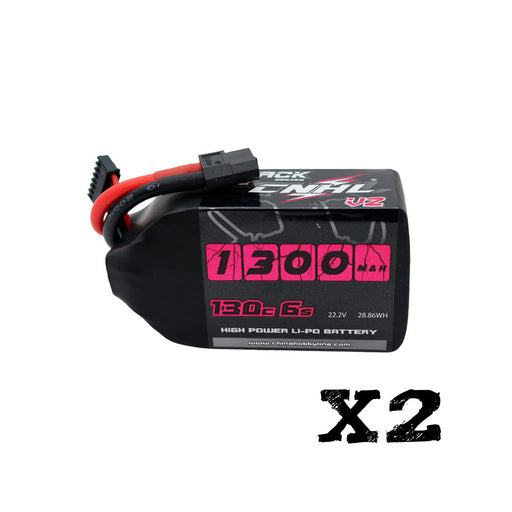
Quick Fit Check The 2 Packs CNHL Black Series V2.0 1300mAh 22.2V 6S 130C LiPo Battery with XT60 Plug is a strong fit for FPV pilots who want a prov...
View full detailsSpare Parts & Long-Term Support We know that for RC pilots, reliable spare parts support is an important part of keeping an aircraft fl...
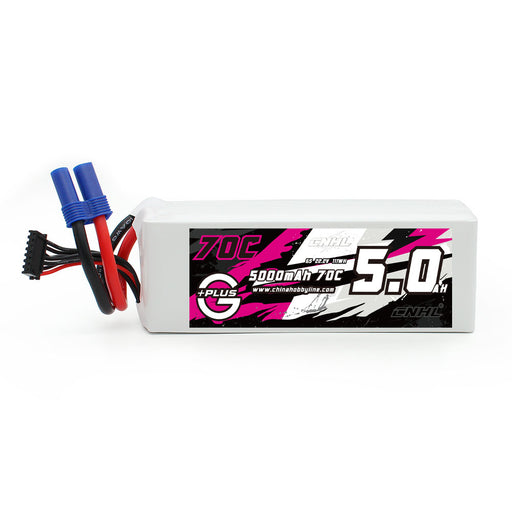
View full detailsSpecifications: Stock Number: 500706EC5 Capacity: 5000mAh Voltage: 22.2V / 6-Cell / 6S1P Discharge Rate: 70C Continual / 140C Burst Charge Rate: ...
View full details
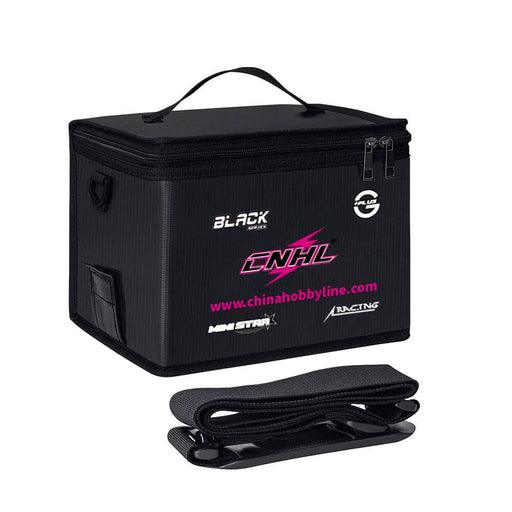
The CNHL LiPo Battery Bag is designed for safer LiPo charging, transport, and storage at home or at the field. It adds a practical layer of protect...
View full detailsQuick Fit Check The 2 Packs CNHL Speedy Pizza Series Pro 1350mAh 6S 150C LiPo Battery with XT60 Plug is built for 5-inch FPV pilots who want a ...
View full details

The CNHL Long Range Series BAK 65E 6350mAh 21700 Li-ion battery cell is built around one clear priority: maximum stored energy from a lightweight c...
View full details

The CNHL Long Range Series BAK 50D 5000mAh 21700 Li-ion battery cell is designed for custom high-energy battery packs that need a strong balance be...
View full details

The ISDT C4 EVO is a versatile smart battery charger built for AA, AAA and cylindrical rechargeable cells from compact 10440 batteries all the way ...
View full details

The CNHL Long Range Series 6350mAh 21.6V 6S1P 21700 Li-ion battery combines six BAK 65E high-energy cells into a 137.16Wh pack designed for ultra-e...
View full details

The CNHL Long Range Series 5000mAh 21.6V 6S1P 21700 Li-ion battery combines six BAK 50D cells into a compact 108Wh pack designed around long-range ...
View full details




Leave a comment