RC Boat ESC Buying Guide: How to Choose the Right Marine Speed Controller
An RC boat ESC controls how electrical power reaches the motor in response to throttle commands. In a fast electric boat, this affects acceleration, power delivery, throttle feel, and how the boat responds when you release the trigger. A well-matched marine ESC also needs to handle sustained motor loads and the demanding operating conditions inside an enclosed hull.
Unlike choosing an ESC solely by its advertised amperage, selecting a brushless RC boat ESC requires evaluating the complete propulsion system. Battery voltage, motor KV, propeller load, cooling efficiency, wiring, and available installation space all influence the result.
For most RC boat builds, the selection process starts with three questions:
- What battery voltage will the boat use? The ESC must support the total connected battery voltage.
- How much current will the motor draw? Choose an ESC with adequate continuous current capacity and operating headroom.
- How will the ESC be cooled? Water-cooled marine ESCs depend on a properly installed and functioning cooling system.
Hobbywing SeaKing ESC Comparison: 30A to 300A
The Hobbywing SeaKing family covers a broad range of electric boat applications, from lightweight recreational models to high-current marine racing systems. The V4 range emphasizes modern waterproof protection and convenient tuning, while the Pro G2 models focus on competition-oriented control in compact packages.
The following comparison summarizes the key specifications for the models featured in this collection.
| SeaKing ESC Model | LiPo Support | Continuous / Peak | BEC Output | Application Guidance |
|---|---|---|---|---|
| SeaKing 30A V4 | 2–3S | 30A / 100A | 6V / 7.4V, 2A | Boats up to 45cm |
| SeaKing 60A V4 | 2–3S | 60A / 200A | 6V / 7.4V, 4A | Boats up to 60cm |
| SeaKing Pro 70A G2 | 2–4S | 70A / 200A | 6V / 7.4V / 8.4V, 5A | Mini ECO, Mono & Hydro racing |
| SeaKing 90A V4 | 2–4S | 90A / 360A | 6V / 7.4V / 8.4V, 8A | Boats up to 80cm |
| SeaKing 120A V4 | 2–6S | 120A / 500A | 6V / 7.4V / 8.4V, 8A | Boats up to 100cm |
| SeaKing 160A V4 | 3–8S | 160A / 800A | 6V / 7.4V / 8.4V, 8A | Boats up to 120cm |
| SeaKing 200A HV V4 | 5–14S | 200A / 1000A | 6V / 7.4V / 8.4V, 8A | Boats up to 140cm |
| SeaKing 300A HV V4 | 5–14S | 300A / 1600A | 6V / 7.4V / 8.4V, 8A | Boats up to 180cm |
Selection note: Boat-length figures reflect Hobbywing's general model guidance, not guaranteed compatibility. Motor loading, propeller selection, cooling capacity, and actual current draw must also be considered. Peak current ratings describe short-duration capability and should not be used as continuous operating targets.
Choosing an RC Boat ESC by Battery Voltage
Battery voltage determines the operating range of the power system. Increasing the number of LiPo cells increases available voltage, but the ESC and motor must both be rated for that voltage. A higher-voltage battery is not automatically a suitable upgrade for an existing boat.
2S–3S RC Boat ESCs: Compact Marine Setups
For smaller brushless RC boats, a 2S or 3S marine ESC offers a practical balance of size, electrical capability, and installation flexibility. The SeaKing 30A V4 and 60A V4 are designed for this voltage range, making them useful choices when space and weight matter.
These controllers are especially relevant to compact hulls where a larger ESC would add unnecessary bulk. The 60A version offers greater continuous current capacity than the 30A, but the correct choice still depends on motor and propeller loading.
4S RC Boat ESCs: More Power and Tuning Flexibility
A 4S brushless boat setup requires an ESC explicitly rated for four LiPo cells. Within the SeaKing selection, the 90A V4 and Pro 70A G2 support 2–4S operation, while the 120A V4 also accommodates 4S within its wider 2–6S range.
The 90A V4 is a versatile option for suitable mid-sized boats. The Pro 70A G2 serves a different purpose: lightweight, competition-oriented marine control with advanced tuning options for Mini ECO, Mini Mono, and Mini Hydro applications.
6S–8S RC Boat ESCs: High-Output Brushless Systems
As motor power increases, higher-voltage setups become attractive for RC speedboat builders. The SeaKing 120A V4 supports up to 6S, while the 160A V4 expands the range to 8S.
These controllers are suitable for appropriately matched higher-output marine systems, but sufficient current capacity remains essential. A powerful motor combined with an aggressive propeller can overload an ESC even when battery voltage is within its stated range.
12S–14S Marine ESCs: Large High-Voltage RC Boats
High-voltage marine systems require ESCs specifically designed for the electrical demands of multi-cell battery configurations. The SeaKing 200A HV V4 and 300A HV V4 support 5–14S LiPo operation and are intended for demanding, high-current applications.
These controllers are relevant to large high-performance RC boats where motor load, wiring, cooling, and battery discharge capability must be carefully matched. Their high-voltage capability should not be confused with a recommendation to use the maximum supported cell count in every build.
Water-Cooled Marine ESCs: Why Cooling Matters
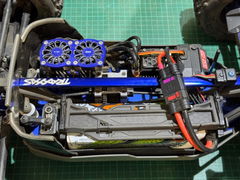
Water cooling is one of the defining features of a dedicated marine electronic speed controller. Unlike many RC car ESCs that rely on airflow and cooling fans, a water-cooled RC boat ESC transfers heat through a cooling plate or heatsink connected to the boat's water-cooling circuit.
This matters because the electronics are usually enclosed beneath the hull hatch, where airflow may be limited. During sustained high-throttle operation, cooling performance can affect how consistently the ESC operates.
A typical water-cooling setup uses a water pickup, appropriately sized tubing, cooling passages, and an outlet. Water must flow correctly through the system, and the tubing must be secured to prevent leaks or disconnections.
When installing a water-cooled ESC, pay attention to:
- Cooling tube dimensions: Match tubing to the ESC's water fittings rather than assuming every SeaKing model uses identical connectors.
- Unrestricted water flow: Avoid sharp tubing bends, blockages, and poorly routed cooling lines.
- Installation clearance: Leave space for the ESC body, water fittings, battery wires, and receiver connections.
- Operating temperature: Check temperatures after short test runs before extending full-throttle operation.
- System maintenance: Inspect cooling lines and fittings regularly, particularly after repairs or modifications.
A higher-amperage ESC does not compensate for an inadequate cooling system or an overloaded motor. Successful marine power systems depend on the complete setup working together.
Waterproof RC Boat ESCs: IP67 vs IP55
Waterproof protection is important in RC boating, but different ESC families use different protection designs.
The Hobbywing SeaKing V4 controllers feature IP67-rated waterproof and dustproof protection, helping them withstand exposure associated with normal marine use. This includes the SeaKing V4 models from 30A through the high-current versions.
The competition-focused SeaKing Pro 70A G2, by comparison, carries an IP55 rating. Its design emphasizes compact dimensions, water resistance, and the control characteristics required by small racing boats.
Neither rating means the entire boat's electrical system can be neglected. Battery connectors, exposed wiring, receiver connections, and other components still require appropriate protection. Inspect and dry exposed electrical connections after use, especially where moisture or corrosion may be present.
For marine ESC selection, waterproof rating, cooling design, and installation requirements should be considered together rather than treating waterproofing as the only deciding feature.
SeaKing V4 vs SeaKing Pro: Which Marine ESC Should You Choose?
Although both series belong to the Hobbywing SeaKing family, the V4 and Pro models are designed around somewhat different priorities.
SeaKing V4: A Broad Range of Marine Power Systems
The SeaKing V4 lineup provides a wide choice of current and voltage ratings for recreational and performance-oriented brushless boats. Depending on the model, it combines IP67 protection, water cooling, programmable throttle behavior, adjustable BEC voltage, and data-monitoring capabilities.
The 30A, 60A, 90A, and 120A V4 models can be configured through compatible Hobbywing programming equipment. Mobile monitoring and certain firmware operations use a compatible external OTA module or programming interface.
For the larger 160A, 200A HV, and 300A HV V4 models, integrated Bluetooth offers direct access to supported HW LINK app functions. Programming-tool compatibility still varies by model.
SeaKing Pro G2: Competition-Focused Performance
The SeaKing Pro 70A G2 is designed for mini racing boats that need a lightweight ESC with precise throttle customization. It supports 2–4S LiPo batteries, selectable BEC output voltage, Turbo Acceleration, and adjustable PWM frequency.
With a compact 38.5 × 30 × 8.4mm body and a listed weight of 35g without the water-cooling pipe, it is particularly relevant to weight-sensitive racing setups. Its water-cooling heatsink can also be removed for suitable low-load applications where reduced weight or packaging space is important.
The best choice is not necessarily the controller with the highest amp rating. For a compact Mini ECO racing boat, precise tuning and low weight may matter more than the additional current capacity of a substantially larger marine ESC.
Marine ESC Programming, Bluetooth & Data Monitoring
Modern marine ESCs offer more than basic forward-throttle operation. Programmable settings allow users to tailor motor response and protection behavior to the boat's requirements.
Depending on the specific SeaKing controller, available functions may include throttle calibration, motor timing, acceleration response, braking behavior, reverse settings, Freewheeling, and low-voltage protection.
Freewheeling and Throttle Response
The Freewheeling function available on supported SeaKing controllers changes how the ESC behaves when throttle is reduced. It can contribute to more responsive deceleration and improved control when approaching turns.
These characteristics can be especially useful in racing applications, where slowing the boat predictably is just as important as accelerating quickly.
HW LINK App and Bluetooth Connectivity
Compatible Hobbywing marine ESCs support parameter adjustments, data viewing, or firmware upgrades using the appropriate HW LINK system.
However, not every SeaKing ESC includes built-in Bluetooth. Certain V4 and Pro models require an external OTA Programmer or another compatible programming device, while selected larger V4 controllers have integrated Bluetooth.
Before purchasing programming accessories, verify compatibility with the exact ESC model and generation.
Understanding Data Logging
ESC data can help diagnose electrical and thermal behavior during operation. Depending on the controller and connected programming equipment, available information may include battery voltage, motor speed, throttle position, current, and ESC temperature.
Some SeaKing models support historical data graphs through internal logging, while others rely on a compatible external OTA device. These features can be useful for evaluating motor load and checking whether setup changes are increasing electrical or thermal stress.
RC Boat ESC Installation: Wiring, Connectors & BEC
Correct installation is essential when upgrading a brushless marine power system. Even a properly rated ESC can experience problems if its wiring, receiver setup, cooling connections, or battery arrangement is unsuitable.
Battery Connectors and Current Capacity
Many Hobbywing SeaKing ESCs are supplied without a preinstalled battery connector. This allows builders to select a suitable connector for their existing battery system and expected current requirements.
Common high-current RC connectors include XT60, XT90, EC5, IC5, and other appropriately rated connector systems. Larger high-voltage boats may require heavier wiring and higher-current connector solutions.
Choose connectors and wire gauge based on the electrical requirements of the complete setup. Avoid undersized connectors, loose solder joints, or adapters that introduce unnecessary resistance into a high-current power system.
Motor Connections and Rotation Direction
Brushless marine ESCs generally connect to a compatible three-phase brushless motor. Motor rotation direction must match the boat's propulsion requirements.
When setting up a new system, remove the propeller or otherwise prevent accidental propulsion during programming and testing. Follow the ESC manual for motor direction changes, throttle calibration, and receiver setup.
BEC Voltage and Servo Compatibility
The built-in BEC supplies regulated power to compatible receiver and steering electronics. Different SeaKing models provide different BEC voltage and current options.
For example, the SeaKing 60A V4 offers 6V or 7.4V output at 4A, while the SeaKing 120A V4 offers 6V, 7.4V, or 8.4V output at 8A. The SeaKing Pro 70A G2 provides 6V, 7.4V, or 8.4V output at 5A.
Select the correct output voltage for the installed receiver and servo. Never assume an ordinary 6V servo can safely operate at 8.4V.
Frequently Asked Questions About RC Boat ESCs
What does an ESC do in an RC boat?
An electronic speed controller regulates electrical power delivered to the boat's motor based on throttle input from the receiver. A suitable marine ESC also provides motor-control settings and protection features appropriate to its design.
What is the difference between a marine ESC and a car ESC?
Marine ESCs are designed for the operating environment and load characteristics of RC boats. Water cooling, marine throttle settings, reverse behavior, and environmental protection may differ from automotive controllers. A car ESC should not be assumed suitable for boat operation without checking its specifications and cooling requirements.
Is a 120A ESC better than a 60A ESC for an RC boat?
A 120A ESC offers greater continuous current capacity, but it is not automatically the best choice. If the motor operates comfortably within the limits of a properly cooled 60A ESC, the larger controller may add unnecessary size and weight. Match the ESC to actual system demand.
Can I use a 6S battery with a 4S marine ESC?
No. A controller rated for a maximum of 4S LiPo must not be operated with a 6S pack. Choose an ESC explicitly rated for the intended battery voltage, and ensure the motor and other components can also support that configuration.
Does every Hobbywing SeaKing ESC have Bluetooth?
No. Bluetooth connectivity varies by model. Selected larger SeaKing V4 controllers have integrated Bluetooth, while other models require an external compatible OTA programming module for supported mobile-app functions.
Are SeaKing Pro ESCs fully waterproof?
Protection ratings vary across the SeaKing family. The SeaKing Pro 70A G2 carries an IP55 rating, while the SeaKing V4 models feature IP67-rated protection. Always follow the manufacturer's installation and maintenance instructions.
What causes a marine ESC to overheat?
Common causes include excessive propeller loading, insufficient cooling-water flow, high motor current, incorrect gearing or drive configuration where applicable, wiring resistance, and operation beyond the ESC's continuous rating. Stop operating the boat and investigate the cause if temperatures become excessive.
Can I connect two LiPo batteries to one RC boat ESC?
Yes, if the battery configuration and complete power system are designed for it. Batteries connected in series increase total voltage, while parallel connections increase available capacity. The final voltage must remain within the ESC's supported range, and the batteries, connectors, wiring, and charging procedures must be appropriate for the configuration.
Can I upgrade my RC boat ESC without replacing the motor?
Often, yes. However, the new ESC must be compatible with the motor's type, voltage range, current requirements, and intended operating behavior. Upgrading the ESC alone does not increase the motor's safe operating limits.
Complete Your RC Boat Power System
A capable ESC is only one part of a dependable brushless boat setup. The motor, LiPo battery, charging equipment, wiring, and cooling hardware must work together to deliver consistent performance.
Explore related CNHL collections to complete your marine power system:
- Hobbywing SeaKing ESCs – Explore the dedicated SeaKing marine controller range.
- RC Boat LiPo Batteries – Find batteries for different marine voltage and power requirements.
- ESC Programmers & Accessories – Browse compatible programming and configuration equipment.
- RC Electronic Speed Controllers – Compare ESC solutions for boats, cars, aircraft, and other RC applications.
Whether you're upgrading a small brushless boat, tuning a competition-ready racing hull, or building a powerful high-voltage speedboat, selecting the right RC boat ESC begins with understanding your complete power system. Compare voltage compatibility, continuous current capacity, cooling requirements, and programming features to find a marine controller suited to your build.