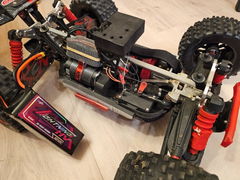
The CNHL Long Range Series BAK 65E 6350mAh 21700 Li-ion battery cell is built around one clear priority: maximum stored energy from a lightweight cylindrical cell. With 22.5Wh of energy at only about 72–73g in CNHL measurements, the N21700CX-65E reaches approximately 310Wh/kg-class cell-level energy density, making it an exceptional building block for long-endurance FPV, fixed-wing and UAV battery systems.
Unlike the more power-and-energy-balanced 5000mAh 50D platform, the 6350mAh 65E is positioned as an Energy First / Maximum Endurance cell. Its advantage is not extreme burst output, but the ability to store more watt-hours for every kilogram of battery mass carried by the aircraft.
This product is an individual cylindrical Li-ion cell rather than a complete ready-to-use RC battery pack. Custom pack construction requires correct cell matching, electrical interconnections, insulation, charging, thermal management and appropriate protection practices.
Quick Fit & Performance Check
| Cell Format |
21700 cylindrical Li-ion cell |
| Cell Model |
BAK N21700CX-65E |
| Marked Capacity |
6350mAh |
| Nominal Voltage |
3.54V |
| Cell Energy |
22.5Wh |
| Approx. Sample Weight |
Approx. 72–73g |
| Calculated Energy Density |
Approx. 308–313Wh/kg (~310Wh/kg class) |
| Performance Direction |
Energy First / Maximum Endurance |
| Primary Applications |
Long-endurance FPV, RC airplane, fixed-wing and UAV battery projects |
Product Specifications
| SKU |
LI635101S70 |
| Brand / Series |
CNHL Long Range Series |
| Cell Manufacturer / Model |
BAK N21700CX-65E |
| Chemistry |
Rechargeable Li-ion |
| Cell Format |
21700 |
| Marked Capacity |
6350mAh |
| Nominal Voltage |
3.54V |
| Cell Energy |
22.5Wh |
| Maximum Charge Voltage |
4.20V |
| Discharge Cutoff Voltage |
2.50V |
| Standard Charge / Discharge Current |
1.3A under standard test conditions |
| Datasheet Maximum Charge |
13A (2C; specified as a maximum condition, not a standard cycle charge rate) |
| Datasheet Maximum Discharge |
26A (4C under specified maximum test conditions; not presented as a continuous cycle rating) |
| AC Internal Resistance |
≤8mΩ at 1kHz |
| Consumer-Facing Size |
Approx. 21mm diameter × 70mm length |
| Technical Size Limit |
Up to approximately Ø21.75 × 71.0mm |
| Approx. Sample Weight |
Approx. 72–73g; pictured sample 73.0g |
| Calculated Cell-Level Energy Density |
Approx. 308–313Wh/kg |
Approx. 310Wh/kg-Class Energy Density – The Key 65E Advantage
The standout feature of the BAK 65E is its exceptionally high gravimetric energy density. The cell marking specifies 22.5Wh of stored energy, while cell have weighed approximately 72–73g. This places the 65E in an approximately 310Wh/kg-class energy-density range.
For aircraft, this matters because every gram of battery must be carried for the entire flight. Higher Wh/kg means more stored energy can be carried without increasing battery mass at the same rate, which is exactly the type of advantage that can translate into longer useful endurance on an efficient aircraft.
65E vs 50D: 25% More Cell Energy with a Much Smaller Weight Increase
The difference becomes especially clear when comparing the two CNHL 21700 Long Range cell directions using actual sample data.
| Cell |
Energy |
Sample Weight |
Calculated Wh/kg |
| BAK 50D |
18Wh |
Approx. 66g |
Approx. 273Wh/kg |
| BAK 65E |
22.5Wh |
Approx. 72–73g |
Approx. 308–313Wh/kg |
The 65E stores approximately 25% more energy per cell than the 18Wh 50D, while CNHL sample weight increases by only about 9–11%. The result is roughly 13–15% higher calculated gravimetric energy density at the individual-cell level.
This does not make the 65E universally better. The 50D remains the stronger power-and-energy-balanced direction, while the 65E is the clear choice when maximum energy per unit of battery mass is the primary design goal.
6350mAh and 22.5Wh from a Single 21700 Cell
Each 65E cell is marked at 6350mAh, 3.54V and 22.5Wh. This high cell-level energy allows substantial pack capacity to be created without requiring unusually large numbers of parallel cells.
For long-range aircraft, the benefit is not simply a larger mAh number. The important advantage is the combination of total watt-hours and relatively low cell mass, which directly improves the amount of stored energy available for a given battery weight.
1P, 2P and 3P High-Energy Battery Pack Possibilities
| Parallel Configuration |
Commercial Capacity |
Long Range Direction |
| 1P |
6350mAh |
Maximum cell-level energy in a compact pack architecture |
| 2P |
12700mAh |
Extended-endurance FPV, fixed-wing and UAV systems |
| 3P |
19000mAh |
Maximum-endurance large UAV and fixed-wing platforms |
CNHL uses a commercial designation of 19000mAh for the corresponding 65E 3P battery range. Parallel configurations also allow electrical load to be shared across multiple cells, but actual pack capability remains dependent on cell limits, pack construction, interconnections, wiring and thermal conditions.
21700 High-Energy Cell for Long-Range FPV
For long-range FPV, the 65E is most attractive when the aircraft has already been optimized around efficient cruising and moderate electrical demand. In these systems, maximum energy per unit of battery mass can be more valuable than additional burst-current capability.
Explore assembled and application-oriented options in the CNHL Li-ion long range FPV battery collection.
Maximum-Endurance Cell for RC Airplanes and Fixed-Wing Aircraft
Efficient fixed-wing aircraft are particularly well positioned to benefit from the 65E because aerodynamic lift can allow relatively low power consumption during steady cruise. That gives the aircraft more opportunity to convert the cell's high Wh/kg into useful flight time.
FPV wings, gliders, sailplanes and other endurance-oriented aircraft are strong application directions when launch and climb current remain within the finished battery's capability.
Browse the CNHL Li-ion batteries for RC airplanes and fixed-wing aircraft collection for finished pack options.
High Energy Density for UAV Battery Systems
Energy density becomes especially important in UAV applications because additional battery mass competes directly with payload and increases the energy required to keep the aircraft in flight.
The 65E's approximately 310Wh/kg-class cell-level energy density makes it a compelling platform for mapping, surveying, inspection and long-duration fixed-wing UAV projects where mission energy has greater value than extreme burst power.
For assembled mission-oriented packs, explore the CNHL Li-ion UAV battery range.
Energy First: When to Choose 65E Instead of 50D
| Priority |
50D 5000mAh |
65E 6350mAh |
| Power Headroom |
Stronger direction |
Secondary priority |
| Capacity per Cell |
5000mAh |
6350mAh |
| Energy per Cell |
18Wh |
22.5Wh |
| Calculated Sample Wh/kg |
Approx. 273Wh/kg |
Approx. 308–313Wh/kg |
| Best Direction |
Power + Energy Balance |
Energy First / Maximum Endurance |
Choose the 65E when the aircraft is efficient enough to make maximum stored energy the higher priority. Choose the 50D when greater usable power headroom is more important than maximizing Wh/kg.
Part of the CNHL Long Range Series
The 65E is part of the CNHL Long Range Series, an endurance-focused battery family designed around high-energy cylindrical Li-ion technology.
Compare this cell with other options in the CNHL 21700 Li-ion cell collection, browse the complete 21700 Li-ion battery range, or explore all CNHL Li-ion batteries.
Charging and Cell Safety
Charge the BAK 65E only with equipment and settings appropriate for rechargeable Li-ion chemistry. The maximum charge voltage is 4.20V per cell. Standard charging conditions should be preferred for routine use, while any higher charge rate must remain within the cell specification and appropriate thermal limits.
Do not interpret maximum test-condition charge or discharge values as normal continuous operating ratings. Finished battery-pack current capability also depends on parallel count, interconnects, wire size, connector, cooling and cell temperature.
Do not short-circuit, crush, puncture, reverse-polarize, overcharge, over-discharge or expose the cell to excessive heat. Individual cylindrical cells should be mechanically protected and should never be carried loose with conductive objects that could bridge the terminals.
Custom multi-cell lithium battery construction requires correct cell matching, insulation, reliable electrical connections and appropriate charging and protection practices. This individual cell is intended for users familiar with safe Li-ion battery handling and pack assembly.
FAQ: CNHL BAK 65E 6350mAh 21700 Cell
What is the capacity of the BAK 65E cell?
The CNHL 65E product uses a commercial and cell-marked capacity of 6350mAh. The cell is marked at 3.54V and 22.5Wh.
What is the energy density of this 21700 cell?
Based on 22.5Wh cell energy and CNHL sample weights of approximately 72–73g, calculated cell-level gravimetric energy density is approximately 308–313Wh/kg, or about the 310Wh/kg class.
Why is Wh/kg important for long-range aircraft?
Every gram of battery must be carried throughout the flight. Higher Wh/kg means more stored energy is available for a given battery mass, which can improve endurance when the aircraft is efficient enough to make use of that energy.
Is the 65E better than the 50D?
Not for every application. The 65E provides significantly higher cell-level energy density and is the Energy First / Maximum Endurance direction. The 50D provides a stronger balance between energy storage and usable power headroom.
Can I use the 65E for a long-range FPV battery?
Yes, particularly for highly efficient cruising-focused systems where stored energy is a higher priority than extreme burst output. Actual pack current and thermal requirements must still be matched to the aircraft.
Is the 65E suitable for UAV battery packs?
It can be especially attractive for mapping, inspection, surveying and efficient fixed-wing UAV applications because its high energy density can provide substantial mission energy without increasing cell mass at the same rate as stored energy.
What capacities can be created using parallel 65E cells?
A 1P configuration provides 6350mAh, 2P provides 12700mAh, and CNHL uses a commercial 19000mAh designation for its corresponding 3P battery range.
Is this a complete RC or UAV battery?
No. LI635101S70 is one individual 21700 cylindrical Li-ion cell. It does not include a finished multi-cell battery assembly, main power connector or balance connector.
What is the maximum charge voltage?
The maximum charge voltage is 4.20V per cell. Always use charging equipment and settings appropriate for Li-ion chemistry and the final battery configuration.
Negara atau wilayah Anda harus sesuai dengan gudang pengiriman
Gudang US
Untuk Gudang US, pesanan biasanya dikirim dalam 1 hingga 2 hari kerja. Pesanan hanya dikirim ke United Status melalui layanan USPS (Pengiriman Gratis untuk pesanan di atas $69), waktu pengiriman memerlukan 3-7 hari kerja.
Gudang EU
Untuk Gudang EU, pesanan biasanya dikirim dalam 1 hingga 2 hari kerja, waktu pengiriman memerlukan 5-10 hari kerja.
Gudang UK
Untuk Gudang UK, pesanan biasanya dikirim dalam 1 hingga 2 hari kerja. Pesanan hanya dikirim ke United Kingdom melalui layanan Yodel/Hermes/DPD (Pengiriman Gratis untuk pesanan di atas $69), waktu pengiriman memerlukan 3-7 hari kerja.
Biaya pengiriman tambahan mungkin berlaku untuk area tertentu, termasuk Highlands & Islands, Channel Islands, Northern Ireland, Isle of Man, dan Isle of Wight.
Gudang AU
Untuk Gudang AU, pesanan biasanya dikirim dalam 1 hingga 2 hari kerja. Pesanan hanya dikirim ke Australia melalui layanan AU Post (Pengiriman Gratis untuk pesanan di atas $79). Waktu pengiriman memerlukan 3-7 hari kerja.
Gudang CA
Untuk Gudang CA, pesanan biasanya dikirim dalam 1 hingga 2 hari kerja. Pesanan hanya dikirim ke Kanada melalui layanan Amazon UPS/FedEx/CA Post (Pengiriman Gratis untuk pesanan di atas $99). Waktu pengiriman memerlukan 3-7 hari kerja.
Gudang Global
Untuk Gudang Global, pesanan biasanya dikirim melalui pengiriman standar dalam 4 hingga 5 hari kerja, dan waktu pengiriman memakan waktu 15-25 hari.