
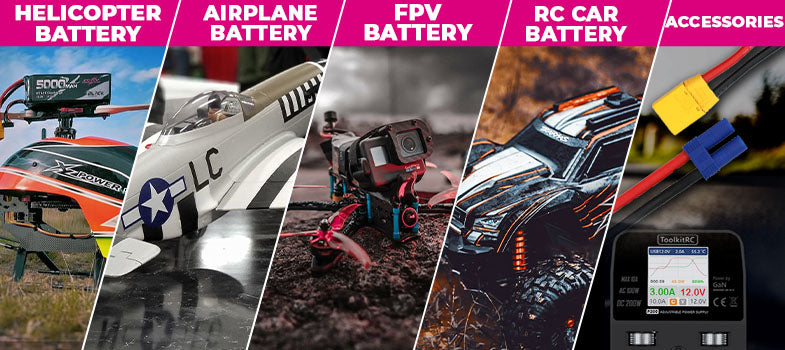
CNHL Lipo Batteries
CNHL aim at providing high-quality Li-Po batteries and RC products to all hobby enthusiasts with excellent customer services and competitive prices

If you have ever searched “LiPo vs Li-ion vs LiFe” and ended up more confused, you are not alone. Most guides start with chemistry and specs. Real-world buying works better in the opposite direction: start with how you actually use the throttle, then pick the chemistry that behaves the way you need.
Here is the simple framing: if your day is bursts of power (racing, punch-outs, EDF launches), you are paying for voltage stability (usually LiPo or a LiHV battery). If your day is steady cruise for a long time (endurance FPV, receiver power, long gentle flights), you are paying for minutes per gram (often Li-ion), or for a flat, servo-friendly voltage (often LiFe).
If you want to browse options by application without turning this into a science project, you can start with our main collections and then come back to this guide to sanity-check the choice: CNHL LiPo batteries, RC car batteries, RC airplane batteries, FPV drone batteries.
This article covers LiPo, LiHV battery, Li-ion, and LiFe (often typed as “life” in searches). We will keep it buyer-focused: voltage, fit, connectors, realistic C corridors, and the behavior you can feel in your model.
| Use case | Best chemistry (typical) | What it feels like | Watch-outs |
|---|---|---|---|
| RC cars (bashing, general driving) | LiPo | Strong punch, predictable power | Tray fit and connector match matter more than chasing the highest C |
| 1/10 racing (shorty packs) | LiPo (hardcase / shorty) | Consistent corner-exit punch | Hardcase format and tray dimensions rule everything |
| Sport planes and warbirds | LiPo (sometimes LiHV battery) | Clean throttle response and stable landings | More mAh can make the plane fly worse if weight creeps up |
| EDF jets and high-current climbs | LiPo, or LiHV battery if you truly use LiHV mode | Less “soft” feeling under load | Under-spec packs heat up fast; cooling and quality matter |
| FPV freestyle / racing (punch-outs) | LiPo or LiHV battery | Snappy recovery, fewer voltage dips | Li-ion often feels mushy here |
| FPV long-range cruising / endurance | Li-ion (build around it) | More minutes per gram when you fly smooth | Low burst current: design for efficiency, not hero moves |
| Receiver / ignition / turbine ECU power | LiFe (LiFePO4, often typed as “life”) | Flat, servo-friendly voltage | Different max voltage than LiPo; use the correct charge mode |
The buyer move that saves money: do not pick chemistry to “fix” a wrong tray size or a connector mismatch. Fit and connector first. Chemistry second. Then C corridor.
Voltage is where confusion usually starts, because different chemistries have different “full charge” numbers. The table below is the quick reference most people actually needed.
| Chemistry | Nominal (per cell) | Full charge (per cell) | Storage target (per cell) | Practical low-voltage habits |
|---|---|---|---|---|
| LiPo | 3.7V | 4.20V | About 3.80V to 3.85V | Avoid “dead-flat.” Stop runs early enough that packs recover to a safe resting voltage. |
| LiHV battery | 3.8V | 4.35V (LiHV mode) | Often similar to LiPo storage targets | LiHV only makes sense if you actually charge in LiHV mode and your system benefits from it. |
| Li-ion | 3.6V to 3.7V (cell dependent) | Often 4.20V (some are lower) | Mid-state storage is healthiest | Great for steady loads. Not ideal for heavy punch unless the build is designed for it. |
| LiFe (LiFePO4, “life”) | 3.3V | 3.60V | Mid-state storage is healthiest | Flat voltage curve is great for receivers and servos. Use the correct LiFe charge mode. |
Important: “Low voltage” depends on load, pack condition, and your model. A pack that sags hard under throttle can look “low” while loaded and recover when resting. The safest habit is to avoid pushing any lithium pack to the point where it struggles to recover and feels hot or weak.

A lot of people search “lipo vs life” when they really mean LiFe (LiFePO4). That typo shows up constantly, so let’s make it clear: LiFe is not a “better LiPo.” It is a different tool.
If you are powering servos directly, LiFe’s nominal voltage often lands in a comfortable range for many setups, and its flatter discharge curve can feel “steady” compared to packs that start high and slide downward.
Li-ion gets recommended everywhere because it has great energy density. But in RC, the question is not “Which lasts longer on paper?” It is “Which holds voltage when I ask for power?”
| If you do this... | LiPo usually feels like... | Li-ion usually feels like... | Best buyer move |
|---|---|---|---|
| Repeated bursts (racing, EDF climbs, FPV punch-outs) | Stable and responsive if the pack is sized correctly | Often softer unless the build is designed for efficiency and current limits | Choose LiPo (or LiHV battery) and size for voltage stability, not just mAh |
| Steady cruise and gentle throttle | Works fine but you may carry extra weight for the minutes you want | Very efficient minutes per gram when built correctly | Consider Li-ion for endurance builds, but build around it |
| Receiver / radio power and accessories | Usually overkill unless you already run LiPo everywhere | Great for low, steady drain loads | Li-ion or LiFe often makes more sense than a high-C LiPo |
In other words: Li-ion can be brilliant when the goal is smooth efficiency. It is not the magic answer for freestyle punch-outs or high-current EDF setups.
A LiHV battery is basically a pack designed to be charged higher per cell (up to 4.35V). That extra headroom can feel “snappier” off the top in burst-heavy setups. But only if you actually use it correctly.
One common example is the 2S LiHV battery space. A 2S LiHV battery is often chosen for small builds that want a lively feel without adding much weight. But the same rule still applies: correct charge mode, correct connector, and realistic expectations about current and heat.

C rating is useful as a store filter, but it is not a lab-standard number you can compare across every brand. The practical approach is simple: use C rating to avoid obviously under-spec packs, then decide with real behavior (sag, heat, consistency) and connector reality.
| Your goal | When C matters more | Practical corridor | What happens if you undershoot |
|---|---|---|---|
| Racing and punchy throttle (cars, EDF, FPV freestyle) | When you need voltage to stay stable during bursts | Roughly 60C to 120C (pack size dependent) | Sag, heat, flat late-run feeling, occasional brownout-type dips |
| General driving and sport flying | Enough current with good efficiency | Roughly 30C to 70C | Warm packs, slower response, shorter pack life |
| Cruise and endurance (gliders, long range) | Energy density matters more than burst | Lower can be fine (Li-ion style) | Not enough burst for “save it” moments if you fly it like freestyle |
Reality check: if your connector or wire gauge is too small, the pack can be “high C” on paper and still feel weak or run hot. In RC, bottlenecks are often mechanical: plugs, wires, fit, airflow.
You cannot measure internal resistance from a product page. So treat sag like a behavior you can predict and diagnose.
| What you feel | What it usually means | What you do next |
|---|---|---|
| “It feels soft on throttle.” | Sag under load (under-spec pack, connector bottleneck, or lower-quality cells) | Stay in the corridor, avoid tiny connectors for high current, and do not under-buy for burst setups |
| “The pack gets hot fast.” | High losses (effective IR) or pushing beyond the efficient zone | Step up quality/series, check airflow, and confirm charge habits and connector fit |
| “It stays punchy longer.” | Better voltage stability and consistency | That is the real value in racing, EDF, and freestyle |
If you only remember one maintenance rule: keep packs cool, do not abuse low voltage, and store them at a healthy mid-state. That alone saves a lot of packs over a year.
Most of the time, yes. People often type “life” when they mean LiFe (LiFePO4). LiFe is a different chemistry than LiPo, with a different full-charge voltage and a flatter discharge curve that is popular for receiver and ignition power.
Sometimes. A LiHV battery is worth it only if you will actually charge in LiHV mode and your setup benefits from the extra voltage without overheating. If you charge it like a normal LiPo anyway, you often get more value by buying the correct size corridor or a higher-quality pack.
They can look similar on paper, but the difference you feel in RC is usually how well the pack holds voltage under load. LiPo is typically better for burst power. Li-ion is excellent for steady, efficient cruise when the build is designed for it.
No. Treat C rating as a corridor. Buy enough for your use case, then judge quality by sag, heat, and consistency. Also make sure your connector and wire gauge are not the real bottleneck.
A 2S LiHV battery can make sense in smaller builds that want a lively feel with low weight, as long as your charger supports LiHV mode and your connectors and wiring match the current demands. If you never charge LiHV mode, the advantage disappears.
Next step: If you want to shop by application first and then double-check chemistry, these are the clean starting points: CNHL LiPo batteries and FPV drone batteries.
CNHL aim at providing high-quality Li-Po batteries and RC products to all hobby enthusiasts with excellent customer services and competitive prices

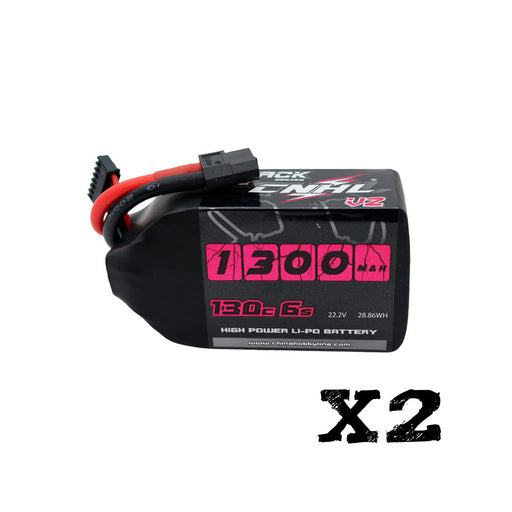
Quick Fit Check The 2 Packs CNHL Black Series V2.0 1300mAh 22.2V 6S 130C LiPo Battery with XT60 Plug is a strong fit for FPV pilots who want a prov...
View full detailsSpare Parts & Long-Term Support We know that for RC pilots, reliable spare parts support is an important part of keeping an aircraft fl...
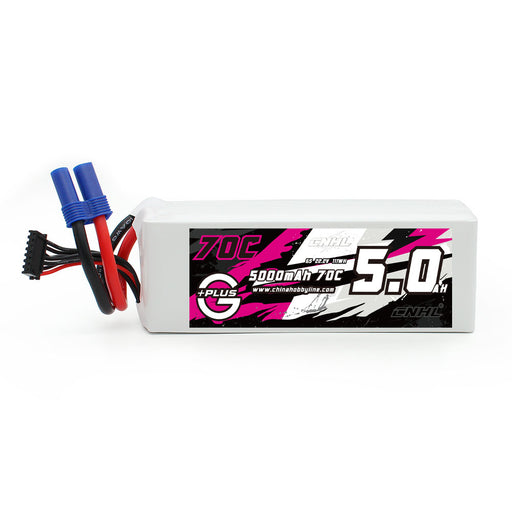
View full detailsSpecifications: Stock Number: 500706EC5 Capacity: 5000mAh Voltage: 22.2V / 6-Cell / 6S1P Discharge Rate: 70C Continual / 140C Burst Charge Rate: ...
View full details
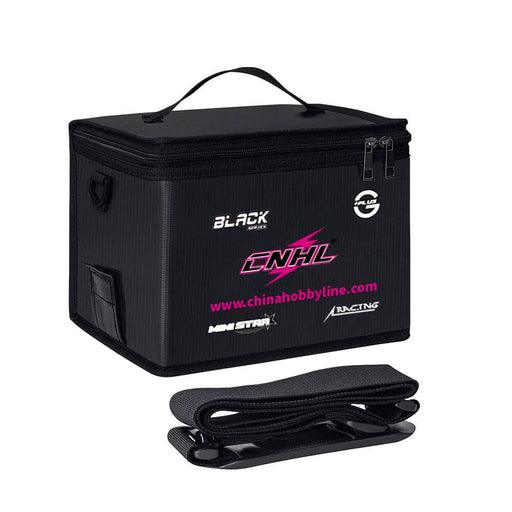
The CNHL LiPo Battery Bag is designed for safer LiPo charging, transport, and storage at home or at the field. It adds a practical layer of protect...
View full details

Quick Fit Check The 2 Packs CNHL Speedy Pizza Series Pro 1350mAh 6S 150C LiPo Battery with XT60 Plug is built for 5-inch FPV pilots who want a ...
View full details

Quick Fit Check The CNHL Speedy Pizza Series 2200mAh 22.2V 6S 120C LiPo Battery with XT60 Plug combines the familiar 2200mAh 6S format with a ligh...
View full details

Quick Fit Check The CNHL Speedy Pizza Series 2200mAh 14.8V 4S 120C LiPo Battery with XT60 Plug combines a widely used 2200mAh 4S format with a sli...
View full details

Quick Fit Check The CNHL Speedy Pizza Series 2200mAh 11.1V 3S 120C LiPo Battery with XT60 Plug takes the familiar 3S 2200mAh aircraft battery form...
View full detailsThe CNHL Long Range Series BAK 65E 6350mAh 21700 Li-ion battery cell is built around one clear priority: maximum stored energy from a lightweight c...
View full details

The CNHL Long Range Series BAK 50D 5000mAh 21700 Li-ion battery cell is designed for custom high-energy battery packs that need a strong balance be...
View full details




Leave a comment