
CNHL Lipo akut
CNHL pyrkii tarjoamaan korkealaatuisia Li-Po-akkuja ja RC-tuotteita kaikille harrastajille erinomaisella asiakaspalvelulla ja kilpailukykyisillä hinnoilla
The Eflite V1200 V2 1.2m PNP is one of those airplanes that sells a feeling before it sells a specification. People notice the speed, the scream on the pass, and the way it covers ground in a hurry. But after the first reaction wears off, the real question becomes more practical: is this simply a fast airplane, or is it a fast airplane that is still enjoyable to own and fly regularly?
The short answer is that the V1200 V2 can be extremely satisfying in the air, but it is not a casual speed toy. Many pilots will find that the hardest part is not the cruise phase at all. The real workload shows up during takeoff roll, speed management, and the landing phase. That distinction matters, because it explains why this airplane can feel surprisingly composed once airborne while still being a handful on a tighter field.
For pilots trying to decide whether the new V2 is worth the attention, the answer is yes. It is not simply a speed-number airplane. It has presence, strong visual energy, and a more polished real-world identity than the older version. But it also asks for honesty. This is not a model that flatters poor runway discipline, and it is not the right choice for every field or every pilot stage.

The V1200 V2 is best understood as a runway-based high-speed prop plane with sport racer energy, not as an ordinary weekend sport model with a higher top end. That difference is important. Its appeal is built around long fast passes, strong visual presence, and the kind of airframe stiffness that gives confidence once it is settled into the air. In other words, this is not a “nice flying all-rounder that also goes fast.” It is a speed-focused airplane that has enough control authority and structure to make that speed feel intentional.
That is also why the updated version matters. The V2 story is not only about another release cycle or a fresh paint scheme. The real-world interest centers on whether the airplane feels more usable, especially around landing gear durability and visibility. Those two areas were not side notes on the previous generation. They were part of the ownership conversation.
From a practical point of view, the V1200 V2 sits in a very specific place in the market. It is big enough to feel serious, fast enough to feel dramatic, and still compact enough to attract pilots who want a speed machine without going all the way into a larger, more demanding class. That combination is a big part of why it gets so much attention.
Most airplanes have one strong hook. The E-flite V1200 V2 has several. The first is obvious: it looks quick even before it leaves the ground. The second is the sound. Real-world reactions repeatedly come back to the same point: this airplane does not just move fast, it sounds fast in a way that adds to the entire experience. That matters more than it seems on paper. A fast prop airplane with a memorable pass sound feels different from one that simply posts a number.
The third reason is presence. Even among experienced RC pilots, there are airplanes that feel quick only when the transmitter is in hand, and there are airplanes that look quick to everyone watching. The V1200 V2 belongs firmly in the second group. When it opens up on a clean pass, it does not look like a warmed-over sport plane. It looks like a dedicated speed machine.
Real-world feedback also suggests that once airborne, the airplane can feel more settled than some people expect. That is part of the attraction. A model can be exciting without being twitchy, and the V1200 V2 seems to hit that balance in the air more often than on the runway. Many pilots end up loving the flight itself while feeling more conflicted about the phases before and after it.

The biggest misconception about the V1200 V2 is that the hard part must be the fast flying itself. In practice, that is often not the main issue. The airplane can feel locked in once it is up and moving. The more difficult part is everything connected to runway management: patient throttle application on takeoff, dealing with P-factor, judging the right amount of energy on final, and having enough space to let the airplane settle down properly.
That point comes up again and again in real-world discussion. The common theme is not that the airplane is impossible to control. It is that it carries speed in a way that punishes poor timing. This is why the V1200 V2 can be described as “not especially hard to fly” by one person and “very easy to mess up” by another, with both observations still being true. They are often talking about different phases of the same flight.
For many pilots, the lesson is simple: the V1200 V2 is less about surviving the sky and more about respecting the runway. That is a very different kind of challenge from what beginners usually imagine when they see a fast airplane. Many people assume speed means instability. Here, speed more often means inertia, carry, and the need to stay ahead of the airplane before landing becomes a rushed problem.
If there is one part of the ownership experience that separates “this looks incredible” from “this actually suits the way this pilot flies,” it is the landing. The airplane is not especially shy about carrying energy. Even with flaps, it can still arrive with a lot of pace if the approach is not managed early enough. That does not mean it cannot be landed cleanly. It means the V1200 V2 does not do much to hide a late or lazy approach.
This is where field size starts to matter as much as skill. On a longer, smoother runway, the airplane’s behavior can make much more sense. It has room to stay what it is, then slow down. On a shorter or tighter field, the same behavior feels much more intense because the pilot is trying to solve the problem inside a smaller box. That is why the same model can seem completely reasonable in one setting and much more demanding in another.
There is also a psychological factor here. Some airplanes feel difficult all the time, so the pilot stays mentally prepared throughout the flight. The V1200 V2 can be the opposite. It can feel excellent in the air and then suddenly become the most serious airplane on the field the moment it is time to land. That contrast is part of what makes it memorable, and part of what makes it catch people out.

Once the official product language is set aside and the pilot commentary starts, several themes show up again and again. First, the speed is not exaggerated. The airplane feels genuinely quick in a way that comes through both visually and acoustically. Second, the gear changes matter. Not because the V2 suddenly becomes a rough-field utility plane, but because the improved gear setup appears to improve survivability and recovery after imperfect arrivals.
Third, the runway discussion is not overblown. A recurring observation is that the airplane is much more enjoyable when it has room to work with. That means rollout room, approach room, visual room, and surface quality. In a big open space, many of the more intimidating characteristics feel more understandable. In a tighter field, the same airplane can feel like it is always arriving with more energy than the site wants to accept.
Fourth, battery choice affects the feel of the airplane more than many buyers expect. Smaller 6S options may lighten the airplane, but not always in a way that makes the total experience better. Larger 6S setups can feel excellent in the air, but they also increase the sense that this is a serious runway airplane rather than a casual “pull it out and go” machine. That is why so much real-world discussion eventually comes back to the same middle-ground conclusion.
On some airframes, battery changes mostly affect flight time and a little bit of punch. On the V1200 V2, battery changes can shift the entire tone of the airplane. That is especially true when comparing 4S against 6S, and then comparing lighter and heavier 6S packs against each other.
A 4S setup still gives a pilot a fast airplane, but it does not give the full V1200 identity most people are shopping for. It works best as a measured entry point. A light 6S setup can feel attractive because it reduces mass, but it may not always feel like the most complete version of the airplane under sustained demand. A bigger 6S pack gives the airplane authority and presence, yet also brings more runway pressure on approach.
That is why the most convincing real-world conclusion is not “buy the biggest one” or “always go as light as possible.” The most convincing conclusion is that a balanced 6S setup often feels like the sweet spot. It lets the airplane sound, move, and pull the way people expect, without immediately pushing every compromise toward maximum landing weight.
| Setup | Flight feel | Main strength | Main tradeoff | Best for |
|---|---|---|---|---|
| 4S 5000mAh | Still quick, but less intense and less “all-in” than 6S | Good way to learn the airframe | Does not fully show the V1200’s full-speed personality | Pilots easing into the platform |
| 6S 3200mAh | Lighter-feeling 6S route | Lower overall flying weight | More specialized setup and not the simplest connector path | Pilots intentionally chasing a lighter 6S feel |
| 6S 4000mAh | Balanced, confident, properly fast | Best overlap of speed, authority, and usability | Still demands respect on landing | Most pilots |
| 6S 5000mAh | Most planted and most committed overall | Strong sustained pull and big-pass presence | Heavier landing feel and more runway demand | Experienced pilots with larger fields |
A balanced 6S 4000mAh setup makes a lot of sense here because it sits in the practical middle of the ownership experience. It gives the airplane the sharper acceleration and stronger overall personality that people want from a speed-oriented model, while avoiding the feeling that every decision is now being made around maximum battery mass. It is not the soft answer, and it is not the extreme answer. That is exactly why it tends to be the best answer for the widest range of pilots.
For this reason, the related collection page recommends the best LiPo batteries for the Eflite V1200 V2 1.2m PNP here, with the 4000mAh-class 6S setup positioned as the main all-around choice.
One of the most useful signs that the V2 is more than a cosmetic refresh is the gear discussion. The improved retract system does not turn the airplane into something it is not. It does not magically remove the runway demands, and it does not make bad landings irrelevant. What it seems to do is improve survivability, and that is often more valuable than a perfect-sounding spec line.
That distinction matters because many pilots are not asking whether a part can theoretically bend. They are asking what happens after a real less-than-perfect landing. If the answer is that the gear is stronger, more manageable, and more recoverable than before, that is a real upgrade. It is the kind of improvement that changes ownership confidence even if it does not change the core landing personality of the airplane.
The V1200 V2 makes the most sense for pilots who already have some runway discipline and enough flight experience to appreciate what kind of machine it is. That usually means pilots who have flown faster low-wing airplanes, warbirds, EDFs, or other models where the approach and rollout matter just as much as the turn rate. It is also a much better fit for pilots with more field than average. This is an airplane that rewards room.
It is less suitable for pilots who are still very early in their flying progression, especially if the appeal is mainly the top speed number. Newer pilots often imagine that the difficult part will be the high-speed pass, when in reality the more likely problem is the first rushed takeoff or the first too-hot landing. That is why the V1200 V2 is not a great “second airplane just because it looks exciting” purchase.

Not every pilot who likes the V1200 V2 concept actually needs the V1200 V2. Some are really looking for a smaller, more everyday-friendly sport speed experience. In that case, something like the CNHL Havok 1000mm 4S Sport Racer PNP may make more sense. It is not a direct substitute, but it offers a related thrill in a format that is easier to enjoy on more ordinary sites.
That comparison is useful because it shows where the V1200 V2 really lives. It is not the “one fast plane for everyone” answer. It is the more runway-dependent, more serious, more committed speed-plane answer.
The Eflite V1200 V2 1.2m PNP is easy to understand once its real challenge is named correctly. It is not mainly a problem in the air. It is mainly a problem on the runway. That is not a weakness in the usual sense. It is simply the truth about what kind of airplane this is. For the right pilot with the right field, that truth is not discouraging at all. It is part of the appeal.
This is a fast, dramatic, genuinely exciting prop-driven airplane with a strong identity. The sound is memorable, the speed passes are addictive, and the updated gear story appears to be a meaningful improvement. But it is also a model that rewards honesty. It needs more than curiosity. It needs space, planning, and a setup that fits the pilot’s real field conditions.
For most owners, that practical setup starts with a balanced 6S battery rather than the heaviest one possible. If the goal is to enjoy the V1200 V2 as a complete package rather than just chase maximum numbers, that is usually the smarter route.
Is the Eflite V1200 V2 hard to fly?
Not in the way many people expect. Many pilots find it more composed in the air than on the runway. The real challenge is usually takeoff discipline, speed management, and landing.
What makes the V1200 V2 difficult to land?
It tends to carry speed honestly, so tighter fields and shorter rollout space make the airplane feel much more demanding. The problem is usually not control response. It is energy management.
Is 6S 4000mAh really the sweet spot?
For many pilots, yes. It often gives the best overlap of speed, authority, and usability without making the airplane feel unnecessarily heavy on landing.
Can the V1200 V2 fly from grass?
It can, but the quality of the grass field matters a lot. A flatter, cleaner surface changes the experience dramatically compared with rougher or tighter sites.
Does the V2 gear upgrade actually matter?
Yes. Real-world impressions suggest the upgrade is meaningful because it improves survivability and recovery after rougher landings, even if it does not change the airplane’s core landing personality.
Is this a good first fast airplane?
Usually no. Pilots still building runway confidence will often find the landing phase more punishing than expected. This is a better fit for pilots who are already a few airplanes into the hobby.
What battery setup should most pilots start with?
Most pilots should begin by looking at a balanced 6S setup rather than jumping straight to the biggest possible pack. The related V1200 V2 battery collection page lays out the most sensible choices more directly.
CNHL pyrkii tarjoamaan korkealaatuisia Li-Po-akkuja ja RC-tuotteita kaikille harrastajille erinomaisella asiakaspalvelulla ja kilpailukykyisillä hinnoilla
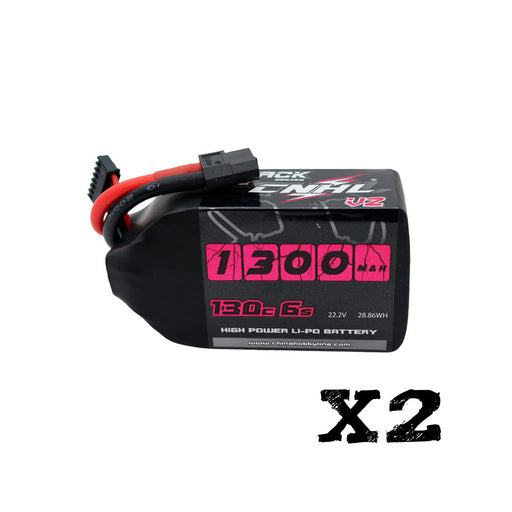
Nopea sovitustarkistus 2 Packs CNHL Black Series V2.0 1300mAh 22.2V 6S 130C LiPo-akku XT60-liittimellä sopii erinomaisesti FPV-lentäjille, jotka ha...
Näytä täydet tiedotVaraosat ja pitkäaikainen tuki Tiedämme, että RC-piloteille luotettava varaosatuki on tärkeä osa sitä, että lentokone pysyy lentokunnossa vuo...
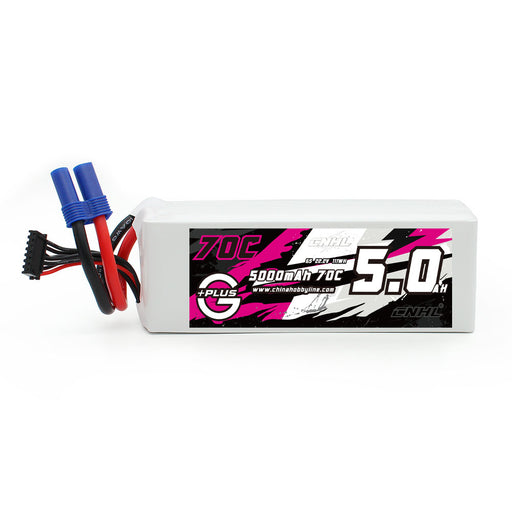
Näytä täydet tiedotTekniset tiedot: Varastonumero: 500706EC5 Kapasiteetti: 5000mAh Jännite: 22,2V / 6-kennoa / 6S1P Purkunopeus: 70C jatkuva / 140C hetkellinen Lata...
Näytä täydet tiedot
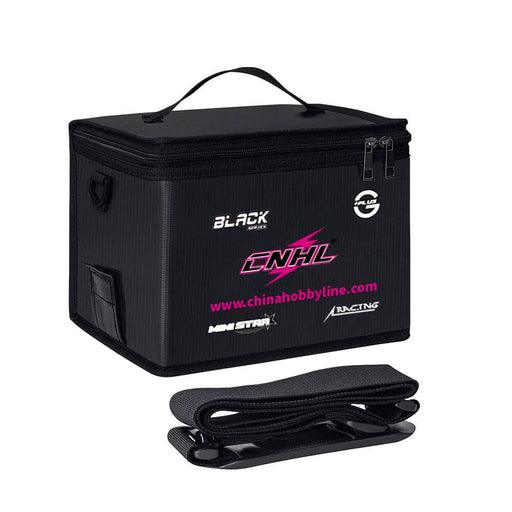
CNHL LiPo Battery Bag on suunniteltu turvallisempaan LiPo-lataukseen, kuljetukseen ja säilytykseen kotona tai kentällä. Se lisää käytännöllisen suo...
Näytä täydet tiedotNopea sovitustarkistus 2 paketin CNHL Speedy Pizza Series Pro 1350mAh 6S 150C LiPo -akku XT60-liittimellä on suunniteltu 5-tuuman FPV-piloteill...
Näytä täydet tiedot

The CNHL Long Range Series BAK 65E 6350mAh 21700 Li-ion battery cell is built around one clear priority: maximum stored energy from a lightweight c...
Näytä täydet tiedot

The CNHL Long Range Series BAK 50D 5000mAh 21700 Li-ion battery cell is designed for custom high-energy battery packs that need a strong balance be...
Näytä täydet tiedot

The ISDT C4 EVO is a versatile smart battery charger built for AA, AAA and cylindrical rechargeable cells from compact 10440 batteries all the way ...
Näytä täydet tiedot

The CNHL Long Range Series 6350mAh 21.6V 6S1P 21700 Li-ion battery combines six BAK 65E high-energy cells into a 137.16Wh pack designed for ultra-e...
Näytä täydet tiedot

The CNHL Long Range Series 5000mAh 21.6V 6S1P 21700 Li-ion battery combines six BAK 50D cells into a compact 108Wh pack designed around long-range ...
Näytä täydet tiedot




Jätä kommentti