
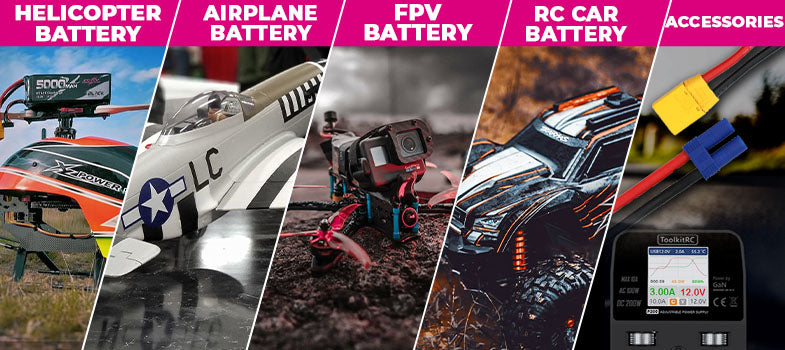
CNHL Lipo Batteries
CNHL aim at providing high-quality Li-Po batteries and RC products to all hobby enthusiasts with excellent customer services and competitive prices

You've just received your first LiPo battery for your new RC car or drone. You open it up, and you notice two different plugs dangling off of it—a large red one and a smaller white or black one with a number of small wires. It's natural to feel somewhat puzzled. What are they? Do you plug both of them in? What if you do it incorrectly?
Do not worry; it is much easier than it appears. Those two plugs have extremely different, yet extremely vital, functions. This tutorial will describe in simple language what each one does, why you require them, and how to properly use them.

First, you'll notice the big main power plug. This is the workhorse. This may be a red JST-RCY plug, a yellow/black XT60, or a number of others, depending on your battery, but whatever type it is, its purpose is the same.
Consider this plug as your car's fuel line. It has one purpose only: to deliver all that power from the battery to the motor of your RC car. When you are ready to drive your car or fly your drone, this is the plug that allows you to do so. It is designed to carry plenty of electricity.
You can readily identify the main plug. It will have just two wires: a red for positive and a black for negative. You'll also see that these wires are a lot thicker than those on the other plug. The thickness is significant, as it allows plenty of power to pass through safely without the wires becoming hot.
This is a simple one: you plug this in when you are ready to run. It connects your battery to your car's Electronic Speed Controller (ESC). This is your "go time" plug.

The second smaller plug is the balance plug. It is typically a white or black JST-XH connector. It may seem less significant, but this small fellow is the key to enabling your battery to have a long life.
Note: While JST-XH balance plugs are most commonly white, many modern packs also use black housings. Functionally they are the same.
To understand what this plug does, you have to know that a LiPo battery (such as a 2S or 3S) is really composed of several individual battery "cells" bundled together. In order for the battery to function properly, all of these cells must be storing the same amount of power, or voltage. The balance plug is like a doctor examining your battery. When you insert it into a suitable charger, the charger can examine each cell individually and ensure they're all balanced. This prevents one cell from becoming overcharged, which is a major concern for battery health and safety.
The balance plug is easy to identify. It has a bunch of small, thin wires. The number of wires is always one more than the number of cells in the battery. So:
Because these wires are so thin, they can only handle a tiny bit of power.
You'll use this plug when you're charging your battery. You plug it into a special "balance port" on your charger. This lets the charger do its important job of keeping all the cells healthy and balanced.
Now, there is one tiny exception. On some super-small FPV drones, where every gram matters, the builders sometimes use this plug for both charging and powering the drone.

This is a very specific situation for low-power models. For 99% of RC cars, boats, and bigger drones, you should only ever use this plug for charging.

To make it even clearer, here’s a simple side-by-side comparison.
| Feature | Main Power Plug (The Big One) | Balance Plug (The Small One) |
| Main Job | Powers your vehicle | Balances the battery cells |
| Also Known As | Discharge Plug | Balance Lead |
| Power Handling | High (Built for a lot of power) | Very Low (Just for monitoring) |
| Number of Wires | Always Two | Number of Cells + 1 |
| When to Use It | When you're driving or flying | When you're charging |
| Where It Plugs In | Into your RC vehicle | Into your battery charger |
Let's put it all together with a super simple guide for what to do.

This is when you use both plugs. To charge your battery safely with a balance charger, you need to plug both of them in.
1. Plug the big main power plug into the main output on your charger.
2. Plug the white or black balance plug into the matching balance port on your charger. The little slots are designed so it will only fit one way.
3. Set your charger to "Balance Charge" mode and start. Now the charger is filling the battery with power through the main plug while using the balance plug to keep everything safe and healthy.

This part is even easier. When you’re ready to hit the track or the field, you only need the big main plug.
1. Connect the main power plug from the battery to your vehicle.
2. The small white or black balance plug just hangs out. Most people will tuck it under the battery strap to keep it from flopping around and getting caught in anything.
3. Quick Warning: Never, ever try to power your car or drone with the balance plug. The tiny wires can't handle the power, and you'll likely fry the plug, the battery, or your vehicle.
And that's it! Those two plugs aren't so confusing after all. Just remember the simple rule: the big plug is for power, and the small plug is for safety. Use both when you charge, and only the big one when you play. Understanding this one basic thing is a huge step toward enjoying the RC hobby safely and getting the most out of your batteries.
CNHL aim at providing high-quality Li-Po batteries and RC products to all hobby enthusiasts with excellent customer services and competitive prices
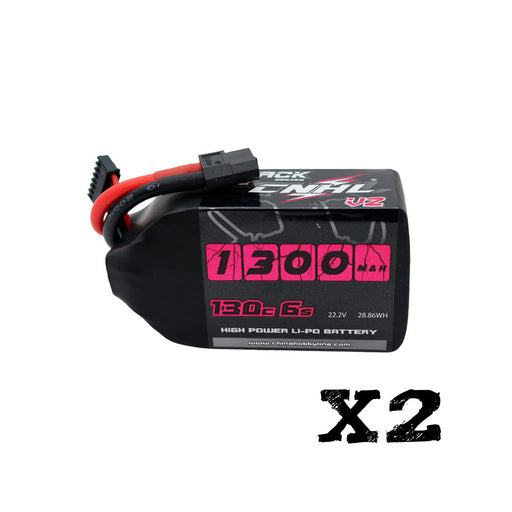
Quick Fit Check The 2 Packs CNHL Black Series V2.0 1300mAh 22.2V 6S 130C LiPo Battery with XT60 Plug is a strong fit for FPV pilots who want a prov...
View full details

Hstar D43-01Q 911 Style is a mini 1/43 alloy drift RC car designed for indoor tabletop fun and realistic drifting. It features full proportional ...
View full details

Spare Parts Availability We know that for RC pilots, reliable spare parts support often determines how long an aircraft can actually sta...
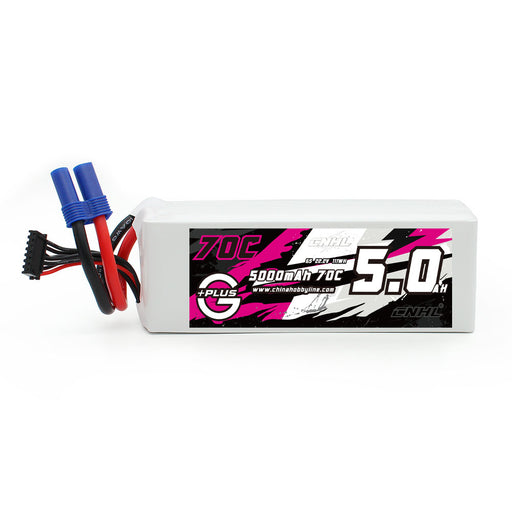
View full detailsSpecifications: Stock Number: 500706EC5 Capacity: 5000mAh Voltage: 22.2V / 6-Cell / 6S1P Discharge Rate: 70C Continual / 140C Burst Charge Rate: ...
View full details
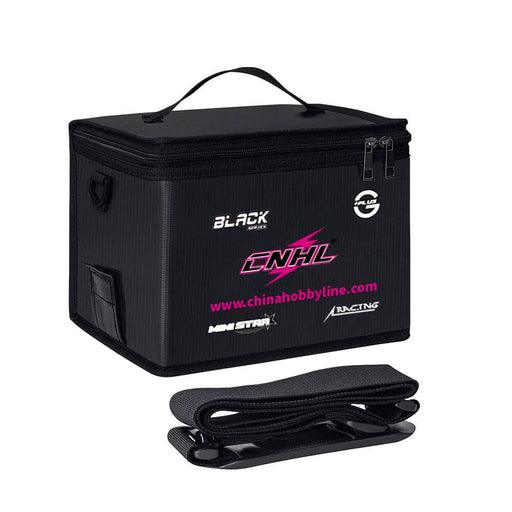
The CNHL LiPo Battery Bag is designed for safer LiPo charging, transport, and storage at home or at the field. It adds a practical layer of protect...
View full details

CNHL Havok 1000mm 4S Sport Racer Plane – Built on a Proven 1m Havok Airframe The CNHL Havok 1000mm 4S Sport Racer RC Plane PNP is a 1-meter foam...
View full detailsQuick Fit Check Voltage: 2S (7.4V)Capacity: 350mAhConnector: PH (UMX) High-Current 3-PinSize (L × W × H): 43 × 19 × 14 mm (±1–5 mm)Weight: Approx. ...
View full details

Quick Fit Check If you are buying a replacement battery for an FMS FCX18 or FCX24, confirm these three points before ordering: Check Item Your V...
View full detailsQuick Fit Check The CNHL Speedy Pizza 1550mAh 14.8V 4S LiPo Battery 120C with XT60 Plug is a compact 4S FPV battery built for pilots who want a liv...
View full detailsSpecifications: Stock Number: S220402BKT Capacity: 2200mAh Voltage: 7.4V / 2-Cell / 2S1P Discharge Rate: 40C Continual / 80C Burst Charge Rate: 5...
View full details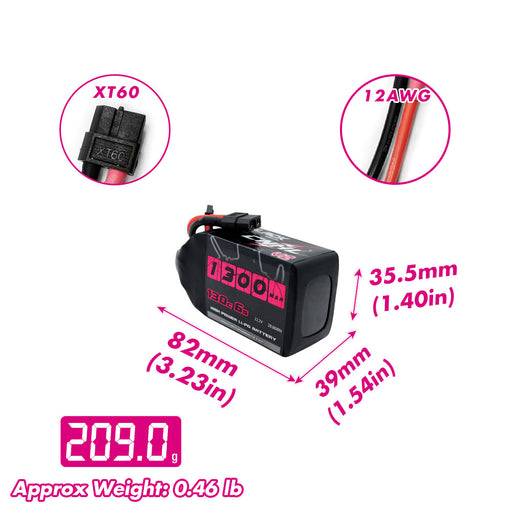



Leave a comment