
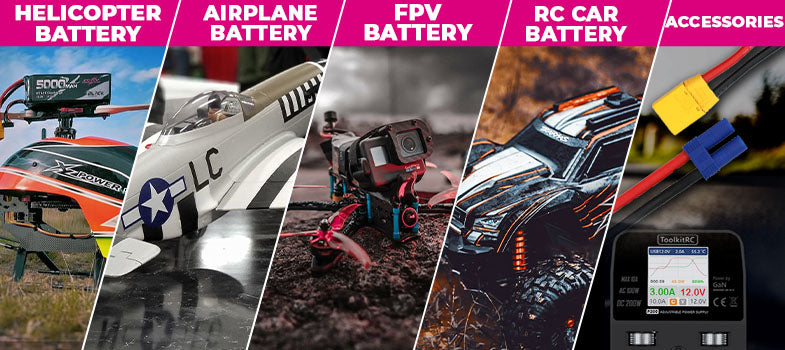
CNHL Lipo Batteries
CNHL aim at providing high-quality Li-Po batteries and RC products to all hobby enthusiasts with excellent customer services and competitive prices
The release of the TLR 22X-4 2.0 marks a significant checkpoint in the evolution of Team Losi Racing’s 1/10 scale 4WD buggy program. Rather than representing a radical redesign, the 2.0 platform reflects a mature phase of development — one where refinement, balance, and surface-specific tuning have become more important than wholesale structural change.
In today’s competitive landscape, the progression of race platforms is less about dramatic innovation and more about incremental geometry improvements, weight distribution optimization, and expanding the tuning window. The 22X-4 2.0 fits squarely within that modern philosophy.
In short, the AC variant is optimized for rotation control on high-grip carpet and astro, while the DC configuration emphasizes traction stability and forward drive on dirt and clay surfaces.

Chassis lifecycle expectations in 1/10 electric racing differ from other consumer categories. While rapid product turnover is common in electronics, race platforms often evolve on a three-to-five-year cadence. That timeline reflects material development, track condition trends, and manufacturing refinement rather than abrupt obsolescence.
From that perspective, the introduction of the 22X-4 2.0 represents a continuation of the TLR development arc rather than a reset. The platform builds upon the established 22X architecture, preserving core layout philosophy while refining how the car interacts with high-grip and clay-based surfaces.
Team Losi Racing’s 22-series lineage has long focused on competitive 1/10 buggy racing. The transition from earlier 22-4 generations to the 22X-4 Elite emphasized tunability, durability, and surface specialization. With the 2.0 release, that specialization becomes more explicit through the AC and DC variants.
Rather than serving as cosmetic distinctions, these variants reflect intentional chassis bias toward specific grip environments. The platform remains modular, but setup direction becomes more defined.
The AC and DC variants of the TLR 22X-4 2.0 are developed around distinct surface conditions. While both share the same core platform architecture, their geometry emphasis reflects different grip environments rather than simple setup adjustments.

| Category | AC (Astro / Carpet) | DC (Dirt / Clay) |
|---|---|---|
| Intended surface | High-grip astro and carpet | High-grip dirt and clay |
| Wheelbase orientation | Extended layout to stabilize rotation at high grip | Moderate extension with traction-biased balance |
| Handling tendency | Responsive turn-in and rapid direction change | Forward stability and controlled traction delivery |
| Suspension architecture | 13mm shock standard | 13mm shock standard |
| Battery format | 2S shorty hardcase | 2S shorty hardcase |
The distinction between AC and DC is therefore embedded in geometry intent rather than interchangeable setup parts. Both versions maintain identical battery packaging and core drivetrain layout.
From a race-condition standpoint, drivers competing on carpet or astro with consistently rising grip levels will typically benefit from the AC platform’s rotation-focused bias. Those racing on clay or dirt, particularly where maintaining forward drive and rear stability over bumps is critical, may find the DC configuration better aligned with their surface demands.
Over the past several seasons, surface trends in 1/10 racing have shifted toward higher-grip environments, particularly carpet and astro in North America. At the same time, clay and traditional dirt tracks remain prevalent in other regions. Designing a single chassis to perform optimally across both extremes often requires compromise.

By releasing dedicated AC (Astro/Carpet) and DC (Dirt/Clay) variants, TLR narrows that compromise. Instead of relying on setup changes alone, the 2.0 generation builds surface bias directly into geometry and weight distribution decisions. The split is less about marketing segmentation and more about aligning chassis intent with modern track conditions.

Across leading brands, 1/10 4WD buggy development has entered a stage of diminishing structural disruption. Performance gains are increasingly found in minute geometry shifts, refined shock placement, and subtle center-of-gravity adjustments.
This maturity has narrowed lap-time gaps across platforms. As a result, platform stability can be as valuable as novelty. The 22X-4 2.0 aligns with this broader industry pattern — measured iteration over reinvention.
The release of the TLR 22X-4 2.0 generated a broad range of discussion within the competitive 1/10 community. Reaction largely reflected differing expectations about update cadence rather than disagreement over the platform’s engineering direction. For many racers, the update signaled renewed attention to the 4WD program and alignment with the newer 22X architecture. For others, the multi-year gap between platform generations shaped expectations differently, particularly regarding development cadence and long-term support visibility.
Such variation in response is not unusual in modern racing categories. As product cycles lengthen and platform updates become more incremental, expectations around timing and communication inevitably evolve alongside the hardware itself.
The modern 1/10 4WD class operates within a highly optimized ecosystem. Materials are lighter, drivetrains more efficient, and suspension geometry more computationally refined than ever before. Price points have risen, but so have durability standards and tuning precision.
Within this environment, differentiation is less about radical architecture and more about driver feel, support ecosystem, and setup adaptability. The TLR 22X-4 2.0 positions itself within that balanced, competition-driven framework.
One of the defining traits of the 22X platform has been adjustability. Battery positioning, differential setup, and suspension configuration allow racers to tailor the chassis to track-specific demands.
In high-grip environments, small changes in weight bias can dramatically influence rotation and entry stability. On clay or looser dirt tracks, incremental rear traction tuning becomes more significant. The 2.0 generation preserves this flexibility while narrowing the setup range toward more predictable baseline behavior.
As grip levels increased across many modern tracks, 4WD platforms began operating closer to the edge of traction balance. Small geometry differences can significantly influence rotation speed, landing stability, and throttle response.
The 22X-4 2.0 incorporates changes such as revised chassis proportions, adjustable differential height options, and updated 13mm shock architecture. Rather than focusing purely on peak lap speed, these revisions aim to widen the usable operating window — allowing the car to remain predictable as grip rises throughout a race day.
The TLR 22X-4 2.0 platform utilizes a 2S shorty hard case LiPo battery format, limited to 96mm in length. This standard applies across both AC and DC variants. The shorty configuration supports low center-of-gravity placement and flexible fore-aft positioning.
On high-grip surfaces, some racers favor slightly lighter shorty packs to enhance rotation response. On clay or longer main events, higher-capacity shorty batteries may contribute to more stable voltage delivery across extended runs.
For detailed fitment specifications and compatible 2S shorty options, see our TLR 22X-4 2.0 battery compatibility guide .
The introduction of the 22X-4 2.0 underscores Team Losi Racing’s continued focus on competition-grade 1/10 platforms. As racing environments evolve and track conditions standardize, development efforts increasingly emphasize predictability and repeatability over radical experimentation.
Whether the lineup expands further into adjacent segments remains to be seen. For now, the 22X-4 2.0 serves as a clear statement that the 1/10 4WD program remains an active and evolving priority.
Neither variant is inherently faster. The AC configuration is optimized for high-grip carpet and astro surfaces, where rotation control and quick direction change are critical. The DC version prioritizes traction stability and forward drive on clay and dirt. Performance depends on track conditions rather than raw chassis speed.
Yes. Both versions share the same 2S shorty hardcase battery format with a maximum length of 96mm. Battery placement and fore-aft adjustment remain identical across the platform.
The core platform architecture is shared. Differences primarily reflect geometry bias and setup direction. Many components are compatible, though each variant is optimized for its intended surface environment.
Modern 1/10 racing includes increasingly high-grip carpet and astro tracks alongside traditional clay and dirt venues. Rather than relying solely on setup changes, separating AC and DC versions allows surface bias to be integrated directly into chassis geometry.
The TLR 22X-4 2.0 does not attempt to redefine the 1/10 4WD category. Instead, it refines an already mature platform, aligning geometry, surface specialization, and tuning philosophy with contemporary race demands.
In an era where incremental gains define competitive advantage, measured evolution may ultimately prove more impactful than radical change. The 22X-4 2.0 reflects that reality.
CNHL aim at providing high-quality Li-Po batteries and RC products to all hobby enthusiasts with excellent customer services and competitive prices
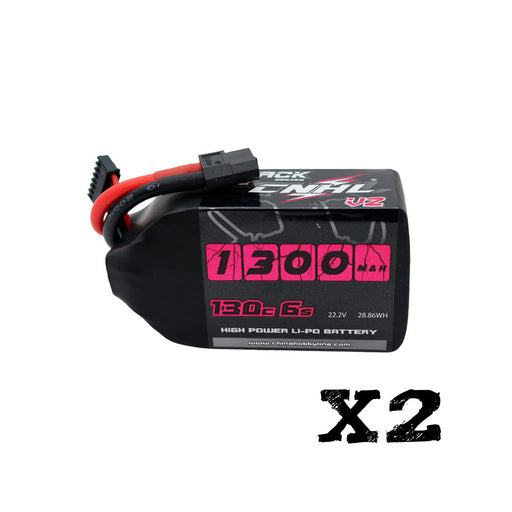
Quick Fit Check The 2 Packs CNHL Black Series V2.0 1300mAh 22.2V 6S 130C LiPo Battery with XT60 Plug is a strong fit for FPV pilots who want a prov...
View full detailsSpare Parts & Long-Term Support We know that for RC pilots, reliable spare parts support is an important part of keeping an aircraft fl...
View full details
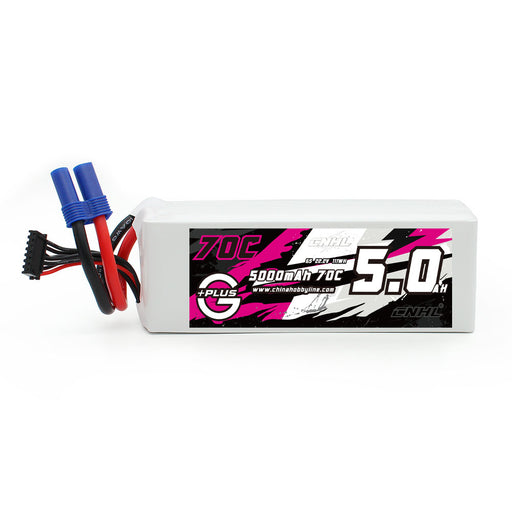
Specifications: Stock Number: 500706EC5 Capacity: 5000mAh Voltage: 22.2V / 6-Cell / 6S1P Discharge Rate: 70C Continual / 140C Burst Charge Rate: ...
View full details
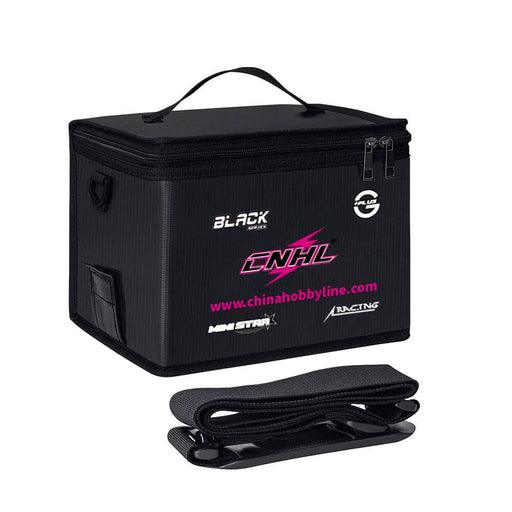
The CNHL LiPo Battery Bag is designed for safer LiPo charging, transport, and storage at home or at the field. It adds a practical layer of protect...
View full details

Quick Fit Check The 2 Packs CNHL Speedy Pizza Series Pro 1350mAh 6S 150C LiPo Battery with XT60 Plug is built for 5-inch FPV pilots who want a ...
View full details

Quick Fit Check The CNHL Speedy Pizza Series 2200mAh 22.2V 6S 120C LiPo Battery with XT60 Plug combines the familiar 2200mAh 6S format with a ligh...
View full details

Quick Fit Check The CNHL Speedy Pizza Series 2200mAh 14.8V 4S 120C LiPo Battery with XT60 Plug combines a widely used 2200mAh 4S format with a sli...
View full details

Quick Fit Check The CNHL Speedy Pizza Series 2200mAh 11.1V 3S 120C LiPo Battery with XT60 Plug takes the familiar 3S 2200mAh aircraft battery form...
View full details

The CNHL Long Range Series BAK 50D 5000mAh 21700 Li-ion battery cell is designed for custom high-energy battery packs that need a strong balance be...
View full details

The ISDT C4 EVO is a versatile smart battery charger built for AA, AAA and cylindrical rechargeable cells from compact 10440 batteries all the way ...
View full details


Leave a comment