
CNHL Lipo akut
CNHL pyrkii tarjoamaan korkealaatuisia Li-Po-akkuja ja RC-tuotteita kaikille harrastajille erinomaisella asiakaspalvelulla ja kilpailukykyisillä hinnoilla
A LiPo charging rate describes how much current is applied relative to the battery’s capacity. For a 5000mAh battery, 1C means 5A, 2C means 10A and 5C means 25A. The calculation is simple, but choosing a safe and achievable charging rate also depends on the battery’s permitted charge rate, the charger’s current and wattage limits, the available input power and the number of channels being used.
Quick answer: Convert battery capacity from milliamp-hours to amp-hours, then multiply by the selected C rate. A 2200mAh battery is 2.2Ah, so 1C is 2.2A, 2C is 4.4A and 5C is 11A. Never assume that a battery can be charged at 2C or 5C unless its label or manufacturer documentation specifically permits it.
Charging at a higher C rate can shorten turnaround time, but the result is not perfectly proportional. LiPo charging uses a constant-current stage followed by a constant-voltage and balancing stage, so the current decreases near full charge. A theoretical 2C rate does not guarantee a complete charge in exactly 30 minutes, and a theoretical 5C rate does not guarantee a complete charge in exactly 12 minutes.

| 1C Charging | Current in amps equals battery capacity in amp-hours. A 5000mAh pack charges at 5A. |
| 2C Charging | Current is twice the battery capacity in amp-hours. A 5000mAh pack charges at 10A. |
| 5C Charging | Current is five times the battery capacity in amp-hours. A 5000mAh pack would require 25A. |
| Battery Limit | The selected rate must not exceed the battery manufacturer’s specified charge rate. |
| Charger Current Limit | The charger must be capable of delivering the calculated amps. |
| Charger Power Limit | The charger must also provide enough watts at the battery’s charging voltage. |
| Input Power | A DC charger or AC/DC charger cannot exceed the power available from its input source. |
| Actual Charge Time | Depends on starting charge, current tapering, balancing, charger limits and battery condition. |
The C rate compares charging current with battery capacity. Battery capacity is normally printed in milliamp-hours, while charger current is set in amps. Convert the capacity to amp-hours before applying the C-rate multiplier.
Battery capacity in amp-hours = capacity in mAh ÷ 1000
Charge current in amps = battery capacity in Ah × charging C rate
For example:
The C value used for charging is not the same as the battery’s discharge rating. A battery marked 100C discharge does not automatically support 100C charging. The permitted charge rate must be stated separately on the label, specification page or manufacturer documentation.
| Battery Capacity | 1C | 2C | 5C |
|---|---|---|---|
| 450mAh | 0.45A | 0.90A | 2.25A |
| 850mAh | 0.85A | 1.70A | 4.25A |
| 1300mAh | 1.30A | 2.60A | 6.50A |
| 1500mAh | 1.50A | 3.00A | 7.50A |
| 2200mAh | 2.20A | 4.40A | 11.00A |
| 3300mAh | 3.30A | 6.60A | 16.50A |
| 5000mAh | 5.00A | 10.00A | 25.00A |
| 6000mAh | 6.00A | 12.00A | 30.00A |
| 8000mAh | 8.00A | 16.00A | 40.00A |
Important: The table only converts C rate into current. It does not confirm that every battery in the table may be charged at 2C or 5C.
Approximately 1C is a sensible general starting point when the battery manufacturer does not specify a different limit. It offers a practical balance between charging time, charger demand and battery stress for many conventional RC LiPo packs.
However, 1C is not a universal requirement for every lithium battery. Some packs specify a lower recommended rate, especially transmitter packs, small specialty batteries or cells designed for low-current applications. Other performance packs may permit 2C, 3C or 5C charging under stated conditions.
The correct decision order is:
A maximum rating should not automatically become the everyday setting. Charging below the maximum may reduce heat and lower the demand placed on the battery, charger, connectors and power supply.
At 2C, the charging current is twice the battery capacity in amp-hours:
The theoretical capacity-replacement time at 2C is about 30 minutes, but a complete balance charge normally takes longer. The battery may not begin completely empty, the charger reduces current near full voltage, and the balancing stage may extend the finish.
Charging at 2C is reasonable only when:
For a small 6S FPV pack, 2C may still require moderate wattage because capacity is low. For a large 6S 5000mAh pack, 2C requires approximately 10A and about 252W near full voltage before allowing for conversion losses.
At 5C, the required charging current becomes substantial:

A 5C label means the battery manufacturer permits charging at up to five times its capacity under the specified conditions. It does not mean that 5C should automatically be used for every charge.
High-rate charging magnifies every system limitation:
- charger current capacity - charger output wattage - input voltage - power-supply wattage - channel power sharing - connector resistance - cable size - cooling - balance current - battery temperature
For example, charging a standard 6S 5000mAh LiPo at 5C requires approximately 25A. Near full voltage, the theoretical battery-side power is:
25.2V × 25A = approximately 630W
After conversion losses and system overhead, the required input power will be higher. Many compact chargers cannot support this output on one channel, even when the battery itself is rated for 5C charging.
High-rate charging should therefore be treated as a complete system decision, not simply a menu setting.
Two batteries with the same capacity use the same 1C current, but a higher-voltage battery requires more charging power.
Approximate charging power = charging voltage × charging current
Using full pack voltage gives a useful estimate of the maximum battery-side power required near the end of the constant-current stage.
| 5000mAh Pack | Full Voltage | 1C / 5A | 2C / 10A | 5C / 25A |
|---|---|---|---|---|
| 2S | 8.4V | 42W | 84W | 210W |
| 3S | 12.6V | 63W | 126W | 315W |
| 4S | 16.8V | 84W | 168W | 420W |
| 6S | 25.2V | 126W | 252W | 630W |
| 8S | 33.6V | 168W | 336W | 840W |
These figures do not include efficiency losses or power used by the charger itself. Leave reasonable input-power headroom rather than selecting a power supply that exactly matches the ideal battery-side calculation.

For a dedicated wattage calculation guide, see How Many Watts Does My LiPo Charger Need?
A charger’s maximum current is only one output limit. The actual available current is usually the lowest value allowed by:
Suppose a charger is rated for 10A but limited to 100W. Its approximate maximum current near full voltage would be:
| Battery | Full Voltage | Approx. Current at 100W |
|---|---|---|
| 2S | 8.4V | Up to about 10A because the current rating becomes the limit |
| 3S | 12.6V | About 7.9A |
| 4S | 16.8V | About 6.0A |
| 6S | 25.2V | About 4.0A |
This is why a charger can accept a 10A setting but gradually reduce or cap the actual current on a higher-voltage pack.
When choosing charging equipment, compare both maximum current and output power. See How to Choose the Right LiPo Battery Charger for the full selection process.
An AC/DC charger may offer different output limits depending on its power source. The built-in AC supply provides wall-plug convenience, but its power may be lower than the charger can deliver from a suitable external DC supply.
A DC charger depends entirely on the external source. Connecting a high-power charger to a low-power supply limits the complete system.
For example:
For moderate-power DC charging, the ToolkitRC ADP200 200W power supply can support a compact setup when its voltage and power match the charger and intended batteries.
For a higher-power bench or several charging devices, the ToolkitRC ADP750 750W power supply provides substantially more total output, but the usable charging power still depends on charger input compatibility and load distribution.
Read AC vs DC LiPo Chargers before building an external-power charging system.
A dual-channel charger may advertise:
- a maximum output per channel - a combined total output - a lower AC total - a higher DC total - synchronous or combined-channel operation - dynamic power sharing
Do not assume that both channels can simultaneously deliver the headline single-channel rating.
Example:
If the charger has a 200W total AC limit, both channels may need to reduce current when charging those two packs from wall power. The same charger may perform differently when connected to a sufficiently powerful DC source.
The ToolkitRC M6D dual-channel DC charger suits users who already have an appropriate external power source. An AC/DC option such as the ToolkitRC M6DAC Pro adds wall-power convenience while retaining a higher-power DC operating path.
To compare independent channels with one-channel parallel charging, read Dual-Channel Charger vs Parallel Charging Board.
The theoretical bulk charging time can be estimated from the C rate:
Theoretical time in minutes ≈ 60 ÷ charging C rate
| Selected Rate | Theoretical Capacity Time | Real-World Result |
|---|---|---|
| 0.5C | About 120 minutes | Usually longer after tapering and balancing |
| 1C | About 60 minutes | Often longer for a complete balance charge |
| 2C | About 30 minutes | Not necessarily half the complete 1C charge time |
| 5C | About 12 minutes | Only theoretical; final tapering and power limits still apply |
Actual time depends on:
A pack that begins at 50% charge will not require the same time as a pack near its safe lower operating level. Similarly, a badly imbalanced pack can spend a long time in the final stage even when the bulk charging current was high.
LiPo charging normally has two main stages:
During Balance Charge, the charger also monitors individual cell voltage and may reduce current while correcting differences. The final portion can therefore take longer than expected, especially when:
Increasing the main charge current does not necessarily solve slow balancing. Read Why Is My LiPo Battery Taking So Long to Balance Charge? for troubleshooting.
Fast Charge is a charger mode, while 1C, 2C and 5C describe selected charging current relative to capacity. They are not the same concept.
A user can select a high current in Balance Charge, or a lower current in Fast Charge, depending on the charger. Fast Charge may shorten or alter the final balancing and termination behavior, but it does not automatically mean the charger is applying a higher C rate.
For routine charging of a conventional multi-cell LiPo, Balance Charge remains the normal default because it monitors individual cell voltages throughout the process.
See Balance Charging vs Fast Charging for a dedicated mode comparison.
| Battery | 1C Current | Approx. 1C Power | Practical Consideration |
|---|---|---|---|
| 2S 850mAh | 0.85A | About 7W | Current-setting resolution and small-pack connectors matter |
| 3S 2200mAh | 2.2A | About 28W | Within the range of many compact chargers |
| 4S 5000mAh | 5A | About 84W | A 50W charger cannot maintain 5A near full voltage |
| 6S 1300mAh | 1.3A | About 33W | Higher voltage but moderate capacity |
| 6S 5000mAh | 5A | About 126W | Requires more than 126W of input after losses |
| 6S 7000mAh | 7A | About 176W | Large EDF, aircraft and boat packs expose low-power charger limits |
Yes. When compatible batteries are connected in parallel, their capacities are added together for the charging-current calculation.
For example, four identical 3S 1500mAh batteries connected in parallel have a combined capacity of:
1500mAh × 4 = 6000mAh total capacity
1C for the combined group = 6A
The cell count remains 3S because the batteries are connected in parallel, but the combined capacity and required current increase.
Parallel charging also requires matching chemistry, cell count, pack voltage and condition. Do not group batteries solely because their connectors fit.
Read How to Parallel Charge LiPo Batteries Safely before connecting a parallel board.
Use this decision sequence:
For the complete connection and setting process, follow How to Charge a LiPo Battery Safely.
Browse the CNHL LiPo battery charger collection for balance chargers, dual-channel chargers and multi-channel charging systems.
For ToolkitRC chargers and external power supplies, visit the ToolkitRC collection.
When comparing products, check:
One C for a 5000mAh battery is 5A. Convert 5000mAh to 5Ah, then multiply by one.
Two C for a 5000mAh battery is 10A. Use this rate only when the battery manufacturer permits at least 2C charging.
Five C for a 5000mAh battery is 25A. A 6S pack charged at this current would require approximately 630W near full voltage before accounting for conversion losses.
No universal rate applies to every pack. Approximately 1C is a common conservative default, but some specialty batteries specify a lower recommended or maximum rate. Always check the battery documentation.
Not when the battery explicitly supports 2C charging and the complete charging system is correctly sized. However, a permitted maximum does not have to be used for routine charging.
Charging at 5C should only be considered when the battery manufacturer permits it under the relevant conditions. Using 5C on a battery rated for a lower charge rate can cause damage, excessive heat or a more serious failure.
The theoretical capacity time is about one hour, but a complete balance charge normally takes longer because current tapers near full voltage and the charger may need time to balance individual cells.
No. Thirty minutes is the theoretical capacity time. The constant-voltage and balancing stages, charger limitations and starting state of charge affect the actual result.
The charger may have reached its maximum wattage, input-power limit, channel allocation or thermal limit. Battery voltage rises throughout charging, so the same selected current requires more watts near full voltage.
The battery-side requirement near full voltage is approximately 25.2V × 5A, or 126W. Choose a charger and input source with additional power headroom for conversion losses and operating conditions.
Yes, when the charger has two suitable channels or the batteries meet all requirements for an appropriate parallel setup. Two independently charged packs require approximately 252W of ideal battery-side output near full voltage, plus additional input-power headroom.
No. Fast Charge is a charger operating mode. The C rate describes current relative to battery capacity. Either mode may use different current settings depending on the charger.
Stop charging and investigate when a LiPo becomes unusually hot. Do not simply lower the current and continue without checking the battery, charger settings, connectors and battery condition.
The C-rate calculation is only the first step. A valid charging setup exists only when the battery permits the rate, the charger can supply the amps and watts, the power source can support the charger, and all connections remain within their operating limits.
For the wider charging system—including charger selection, safe connection procedures, operating modes and multi-pack charging—visit the CNHL LiPo Battery Charging Guide.
CNHL pyrkii tarjoamaan korkealaatuisia Li-Po-akkuja ja RC-tuotteita kaikille harrastajille erinomaisella asiakaspalvelulla ja kilpailukykyisillä hinnoilla
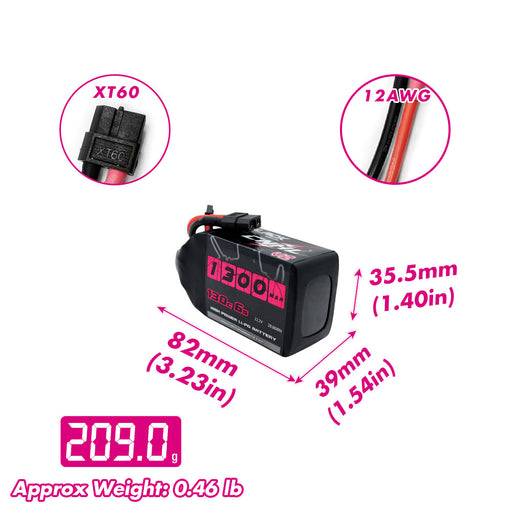
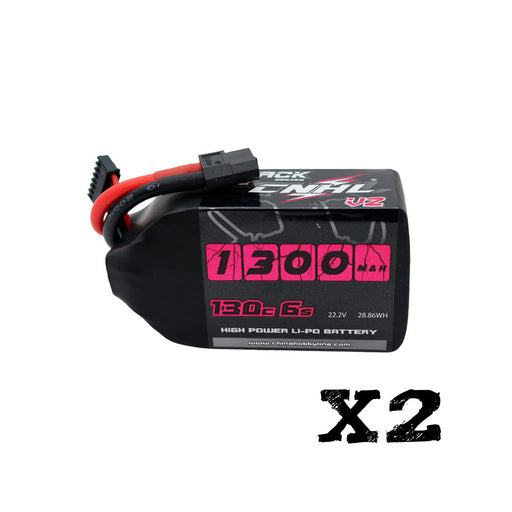
Nopea sovitustarkistus 2 Packs CNHL Black Series V2.0 1300mAh 22.2V 6S 130C LiPo-akku XT60-liittimellä sopii erinomaisesti FPV-lentäjille, jotka ha...
Näytä täydet tiedot

Hstar D43-01Q 911 Style on mini 1/43 alumiininen drift RC-auto, joka on suunniteltu sisätiloihin pöytäpeliksi ja realistiseen driftingiin. Siinä ...
Näytä täydet tiedot

Varaosien saatavuus Tiedämme, että RC-lentäjille luotettava varaosatuki usein määrittää, kuinka kauan lentokone voi oikeasti pysyä ilmas...
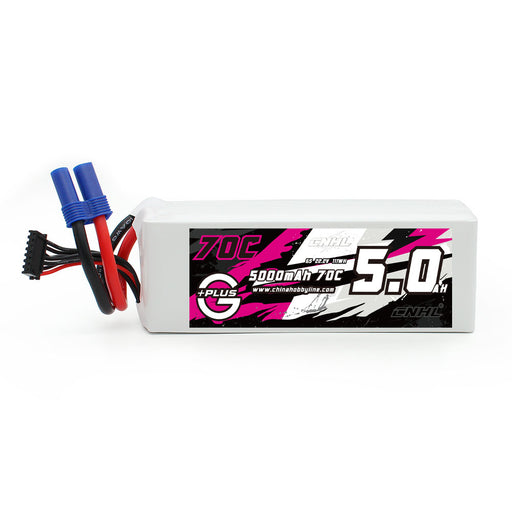
Näytä täydet tiedotTekniset tiedot: Varastonumero: 500706EC5 Kapasiteetti: 5000mAh Jännite: 22,2V / 6-kennoa / 6S1P Purkunopeus: 70C jatkuva / 140C hetkellinen Lata...
Näytä täydet tiedot
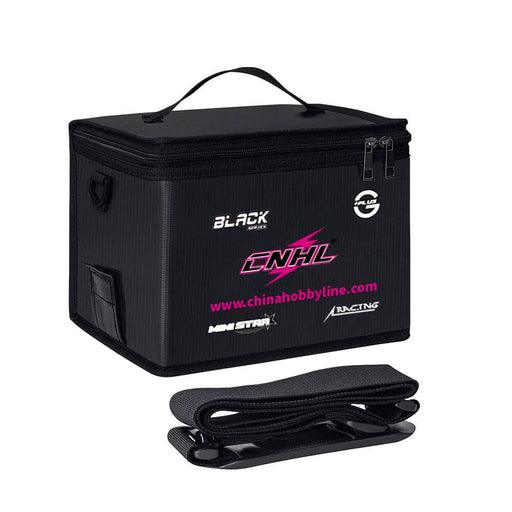
CNHL LiPo Battery Bag on suunniteltu turvallisempaan LiPo-lataukseen, kuljetukseen ja säilytykseen kotona tai kentällä. Se lisää käytännöllisen suo...
Näytä täydet tiedot

Quick Fit Check The CNHL Racing Series 6000mAh 15.2V 4S2P 130C LiHV Shorty Hardcase LiPo Battery with 5mm Bullet Sockets is a true 4S shorty LiPo b...
Näytä täydet tiedot

The CNHL 2 Pairs 5mm Heatsink Bullet Plug Grips with Bullet Connectors are designed for RC racers who need a clean, secure and easy-to-handle conne...
Näytä täydet tiedot

The Hobbywing Multifunction LCD Program Box PRO G3 is an advanced ESC programming device for compatible Hobbywing brushless ESCs. Compared with a...
Näytä täydet tiedot

The Scania S730 Official Licensed 1/64 Mini Drift RC Tractor Trailer brings scale truck collecting and RC driving into one compact desktop model...
Näytä täydet tiedot

Nopea sovitustarkistus 2 Packs CNHL Black Series V2.0 1500mAh 8S 130C LiPo Battery with XT60 Plug on suunnattu edistyneille FPV-lentäjille, jotka h...
Näytä täydet tiedot
Jätä kommentti