
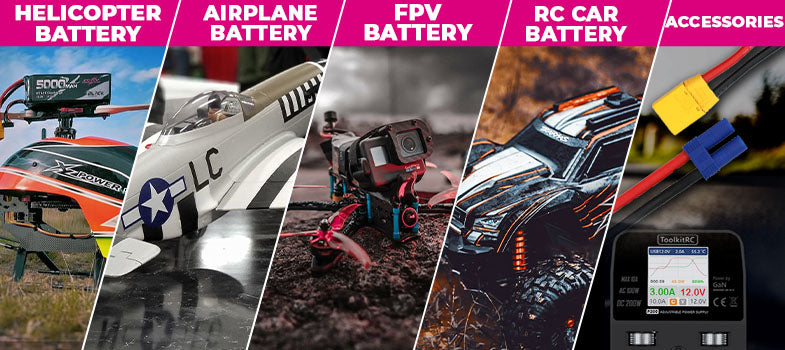
CNHL Lipo Batteries
CNHL aim at providing high-quality Li-Po batteries and RC products to all hobby enthusiasts with excellent customer services and competitive prices

Quick answer: the Goosky S2 Ultra is more than a cosmetic update to the S2 family. It combines a carbon-fiber chassis, full-metal servos, revised direct-drive hardware, split electronics and a Rotorflight-based flight controller in a helicopter that still weighs only about 360g. The result is a highly tunable micro heli that can remain manageable for sport flying while giving experienced pilots the control authority required for aggressive 3D.
The original Goosky S2 established the basic appeal of the platform: a portable collective-pitch helicopter with direct-drive simplicity, useful durability and enough performance to remain interesting after the first few flights. The S2 Max then pushed the series toward a more accessible, simplified package. The Goosky S2 Ultra moves in the opposite direction. It restores a more premium mechanical specification and adds an electronics package that is unusually advanced for this size class.
The most important change is not one individual metal component. It is the way the entire system now works together. The stiffer structure gives the servos and flight controller a more consistent platform, the revised motors provide the necessary authority, and Rotorflight opens the door to governor control, telemetry, Blackbox analysis and much deeper tuning than a conventional preset micro-heli FBL system.
This review examines the S2 Ultra’s specifications, construction, Rotorflight system, flight performance, receiver options and practical battery requirements. It also addresses a question that matters to existing owners: does the Ultra provide a meaningful advantage over the S2 Max, or is it mainly a more sophisticated version for pilots who enjoy tuning?
| Overall Length | 440mm |
| Height | 137mm |
| Width | 74mm |
| Main Rotor Blade Length | 195mm |
| Main Rotor Diameter | 443mm |
| Tail Rotor Diameter | 89mm |
| Approximate Takeoff Weight | 360g |
| Factory Battery | 11.1V 3S 750mAh, 8.325Wh |
| Quoted Flight Time | About 10 minutes regular flying or 4 minutes aggressive flying |
The flight-time figures illustrate how much flying style matters. A pilot using lower head speed, moderate collective and smooth sport manoeuvres may approach the longer figure. Repeated tic-tocs, rapid reversals and sustained high-head-speed 3D can consume the same 750mAh pack much faster.
The S2 Ultra immediately looks more serious than a typical ready-to-fly micro helicopter. Its new stacked fuselage uses high-strength carbon-fiber side panels, producing a cleaner and more rigid structure around the servos, electronics and direct-drive system.
Rigidity matters because every control correction begins with the flight controller and ends as a mechanical movement at the rotor head. Flex between those points can soften stops, introduce inconsistency and make aggressive tuning more difficult. The carbon structure cannot create precision by itself, but it provides a more stable foundation for the upgraded electronics and servos to work from.
The cyclic servos now use full-metal housings. The practical benefits are improved structural support and better heat transfer from the servo assembly. It would be misleading to assume that a metal casing automatically makes every internal component indestructible, but the complete installation feels more appropriate for repeated high-load collective-pitch flying than a lightweight cost-focused layout.

Goosky also retained one of the platform’s most practical features: the battery can be changed without removing the canopy. That sounds like a small detail until several packs are being flown in one session. The open access reduces turnaround time and avoids repeatedly flexing or detaching the canopy.
Amber Orange and Green canopy versions use the newer Flow Ink Phantom finish. Visibility will still depend on sky conditions, viewing angle and pilot preference, but the contrasting graphics help distinguish the compact airframe during close sport flying.
Rotorflight is open-source flight-control firmware developed specifically for collective-pitch RC helicopters. It is not simply drone firmware installed on a helicopter. Its mixer, governor, filtering, servo control and tuning tools are designed around the requirements of main-rotor cyclic control, collective pitch and tail authority.
The S2 Ultra flight controller integrates an STM32F405 processor, a CM42688P six-axis sensor and 128MB of Blackbox storage into a compact 24 × 33mm CNC aluminum enclosure weighing approximately 12g. Goosky supplies it with Rotorflight 2.2 tuning intended for the S2 Ultra hardware.
Rotorflight gives the S2 Ultra access to several tools that were previously uncommon in a production micro helicopter:

This flexibility is both the Ultra’s greatest advantage and the reason it will not appeal equally to every pilot. Someone who wants to bind the helicopter, select basic rates and fly may never use most of the available data. A pilot who wants to inspect vibration, refine the governor or create separate sport and 3D profiles will find considerably more room to work.
The useful distinction is that Rotorflight does not require every owner to become a tuning specialist. The supplied configuration provides a starting point. The advanced tools become valuable when the pilot has a specific issue to solve or a clearly defined flight characteristic to pursue.
The S2 Ultra separates its flight controller and ESCs rather than combining everything into one board. This layout gives each part a clearer role and can make fault diagnosis or component replacement more manageable than an all-in-one assembly.
The ESC system uses AM32 firmware and provides the speed information required for closer integration with Rotorflight. Accurate RPM feedback is especially valuable on a direct-drive helicopter because the controller can relate motor speed directly to rotor speed without calculating through a conventional main-gear reduction.

Both the main and tail drive systems have been revised. In practice, the important result is not simply a higher peak-power claim. A useful micro-heli power system must deliver repeated torque changes without excessive temperature rise or a weak tail response when collective load suddenly increases.
The upgraded motors, metal servos, carbon structure and Rotorflight electronics should therefore be viewed as one system. A stronger motor would have limited value if the frame flexed, the servos lagged or the flight controller could not use the available RPM data.
In our own testing, the Goosky S2 Ultra could be pushed substantially harder than most micro helicopters without immediately losing its composed feel. Fast circuits, high-energy tic-tocs, rapid flips and inverted transitions remained connected rather than breaking down into a series of nervous corrections.

The closest large-heli comparison is not based on physical size or stored energy. It is the way the helicopter accepts a command, stops and then settles into the next line. At an appropriate tune, the Ultra displays less of the loose, over-reactive character often associated with very small collective-pitch models.
Rotorflight’s filtering and governor tools contribute to that consistency, but the mechanical upgrades remain equally important. Software cannot compensate indefinitely for structural movement, weak servo response or an underpowered tail.
Sport pilots can reduce head speed and rates to make the helicopter calmer, while experienced 3D pilots can explore more aggressive collective and cyclic settings. That range is a major part of the S2 Ultra’s appeal: the same airframe can be configured to feel relatively smooth or extremely fast without replacing the core electronics.
The Ultra is still a small collective-pitch helicopter, however. Its low mass makes it portable and reduces the energy involved compared with a large model, but its rotor blades can still cause injury. Proper spool-up distance, throttle-hold discipline and a suitable flying area remain essential.
| Area | S2 Max Approach | S2 Ultra Upgrade |
|---|---|---|
| Frame | Simplified, cost-conscious structure | High-strength carbon-fiber side panels |
| Cyclic Servos | Lighter, simpler servo construction | Full-metal servo housings |
| Flight Controller | Conventional factory FBL setup | Rotorflight F405 platform with deep tuning and Blackbox support |
| ESC Integration | More straightforward factory electronics | Split ESC arrangement with AM32 and RPM data integration |
| Setup Experience | Faster route to a familiar factory feel | More tuning freedom, but also more settings to understand |
| Best Suited To | Pilots who value simplicity and proven performance | Pilots who want premium hardware, data logging and detailed control |
The S2 Max does not become obsolete simply because the Ultra exists. Skilled pilots have already demonstrated that the Max is capable of advanced manoeuvres. The Ultra’s value is not that it suddenly makes difficult flying automatic. It gives the pilot a stiffer platform, more sophisticated electronics and far greater control over how the helicopter responds.
An S2 Max owner who is satisfied with the current setup and does not want Rotorflight may gain little from changing models. A pilot who enjoys analysing logs, refining head-speed behaviour or building several tuned profiles will see a much clearer reason to upgrade.
The BNF package includes a compact external ELRS receiver, and the flight controller supports ELRS, SBUS and DSMX receiver options through its plug-in interface. This gives the Ultra more radio flexibility than a model tied to a single integrated protocol.
Futaba pilots are not restricted to a dedicated “Rotorflight transmitter.” They need a compatible receiver that can provide one of the supported signals, together with the correct micro connector or adapter wiring. Depending on the transmitter and receiver combination, this may involve a compact Futaba S-FHSS or SBUS-capable receiver.
A receiver with sufficient usable channels is preferable because Rotorflight may use separate channels for arming, throttle, profile switching, rescue and other auxiliary functions. Confirm the channel map, voltage requirement and plug orientation before powering the helicopter.

The Goosky S2 Ultra is designed around an 11.1V 3S 750mAh LiPo battery. This is the correct reference point when comparing normal flying weight, energy capacity and expected runtime.
Smaller 350mAh and 450mAh batteries can be useful alternatives when their dimensions, connector and retention method are suitable, but they should not be described as equivalent replacements for the stock pack. They contain substantially less energy and will produce shorter flight times.
The correct way to compare the three capacities is by intended use:
| Battery | Primary Benefit | Best Use | Trade-Off |
|---|---|---|---|
| 350mAh 3S | Lowest installed weight | Very short drills, hovering practice and lightweight response | Much shorter runtime than the stock 750mAh pack |
| 450mAh 3S | Lightweight setup with more capacity than 350mAh | Short sport and 3D practice flights | Still significantly below factory capacity |
| 750mAh 3S | Capacity and weight closer to the intended setup | Regular sport flying, longer practice and sustained 3D | Physical dimensions must still match the battery area |
A high discharge rating can improve voltage stability under load, but it cannot replace missing capacity. A strong 450mAh pack may feel responsive during a short flight, yet it cannot reasonably be expected to match the runtime of a healthy 750mAh battery.
The new CNHL 750mAh 3S battery is approximately 78 × 21 × 22mm, weighs about 61g, uses 16AWG wire and is fitted with an XT30 connector. Its capacity and weight are much closer to the factory Goosky setup than the smaller 350mAh and 450mAh packs.
Its shape is different from the shorter, wider format commonly seen in S2-compatible batteries. The new pack is longer but also relatively narrow and low. The S2 Ultra’s forward-facing, open-access battery arrangement makes that long, narrow shape a promising candidate rather than an automatic rejection.
However, it should not be advertised as a confirmed drop-in fit until a physical installation test has been completed. Before flying, verify all of the following:
Until that test is complete, the most accurate description is: a 750mAh capacity-and-weight match with promising dimensions, subject to final physical fit verification.
Pilots should choose by flight objective rather than assuming that every physically compatible pack serves the same purpose.
View the complete and most recently updated selection in the Goosky S2 and S2 Ultra Battery Collection.
The S2 Ultra serves several pilot groups, but the reasons for buying it are different.
Developing collective-pitch pilots can use the supplied setup and moderate rates to build orientation, circuit and basic aerobatic skills. The compact size is convenient, but beginners still need simulator practice, throttle-hold discipline and enough space to fly safely.
Intermediate pilots may gain the most immediate value. The airframe is small enough for frequent practice, while Rotorflight profiles allow the helicopter to evolve as confidence and control improve.
Experienced 3D pilots receive the strongest argument for choosing the Ultra. They are more likely to notice the cleaner stops, tail authority, governor behaviour and freedom to tune the helicopter around a specific head speed and manoeuvre style.
Existing S2 Max owners should upgrade only when the premium structure or Rotorflight platform solves a real need. Buying the Ultra will not automatically improve pilot skill, and the S2 Max remains capable in experienced hands. The Ultra is more compelling when the owner wants deeper control, data analysis and a more premium mechanical package.
What battery does the Goosky S2 Ultra use?
It uses an 11.1V 3S LiPo battery, with 750mAh being the factory capacity reference.
Can a 350mAh or 450mAh battery be used?
A correctly sized 3S pack with the right connector can power the helicopter, but these capacities provide much shorter flight time than the stock 750mAh battery. They should be treated as lightweight alternatives rather than equivalent replacements.
Will a 78 × 21 × 22mm 750mAh battery fit?
Its narrow cross-section, 61g weight and XT30 connector make it a promising candidate, but the 78mm length requires an actual installation test. Confirm canopy clearance, connector routing, battery retention and center of gravity before flight.
Does the S2 Ultra require an ELRS transmitter?
No. The package includes an ELRS receiver, but the flight controller also supports compatible SBUS and DSMX receiver arrangements.
Can the Goosky S2 Ultra be flown with Futaba?
Yes, when using a suitable Futaba-compatible receiver that outputs a supported signal such as SBUS, together with the correct connector or adapter wiring.
Is Rotorflight difficult to use?
The supplied configuration provides a practical starting point, so every pilot does not need to tune from zero. Its complexity becomes more relevant when changing governor behaviour, filters, gains, rates or receiver functions.
The Goosky S2 Ultra is not simply a faster S2 Max. Its real upgrade is the combination of a stiffer carbon structure, metal servos, revised direct-drive hardware, split AM32 electronics and a Rotorflight flight controller capable of logging and responding to detailed flight data.
Pilots who want the simplest possible micro-heli experience may not use enough of those capabilities to justify changing from an S2 or S2 Max. Pilots who want to adjust head speed, examine Blackbox logs, refine control response and carry a serious 3D practice helicopter in a compact case will understand the Ultra’s purpose immediately.
Battery choice should follow the same practical logic. The factory 750mAh capacity remains the correct benchmark for normal duration and flying weight. Smaller 350mAh and 450mAh packs trade endurance for lower mass, while the new CNHL 750mAh option moves much closer to the intended energy and weight class but still requires final verification of its long, narrow case.
Compare all currently available options in the Goosky S2 and S2 Ultra Battery Collection, browse more compact packs in the Micro Helicopter Batteries Collection, or explore the wider CNHL Helicopter Batteries Collection.
CNHL aim at providing high-quality Li-Po batteries and RC products to all hobby enthusiasts with excellent customer services and competitive prices
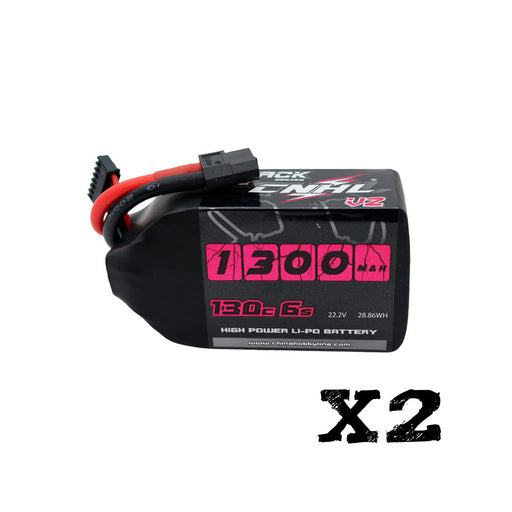
Quick Fit Check The 2 Packs CNHL Black Series V2.0 1300mAh 22.2V 6S 130C LiPo Battery with XT60 Plug is a strong fit for FPV pilots who want a prov...
View full detailsSpare Parts & Long-Term Support We know that for RC pilots, reliable spare parts support is an important part of keeping an aircraft fl...
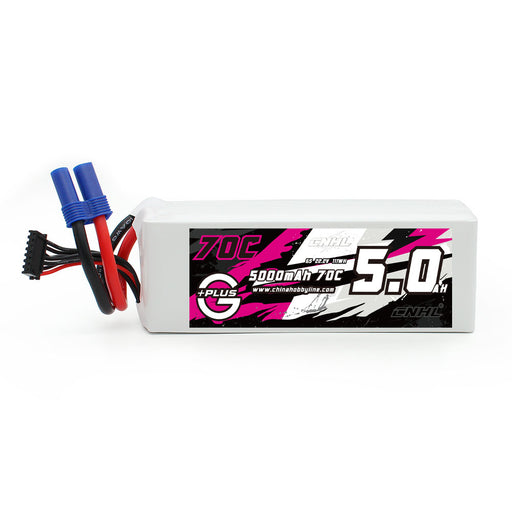
View full detailsSpecifications: Stock Number: 500706EC5 Capacity: 5000mAh Voltage: 22.2V / 6-Cell / 6S1P Discharge Rate: 70C Continual / 140C Burst Charge Rate: ...
View full details
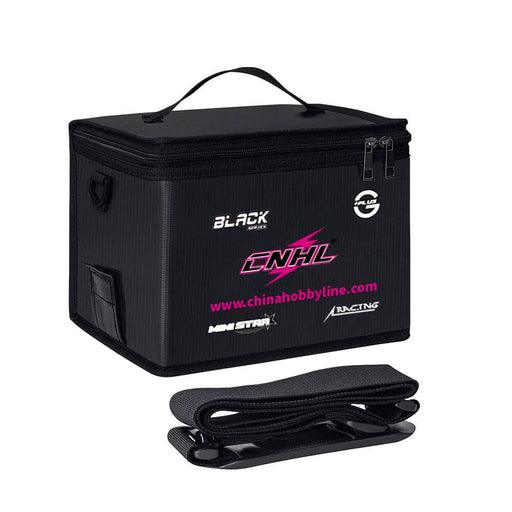
The CNHL LiPo Battery Bag is designed for safer LiPo charging, transport, and storage at home or at the field. It adds a practical layer of protect...
View full detailsQuick Fit Check The 2 Packs CNHL Speedy Pizza Series Pro 1350mAh 6S 150C LiPo Battery with XT60 Plug is built for 5-inch FPV pilots who want a ...
View full details

The CNHL Long Range Series BAK 65E 6350mAh 21700 Li-ion battery cell is built around one clear priority: maximum stored energy from a lightweight c...
View full details

The CNHL Long Range Series BAK 50D 5000mAh 21700 Li-ion battery cell is designed for custom high-energy battery packs that need a strong balance be...
View full details

The ISDT C4 EVO is a versatile smart battery charger built for AA, AAA and cylindrical rechargeable cells from compact 10440 batteries all the way ...
View full details

The CNHL Long Range Series 6350mAh 21.6V 6S1P 21700 Li-ion battery combines six BAK 65E high-energy cells into a 137.16Wh pack designed for ultra-e...
View full details

The CNHL Long Range Series 5000mAh 21.6V 6S1P 21700 Li-ion battery combines six BAK 50D cells into a compact 108Wh pack designed around long-range ...
View full details




Leave a comment