Best Batteries for the Black Horse P-80 Shooting Star 120mm EDF
The Black Horse P-80 Shooting Star 120mm EDF is a large balsa, plywood, and fiberglass-reinforced ARF jet built for a serious 12S EDF power system. The main flight battery setup uses two matched 6S LiPo batteries connected in series. For this type of aircraft, battery choice directly affects thrust, voltage stability, flight time, center of gravity, takeoff roll, and landing behavior.
This collection focuses on EC5-equipped 6S packs selected for large EDF jet use. The lineup includes the lighter CNHL G+Plus 5000mAh 22.2V 6S 100C LiPo Battery with EC5 Plug, the balanced CNHL Black Series 6000mAh 22.2V 6S 65C LiPo Battery with EC5 Plug, the higher-discharge CNHL Racing Series 6200mAh 22.2V 6S 90C LiPo Battery with EC5 Plug, and multiple CNHL Lightning LiHV 6S 120C HV EC5 options for pilots who want more voltage support and capacity choices.
Why This Jet Uses Two 6S Batteries in Series
The EDF version of the Black Horse P-80 Shooting Star is designed around 12S power. Instead of using one single 12S battery, most pilots build the setup with two separate 6S packs connected in series. Series wiring increases voltage while keeping the same capacity. For example, two 6S 6000mAh packs connected in series create a 12S 6000mAh main flight battery system.
Because both packs work together as one 12S system, they should be matched carefully. Use the same model, same capacity, same C rating, same connector, similar age, and similar cycle count. Avoid mixing a new pack with an old pack or pairing batteries with different capacities. In a high-current EDF jet, the weaker battery can limit the performance and safety of the entire 12S setup.
6000mAh to 6200mAh: The Most Balanced Starting Point
For most pilots, the most balanced direction for the Black Horse P-80 Shooting Star is a matched pair of 6S 6000mAh to 6200mAh LiPo batteries. This range gives the aircraft a practical mix of capacity, discharge support, and manageable flying weight. It also stays close to the common 12S 6000mAh direction used for large 120mm EDF jets.
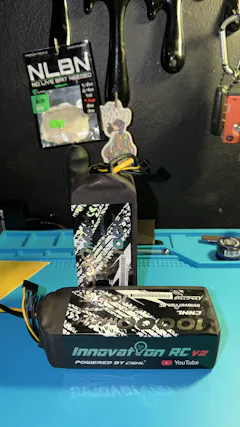
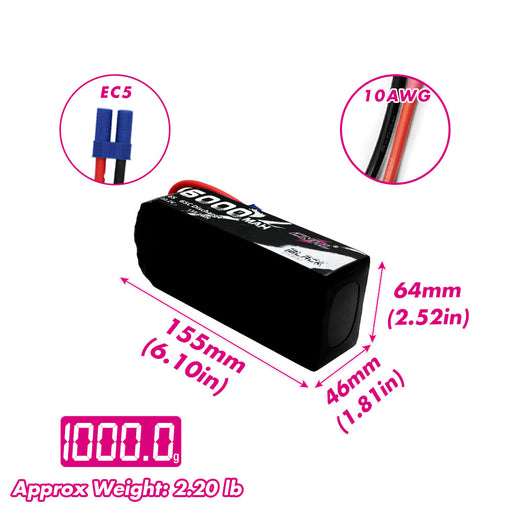
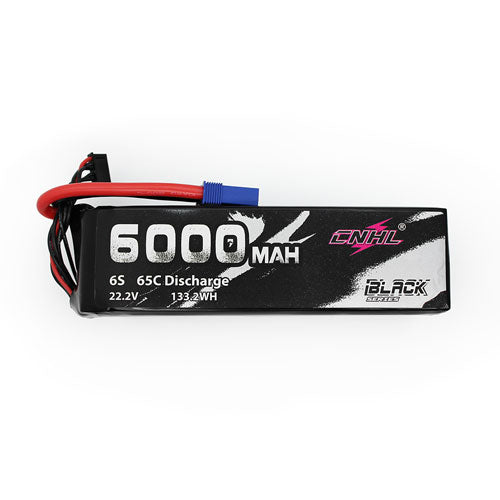
The CNHL Black Series 6000mAh 22.2V 6S 65C LiPo Battery with EC5 Plug is the practical baseline choice in this collection. Used as a matched pair, it creates a straightforward 12S 6000mAh setup. For pilots who want more discharge headroom in a standard LiPo pack, the CNHL Racing Series 6200mAh 22.2V 6S 90C LiPo Battery with EC5 Plug is a stronger high-C option while staying close to the same general capacity range.
5000mAh 6S Packs for a Lighter P-80 Setup
The CNHL G+Plus 5000mAh 22.2V 6S 100C LiPo Battery with EC5 Plug is the lighter option in this collection. When used as a matched pair, it creates a 12S 5000mAh setup for pilots who want to reduce flying weight and keep the aircraft feeling lighter on takeoff, in the air, and on landing approach.
The tradeoff is flight time. A 5000mAh setup will usually require a more conservative timer than 6000mAh or larger packs. For the first flights, avoid long full-throttle passes, land early, and check remaining voltage after landing. Once you understand your flying style and current draw, adjust the timer gradually.
Lightning LiHV Options for Performance and Capacity
The CNHL Lightning LiHV 6S EC5 options in this collection are aimed at experienced EDF pilots who want high discharge capability, strong voltage stability, and more capacity choices. The lineup includes 6000mAh, 6700mAh, 7200mAh, 7800mAh, and 8500mAh 6S LiHV packs. Used in matched pairs, these create 12S LiHV setups for pilots who understand LiHV charging, voltage settings, and large EDF power management.
The CNHL Lightning LiHV 6000mAh 22.8V 6S 120C HV LiPo Battery with EC5 Plug is the performance version of the 6000mAh baseline. It is the most natural LiHV choice for pilots who want to stay close to the recommended capacity range while gaining the benefits of the Lightning high-voltage series. The 6700mAh and 7200mAh options add more capacity, while the 7800mAh and 8500mAh packs are better suited to pilots who prioritize longer flight time and can manage the added battery weight.
How to Choose Between 5000mAh, 6000mAh, 6200mAh, and Larger LiHV Packs
If you want the simplest and most balanced battery direction, start with a matched pair of 6S 6000mAh or 6200mAh packs. If you want a lighter aircraft and do not mind shorter flights, choose 5000mAh. If you want stronger performance and are comfortable with LiHV operation, choose the Lightning LiHV 6000mAh or 6700mAh packs. If you want maximum capacity, the 7200mAh, 7800mAh, and 8500mAh LiHV packs are advanced options that should be used with careful attention to CG, takeoff roll, landing speed, and runway length.
Battery capacity is not automatically better just because the number is larger. On a large EDF jet, bigger batteries can improve flight time and voltage support, but they also add weight. Extra weight can affect the way the aircraft rotates, climbs, slows down, and lands. The P-80 is known for its large, stable presence in the air, but it still needs a properly balanced setup to fly well.
EC5 Connectors and Series Wiring
All batteries in this collection use EC5 plugs, which is convenient for many large EDF setups and EC5 series adapter configurations. For the Black Horse P-80, two 6S batteries must be connected in series to create the 12S main power system. Always confirm polarity, adapter quality, wire gauge, and connector condition before powering the aircraft.
Do not use damaged connectors, loose solder joints, or undersized wiring in a 120mm EDF jet. High-current systems can generate heat quickly when resistance is too high. Before the first flight, check the full power path from each battery to the series adapter, ESC, and EDF motor. After early flights, inspect connector temperature and wiring condition to make sure the setup is working efficiently.
Complete 12S EDF Power Setup: Battery, ESC, and Receiver Power
The main batteries are only one part of the Black Horse P-80’s power system. A large 120mm EDF jet also needs a suitable high-voltage ESC. A 160A-class HV OPTO ESC such as the Hobbywing SkyWalker 160A HV 14S OPTO V2 ESC is a logical option for large 12S EDF applications where voltage capability, current handling, cooling, and throttle response matter.
Because OPTO ESCs generally do not power the receiver directly, the aircraft also needs a separate receiver power solution. This is especially important on a large ARF jet with multiple servos, retracts, brakes, gear doors, and a sequenced retract controller. A dedicated CNHL LiFe battery for receiver power can be used to power the receiver and onboard control systems independently from the main 12S EDF battery pack.
Why Receiver Power Matters on This Aircraft
The Black Horse P-80 Shooting Star is not a simple electric sport model. It uses multiple high-torque mini servos for ailerons, flaps, elevators, rudder, and nose steering. It also includes retractable landing gear, brakes, gear doors, and a sequenced retract controller. These systems create a much higher onboard electrical load than a basic foam EDF jet.
A stable receiver power system helps keep control response, retract operation, and brake function reliable throughout the flight. This is why many large EDF pilots prefer a dedicated receiver battery instead of depending on a BEC in high-voltage applications. With an OPTO ESC setup, independent receiver power is not just a convenience; it is part of building the aircraft correctly.
Standard LiPo vs LiHV for the Black Horse P-80
Standard 22.2V 6S LiPo packs are the straightforward choice for most pilots. They are familiar, easy to manage, and suitable for a conventional 12S EDF setup when matched properly. The 5000mAh G+Plus, 6000mAh Black Series, and 6200mAh Racing Series options give pilots three clear standard-LiPo paths: lighter weight, balanced capacity, or higher discharge support.
LiHV packs use a higher full-charge voltage and should be used by pilots who understand the difference between LiPo and LiHV charging. The Lightning LiHV options can offer excellent voltage support and capacity choices, but they should be matched with appropriate charger settings, ESC setup, flying habits, and post-flight voltage checks. If you are new to large EDF jets, a standard 6000mAh or 6200mAh 6S pair is usually the more straightforward first setup.
Battery Weight, CG, and Flight Behavior
Battery weight has a major effect on how a large EDF jet feels. A lighter 12S 5000mAh setup may make the P-80 feel more responsive and easier to slow down, but it will reduce flight time. A 12S 6000mAh or 6200mAh setup is a more balanced middle ground. Larger LiHV setups can increase capacity and voltage support, but they may also increase takeoff roll, landing speed, and overall wing loading.
Before flying, always check the CG with the aircraft fully assembled and both flight batteries installed. The manual lists the CG range at approximately 165–168mm back from the leading edge of the wing at the fuselage. Do not assume that all 6S packs balance the same way, even if they have similar capacity. Battery dimensions, wire exit direction, and weight distribution can all affect the final CG.
EDF Version vs Turbine Version
This battery guide is for the Black Horse P-80 Shooting Star 120mm EDF version. The turbine version of the airframe uses a different power and support setup and should not be treated as a 12S EDF battery application. EDF pilots should focus on matched 6S flight batteries, correct series wiring, high-voltage ESC setup, cooling, receiver power, and safe battery handling.
FAQ: Black Horse P-80 Shooting Star Batteries
What battery does the Black Horse P-80 Shooting Star 120mm EDF use?
The Black Horse P-80 Shooting Star 120mm EDF uses a 12S LiPo setup, normally built from two matched 6S LiPo batteries connected in series. The most balanced starting point is usually a matched pair of 6S 6000mAh or 6200mAh packs.
Which CNHL battery is the best starting point for this P-80?
For a standard setup, the CNHL Black Series 6000mAh 22.2V 6S 65C LiPo Battery with EC5 Plug is the practical baseline choice. For more discharge headroom, the CNHL Racing Series 6200mAh 22.2V 6S 90C LiPo Battery with EC5 Plug is a stronger standard-LiPo option.
Can I use two 6S 5000mAh batteries?
Yes. Two matched CNHL G+Plus 5000mAh 22.2V 6S 100C LiPo batteries can create a lighter 12S setup. This can help reduce flying weight, but flight time will usually be shorter than with 6000mAh or larger packs.
Can I use CNHL Lightning LiHV batteries in the P-80?
Yes, experienced pilots can use matched CNHL Lightning LiHV 6S packs, including 6000mAh, 6700mAh, 7200mAh, 7800mAh, and 8500mAh options. Make sure your charger settings, ESC setup, flying habits, and post-flight voltage checks are appropriate for LiHV operation.
Do I need two identical batteries?
Yes. Since the aircraft uses two 6S packs in series, both batteries should match in capacity, C rating, connector, age, and condition. Using mismatched packs can reduce performance and may increase risk in a high-current EDF setup.
Do I need a separate receiver battery?
Yes, a separate receiver power solution is recommended when using a high-voltage OPTO ESC. A dedicated LiFe receiver battery can power the receiver, servos, retract controller, and brake system independently from the main 12S EDF battery system.