Quick Fit Check
The CNHL Lightning LiHV 7800mAh 22.8V 6S 120C HV LiPo Battery with EC5 Plug combines unusually high 7800mAh capacity with a size and weight closer to many conventional 6000mAh-class 6S batteries.
At approximately 875g and only 152 × 51 × 59mm, this pack gives pilots and drivers a way to carry substantially more energy without moving into the much larger and heavier format normally associated with a conventional 7800mAh 6S battery.
Compared with a 6000mAh battery, 7800mAh represents a 30% increase in rated capacity. This makes the pack particularly relevant to large EDF jets, performance RC airplanes, high-power RC vehicles and other 6S systems where additional runtime is useful but battery weight still matters.
| Check Item |
Your Model Should Match |
This Battery |
| Cell Count |
6S-compatible power system |
22.8V nominal / 6S LiHV |
| Maximum Voltage |
ESC supports the selected charge voltage |
26.1V full LiHV / 25.2V at standard LiPo limit |
| Battery Space |
Bay or tray accepts a high-capacity 6S pack |
152 × 51 × 59mm |
| Installed Weight |
Model can safely carry and balance the pack |
Approx. 875g |
| Connector |
EC5 or physically compatible IC5 main power connection |
EC5 Plug |
| Power Demand |
Battery, ESC and wiring support the actual system load |
120C continuous / 240C burst |
Product Specifications
| Capacity |
7800mAh |
| Nominal Voltage |
22.8V |
| Chemistry |
LiHV High Voltage Lithium Polymer |
| Cell Configuration |
6S |
| Nominal Energy |
177.84Wh |
| Fully Charged Voltage |
26.1V in LiHV Mode / 25.2V at Standard LiPo Limit |
| Discharge Rate |
120C Continuous / 240C Burst |
| Maximum Charge Rate |
5C |
| Output Connector |
EC5 Plug |
| Balance Connector |
JST-XH-7P |
| Dimensions (L × W × H) |
152 × 51 × 59mm |
| Approx. Weight |
875g |
| Wire Gauge |
10AWG |
| Stock Number |
HV7801206EC5 |
7800mAh Capacity in a 6000mAh-Class Weight Range
The defining advantage of this CNHL Lightning 7800mAh 6S LiHV battery is not capacity alone. It is the relationship between capacity, size and installed weight.
Increasing from 6000mAh to 7800mAh normally means accepting a substantially larger and heavier battery. This pack is designed differently. At approximately 875g and 152 × 51 × 59mm, it remains close to the installation class of many conventional 6000mAh 6S batteries while providing 1800mAh more rated capacity.
That is a 30% capacity increase compared with 6000mAh, creating additional usable energy for longer flights or runs without automatically moving the model into the size and weight class of a conventional high-capacity 7800mAh pack.
Why Choose This Battery?
-
7800mAh capacity: 30% more rated capacity than a 6000mAh battery.
-
Approx. 875g weight: Unusually light for this capacity class.
-
Compact 152mm length: Keeps the pack practical for compatible EDF jets and large RC models.
-
120C continuous output: Built for demanding high-current power systems.
-
177.84Wh nominal energy: Provides substantial energy reserve for runtime-focused setups.
-
EC5 connector: Suitable for high-current applications and physically compatible with IC5 main power connections.
-
LiHV capability: Supports up to 26.1V full charge when the complete power system is rated for it.
Verified for the Freewing Eurofighter Typhoon V2 6S 90mm EDF Jet
The CNHL Lightning LiHV 7800mAh 6S 120C battery with EC5 has been verified for use in the Freewing Eurofighter Typhoon V2 6S 90mm EDF Jet.
This is where the pack's low weight for its capacity becomes especially useful. A conventional 7800mAh battery would often be too large or heavy for a 90mm EDF aircraft, but this Lightning pack remains close to the physical and weight class of the 6000mAh batteries commonly used in large EDF jets.
Moving from 6000mAh to 7800mAh provides 30% more rated capacity while retaining a battery format that has been successfully installed and balanced in the Eurofighter Typhoon V2.
The EC5 output plug also matches the aircraft's EC5 power connection, so no connector adapter is required when the aircraft remains in its standard EC5 configuration.
The additional capacity should not be interpreted as a guaranteed 30% increase in flight time. EDF current draw changes considerably with throttle position, vertical flying, high-alpha maneuvers, wind and external stores. The practical benefit is additional usable energy and landing reserve.
Always confirm the final center of gravity after installation and secure the battery firmly before flight.
Compare batteries for the Freewing Eurofighter Typhoon V2 6S and 8S 90mm EDF Jet
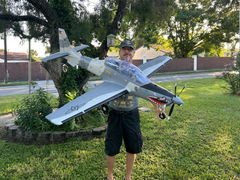
High-Capacity Battery Option for the Eflite Pilatus PC 21 1.3m
The CNHL Lightning LiHV 7800mAh 6S 120C is also an interesting high-capacity direction for the Eflite Pilatus PC 21 1.3m, particularly for pilots who prioritize endurance and are comfortable tuning battery position and center of gravity.
The key advantage is that 7800mAh does not automatically mean carrying the weight normally associated with a conventional battery of this capacity. At approximately 875g, this pack stays much closer to the weight class pilots typically consider when experimenting with larger-capacity 6S airplane setups.
For the PC 21, the 7800mAh option should be treated primarily as an endurance-focused setup. A smaller 5000–6000mAh battery can favor lower flying weight and a lighter feel, while 7200–7800mAh options carry more energy for longer mixed-throttle flights.
Before flight, confirm hatch clearance, battery retention, wire routing and final CG. Battery capacity alone does not determine whether a pack is appropriate for the aircraft.
See the complete Eflite Pilatus PC 21 Battery Collection to compare 5000mAh, 6000mAh, 7200mAh and 7800mAh 6S options by capacity, weight and flying style.
Large 6S EDF Jets and RC Airplanes
The lightweight high-capacity format makes this battery especially relevant to large 6S EDF jets and propeller aircraft that normally operate with approximately 5000–6000mAh batteries but have enough physical space and CG adjustment to accept additional capacity.
For aircraft, battery selection should always consider more than capacity. Check battery-bay dimensions, final center of gravity, takeoff weight, ESC maximum voltage, cooling, wire routing and battery retention before moving to a larger pack.
The 120C rating provides substantial current capability, but actual current is determined by the motor, ESC, EDF unit, propeller and operating conditions.
6S RC Cars, Trucks and Boats
The 7800mAh capacity can also provide longer sessions in compatible large RC cars, trucks and boats where the 152 × 51 × 59mm dimensions and approximately 875g weight can be accommodated.
For surface vehicles, additional capacity can reduce the number of battery changes during long bash sessions. The tradeoff is additional chassis mass compared with a smaller 5000–6000mAh pack.
For boats, confirm battery tray dimensions, hatch clearance, hull trim, cooling-line clearance, connector position and secure retention before running.
Browse more options for surface vehicles in the RC Car Battery Collection.
6000mAh vs. 7800mAh 6S Battery
| Priority |
7800mAh Lightning LiHV |
Conventional 6000mAh Class |
| Rated Capacity |
7800mAh |
6000mAh |
| Capacity Difference |
+30% |
Baseline |
| Main Priority |
More energy and endurance |
Lower capacity and typically lower installed mass |
| Best Use |
Runtime-focused setups with available CG range |
Weight-sensitive performance setups |
The right battery depends on the model and flying style. More capacity provides more stored energy, but a smaller pack may still be preferable when minimum weight, acceleration or agility is the priority.
EC5 and IC5 Connector Compatibility
EC5 and IC5 are physically compatible at the main power connection. This battery can provide normal positive and negative power through a corresponding IC5 device-side connector when polarity and orientation are correct.
This is a conventional CNHL EC5 battery and does not provide Spektrum Smart battery communication, automatic battery identification or Smart battery telemetry.
Models using XT60, XT90, EC3, IC3, TRX or another connector require a correctly rated adapter or professional connector conversion.
LiHV Charging and Maximum Voltage
This is a 6S LiHV battery. When charged in LiHV mode, the maximum voltage is 4.35V per cell, or 26.1V total.
A power system being described as “6S compatible” does not automatically prove that it supports 26.1V. Many conventional 6S systems are designed around the 25.2V maximum voltage of a standard LiPo battery.
Before charging to full LiHV voltage, confirm the ESC manufacturer's maximum input-voltage specification.
If full LiHV support has not been confirmed, this pack can be balance charged to the standard LiPo limit of 4.20V per cell, or 25.2V total. This gives up some usable energy but keeps the battery within conventional 6S LiPo voltage limits.
The 5C specification is the maximum charge rate. A lower balanced charge rate is generally preferred for routine charging because it generates less heat and places less stress on the battery.
About the CNHL Lightning LiHV Series
The CNHL Lightning LiHV Series focuses on combining high discharge capability with improved capacity-to-weight performance for EDF jets, RC airplanes, vehicles, boats and other high-power electric models.
The 7800mAh 6S version demonstrates this concept particularly clearly: unusually high capacity is packaged into a size and weight range that remains practical for applications normally associated with much smaller 6S batteries.
Explore the CNHL Lightning LiHV Battery Series
More 6S Battery Options
Product Image

FAQ
Why is this 7800mAh 6S battery unusual?
Its main advantage is the combination of 7800mAh capacity, approximately 875g weight and compact 152 × 51 × 59mm dimensions. It carries considerably more capacity than a 6000mAh pack without moving into the size and weight normally associated with many conventional 7800mAh batteries.
How much more capacity does 7800mAh provide than 6000mAh?
It provides 1800mAh more rated capacity, which is a 30% increase. Actual runtime improvement depends on throttle use, model efficiency, wind, operating load and the reserve maintained at the end of use.
Does this battery fit the Freewing Eurofighter Typhoon V2 6S?
Yes. This battery has been verified for use in the Freewing Eurofighter Typhoon V2 6S 90mm EDF Jet. Always confirm final CG and secure battery retention before flight.
Can this battery be used in the Eflite Pilatus PC 21 1.3m?
It is an endurance-focused option to consider when the aircraft can accommodate its dimensions, approximately 875g weight and final CG. Compare it with lighter 5000–7200mAh options to choose the setup that best matches your flying style.
Is EC5 compatible with IC5?
Yes. EC5 and IC5 are physically compatible for the main power connection. This conventional EC5 battery does not provide Spektrum Smart battery data.
What is the fully charged voltage of this 6S LiHV battery?
A full LiHV charge reaches 26.1V, or 4.35V per cell. Confirm that the ESC supports this voltage before using full LiHV charging.
Can I charge this LiHV battery only to 25.2V?
Yes. It can be balance charged to the standard 6S LiPo limit of 25.2V, or 4.20V per cell, when full LiHV voltage is not required or has not been confirmed for the model.
Should this battery always be charged at 5C?
No. The 5C value is the maximum specified charge rate. A lower balanced charge rate is generally preferred for routine charging.
Notice
- This is a 6S LiHV battery with a maximum charge voltage of 4.35V per cell.
- Use a compatible LiHV balance charger when charging above the standard LiPo voltage limit.
- Confirm the ESC supports the full 26.1V LiHV voltage before charging the battery to 4.35V per cell.
- If full LiHV support has not been confirmed, the battery may be charged to the standard 25.2V / 4.20V-per-cell LiPo limit.
- Confirm the 152 × 51 × 59mm dimensions, approximately 875g weight and EC5 connector before use.
- EC5 and IC5 are physically compatible for main power, but this battery does not provide Spektrum Smart battery data.
- Check battery retention, center of gravity and wire clearance whenever the pack is installed in an aircraft.
- Keep output and balance wires clear of EDF rotors, propellers, driveshafts, gears and sharp edges.
- Never charge unattended, and do not use a swollen, punctured, damaged or overheated battery.
- Allow the battery to cool before recharging and use storage mode when it will not be used for an extended period.