Choosing the Right 6S Battery for the Eflite PC 21
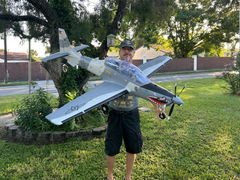
The E-flite Pilatus PC-21 is a high-performance scale airplane, but we would not choose its battery the same way we would choose a pack for an EDF jet or a pure speed model.
The PC 21 has enough battery-bay space and CG adjustment to let the battery become part of the setup rather than simply something that has to fit. A lighter pack can keep the aircraft feeling responsive and reduce landing mass. A higher-capacity pack can extend the useful flying session, but only if the extra energy is not accompanied by unnecessary bulk and weight.
That leads us to four practical battery directions:
- 4000–4500mAh: for pilots deliberately building around lower battery weight;
- 5000–5200mAh: the most sensible all-round starting point;
- 5500–6200mAh: the range we like for longer everyday flights;
- 7200–7800mAh Lightning: high-energy-density options for pilots who want substantially more capacity without the weight of a conventional large 6S pack.
E-flite's published setup uses 6S LiPo power and covers a broad 4000–7000mAh range. We treat that as useful background information, but when comparing individual batteries for the PC-21, actual pack weight and dimensions tell us much more than capacity alone.
Eflite PC 21 Battery Quick Fit Guide
| Battery System | 6S |
| Standard Battery Voltage | 22.2V LiPo |
| ESC | Spektrum Avian 100A Smart ESC |
| Power Connector | EC5 / IC5 interface |
| Our All-Round Starting Point | 5000–5200mAh |
| Longer-Flight Direction | 5500–6200mAh |
| CG Reference | 105–119mm behind the leading edge at the fuselage; around 115mm is a useful starting point |
5000mAh: Our Starting Point for the PC 21
If we were setting up a new PC-21 for the first time, we would start around 5000mAh.
It gives the aircraft enough energy for a useful flight without immediately pushing the setup toward maximum capacity. More importantly, it gives you a good reference for battery position and CG. Once you know how the airplane feels with a 5000mAh-class pack, it becomes much easier to decide whether your next battery should be lighter or should carry more energy.
This is also a good capacity for pilots who use the stock five-blade prop but do not spend the entire flight at high throttle. The PC-21 carries speed efficiently, so a sensible 5000mAh setup already covers a broad range of scale flying, aerobatics and high-speed passes.
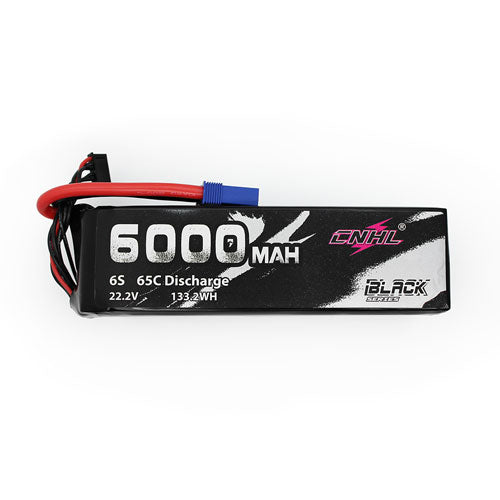
Featured Pick: CNHL Black Series 5000mAh 22.2V 6S 65C EC5
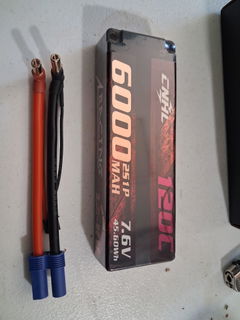
The CNHL Black Series 5000mAh 6S 65C is our straightforward conventional-LiPo choice for the PC 21. It uses standard 22.2V 6S chemistry, comes with the EC5 connector this aircraft needs, and keeps the setup simple for pilots who want to establish the airplane before experimenting with larger capacities.
Best for: balanced everyday flying, first battery setup and pilots who prefer standard 6S LiPo charging.
6000mAh: The Capacity We Like for Longer Everyday Flights
The jump from 5000mAh to around 6000mAh makes a lot of sense on the PC-21 when the battery itself is still sensibly sized.
This aircraft has enough power that we are not trying to protect a marginal power-to-weight ratio. What matters more is avoiding a battery that adds weight faster than it adds useful energy. A well-chosen 6000mAh pack gives the PC 21 more time for long scale circuits, repeated approaches, aerobatics and high-speed passes without forcing the setup into an extreme endurance configuration.
That is why we see the 5500–6200mAh range as the natural step up from 5000mAh. It is large enough to make the extra capacity meaningful, but still conventional enough to work as an everyday PC 21 setup rather than a specialist one.
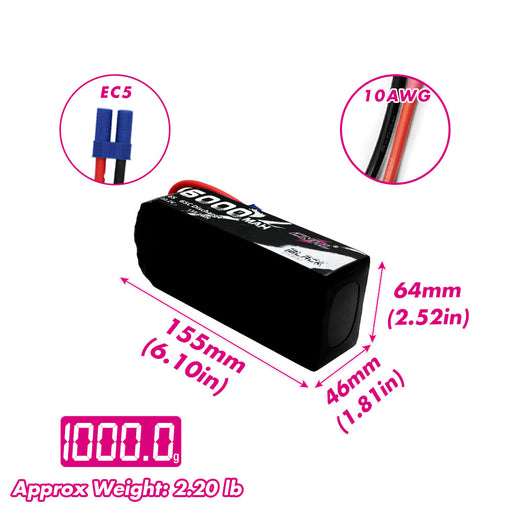
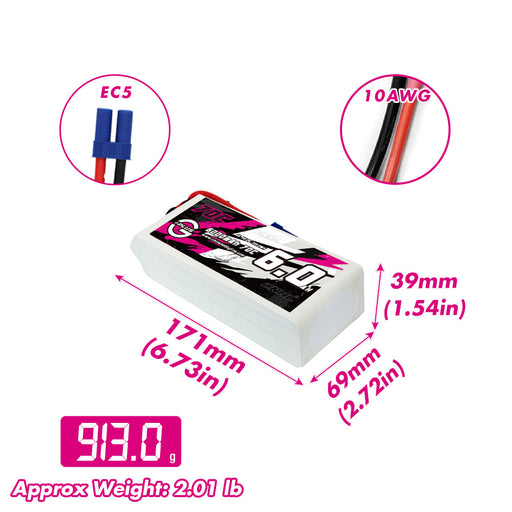
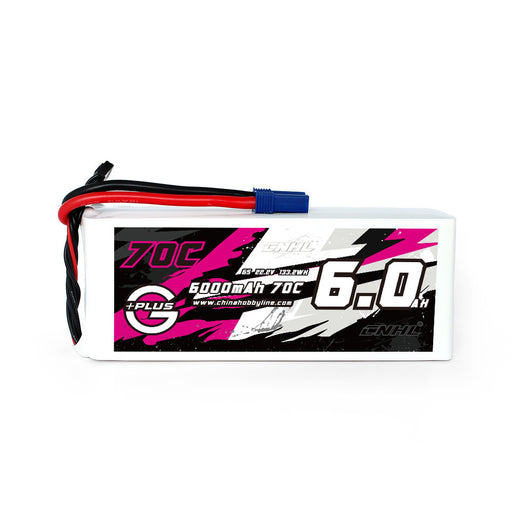
Featured Pick: CNHL G+Plus 6000mAh 22.2V 6S 70C EC5
The CNHL G+Plus 6000mAh 6S 70C with EC5 is the option we would highlight for pilots who want more endurance while staying with normal 22.2V LiPo chemistry.
That standard-LiPo chemistry matters because it keeps charging and voltage management simple. You gain capacity without introducing the additional full-charge voltage considerations that come with LiHV.
Best for: longer everyday flights, mixed scale and aerobatic flying, and pilots who prefer standard LiPo operation.
Why Battery Weight Matters So Much on the PC 21
A common mistake with large RC airplane batteries is to assume that capacity and weight rise together at roughly the same rate. That is often true within one battery family, but it becomes much less reliable when comparing different cell technologies and pack designs.
For the PC 21, we would rather carry more usable energy in a compact pack than add battery mass simply because a conventional high-capacity pack happens to be available.
Battery weight influences more than just CG. It also changes:
- total flying weight;
- how much energy the aircraft carries into a landing;
- how quickly it changes direction;
- how much work the landing gear has to absorb;
- and how much room remains to tune the battery fore and aft.
This is where the Lightning series becomes particularly interesting.
7200mAh Lightning: More Capacity Without Moving Into a Heavier Battery Class
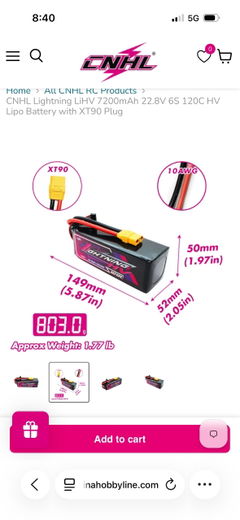
The CNHL Lightning 7200mAh 6S changes the usual capacity-versus-weight calculation.
It measures approximately 149 × 52 × 50mm and weighs about 800g. For comparison, the CNHL Black Series 5000mAh reference is approximately 149 × 52 × 51mm and 798g.
| Battery | Capacity | Dimensions | Approx. Weight |
|---|---|---|---|
| Black Series 5000 6S | 5000mAh | 149 × 52 × 51mm | 798g |
| Lightning 7200 6S | 7200mAh | 149 × 52 × 50mm | 800g |
From an airplane-setup perspective, those numbers are far more interesting than the capacity labels. The two packs occupy almost the same physical envelope and weight class, yet the Lightning carries substantially more rated capacity.
That makes the 7200mAh Lightning one of the most interesting PC 21 batteries in this collection. It is not about installing the largest battery possible. It is about carrying more energy without paying the usual weight penalty associated with moving from 5000mAh into the 7000mAh class.
Featured Pick: CNHL Lightning LiHV 7200mAh 22.8V 6S 120C EC5
Best for: pilots who prioritize high energy density and longer flight potential while keeping battery weight close to a conventional 5000mAh-class setup.
Because this is a LiHV pack, read the charging-voltage section below before using it in the PC-21.
7800mAh Lightning: When Maximum Energy Matters More
The Lightning 7800mAh 6S pushes the same idea further, but we would approach it differently from the 7200.
At approximately 152 × 51 × 59mm and 875g, it is still remarkably compact and light for a 7800mAh 6S pack, but there is now a meaningful increase in both battery height and installed weight compared with the 5000/7200 setup.
That does not make it a poor PC 21 choice. It simply changes its role.
The 7800 is the option for a pilot who deliberately wants to maximize carried energy and is comfortable treating battery position, hatch clearance and CG as part of the setup process.
Featured Pick: CNHL Lightning LiHV 7800mAh 22.8V 6S 120C EC5
Best for: maximum-capacity PC 21 setups where the pilot is willing to accept some additional battery mass in exchange for more stored energy.
The 7200 remains our more balanced high-energy-density choice. The 7800 is the step beyond it for pilots who know endurance is their priority.
What About the Other Batteries in This Collection?
The four batteries highlighted above are not the only useful PC 21 options. They simply represent the clearest setup directions.
The rest of this collection includes:
- Black Series 4000, 5000 and 6000mAh packs;
- G+Plus 5000 and 6000mAh options;
- Racing Series 5200 and 6200mAh batteries;
- and additional Lightning capacities including 4000, 4500, 5500, 6000, 6700, 7200 and 7800mAh.
These intermediate capacities are useful when you already know roughly where you want the airplane to sit on the weight-versus-runtime spectrum. For example, a 5200mAh or 5500mAh pack makes sense when you want a little more energy than a basic 5000 without moving all the way to 6000mAh.
We deliberately do not rank every battery from best to worst because the PC-21 gives pilots enough setup freedom that there is no useful universal ranking. The better question is what kind of flight you are trying to build the airplane around.
Stock 5-Blade Prop or 2-Blade Prop?
Propeller choice changes what we value in a PC 21 battery.
The stock five-blade prop is central to the airplane's character. It gives the model the appearance, sound and strong vertical response that make the PC-21 feel like a modern turboprop rather than a generic sport airplane.
It is also the more demanding propeller setup electrically.
If you plan to keep the stock five-blade and spend a meaningful part of every flight using higher throttle, moving from 5000 toward 6000mAh becomes especially attractive. The extra capacity gives you more usable flying time without changing what makes the airplane visually distinctive.
The optional APC 12×12E two-blade setup takes a different approach. Its main advantage is efficiency. Lower propeller load means the aircraft can make better use of a given battery capacity, so a pilot focused on long flights with the two-blade may not need to carry the largest pack available.
| Flying Priority | Battery Direction | Prop Direction |
|---|---|---|
| Lighter / more responsive setup | 4000–5000mAh | 5-blade |
| Balanced everyday flying | 5000–5200mAh | 5-blade |
| Longer flights while keeping scale character | 5500–6200mAh | 5-blade |
| High energy density | Lightning 7200mAh | Either, after setup checks |
| Maximum endurance-oriented setup | Lightning 7800mAh | 2-blade is especially efficiency-focused |
Battery Position and CG Matter More Than Copying Someone Else's Setup
The PC-21 has an unusually useful amount of fore-aft battery adjustment. That is good news because it means a pilot can work with different pack weights without immediately resorting to ballast.
It also means there is no single battery position that should be copied across every 5000, 6000 or 7200mAh pack.
Use approximately 115mm behind the leading edge at the fuselage as a sensible starting point within the published CG range, then fine-tune the airplane based on your own battery and preferred handling.
Once you have established a setup you like:
- mark the battery position in the tray;
- secure the pack so it cannot move fore or aft;
- recheck CG whenever changing to a battery with a meaningfully different weight;
- keep the EC5 lead clear of the hatch and control system;
- and check that the battery still receives adequate airflow.
The battery bay is large, but a large battery bay should be treated as setup freedom, not permission to install any battery that physically fits.
EC5 and IC5 Compatibility on the E-flite PC-21
The PC-21 uses an IC5/EC5-compatible power interface, so the EC5-equipped batteries in this collection are a natural connector direction.
EC5 and IC5 share a physically compatible main-power connection. A standard CNHL EC5 battery, however, is not a Spektrum Smart battery and does not provide Smart Battery-originated identification or battery data.
That distinction does not mean the airplane automatically loses every telemetry function. With the Avian Smart ESC and a compatible Spektrum receiver/transmitter setup, ESC-side telemetry may still be available.
Always check polarity, connector condition, wire clearance and battery retention before powering the model.
Important LiHV Note for Lightning Batteries
The Lightning batteries in this collection are attractive partly because of their energy density, but the Lightning 6S options are LiHV batteries. Physical fit and electrical voltage limits need to be considered separately.
A normal 6S LiPo reaches 25.2V when charged to 4.20V per cell. A 6S LiHV battery can reach 26.1V when fully charged to 4.35V per cell.
Do not assume that a model described simply as 6S-compatible automatically supports a fully charged 6S LiHV pack.
Unless the maximum input voltage of the complete E-flite PC-21 power system has been specifically confirmed for 26.1V operation, use the conservative standard-LiPo ceiling of 4.20V per cell / 25.2V total when using a Lightning LiHV pack in this aircraft.
If you charge a LiHV battery only to standard LiPo voltage, usable energy will be lower than when the same pack is charged fully to 4.35V per cell. Keep that in mind when comparing expected runtime purely from the rated capacity on the label.
Does the Eflite PC 21 Need an Extremely High C-Rating?
No. We would not make C-rating the first filter for this airplane.
The PC-21 uses a 100A ESC, and every battery in this collection already sits in a performance range intended for demanding RC use. The more useful differences between these packs are capacity, cell design, voltage stability, dimensions and weight.
Our order of priorities for the PC 21 is:
- correct voltage;
- physical dimensions and secure installation;
- battery weight;
- CG flexibility;
- capacity for the flight style you want;
- adequate discharge performance.
A very high C-rating can provide useful voltage stability and additional current headroom, particularly with repeated high-power use on the stock five-blade prop, but a heavier or poorly fitting battery does not become the better PC-21 pack simply because its printed C number is larger.
Eflite PC 21 Battery FAQ
What battery would we choose first for the E-flite PC-21?
We would start with a 6S 5000–5200mAh EC5 battery. It gives a balanced reference for weight, battery position, CG and usable flight time before you decide whether to move toward a lighter or higher-capacity setup.
Is 6000mAh a good size for the PC 21?
Yes. Around 6000mAh is one of our preferred directions for a pilot who wants longer everyday flights. The important part is choosing a 6000mAh pack whose weight still makes sense for the aircraft rather than assuming every battery with the same capacity will create the same setup.
Why is a 7200mAh battery included for the PC 21?
The Lightning 7200mAh is included because it changes the normal capacity-versus-weight trade-off. At approximately 149 × 52 × 50mm and 800g, its physical size and weight are almost identical to the Black Series 5000mAh reference while carrying substantially more rated capacity.
Should I choose the Lightning 7200 or 7800?
We would choose the 7200 for the more balanced high-energy-density setup. Choose the 7800 when maximum stored energy is more important and you are comfortable with its additional height and approximately 875g installed battery weight.
Is a lighter battery always better?
No. Lower battery weight can improve some aspects of handling, but a battery still needs enough capacity for the way you fly. The goal is not minimum weight or maximum capacity by itself; it is the best balance between the two.
Will a CNHL EC5 battery connect to the PC-21 IC5 interface?
EC5 and IC5 use a physically compatible main-power connection. A standard CNHL EC5 pack does not provide Spektrum Smart Battery communication, so physical connector compatibility and Smart battery functions should be treated separately.
Can I charge a Lightning LiHV pack to 4.35V per cell in the PC-21?
Only if the complete PC-21 power system has been specifically confirmed to support the resulting 26.1V fully charged voltage. If that has not been confirmed, use the conservative standard-LiPo ceiling of 4.20V per cell / 25.2V total.
Is the 2-blade prop better for long flight times?
It is the more efficiency-oriented setup. The stock five-blade is the choice we prefer when scale appearance, sound and the aircraft's turboprop character are priorities, while the optional two-blade reduces propeller load and makes better use of a given battery capacity.
Our Eflite PC 21 Battery Recommendations
If you want the simplest answer, we would narrow the collection down like this:
- Black Series 5000mAh 6S 65C EC5: start here for a conventional all-round PC 21 setup.
- G+Plus 6000mAh 6S 70C EC5: choose this direction when longer everyday flights matter and you want to stay with standard LiPo chemistry.
- Lightning LiHV 7200mAh 6S 120C EC5: our standout high-energy-density option because its weight and physical size remain close to a conventional 5000mAh-class pack.
- Lightning LiHV 7800mAh 6S 120C EC5: choose this when maximizing carried energy matters more than keeping the battery near the 5000/7200 weight class.
There are plenty of useful options between those four points. That is why this collection also includes 4000, 4500, 5200, 5500, 6000, 6200 and 6700mAh choices.
The important part is not finding one universal “best battery.” It is choosing the pack that gives your PC 21 the balance between weight, endurance and CG flexibility that matches the way you actually fly it.
For more standard-voltage 6S options, browse the CNHL 6S 22.2V LiPo battery collection.
More RC Warbird and Airplane Batteries
The full-scale Pilatus PC-21 is an advanced military trainer, while the RC model's retractable landing gear, flaps, scale military design and high-performance 6S power system make it a natural fit within CNHL's modern RC warbird battery category.
For other scale military aircraft, fighters and military trainers, explore our LiPo batteries for RC warbirds.
For batteries across EDF jets, sport planes, trainers, aerobatic aircraft, gliders, warbirds and other fixed-wing models, browse the complete CNHL airplane battery collection.