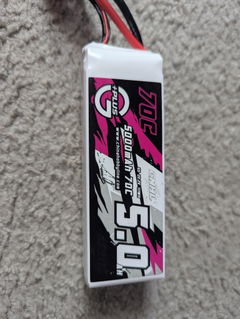
The CNHL Racing Series 8200mAh 1S Shorty LiHV battery is a high-capacity, low-profile hardcase pack developed for compatible 1/12 pan cars, LMP12 racers, GT12 cars and other purpose-built 1S racing platforms. Its 91 × 46 × 18mm case, 150g approximate weight, 130C rating and 5mm bullet output format place it in the specialist 1S RC racing category—not the conventional 2S shorty battery category used by most 1/10 drift, touring and off-road cars.
Best suited to: Compatible 1/12 pan cars, LMP12, GT12, open-rule club racing, practice and chassis testing.
Important: Confirm the battery tray dimensions, 1S ESC compatibility, receiver and servo power supply, connector arrangement and local race approval requirements before ordering.
Quick Fit Check
| Required Battery Voltage |
Your ESC and motor system must be designed for a 1S battery. |
| Battery Dimensions |
Approximately 91 × 46 × 18mm, excluding connector leads. |
| Battery Weight |
Approximately 150g. Check chassis balance and minimum race weight. |
| Power Connection |
5mm bullet terminals with an XT60 connection lead. |
| Receiver and Servo Power |
Use a purpose-built 1S ESC with a boost BEC, an external voltage booster or another approved receiver power solution. |
Product Specifications
| Stock Number |
HC8201301HV |
| Capacity |
8200mAh |
| Configuration |
1S2P |
| Nominal Voltage |
3.8V LiHV |
| Discharge Rating |
130C continuous / 260C burst manufacturer rating |
| Maximum Charge Rate |
5C maximum |
| Dimensions |
Approximately 91 × 46 × 18mm, with a normal production tolerance of 1–5mm |
| Approximate Weight |
150g ±5g |
| Output Connector |
5mm bullet plug to XT60 lead |
| Balance Connector |
JST-XH |
| Wire Gauge |
12AWG |
8200mAh 1S Shorty LiHV Battery for 1/12 Pan Cars
This is a specialist 1S shorty LiPo battery for 1/12 racing applications. The wide, flat 91 × 46 × 18mm hardcase format is commonly associated with low-profile 1S battery compartments used in pan cars and related competition chassis.
Unlike a conventional 2S shorty pack, this battery supplies only one cell of voltage. Its purpose is not to produce the voltage required by a normal 2S touring or drift system. Instead, it combines a large 8200mAh capacity with a low-profile case for vehicles specifically engineered around 1S power.
This makes the pack particularly relevant to drivers searching for a:
- 1/12 pan car battery;
- 1S battery for LMP12;
- GT12 LiPo battery;
- 1S stick or shorty racing battery;
- high-capacity practice battery for a compatible 1S chassis;
- budget-friendly battery for open-rule club racing.
Why Use an 8200mAh Battery in 1/12 Racing?
Capacity in a 1/12 pan car is not only about achieving the longest possible runtime. A larger-capacity 1S pack also gives the electrical system more reserve throughout a full run, which can be valuable during extended practice sessions and longer race formats.
The 8200mAh capacity is intended for drivers who want:
- ample energy reserve for a complete race run;
- fewer interruptions during practice and setup sessions;
- more time for tyre, gearing and chassis adjustments;
- a battery that can support repeated track testing without immediately returning to the charger;
- a practical alternative to much more expensive specialist 1S race packs.
Actual runtime and voltage behavior will still depend on the motor, ESC settings, gearing, timing, track layout, tyre load, vehicle weight, driving style and charging procedure.
130C Output for Demanding 1S Power Systems
A 1S racing system operates at a much lower voltage than a 2S system, so current delivery and electrical resistance become particularly important. The CNHL Racing Series pack carries a manufacturer rating of 130C continuous and 260C burst, targeting the acceleration and sustained-load demands of compatible 1S racing electronics.
The 5mm bullet connection format also suits the compact, low-resistance wiring layouts frequently used in 1/12 pan cars. For the best result, keep the complete electrical path clean and secure, including the battery terminals, ESC wires, solder joints, motor wires and capacitors.
Low-Profile 18mm Hardcase for Pan Car Chassis
At approximately 18mm high, this 1S hardcase battery keeps the battery mass low inside a compatible chassis. A lower battery position can help preserve the low center-of-gravity layout expected from 1/12 pan cars and GT12 platforms.
The hard plastic case also provides more physical protection than an exposed softcase pack during installation, transportation and normal track use. The case does not make the battery impact-proof, so the pack must still be inspected after crashes or chassis damage.
Measure the available battery space and verify the retention system, terminal clearance and lead routing before ordering.
Compatible RC Applications
| Application |
Suitability |
Fitment Notes |
| 1/12 Pan Car / LMP12 |
Primary application |
Confirm a 1S power system and a battery compartment large enough for 91 × 46 × 18mm. |
| GT12 |
Recommended with checks |
Verify chassis dimensions, connector format and organizer battery rules. |
| 1S World GT or Oval |
Possible |
Only for platforms and classes that specifically permit a battery of this size and voltage. |
| Open-rule club racing |
Good application |
Ask the organizer whether non-homologated commercial hardcase batteries are allowed. |
| Practice and testing |
Good application |
High capacity is useful for setup work, tyre testing and extended club sessions. |
| Custom 1S buggy |
Specialist use only |
Do not assume compatibility based on scale or battery-tray length alone. |
1S Shorty Battery vs a Conventional 2S Shorty Battery
| Comparison |
CNHL 8200mAh 1S LiHV |
Typical 2S Shorty |
| Nominal Voltage |
3.8V |
7.4V LiPo or 7.6V LiHV |
| Primary Application |
1/12 pan car, LMP12 and GT12 |
1/10 drift, touring, buggy and other 2S platforms |
| Required ESC |
Purpose-built or verified 1S-compatible ESC |
2S-compatible ESC |
| Receiver Power |
May require a boost BEC or external booster |
Normally supplied by a conventional step-down BEC |
Check Your 1S ESC, Receiver and Servo Power
A normal ESC BEC commonly reduces battery voltage to power the receiver and steering servo. With only one cell supplying the vehicle, an ordinary step-down BEC may not provide sufficient receiver voltage.
A compatible 1S setup will generally use one of the following:
- a purpose-built 1S racing ESC with an integrated boost BEC;
- an external 1S DC-DC voltage booster;
- an approved separate receiver power source;
- another complete 1S electronics arrangement specified by the chassis or ESC manufacturer.
Confirm that the receiver, steering servo, transponder, cooling equipment and any additional electronics receive the voltage and current they require. Battery fit alone does not guarantee electronic compatibility.
5mm Bullet Terminals with XT60 Connection Lead
The battery uses the 5mm bullet terminal format commonly found in specialist RC racing packs. This arrangement allows drivers to keep the wiring short and position the ESC leads according to the chassis layout.
An XT60 connection lead is included in the output configuration for setups that require an XT60 connector. Before use, confirm:
- positive and negative terminal polarity;
- bullet plug diameter and insertion depth;
- lead length and routing;
- clearance beneath the body shell;
- that the connector cannot touch rotating or moving chassis components.
Never allow the exposed positive and negative bullet connectors to contact each other.
How to Charge the 3.8V 1S LiHV Battery
Use a quality computerized charger that supports the correct cell count and LiHV chemistry. Select the charging voltage according to both the battery specification and the rules of the event you are entering.
- A LiHV-capable charger may provide a LiHV termination setting of up to 4.35V per cell.
- Many regulated racing classes limit the battery voltage presented at technical inspection or before a race to 4.20V per cell.
- Charging a LiHV battery only to 4.20V is possible but will not use its complete high-voltage capacity.
- Although this pack carries a maximum 5C charge rating, a 1C balance charge is a conservative default when maximum charging speed is not required.
- Use the charger’s storage program before leaving the battery unused for an extended period.
Never charge unattended. Stop immediately if the battery becomes excessively hot, swells, leaks, develops physical damage or displays abnormal cell voltage.
Browse compatible LiPo and LiHV battery chargers.
Competition Approval and Club Racing Notice
This battery is designed around a common low-profile 1S racing format, but physical dimensions do not automatically make a battery legal for every organized event.
This specific model is not currently advertised by CNHL as ROAR, IFMAR, EFRA or BRCA homologated. Some clubs and open-rule events allow commercially available hardcase batteries that meet their voltage, size and safety requirements. Other races require the exact battery model to appear on an approved equipment list.
Before entering a sanctioned or regulated event:
- check the organizer’s latest battery rules;
- search for the exact manufacturer and stock number;
- confirm the permitted maximum charging voltage;
- verify connector, hardcase and dimensional requirements;
- do not assume that another CNHL or competing-brand battery approval covers this model.
For practice, testing and informal club sessions, approval-list requirements may not apply, but the final decision always belongs to the race organizer.
Who Should Choose This Battery?
This CNHL 8200mAh 1S Shorty LiHV battery is a strong option for drivers who:
- already own a purpose-built 1S pan car, LMP12 or GT12 chassis;
- need a low-profile 1S hardcase pack close to the common 93 × 47 × 18.5mm racing format;
- want high capacity for practice, testing or extended track sessions;
- race at a club or event that permits non-homologated batteries;
- want a cost-conscious alternative to premium specialist 1S racing packs;
- understand how to configure receiver and servo power in a 1S system.
Choose a different battery if your vehicle requires 2S voltage, a thicker conventional shorty case, a different connector arrangement or an explicitly approved race battery.
Explore More Compatible RC Batteries
LiPo batteries for 1/12 scale RC cars
CNHL 3.8V 1S LiHV batteries
Racing Series LiHV hardcase batteries
CNHL Shorty LiPo battery hub
Frequently Asked Questions
Is this a good battery for a 1/12 pan car?
Yes, a compatible 1/12 pan car or LMP12 chassis is the primary application for this battery. Confirm that the battery compartment accepts approximately 91 × 46 × 18mm, that the vehicle uses a 1S power system and that the 5mm bullet terminal layout works with your ESC installation.
Can I use this battery in a GT12 car?
It may fit many GT12-style battery compartments because its dimensions are close to the common low-profile 1S racing format. However, chassis dimensions and competition rules vary. Measure the tray and check the applicable battery approval list before purchasing for an organized GT12 event.
Is the CNHL 8200mAh 1S battery ROAR approved?
This specific model is not currently advertised as ROAR approved. Do not assume that its dimensions or another manufacturer’s approval make it legal. Check the latest ROAR approved battery list for stock number HC8201301HV before entering an event that requires approved equipment.
Do I need a voltage booster with a 1S pan car battery?
It depends on the ESC. A purpose-built 1S racing ESC may contain an integrated boost BEC for the receiver and servo. If the ESC does not provide a suitable boosted output, an external DC-DC booster or another approved receiver power solution may be required.
Should I charge this LiHV battery to 4.20V or 4.35V?
Use the voltage permitted by your charger, battery instructions and race rules. LiHV mode may charge the pack to as much as 4.35V per cell, while many racing organizations limit the pre-race voltage to 4.20V. Charging to 4.20V is acceptable but provides less usable capacity than a full LiHV charge.
Important Battery Notice
- Confirm the voltage, dimensions, weight, connector, polarity and electronics compatibility before use.
- Use only a charger designed for LiPo and LiHV batteries.
- Never charge, discharge or store the battery unattended in an unsafe location.
- Do not short the exposed 5mm battery terminals.
- Do not use a swollen, leaking, punctured, overheated or crash-damaged battery.
- Avoid overcharging, over-discharging, water exposure, crushing and excessive heat.
- Store the battery at an appropriate storage voltage when it will not be used for an extended period.
- Competition eligibility is determined by the event organizer, not by physical fit alone.