
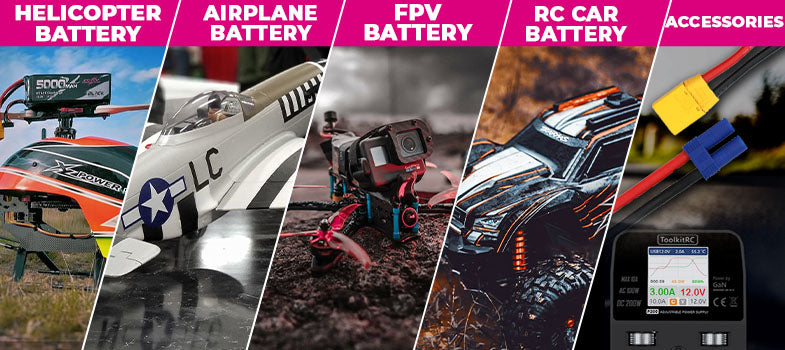
CNHL Lipo Batteries
CNHL aim at providing high-quality Li-Po batteries and RC products to all hobby enthusiasts with excellent customer services and competitive prices
Durafly Tundra TPX (PNF) 1050mm is a rare kind of release: it looks like a simple EPP profile foamy, but it behaves like a “practice environment” more than a single-purpose aerobatic toy. It carries the Tundra family’s bush-plane attitude (big wheels, rough-surface confidence, short takeoff/landing) and mixes it with the instant response and low-speed control that pilots expect from a 3D profile design.
That mix can sound contradictory at first. When evaluating the TPX across different flying contexts, two distinct styles emerge. In one scenario, it is flown assertively in breezy conditions on lower rates while still holding knife-edge lines and clean tumbles. In another, it is treated more casually — almost like a backyard practice machine — where even non-dedicated 3D pilots feel comfortable experimenting. That contrast is exactly where the TPX starts to make sense.

The Tundra TPX is built for pilots who want maximum “try again” freedom. In other words: it’s designed to make experimentation feel normal. The airframe is light enough to fly slow, reinforced enough to survive the moments where slow flying turns into “oops,” and powerful enough (especially on 4S) to recover quickly when a maneuver goes sideways.
That last point is not marketing fluff. In the casual review, the pilot explicitly frames the TPX as a “low consequence” airplane — the kind that keeps flying fun when high-end 3D models start feeling like stress because every mistake costs money and time.
The “TPX” name suggests an extension of the familiar Tundra concept — not a departure from it. Instead of abandoning the recognizable bush-style DNA, the platform reshapes it into a profile-format airframe that can transition smoothly from mellow sport flying to aggressive stick inputs when rates are opened up.
This is why the TPX feels different from a typical “performance-only” indoor foamy. The goal is not to be the lightest possible. The goal is to be a profile airplane that still feels useful outdoors, including days when the wind is not perfect.
The TPX uses EPP foam reinforced with carbon and fiberglass elements, with visible diagonal bracing along the fuselage to increase torsional stiffness where it matters most. That structural rigidity translates directly into the air: tracking remains cleaner, and abrupt direction changes feel more controlled rather than introducing unwanted flex or “mystery wobbles.”
Early feedback from pilots helps explain why that matters. Many profile models are optimized for perfectly calm air and can feel fragile while pilots are still learning 3D fundamentals. The TPX, by contrast, is positioned as more forgiving in real-world handling — not indestructible, but noticeably less delicate in the moments that matter most.

Rather than repeating every line item, it’s more useful to focus on the specifications that directly shape the experience:
The real takeaway is not about spec-sheet numbers. It’s about how noticeably the airplane’s personality shifts with different battery choices — all without requiring a change in propeller or motor setup.
Across different flight setups, a clear pattern emerges. On 4S, the TPX delivers strong vertical authority and confident prop-hang performance, allowing quicker exits from stalled or high-alpha maneuvers. In tighter environments, that extra punch shortens recovery time and demands more throttle discipline.
On 3S, the character changes noticeably. The airplane feels calmer and more cooperative, while still remaining lively enough for sport aerobatics and basic 3D practice. Many pilots find this setup strikes a comfortable balance between control and forgiveness.
LiHV packs introduce a slightly sharper initial response, but they are not strictly necessary to unlock the TPX’s core capability. Standard voltage packs already provide strong performance for most flying scenarios, making HV more of a preference than a requirement.
| Setup | Flight Character | Best Fit Scenario | Considerations |
|---|---|---|---|
| 3S (approx. 650–750mAh class, XT30) | Calmer and more cooperative, with smooth throttle response | Sport flying, foundational 3D learning, relaxed outdoor sessions | Less aggressive vertical recovery compared to higher voltage setups |
| 4S (approx. 500–750mAh class, XT30) | Stronger vertical authority and faster throttle response | Advanced 3D maneuvers, tighter recovery margins, higher energy routines | Requires throttle discipline, especially in confined environments |
| LiHV (equivalent capacity range) | Sharper initial punch and slightly increased urgency | Pilots seeking maximum responsiveness without airframe changes | Optional upgrade; standard LiPo already delivers strong performance |
For compatible battery options (organized specifically for this model and connector style), use: Durafly Tundra TPX LiPo Batteries Collection.
In practical use, conservative timer settings often underestimate how long the TPX remains comfortably flyable. With packs in the 700–750mAh range, total airtime commonly reaches around 11–12 minutes, depending on throttle habits, temperature, and maneuver intensity.
Even toward the end of the pack, the airframe retains enough authority for controlled sport aerobatics rather than immediately feeling depleted. That gradual power taper contributes to a more relaxed flying experience.
A typical low-voltage alarm setting of 3.3V per cell remains appropriate, including when using LiHV packs. The higher initial charge ceiling of LiHV does not alter the fundamental discharge safety threshold — it simply changes the feel earlier in the flight, not the logic at the end.
Post-flight voltage readings are not always perfectly uniform across all cells, especially after higher-load flying sessions. Minor variation between cells at the end of discharge is common and does not automatically indicate a problem.
What matters more is how the pack behaves during charging. Persistent imbalance while charging forces the charger to work harder and extend balance time, which is where inconvenience — and potential long-term stress on the pack — can appear.
The key takeaway is not to ignore cell balance, but to understand where in the charge–discharge cycle imbalance becomes meaningful. Real-world flying rarely produces perfectly symmetrical numbers, and that’s normal.

The TPX offers generous control surface deflection, particularly on the elevator due to its all-moving tail surface. That design choice delivers strong pitch authority when high rates are enabled, while still allowing pilots to dial the response back for smoother handling on lower rates.
The result is flexibility rather than intimidation. The airframe provides the authority; the pilot decides how much of it to use. With reduced rates, the airplane remains composed and predictable. With full throws, it becomes capable of aggressive maneuvers such as knife-edge flight, tumbles, and high-alpha transitions — without requiring competition-level skill to explore them.

On the TPX, flaps are not a novelty — they meaningfully change the airplane’s pace. When deployed, the model slows noticeably, floats longer on approach, and becomes more deliberate in tight airspace. That behavior expands its usability beyond pure aerobatics.
The airframe includes a Y-cable, so flapperons are optional rather than mandatory. However, because the ailerons run nearly full-span and overall control authority is strong, enabling flapperons can add another layer of slow-speed flexibility for pilots who want it.
Proper setup remains important. Mixing in appropriate down-elevator compensation helps maintain stable pitch behavior as flap deflection increases. For pilots new to flapperon programming, this is not a complication — it is simply part of extracting the full potential from a lightweight, responsive profile airframe.
The TPX is engineered around small, lightweight packs. On an airframe this light, battery mass influences not only flight time, but also feel, balance, and response character. Choosing the correct size matters more than chasing a specific label or brand.
Battery retention and placement also deserve attention. A strap can be useful, but on very light profile models it can slightly alter nose weight depending on positioning. Many pilots prefer using Velcro on both the pack and battery bay to ensure consistent placement flight after flight.
Lightweight, high-area profile aircraft often create an interesting contrast in wind. At certain throttle settings and angles, the model can appear remarkably stable and almost suspended in place. Yet when exposed broadside to a stronger gust, the same airframe can momentarily behave like a sail. Both behaviors are normal for this category of design.
What matters more is controllability. The TPX remains readable and correctable in moderate breeze conditions, especially compared with ultra-fragile, smaller profile models. Its slightly larger footprint and reinforced structure help it track more cleanly when inputs are applied, even when the air is not perfectly calm.
The correct expectation is not “windproof.” The correct expectation is that it remains manageable and predictable for its weight class.
The TPX arrives with motor, ESC, and servos pre-installed, but some assembly is still required. The all-moving tail surface requires careful linkage setup, and the wing structure and reinforcement components need adhesive installation and alignment.
For an organized builder, the process is typically measured in tens of minutes rather than hours. This is not a fully factory-assembled foam trainer, but it is also far from a full scratch-build project. The structure is straightforward, and the electronics layout is accessible, making field maintenance and future adjustments simple.
In practical terms, this is “Plug-N-Fly light” — enough involvement to understand the airframe, without turning first flight into a weekend-long build session.
Profile airplanes are rarely about scale detail — they are about responsiveness, survivability, and fun. In that landscape, the TPX positions itself as a lightweight, forgiving option built around durable EPP construction rather than rigid foam-board structures.
Compared with some higher-tier profile offerings that incorporate more integrated electronics or advanced stabilization systems, the TPX focuses on delivering the core flying experience without unnecessary complexity. It does not attempt to be the most feature-packed platform in the category. Instead, it aims to provide a cost-conscious, well-executed profile airframe that captures the essence of what makes this style addictive: low-speed control, big control authority, and everyday durability.
Market feedback around the TPX consistently points toward accessibility. Many pilots are not chasing elite-level 3D precision; they are looking for something that is easy to own — easy to transport, easy to fly in tighter spaces, and forgiving enough that a small mistake does not translate into a rebuild session.
In practical terms, the TPX is being treated less as a specialist competition tool and more as an “always ready” profile aircraft — something that can stay in the car, operate from rough ground, and still deliver satisfying performance even when the pilot keeps the flying simple.

The TPX is less oriented toward pilots chasing top-end speed. Its design prioritizes control authority, float, and maneuver recovery over raw velocity. That trade-off is intentional: this is an airplane built around feel and responsiveness rather than straight-line performance.
Is the Tundra TPX enjoyable even for non-3D pilots?
Yes. The TPX is not limited to advanced aerobatic routines. Its light weight, slow-flight capability, and forgiving EPP structure make it enjoyable for pilots who simply want relaxed sport flying with the option to explore 3D over time.
Is it practical to keep in a car or truck for quick flights?
Yes. Its profile design, removable landing gear, and modest wingspan make transport straightforward. It fits the role of a “grab-and-go” aircraft suitable for spontaneous sessions in smaller flying areas.
Why is removable landing gear important on a profile model?
On many flat-foam designs, fixed landing gear can complicate transport and storage. Removable gear adds flexibility, reduces daily handling frustration, and supports both rough-field operation and compact transport.
Is it suitable as a low-stress backyard flyer?
For many pilots, yes. When flown on moderate rates or 3S power, the TPX can behave as a controllable, confidence-building aircraft. Its durability also lowers the stress associated with minor mishaps.
How does it compare to Eratix or 4-Site-style profile aircraft?
The TPX occupies a similar “fun-first” profile category but distinguishes itself through EPP resilience and Tundra-inspired STOL practicality. It offers a slightly different flight feel while maintaining strong control authority.
Why might availability appear inconsistent between regions?
Stock status may vary depending on warehouse location and regional distribution timing. The most reliable indicator is the live inventory status on the product page for the selected region.
Does this model tend to sell quickly?
Initial demand has been strong in several regions. If stock visibility is limited, checking availability sooner rather than later is advisable.
Can the Tundra TPX be flown indoors?
Yes — in the right environment. At 450–500g flying weight and especially on 4S, it is not a small ultra-micro model. Large indoor venues such as sports halls are more suitable than tight garages. On 3S with reduced rates and proper throttle discipline, it can be slowed down significantly. However, space awareness is important, as the airframe’s power-to-weight ratio allows it to accelerate quickly when commanded.
The Durafly Tundra TPX succeeds because it balances durability, controllability, and real-world usability better than most lightweight profile aircraft in its class.
It is not designed to be the lightest ultra-micro indoor specialist. Instead, it is built to be the airplane pilots actually take flying — outdoors in imperfect conditions, off rough ground, or inside larger venues — where confidence and recovery authority matter more than razor-thin weight savings.
On reduced rates and moderate power, it floats and slows comfortably. On 4S with higher throws, it transitions into a legitimately capable 3D platform. That dual personality is what defines the TPX.
For pilots looking to match the correct pack size and XT30 configuration for this airframe, see the curated battery options here: Durafly Tundra TPX LiPo Batteries Collection. In short, the TPX is a durability-forward profile aircraft with real-world usability at its core.
CNHL aim at providing high-quality Li-Po batteries and RC products to all hobby enthusiasts with excellent customer services and competitive prices
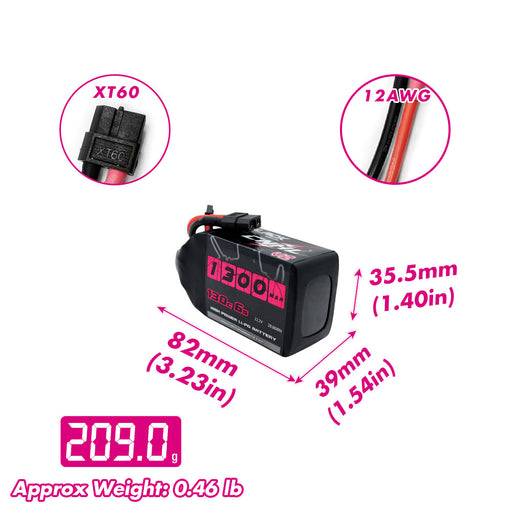
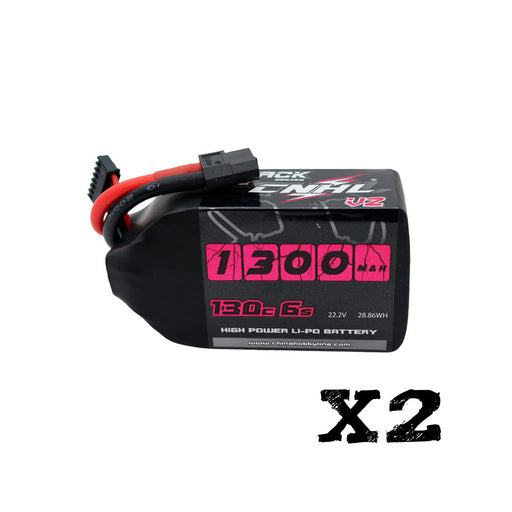
Quick Fit Check The 2 Packs CNHL Black Series V2.0 1300mAh 22.2V 6S 130C LiPo Battery with XT60 Plug is a strong fit for FPV pilots who want a prov...
View full detailsHstar D43-01Q 911 Style is a mini 1/43 alloy drift RC car designed for indoor tabletop fun and realistic drifting. It features full proportional ...
View full details

Spare Parts & Long-Term Support We know that for RC pilots, reliable spare parts support is an important part of keeping an aircraft fl...
View full details
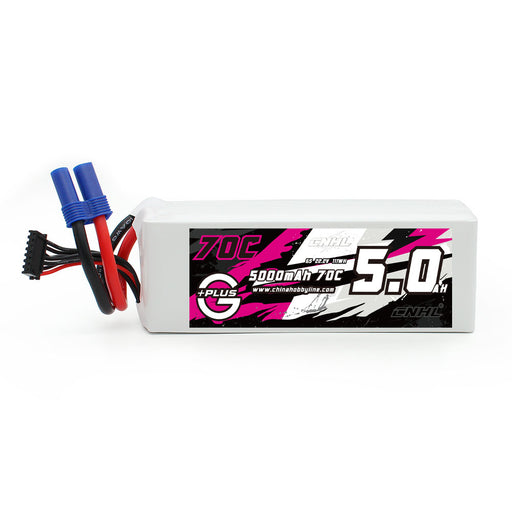
Specifications: Stock Number: 500706EC5 Capacity: 5000mAh Voltage: 22.2V / 6-Cell / 6S1P Discharge Rate: 70C Continual / 140C Burst Charge Rate: ...
View full details
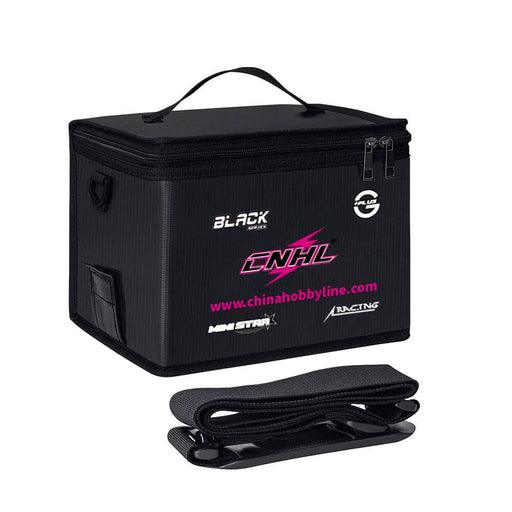
The CNHL LiPo Battery Bag is designed for safer LiPo charging, transport, and storage at home or at the field. It adds a practical layer of protect...
View full details

The Hobbywing EZRUN MAX4 HV is a high-voltage, high-current brushless ESC built for 1/5-scale off-road vehicles and heavy-load RC trucks. With sup...
View full details

The Hobbywing QUICRUN Fusion Pro 2300KV combines a brushless crawler motor and electronic speed controller inside one compact 540-spec power unit. ...
View full details

Quick Fit Check The CNHL Racing Series 6000mAh 15.2V 4S2P 130C LiHV Shorty Hardcase LiPo Battery with 5mm Bullet Sockets is a true 4S shorty LiPo b...
View full details

The CNHL 2 Pairs 5mm Heatsink Bullet Plug Grips with Bullet Connectors are designed for RC racers who need a clean, secure and easy-to-handle conne...
View full details

The Hobbywing Multifunction LCD Program Box PRO G3 is an advanced ESC programming device for compatible Hobbywing brushless ESCs. Compared with a...
View full details

Comments
Leave a comment