
CNHL Lipo Batteries
CNHL aim at providing high-quality Li-Po batteries and RC products to all hobby enthusiasts with excellent customer services and competitive prices

Quick answer: the Losi 5IVE TE 3.0 is not just a gas 5IVE T with an electric system dropped in. It is Losi’s factory-built 12S return to serious fifth-scale RC, with a huge desert truck body, dual 6S battery layout, massive tires, 32mm big-bore shocks, and a driving style that feels more like a heavy off-road machine than a normal basher. It is expensive, it needs open space, and 8S only shows part of its personality, but on 12S the Losi 5IVE-TE 3.0 makes the 5IVE T name feel alive again.
The Losi 5IVE T name already means something in large-scale RC. The original gas-powered truck became one of those platforms people remembered not only because it was big, but because it felt serious. It had weight, noise, mechanical presence, and a kind of scale drama that smaller RC trucks could not copy. The Losi 5IVE-T 2.0 kept that heritage going for owners who wanted a gasoline-powered fifth-scale truck with real attitude.
The new 5IVE TE 3.0 changes the power story. Instead of asking owners to buy a gas truck and convert it themselves, Losi now gives them a factory electric RTR version built around 12S power. That alone makes this release important. It does not erase the gas 5IVE T. It creates a new electric branch for drivers who want the same large-scale presence without the sound, tuning, fuel smell, and starting routine of a two-stroke engine.

The easiest way to misunderstand this truck is to judge it like a normal basher. The Losi 5IVE TE 3.0 is not trying to be the lightest, cheapest, or easiest RC car to carry around. It is a true 1/5 scale electric desert truck with a long wheelbase, huge body, large tires, and a power system sized for serious voltage.
The headline is the 12S-capable Spektrum system. The truck uses a Spektrum Firma 250A Smart brushless ESC, a 560Kv 70120 brushless motor, dual motor cooling fans, and a large-scale steering servo rated at 1,000 oz-in. That tells us the platform was not designed as a small electric layout stretched into a big truck. The electronics, motor size, cooling, steering hardware, and battery requirement all point in the same direction: this is a heavy electric fifth-scale platform built to carry real load.
The body construction also shows that Losi expected this truck to take abuse. The six-piece injection-molded polypropylene body is a major change from a normal thin polycarbonate shell. It gives the 5IVE-TE 3.0 a harder, more molded look and should handle impacts differently from a traditional clear body. It also means owners who love custom paint may need to think more in terms of wraps or replacement panels rather than standard body painting.
The gas-versus-electric debate is part of the story. For some longtime 5IVE T owners, the two-stroke sound, fuel smell, and mechanical tuning are part of the truck’s identity. That is easy to understand. A gasoline fifth-scale truck feels different from an electric one. It has more ritual around it, more noise, and often longer fuel-based sessions.
But electric power solves real ownership problems too. It is cleaner, quieter, easier to start, and more realistic for drivers who do not have a large private space where noise is welcome. For many owners, that is exactly why the Losi 5IVE TE 3.0 is attractive. It keeps the big 5IVE T feeling while removing the part of the ownership experience that made gas trucks harder to use regularly.
The best way to look at this truck is not “electric replaced gas.” It is more accurate to say that Losi opened a new path for the platform. The gas 5IVE T and the 12S electric 5IVE-TE serve different owners. One is about engine character and fuel-based tradition. The other is about high-voltage convenience, instant torque, and modern electric usability.
The Losi 5IVE TE 3.0 is not just large in the spec sheet. Its size changes the whole ownership experience. This is the kind of RC truck that makes smaller vehicles feel easy to transport, easy to store, and easy to run. A fifth-scale truck over 50 lb with batteries installed needs room, planning, and respect.
That size is also the appeal. When a truck this heavy squats under throttle, rolls across rough grass, throws loose dirt, or lands from a jump, it does not move like a small RC car. It has a slower, heavier, more realistic body motion. It may not always look as fast as a lighter basher, but in person, a 50 lb truck running near 50 mph is not casual at all.
This is why direct comparisons with smaller 6S and 8S bashers can be misleading. A Kraton, Outcast, X-Maxx, or XRT may be easier to run hard in more places. Some may look faster or more violent for less money. The Losi is different. It is about fifth-scale presence, desert-truck movement, and a much heavier style of performance.

The Losi 5IVE TE 3.0 can run on 8S or 12S. For 8S, it uses two 4S LiPo batteries. For 12S, it uses two 6S LiPo batteries. That flexibility is helpful, but the two setups do not feel equal.
8S is useful for first runs, smaller open spaces, or cautious driving. It lets the owner understand the braking distance, steering feel, and physical size of the truck before using full voltage. But 8S does not really show why this platform exists. It moves the truck, but it does not fully wake it up.
12S is where the 5IVE-TE 3.0 starts to make sense. With two strong 6S packs, the truck pulls harder, feels more alive, and better matches its own size. Real-world stock speed can sit around the high-40 mph to 50 mph range depending on batteries, surface, break-in, temperature, and conditions. Some drivers will want more, especially if they expect every 12S vehicle to be a speed-run machine. But this truck is not a light speed platform. It is a huge desert truck carrying heavy tires and a massive chassis across rough terrain.
| Power Setup | Battery Layout | Driving Feel | Best Use |
|---|---|---|---|
| 8S | 2 × 4S LiPo batteries | Controlled, softer, easier to manage | First runs, smaller areas, lower-stress driving |
| 12S | 2 × 6S LiPo batteries | Stronger, fuller, better matched to the platform | Open dirt, grass, sand, large fields, fifth-scale driving |
For most owners, the honest answer is simple: use 8S to learn the truck if needed, but build the real setup around 12S.
The Losi 5IVE TE 3.0 can jump, and it jumps better than its weight suggests. The long wheelbase, huge tires, and 32mm big-bore shocks help it stay calm in the air. It does not feel twitchy in the way a smaller, lighter stunt truck can feel. The suspension movement is one of the most satisfying parts of the whole platform.
But this is not the best choice for someone whose main goal is to launch an RC truck vertically off extreme ramps all day. It is more refined than that. The 5IVE-TE 3.0 feels best when it flows across rough ground, takes realistic desert-truck style jumps, and lets the suspension work. It can be driven hard, but its personality is more controlled and heavy than wild and nervous.
That is also why some people may describe it as mellow or even a little lazy. That is not necessarily a weakness. For a fifth-scale desert truck, that calmer movement can make the truck easier to place, easier to enjoy, and more believable across open terrain.

The Losi 5IVE TE 3.0 does not include batteries or a charger, so the real ownership cost goes beyond the truck itself. For full 12S running, owners need two 6S LiPo packs. Many will eventually want more than one matched pair, because a truck this large can make a single battery session feel short very quickly.
Battery capacity matters more here than it does on a smaller basher. A 6000mAh pair can work, but the truck naturally points toward larger 6S packs when runtime and voltage stability matter. In this size class, mAh is not only about how long the truck runs. Larger packs can also help reduce voltage sag under heavy load, especially in grass, loose dirt, sand, repeated full-throttle launches, or higher-geared setups.
For CNHL users, the most practical direction is a matched pair of high-capacity 6S EC5 LiPo batteries. The CNHL Losi 5IVE TE 3.0 LiPo battery collection focuses on dual 6S options from 6000mAh to 10000mAh, including standard LiPo and LiHV choices for owners who want a stronger 12S setup.
The truck is listed with IC5 connectors, while many CNHL large-scale packs use EC5 plugs. EC5 and IC5 are commonly discussed together in high-current RC car battery setups, but standard CNHL EC5 batteries should not be described as Spektrum Smart batteries. If Smart battery telemetry is important, that depends on Spektrum Smart battery technology. For drivers mainly focused on capacity, output, and practical connector fit, CNHL EC5 packs are a useful direction to consider.
The Losi 5IVE TE 3.0 naturally gets compared with the Losi DBXL-E 2.0, Super Baja Rey 2.0, older Losi 5IVE T 2.0 trucks, ARRMA Kraton 8S, ARRMA Outcast 8S, Traxxas X-Maxx, Traxxas XRT, Rovan platforms, and other large-scale builds. Those comparisons are useful, but only if the goal is clear.
If the goal is maximum speed per dollar, the 5IVE-TE 3.0 may not be the obvious winner. If the goal is easy transport and everyday convenience, smaller platforms are easier to live with. If the goal is gas sound and fuel-based runtime, the older 5IVE T identity still has a strong emotional pull.
But if the goal is a factory 12S fifth-scale electric desert truck with huge presence, serious suspension movement, and a platform that feels far larger than a normal basher, the Losi 5IVE TE 3.0 has a clear reason to exist.
| Comparison | Main Difference | What It Means |
|---|---|---|
| 5IVE TE 3.0 vs 5IVE T 2.0 Gas | Factory 12S electric versus gas-powered heritage | Electric is cleaner and easier to run, while gas keeps the classic sound and fuel-based experience. |
| 5IVE-TE 3.0 vs DBXL-E 2.0 | Larger desert truck presence with stronger 12S focus | The 5IVE-TE feels more extreme in size and battery demand. |
| 5IVE TE 3.0 vs Super Baja Rey 2.0 | More fifth-scale mass and heavier platform feel | Both have desert-truck appeal, but the 5IVE TE 3.0 is the larger and more demanding truck. |
| 5IVE TE 3.0 vs Kraton / Outcast 8S | Scale mass and desert-truck movement versus stunt basher aggression | The Losi is not about being the most violent stunt truck. It is about large-scale presence. |
| 5IVE TE 3.0 vs X-Maxx / XRT | More specialized fifth-scale desert truck character | The Losi needs more space but delivers a different kind of scale drama. |
The Losi 5IVE TE 3.0 is ready-to-run, but that does not make it a casual starter truck. Its size, weight, speed, battery cost, and required running space make it better suited to experienced RC owners. A careful beginner could drive it slowly on 8S with throttle limiting, but this is not the kind of truck most people should choose as a first RC vehicle.
Space is the biggest hidden requirement. This truck needs a large field, dirt lot, private land, fifth-scale track, or wide open off-road area. Crowded parks, sidewalks, tight yards, and areas near people or pets are not a good match. A 50 lb truck moving near 50 mph can cause real damage if it is driven carelessly.
Transport and storage also matter. The truck is large enough that moving it, cleaning it, charging for it, and storing it all become part of the ownership experience. Anyone thinking about buying one should also think about how many battery pairs they want, where they will charge them, and where the truck can be run safely.
The 5IVE-TE 3.0 looks strong, but no truck this large is free from details worth watching. The pull-tab body system is easier than older screw-heavy body systems, but sand and dirt can make latch areas less smooth over time. The front hood area and body panel fit are also worth checking after hard landings, rollovers, or rough running.
The drivetrain has a noticeable mechanical sound. That is not surprising for a large metal-geared truck with serious rotating mass. Some sound may settle as the truck breaks in, but owners coming from smaller electric bashers should expect the Losi 5IVE TE 3.0 to sound more mechanical and less silent than a lightweight RC car.
The 250A Spektrum Firma ESC will also be something experienced owners watch over time, especially with taller gearing, repeated hard pulls, deep grass, sand, or hot weather. Stock gearing is the safer starting point. Once owners start chasing more speed, temperature checks become much more important.
Many owners will probably experiment with pinion changes. The stock truck feels controlled rather than wild, and some drivers will want more top speed from a 12S platform. A larger pinion can wake the truck up, especially for pavement passes or wide open running.
But gearing up is not free performance. This truck has weight, large tires, and heavy current demand. Taller gearing increases heat and load through the motor, ESC, and batteries. Before chasing higher speed, it makes sense to run the truck stock first, check temperatures, understand the driving area, and choose batteries that can support repeated high-load pulls.
For the wrong owner, probably not. If someone wants a fast, cheap, easy-to-carry basher, there are easier choices. Smaller vehicles cost less, use cheaper battery setups, fit more places, and require less storage and charging commitment.
For the right owner, the answer is different. The Losi 5IVE TE 3.0 gives fifth-scale fans a factory electric route into the 5IVE T style platform without doing a custom conversion. It has the size, hardware, power system, and suspension presence to feel special every time it comes out. That is not something every RC truck can do.
The price is high, but the truck also gives a lot back: large electronics, huge tires, serious shocks, a molded body system, fifth-scale steering hardware, and a driving experience that feels far removed from normal 1/8 or 1/7 scale vehicles. The real question is not only whether the truck is worth the money. It is whether the owner has the space, batteries, charger, and appetite for what this kind of truck demands.

The Losi 5IVE TE 3.0 is one of the most interesting large-scale RC releases in years because it brings the 5IVE T platform back into active discussion. It will not satisfy every gas loyalist, and it will not impress every speed-run driver. It is expensive, heavy, space-hungry, and serious enough that battery choice becomes part of the ownership plan.
But that is also why it works. The truck feels different because it is different. It is not a small basher trying to look big. It is a true fifth-scale electric desert truck with 12S power, huge visual presence, and the kind of movement that makes smaller vehicles feel ordinary for a moment.
For owners who have the space to run it and the right pair of 6S packs to feed it, the Losi 5IVE-TE 3.0 is not just another electric truck. It is a sign that fifth-scale RC still has room to grow.
For more Losi-focused battery options, browse the LiPo battery for Losi cars collection. You can also explore the wider CNHL RC car batteries collection for more voltage, connector, and capacity choices across RC car platforms.
The Losi 5IVE TE 3.0 is electric. It uses a 12S-capable Spektrum brushless system instead of the two-stroke gas engine associated with older Losi 5IVE T models.
8S is enough for controlled driving and first runs, but it does not show the full character of the truck. The Losi 5IVE TE 3.0 feels much more complete on 12S with two 6S LiPo batteries.
For full 12S running, the Losi 5IVE TE 3.0 uses two 6S LiPo batteries. For a softer 8S setup, it uses two 4S LiPo batteries. High-capacity 6S packs are the most natural choice for the full 12S experience.
In stock form, the 5IVE TE 3.0 is generally expected to run in the high-40 mph to around 50 mph range depending on batteries, surface, temperature, break-in, and conditions. Because the truck weighs over 50 lb with batteries installed, that speed feels much more serious than the number alone suggests.
It can be used for bashing, but it is better understood as a fifth-scale desert truck than a pure stunt basher. It is large, heavy, plush, and stable, making it better for open terrain and realistic jumps than repeated extreme ramp launches.
Not really. The truck is RTR, but its size, weight, battery cost, speed, and required running space make it better suited to experienced RC owners. Beginners should usually start with smaller platforms before moving into a 1/5 scale 12S truck.
It does not strictly need 10000mAh packs, but large-capacity 6S batteries make sense for this truck. Higher capacity can improve runtime and may help reduce voltage sag under heavy load, as long as the packs fit securely in the battery trays.
A larger pinion can increase speed, but it also increases heat and current demand. Owners should run the truck stock first, check temperatures, and only gear up carefully with strong batteries and enough running space.
Many long-time 5IVE T fans want a gas option, but the electric 5IVE TE 3.0 should be viewed as its own branch of the platform. A gas model would appeal to drivers who want two-stroke sound and fuel-based runtime, while the electric version is built for cleaner 12S power.
It depends on the owner. For casual drivers, it is expensive and demanding. For fifth-scale fans who want a factory 12S electric desert truck with serious size and presence, the price is easier to understand. The full cost should include batteries, charger, storage, transport, and future maintenance.
CNHL aim at providing high-quality Li-Po batteries and RC products to all hobby enthusiasts with excellent customer services and competitive prices
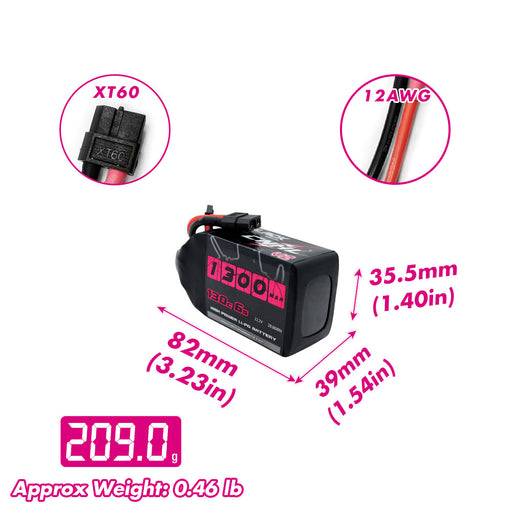
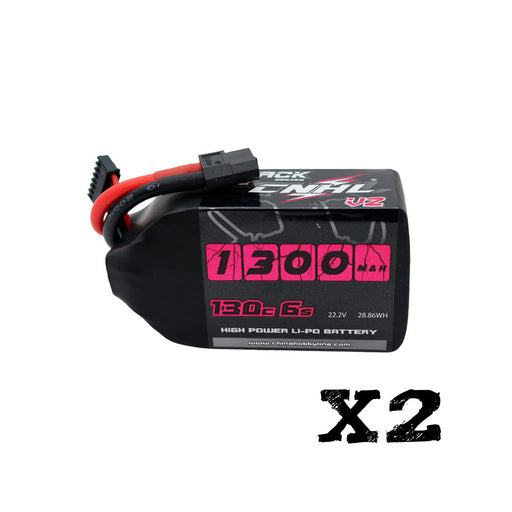
Quick Fit Check The 2 Packs CNHL Black Series V2.0 1300mAh 22.2V 6S 130C LiPo Battery with XT60 Plug is a strong fit for FPV pilots who want a prov...
View full details

Hstar D43-01Q 911 Style is a mini 1/43 alloy drift RC car designed for indoor tabletop fun and realistic drifting. It features full proportional ...
View full details

Spare Parts Availability We know that for RC pilots, reliable spare parts support often determines how long an aircraft can actually sta...
View full details
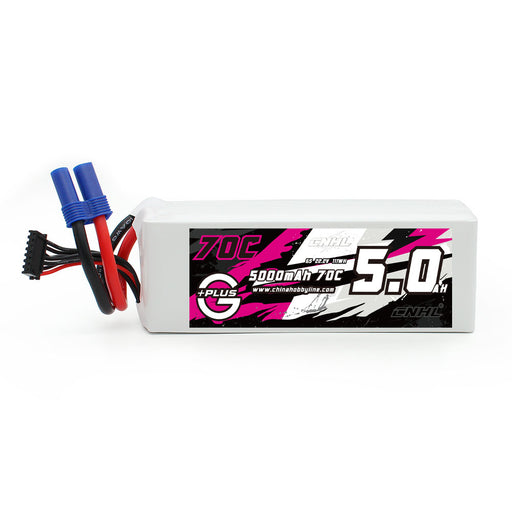
Specifications: Stock Number: 500706EC5 Capacity: 5000mAh Voltage: 22.2V / 6-Cell / 6S1P Discharge Rate: 70C Continual / 140C Burst Charge Rate: ...
View full details
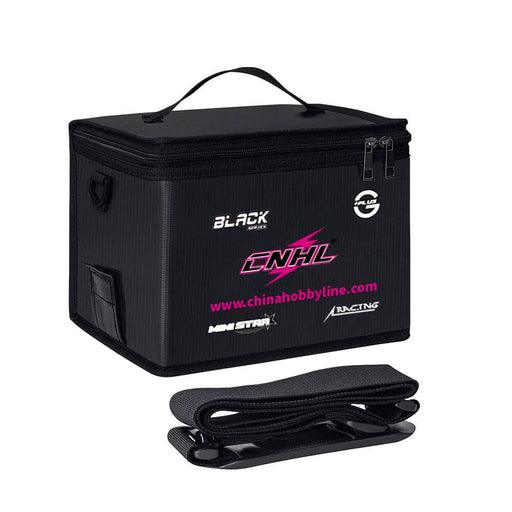
The CNHL LiPo Battery Bag is designed for safer LiPo charging, transport, and storage at home or at the field. It adds a practical layer of protect...
View full details

CNHL is the first to bring AviNationRC’s debut aircraft, the Horten Ho-229, to market — a compact EDF that combines a rare scale flying-wing desig...
View full details

The CNHL KAVAN Pulse 2200 V2 PNP Glider in orange is not a basic powered glider for casual first flights. It is a 2206mm full-house electric sport...
View full details

CNHL Bison XT STOL 1750mm PNP RC Airplane (Orange) CNHL Bison XT STOL V2 is a large high-wing bush-style aircraft built for slow, confident flyin...
View full details

Quick Fit Check The CNHL Lightning LiHV 7800mAh 4S 120C battery is designed for high-performance RC platforms that require strong burst power, stab...
View full details

Quick Fit Check The CNHL Lightning LiHV 6700mAh 6S battery is designed for RC pilots who need strong burst power with stable voltage delivery. ...
View full details
Leave a comment