
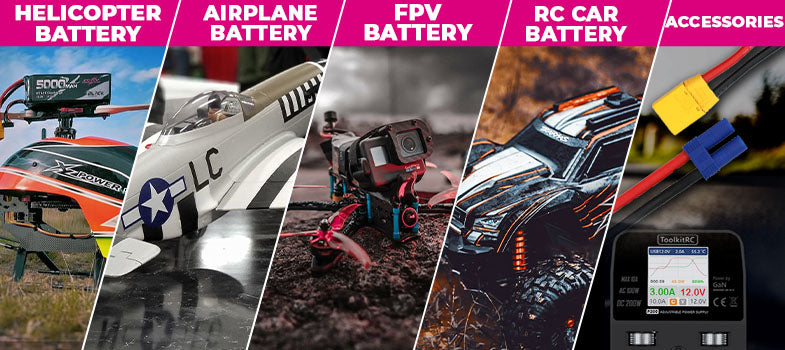
CNHL Lipo Batteries
CNHL aim at providing high-quality Li-Po batteries and RC products to all hobby enthusiasts with excellent customer services and competitive prices
Yes, some programmable chargers can handle LiPo batteries from 1S through 4S. However, the better question is whether one charger can handle all of those batteries conveniently, accurately and efficiently. A charger that works well for a 4S 5000mAh RC battery may be unnecessarily large or awkward for rotating several 1S Tiny Whoop packs.
Quick answer: One charger can cover 1S–4S when it supports the full cell-count range, provides sufficiently low current settings for small 1S packs, offers the correct LiPo or LiHV mode, and can connect to the battery’s main plug. In practice, many Tiny Whoop pilots are better served by a dedicated independent-port 1S charger plus a general-purpose balance charger for 2S–4S batteries.
The most flexible setup is not always one physical device. A compact multi-port 1S charger can handle fast battery rotation at the field, while a programmable AC/DC charger can manage larger 2S, 3S and 4S packs at home or on the workbench.

| Cell-Count Range | The charger must explicitly support both 1S and 4S. A maximum 4S rating alone does not confirm 1S support. |
| Chemistry Modes | Check whether the charger supports standard LiPo, LiHV and any other battery type you actually use. |
| Low-Current Control | Small 1S packs may require settings such as 0.2A, 0.3A or 0.5A rather than whole-amp adjustments. |
| 1S Connectors | PH2.0, BT2.0, A30 and similar micro connectors normally require dedicated ports or a correctly wired lead. |
| Independent Ports | Independent 1S ports allow each battery to start and finish separately without grouping all packs into one task. |
| 2S–4S Power | Larger packs need enough charger watts and current to maintain the selected charge rate. |
| Best Practical Setup | Often a dedicated multi-port 1S charger plus a general-purpose balance charger for 2S–4S. |
A true 1S–4S charger should support every cell count in that range rather than only accepting a maximum 4S battery. Its specifications should clearly list 1S, 2S, 3S and 4S compatibility.
That still does not guarantee an ideal user experience. Check:
A charger may be technically capable of charging one 1S pack through a special lead while remaining inconvenient for users who need to rotate six or more small batteries throughout a flying session.
For a broader charger-selection method, read How to Choose the Right LiPo Battery Charger for Your RC Batteries.
A Tiny Whoop session may involve far more battery swaps than a larger FPV or RC session. Small 1S packs have limited capacity and short flight times, so users often rotate many batteries rather than waiting for one large pack to finish charging.

For this use case, charger convenience depends less on total wattage and more on:
A large 300W or 800W charger offers little practical advantage when charging a 300mAh 1S battery at a fraction of an amp. The bottleneck is normally port count and workflow, not charging power.
Most 2S, 3S and 4S RC batteries use a main power connector plus a balance plug. They are usually charged through a programmable balance charger that allows the user to set:
For larger batteries, charger output power becomes important. A 4S 5000mAh battery charged at approximately 1C requires 5A and roughly 84W near full voltage. Charging two such batteries independently requires substantially more total power.
A general-purpose charger is therefore selected by:
For common battery-size examples, see How to Choose the Right Charger for 2S, 3S, 4S and 6S LiPo Batteries.
A 1S 300mAh battery charged at approximately 1C needs only 0.3A. A 1S 450mAh battery needs about 0.45A. The charger must allow current settings appropriate for these small capacities.
| 1S Battery | Approx. 1C Current | Practical Charger Requirement |
|---|---|---|
| 250mAh | 0.25A | Fine current adjustment near 0.2–0.3A |
| 300mAh | 0.30A | Independent low-current port preferred |
| 350mAh | 0.35A | 0.3A or 0.4A setting where permitted |
| 450mAh | 0.45A | 0.4A or 0.5A setting where permitted |
| 650mAh | 0.65A | 0.6A or 0.7A setting where permitted |
A charger that only adjusts current in large steps may be poorly suited to small 1S packs even if it nominally supports 1S voltage.
The selected current must also remain within the battery manufacturer’s charge specification. Read LiPo Charging Rates Explained for the relationship between capacity, C rate and amps.
Not every 1S FPV battery uses the same final voltage. A standard 1S LiPo normally charges to approximately 4.20V, while many high-voltage 1S packs are designed for a higher LiHV limit such as 4.35V when specified by the manufacturer.
| 1S Battery Type | Typical Full Voltage | Required Mode |
|---|---|---|
| Standard LiPo | Approximately 4.20V | LiPo |
| LiHV | Often up to approximately 4.35V when specified | LiHV |
Never select LiHV mode for a standard LiPo battery. A charger that only supports one 1S voltage may not be suitable for a mixed collection of standard LiPo and LiHV packs.
Tiny Whoop batteries commonly use compact connectors such as PH2.0, BT2.0 and A30. These connectors are not automatically interchangeable simply because they serve similar 1S applications.
A general-purpose charger may use an XT60 output and therefore require a purpose-built 1S charge lead. A dedicated 1S charger may include one or more micro-connector types directly on the case.
Before buying or connecting a charger, check:
For a detailed connector comparison, read PH2.0, BT2.0 or A30? Choosing the Right Battery Plug for Your Micro FPV Drone.
A programmable main charger can be a genuine one-device solution when it:
This solution works best for users who own mostly 2S–4S packs and only occasionally charge one or two 1S batteries.
An independent-port 1S charger treats each connected battery as a separate charging task. One pack can be inserted while another is already charging, and each port can complete independently.

This is usually the most efficient option for users who fly Tiny Whoops frequently and rotate several 1S batteries during one session.
A series charging board connects several 1S batteries so the main charger sees a higher-S battery. For example, four 1S batteries may be presented as one 4S charging task when the board is designed and connected correctly.
This is different from independent-port charging. Every connected battery becomes part of one series string.
Series-board requirements can include:
A series board can efficiently prepare a matched batch at home, but it does not provide the flexible plug-in and plug-out workflow of an independent multi-port charger.
A 1S parallel board keeps the combined group at 1S while adding the capacities of the connected batteries. Four 1S 300mAh batteries become one 1S group with 1200mAh combined capacity.
4 × 300mAh = 1200mAh combined
Approximate 1C group current = 1.2A
Parallel charging requires:
Independent 1S ports are generally easier for high-frequency battery rotation because packs do not need to be grouped and started together.
For the full parallel-charging method, read How to Parallel Charge LiPo Batteries Safely.
| Method | How Batteries Are Managed | Best Use | Main Limitation |
|---|---|---|---|
| Independent 1S Ports | Each battery charges separately | Tiny Whoop battery rotation | Usually only supports 1S |
| Series Board | Batteries form one higher-S string | Matched batch preparation | One missing or poor connection affects the group |
| Parallel Board | Voltage remains 1S while capacities are combined | Closely matched batteries charged together | Starting voltages must be closely matched |
| General Charger, One Pack | One battery per channel | Occasional 1S charging | Slow for large numbers of packs |
A charger with independent channels may be able to run different tasks at the same time. For example, one channel could charge a 2S battery while another charges a 4S battery, provided both channels support those settings and the charger has enough total power.
One channel cannot normally charge a 1S battery and a 4S battery as one combined task. Each channel uses one chemistry, one S count and one charging program.
Check whether the charger:
A multi-channel charger improves flexibility, but it may still be less convenient than a dedicated six-port 1S charger for Tiny Whoop use.
An AC charger plugs directly into household power and is convenient for a home charging bench. It may be larger than a dedicated 1S field charger.
A DC charger requires an external supply or field battery. It can offer high output for 2S–4S packs but adds another component to the setup.
A USB-C charger is compact and convenient for Tiny Whoop batteries. Confirm that the USB-C source provides the voltage and power required by the charger rather than assuming every USB port offers the same output.
For a detailed comparison, read AC vs DC LiPo Chargers: Which One Should You Buy?.
Choose one programmable charger that explicitly supports 1S–4S, low-current adjustment and the required 1S adapter.
Best for:
Use an independent multi-port 1S charger for Whoop batteries and a separate balance charger for 2S–4S packs.
Best for:
Use a dual- or multi-channel AC/DC main charger plus a compact independent 1S charger.
Best for:
This combination usually provides more flexibility than forcing every battery through one connector and one charging channel.
A general-purpose AC/DC charger is useful as the main device for 2S–4S batteries and larger RC packs. It should not automatically be described as a direct multi-port Tiny Whoop charger unless its specifications confirm the necessary 1S support and connectors.
The ToolkitRC M6DAC V2 dual-channel AC/DC charger represents a flexible main-charger format for users who need wall-power convenience and separate charging channels.
For several independent mainstream battery tasks, the ToolkitRC Q6AC quad-channel charger represents a multi-channel approach. Confirm the supported minimum S count, current range and required leads for every battery before purchase.
Browse the CNHL LiPo battery charger collection for balance chargers, dual-channel chargers and multi-channel systems.
For ToolkitRC chargers and charging equipment, visit the ToolkitRC collection.
Before ordering, confirm:
Yes, when the charger explicitly supports every cell count from 1S through 4S and offers suitable current, chemistry modes and charge leads. Do not infer 1S support only from a 4S maximum rating.
Potentially, but check the minimum current, connector requirements and whether the charger provides a practical 1S charging method. Technical support does not guarantee convenient multi-pack use.
For frequent Tiny Whoop use, an independent multi-port 1S charger is generally the most efficient option. Occasional users may prefer a general charger with a suitable 1S lead.
A 1S battery has only one cell, so there are no cells to balance against each other. It still requires the correct charging mode, current and final voltage.
A standard LiPo mode normally stops at a lower final voltage than a LiHV program. It may undercharge a LiHV battery rather than reaching its full specified voltage. Never use LiHV mode on a standard LiPo.
Only when the charger has separate compatible ports or correctly wired adapters for both connector types. Connector compatibility does not replace correct voltage and chemistry settings.
No. A series board increases the combined S count, while a parallel board keeps the group at 1S and adds capacity. They require different charger settings and connection procedures.
Yes, with a charger that provides several genuinely independent 1S ports. Each port can monitor and terminate its own battery task.
It may handle several independent tasks when its minimum S count, current range and leads support the batteries. A dedicated 1S charger can still be smaller and more convenient for Tiny Whoop battery rotation.
At approximately 1C, the battery requires 5A and roughly 84W near full voltage. Choose additional headroom for conversion losses and any other active channels.
One charger is reasonable when you only have a few 1S batteries. Frequent Tiny Whoop pilots usually benefit from a dedicated multi-port 1S charger plus a general-purpose balance charger for larger packs.
A true 1S–4S charger must do more than display the correct cell-count range. It needs low-current control, suitable LiPo and LiHV modes, the correct micro-battery connection and enough output power for larger 4S batteries.
For users with mostly 2S–4S packs and only occasional 1S use, one programmable charger can be sufficient. For Tiny Whoop pilots who rotate many small batteries, the better all-in-one system is usually a dedicated independent-port 1S charger combined with a general-purpose balance charger.
For the wider charging system—including charger selection, safe charging procedures, C-rate calculations and charger programs—visit the CNHL LiPo Battery Charging Guide.
CNHL aim at providing high-quality Li-Po batteries and RC products to all hobby enthusiasts with excellent customer services and competitive prices
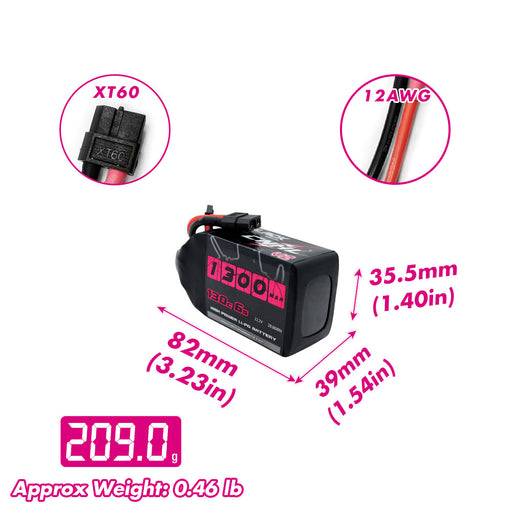
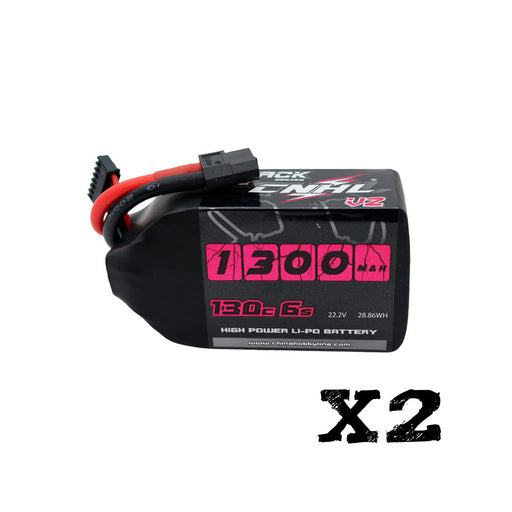
Quick Fit Check The 2 Packs CNHL Black Series V2.0 1300mAh 22.2V 6S 130C LiPo Battery with XT60 Plug is a strong fit for FPV pilots who want a prov...
View full detailsHstar D43-01Q 911 Style is a mini 1/43 alloy drift RC car designed for indoor tabletop fun and realistic drifting. It features full proportional ...
View full details

Spare Parts & Long-Term Support We know that for RC pilots, reliable spare parts support is an important part of keeping an aircraft fl...
View full details
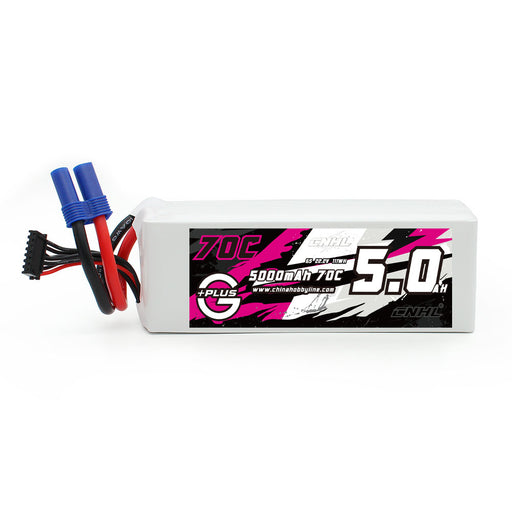
Specifications: Stock Number: 500706EC5 Capacity: 5000mAh Voltage: 22.2V / 6-Cell / 6S1P Discharge Rate: 70C Continual / 140C Burst Charge Rate: ...
View full details
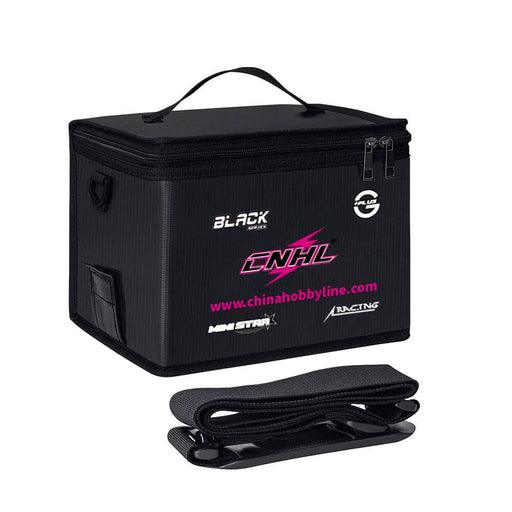
The CNHL LiPo Battery Bag is designed for safer LiPo charging, transport, and storage at home or at the field. It adds a practical layer of protect...
View full details

The Hobbywing EZRUN MAX4 HV is a high-voltage, high-current brushless ESC built for 1/5-scale off-road vehicles and heavy-load RC trucks. With sup...
View full details

The Hobbywing QUICRUN Fusion Pro 2300KV combines a brushless crawler motor and electronic speed controller inside one compact 540-spec power unit. ...
View full details

Quick Fit Check The CNHL Racing Series 6000mAh 15.2V 4S2P 130C LiHV Shorty Hardcase LiPo Battery with 5mm Bullet Sockets is a true 4S shorty LiPo b...
View full details

The CNHL 2 Pairs 5mm Heatsink Bullet Plug Grips with Bullet Connectors are designed for RC racers who need a clean, secure and easy-to-handle conne...
View full details

The Hobbywing Multifunction LCD Program Box PRO G3 is an advanced ESC programming device for compatible Hobbywing brushless ESCs. Compared with a...
View full details

Leave a comment