
סוללות CNHL ליפו
CNHL שואפת לספק סוללות Li-Po באיכות גבוהה ומוצרי RC לכל חובבי התחביב עם שירות לקוחות מצוין ומחירים תחרותיים
The CEN Racing Matrix-E takes a refreshingly simple approach to the modern 1/10 RC buggy. It is rear-wheel drive, powered by a brushed 550 motor, built around a lightweight composite chassis, and supplied as an RTR platform without forcing beginners into an overly complicated electronics package.
That simplicity is also what makes the Matrix-E interesting. The chassis has more of the stance and layout of a traditional 1/10 2WD buggy than a heavy modern basher, yet it is clearly designed for recreational driving rather than requiring a race program to enjoy it. Add a 2S LiPo, learn how the rear-drive chassis responds to throttle, and there is plenty of usable performance before any upgrade becomes necessary.

Quick answer: For a stock CEN Racing Matrix-E, a 7.4V 2S LiPo with a T/Deans plug is the sensible everyday battery setup. The official battery tray measures 160 × 48mm, and standard-height packs around 25mm are the practical target because the battery sits beneath the electronics tray. For most owners, a 5200mAh 2S pack gives the best balance of capacity and chassis feel, while 6200mAh and 6600mAh packs are useful when longer runtime matters more.
The Matrix-E is a 1/10-scale rear-wheel-drive electric buggy built around a low-center-of-gravity molded composite chassis. Power comes from an RS-550 high-torque brushed motor controlled by a 60A HobbyWing WP-1060 brushed ESC, while steering is handled by a 6kg-class servo.
The suspension follows a straightforward independent double-wishbone layout with oil-filled adjustable coil-over shocks. A slipper clutch sits in the drivetrain, the transmission uses metal gears, and the car rolls on conventional 2.2-inch buggy wheels and tires.
None of those components sounds exotic in isolation, and that is part of the appeal. The Matrix-E feels like a hobby-grade RC car that focuses on the fundamentals: a relatively light chassis, simple rear-wheel-drive mechanics, serviceable electronics and enough adjustment to learn what changes in setup actually do.

| Scale | 1/10 |
| Drive | 2WD, rear-wheel drive |
| ESC | HobbyWing WP-1060 60A brushed ESC |
| Motor | RS-550 high-torque brushed motor |
| Recommended Everyday Battery | 7.4V 2S LiPo |
| Battery Tray | 160 × 48mm |
| Practical Battery Height | Around 25mm for a conventional standard-height pack |
| Battery Connector | T-Plug / Deans |
| Length | 412mm |
| Width | 245mm |
| Wheelbase | 294mm |
| Approx. Weight | 1.68kg / 3.7lb |
For a stock Matrix-E, 2S LiPo is the straightforward choice. A 7.4V pack gives the brushed system enough speed to make the lightweight chassis entertaining without turning battery voltage into the main event.
The official battery tray measures 160 × 48mm, but those two measurements are not the whole fitment story. The electronics tray sits above part of the battery area, so a tall hardcase can interfere even when its length and width look correct on paper. Conventional packs around 25mm high fit this layout much more naturally.
Connector compatibility is equally simple: the stock ESC uses a T-Plug, also commonly called a Deans connector. Choosing a battery with the same plug keeps the installation clean and avoids putting another adapter into the power path.

A lightweight 2WD buggy behaves very differently from a heavy 4WD monster truck. More voltage does not automatically make the driving experience better. With only the rear tires responsible for putting power down, throttle control and chassis balance matter almost as much as peak power.
On 2S, the Matrix platform already has enough speed to feel lively. The brushed system can move the buggy at a respectable pace while still giving the driver enough room to work with the rear-wheel-drive handling rather than simply overpowering the tires.
Higher-voltage experiments can make the car dramatically faster, but they also increase heat and mechanical stress. That may be interesting as an enthusiast project, but it is not the battery recommendation we would give for an otherwise stock Matrix-E. For normal use, stay with a properly sized 2S pack and let the chassis do what it was designed to do.
There is no single correct capacity for every owner. Once voltage, dimensions and connector are correct, capacity becomes a choice between keeping the car relatively light and extending the time between battery changes.
| Recommended Pack | Why Choose It | Best Match |
|---|---|---|
| CNHL Racing 5200mAh 2S 100C | Balanced capacity without automatically choosing the largest pack | Stock Matrix-E and everyday driving |
| CNHL Racing 6200mAh 2S 100C | More capacity for longer recreational sessions | Drivers prioritizing runtime |
| CNHL Racing 6600mAh 2S 120C | Largest highlighted capacity with additional discharge headroom | Runtime-focused setups and future upgrades |
For most stock cars, the 5200mAh 2S 100C is where we would start. The stock WP-1060 and 550 brushed motor do not need an extreme discharge rating, so there is little reason to select a battery purely because one C number is higher than another. Capacity, fitment and overall pack weight are more useful considerations here.
You can see the full group of matched options in the CEN Racing Matrix-E and Matrix Stadium Truck 2S LiPo battery collection.
The first thing to understand is that this is a light rear-wheel-drive buggy. That means the rear tires are doing all of the acceleration work, and the car is naturally more sensitive to throttle input than a typical 4WD basher.
On higher-grip pavement, the rear of the car can rotate quickly if the throttle is applied too aggressively. That is not necessarily a flaw. It is part of what gives a traditional 2WD buggy its responsive character, but it does mean a new driver may need a few runs to learn how much throttle the surface will accept.
Move onto dirt or loose gravel and the same chassis balance starts to make more sense. The Matrix-E turns willingly and feels more at home when the tires are allowed to slip progressively rather than suddenly breaking traction on a harder surface.
That makes throttle control part of the fun. Instead of relying on four driven wheels to pull the car straight, you learn to manage weight transfer, rear grip and steering angle. For someone moving from toy-grade RC cars into a proper hobby chassis, those are useful skills to develop.

Visually, the Matrix-E carries plenty of race-buggy influence. The narrow body, rear wing, ribbed front tires, rear-mounted motor and low composite tub all look familiar to anyone who remembers traditional 1/10 2WD buggy layouts.
The actual specification, however, makes more sense as a recreational hobby-grade buggy. It does not offer the extensive link adjustment or competition-focused tuning range of a dedicated modern race kit. That is fine because the Matrix-E is much easier to understand when judged by what it is trying to accomplish rather than by race-kit standards.
Think of it as a simple 2WD platform that lets you enjoy some of the driving character of an old-school buggy without requiring race electronics, race tires and a toolbox full of setup changes before the first run.
The composite chassis and drivetrain are more robust than the light overall feel might suggest. The transmission uses metal gearing, the rear drivetrain incorporates a slipper clutch, and the suspension is backed by relatively substantial oil-filled shocks.
Severe impact testing has also shown that the basic structure can tolerate surprisingly hard treatment. Even after an extreme rear-first impact strong enough to dent the brushed motor can, the chassis remained driveable with relatively limited surrounding damage.
That should not be interpreted as an invitation to deliberately abuse the car. Shock towers, suspension arms, body mounts and drivetrain parts can still break. The useful takeaway is simply that this lightweight platform is not as delicate as its size or price positioning might first suggest.
CEN also offers the same basic concept as the Matrix Stadium Truck. The two vehicles share their core power-system philosophy and battery layout, so you do not need a completely different battery strategy when moving between them.
| Feature | Matrix-E Buggy | Matrix Stadium Truck |
|---|---|---|
| Scale | 1/10 | 1/10 |
| Drivetrain | 2WD | 2WD |
| Battery Tray | 160 × 48mm | 160 × 48mm |
| Body Style | Traditional buggy body and rear wing | Wider stadium-truck body |
| Width | 245mm | 320mm |
| Weight | Approx. 1.68kg | Approx. 1.9kg |
The Stadium Truck is considerably wider, with larger tires and different suspension dimensions giving it a more substantial stance. The buggy is narrower and feels closer to the classic rear-drive buggy formula. From a battery buyer's perspective, though, the useful part is simple: the same compatible 2S packs can serve both.

A simple brushed RTR can be enjoyable precisely because it gives the owner somewhere to go next. The Matrix platform has a conventional layout, removable transmission assembly, slipper clutch and enough space to make future experimentation possible.
A brushless conversion can transform the character of the car, but it should be treated as a complete system change rather than an excuse to install a higher-voltage battery into the stock electronics. Motor KV, ESC capability, gearing, tires, radio control and battery clearance all start to matter much more once speed increases.
This distinction is important because highly modified Matrix builds can become dramatically faster than the stock buggy. Those results do not mean a stock owner should simply install the same battery and expect the rest of the drivetrain to behave as if nothing changed.
Run it on 2S first, learn how the chassis behaves, and then decide whether you actually want more motor rather than assuming an upgrade is mandatory from day one.
The Matrix-E makes the most sense for someone who wants a genuine hobby-grade RC experience without jumping immediately into a high-power 4WD platform. Its mechanical simplicity makes the car easier to understand, and its 2WD handling gives the driver something meaningful to learn.
It also has appeal for experienced hobbyists who miss straightforward rear-drive buggies. There is something satisfying about a chassis where tire choice, throttle control and rear grip are obvious parts of the driving experience rather than being hidden beneath overwhelming power and electronic assistance.
For a beginner, the main requirement is simply to respect the fact that rear-wheel drive reacts quickly to aggressive throttle inputs. Once that becomes familiar, the Matrix-E is easy to understand and leaves plenty of room to grow.
Before ordering a battery, check four things: voltage, dimensions, height and connector. For a stock car, start with 2S. Keep the pack inside the 160 × 48mm tray footprint, avoid unusually tall cases under the electronics tray, and choose the stock-compatible T/Deans connector.
Capacity can then be chosen around how you drive. A 5200mAh pack is the most balanced starting point, while 6200mAh and 6600mAh options trade some of that light-pack philosophy for additional runtime.
For additional voltage-compatible options, you can also browse the CNHL 2S LiPo battery collection, or explore the wider CNHL RC car battery range.
The CEN Racing Matrix-E does not need huge power or a complicated specification sheet to make sense. Its strengths are much simpler: a light 2WD chassis, familiar hobby-grade components, a proper slipper-equipped drivetrain, oil-filled suspension and enough speed on 2S to make the car entertaining in stock form.
The rear-drive layout rewards smoother throttle control, particularly on pavement, while loose dirt gives the chassis more room to use its natural rotation. That gives the Matrix-E more personality than a platform designed only to go straight with as much power as possible.
Most importantly for battery buyers, there is no need to overcomplicate the setup. A correctly sized 7.4V 2S LiPo with a T/Deans plug is the right starting point. Pick the capacity that suits the way you drive, enjoy the car in stock form, and treat brushless power as a future project rather than a requirement.
Ready to choose a pack? See the dedicated CEN Racing Matrix-E & Matrix Stadium Truck 2S LiPo batteries selected for the stock tray and connector setup.
A 7.4V 2S LiPo is the sensible everyday choice for the stock brushed Matrix-E. The stock ESC uses a T/Deans battery connector.
The official battery tray measures 160 × 48mm. Battery height also matters because the pack sits beneath the electronics tray, so conventional standard-height packs around 25mm are a practical target.
Yes. A 5200mAh 2S pack is a strong all-round choice because it provides useful capacity without automatically adding the weight of the largest battery that will fit.
Yes, compatible 6200mAh and 6600mAh 2S packs are good options when longer runtime is the priority. Always confirm the exact dimensions and connector of the individual battery.
Yes. The Matrix Stadium Truck uses the same 160 × 48mm battery tray and the same basic brushed power-system configuration, so the compatible 2S batteries selected for the Matrix platform can serve both vehicles.
For normal stock use, we recommend staying with 2S. Increasing voltage adds considerably more speed, heat and drivetrain load, and should not be treated as the normal battery setup for the stock brushed system.
Yes. The stock brushed power system does not require an unusually high discharge rating. Battery fit, capacity and connector compatibility are more meaningful buying considerations than choosing between already-high C ratings purely for the number printed on the case.
CNHL שואפת לספק סוללות Li-Po באיכות גבוהה ומוצרי RC לכל חובבי התחביב עם שירות לקוחות מצוין ומחירים תחרותיים

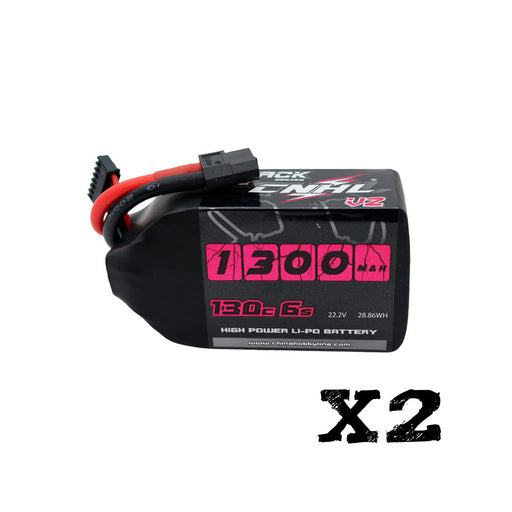
בדיקת התאמה מהירה ה2 Packs CNHL Black Series V2.0 1300mAh 22.2V 6S 130C LiPo Battery with XT60 Plug מתאים היטב למטיסי FPV שרוצים סוללת 6S 1300mAh X...
הצג פרטים מלאיםחלקי חילוף ותמיכה לטווח ארוך אנו יודעים שעבור טייסי RC, תמיכה אמינה בחלקי חילוף היא חלק חשוב בשמירה על מטוס כשיר לטיסה במשך שנים. לכן CNHL מת...
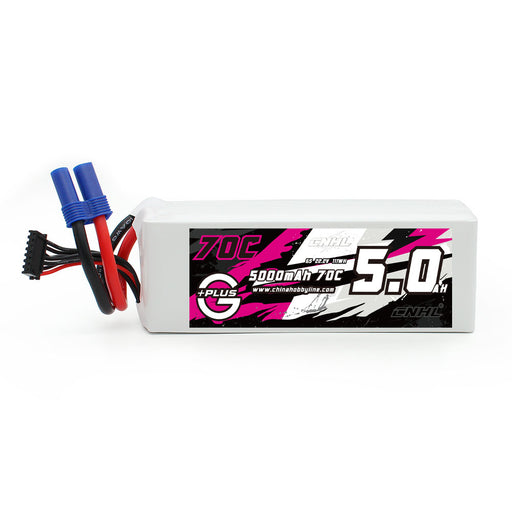
הצג פרטים מלאיםמפרטים: מספר מלאי: 500706EC5 קיבולת: 5000mAh מתח: 22.2V / 6 תאים / 6S1P קצב פריקה: 70C רציף / 140C פיצוץ קצב טעינה: 5C מקסימום גודל (הבדל של 1-5 ...
הצג פרטים מלאים
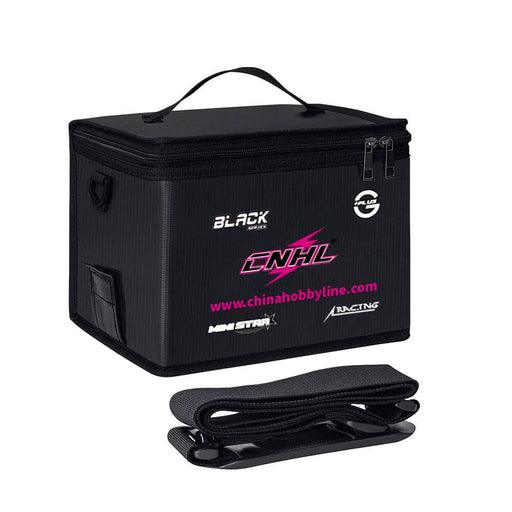
תיק סוללות LiPo של CNHL מיועד לטעינה, הובלה ואחסון בטוחים יותר של סוללות LiPo בבית או בשדה. הוא מוסיף שכבת הגנה פרקטית על ידי סיוע במניעת התפשטות ח...
הצג פרטים מלאים

בדיקת התאמה מהירה חבילת 2 CNHL Speedy Pizza Series Pro 1350mAh 6S 150C LiPo עם תקע XT60 מיועדת לטייסי FPV בגודל 5 אינץ' שרוצים מערכת 6S חופשית ...
הצג פרטים מלאים

Quick Fit Check The CNHL Speedy Pizza Series 2200mAh 22.2V 6S 120C LiPo Battery with XT60 Plug combines the familiar 2200mAh 6S format with a ligh...
הצג פרטים מלאים

Quick Fit Check The CNHL Speedy Pizza Series 2200mAh 14.8V 4S 120C LiPo Battery with XT60 Plug combines a widely used 2200mAh 4S format with a sli...
הצג פרטים מלאים

Quick Fit Check The CNHL Speedy Pizza Series 2200mAh 11.1V 3S 120C LiPo Battery with XT60 Plug takes the familiar 3S 2200mAh aircraft battery form...
הצג פרטים מלאים

The CNHL Long Range Series BAK 50D 5000mAh 21700 Li-ion battery cell is designed for custom high-energy battery packs that need a strong balance be...
הצג פרטים מלאים

The ISDT C4 EVO is a versatile smart battery charger built for AA, AAA and cylindrical rechargeable cells from compact 10440 batteries all the way ...
הצג פרטים מלאים


Leave a comment