

CNHL Lipo Batteries
CNHL aim at providing high-quality Li-Po batteries and RC products to all hobby enthusiasts with excellent customer services and competitive prices
The Flybeam name brings back memories for many RC pilots. Years ago, the original hobbyking Flybeam earned a reputation as a fun and distinctive night flyer. With the Flybeam V2, hobbyking did not try to reinvent the concept. Instead, the focus was on making the aircraft lighter, more practical, and better suited to how people actually fly today.

The timing of the Flybeam V2 makes sense. Shorter days, longer evenings, and cooler seasons naturally push pilots toward dusk and low-light flying. The Flybeam 2 fits neatly into that window, offering a familiar airframe with refinements that make it easier to enjoy those extra flying hours.
Rather than chasing a new look or bigger dimensions, hobbyking kept the proportions close to the original Flybeam. The real story of the V2 is not about size—it is about how the airplane feels in the air.
On paper, the Flybeam V2 looks very similar to the earlier Flybeam. In practice, several subtle changes add up to a noticeable difference in flight behavior.
The biggest shift is weight. The Flybeam 2 now uses EPO foam instead of the heavier material found on the original version. The finish is smoother, and the airframe sheds unnecessary mass where it matters most.
The LED system also received a major update. Older, heavier LED boards have been replaced by modern sealed LED strips. These are lighter, more efficient, and far less sensitive to moisture—an important detail when flying early in the morning or late in the evening, when grass is often damp.

It is easy to think of the Flybeam 2 as “just” a night plane, but that misses the point of the V2 update. In demonstrations, hobbyking repeatedly emphasizes that the Flybeam V2 is first and foremost a sport model.
The high-wing layout gives it natural stability, but control response is crisp enough for relaxed aerobatics. Loops, stall turns, gentle rolls, and smooth cruising passes all feel predictable. This balance makes the Flybeam 2 equally enjoyable in full daylight and in fading light.
Night flying is an added advantage, not the sole purpose. The LEDs extend usable flying time, but the underlying airframe is what makes the experience comfortable.

Several V2 changes only reveal their value on the ground. The landing gear now rakes forward, wheel pants are removed, and the wheels are larger. These updates improve handling on grass and uneven surfaces, especially during cooler months.
The inclusion of a reverse-capable ESC is another practical touch. Reverse thrust is not about showmanship—it helps with taxi control, short landings, and repositioning on tighter fields.

The Flybeam 2’s LED system is designed with orientation in mind. Clear color separation between left and right, strong contrast between top and bottom surfaces, and flashing wingtips all work together to keep the aircraft readable at a distance.
One interesting detail is that the LEDs remain visible even in bright daylight. That extra visibility helps during fast passes or when flying against a bright sky, not just at night.

The Flybeam 2 is designed around a 12V LED system, which is why it is a 3S-only aircraft. Staying within that voltage range protects the LEDs and keeps the system operating as intended.
Some pilots also consider a 3S LiHV pack as a practical upgrade option, as it stays within the safe voltage window while offering slightly higher energy density.
For pilots who want a clean and well-matched setup, this collection breaks down suitable options for the Flybeam 2: 3S battery recommendations for hobbyking Flybeam V2
The Flybeam V2 keeps a more traditional assembly process. Wing halves and the tailplane require gluing, but alignment is straightforward when using the wing bolts as a reference.
It is not a five-minute snap-together model, but it is a one-evening build that rewards careful setup with reliable results.

The hobbyking Flybeam V2 is not aimed at speed records or extreme 3D aerobatics. Instead, it suits pilots who value smooth handling, good visibility, and the flexibility to fly outside the narrow window of midday sunlight.
If you enjoy relaxed sport flying, want to extend your flying sessions into the evening, and appreciate a design that favors real-world usability over hype, the Flybeam 2 fits that role well.
CNHL aim at providing high-quality Li-Po batteries and RC products to all hobby enthusiasts with excellent customer services and competitive prices
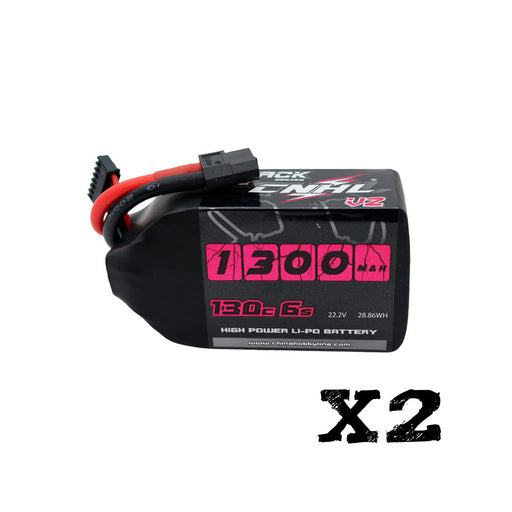
Quick Fit Check The 2 Packs CNHL Black Series V2.0 1300mAh 22.2V 6S 130C LiPo Battery with XT60 Plug is a strong fit for FPV pilots who want a prov...
View full detailsSpare Parts & Long-Term Support We know that for RC pilots, reliable spare parts support is an important part of keeping an aircraft fl...
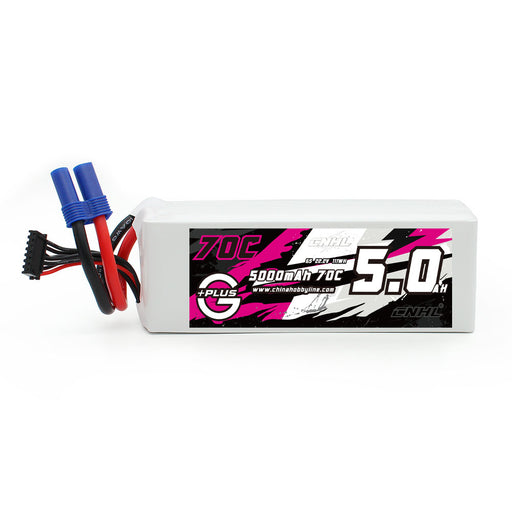
View full detailsSpecifications: Stock Number: 500706EC5 Capacity: 5000mAh Voltage: 22.2V / 6-Cell / 6S1P Discharge Rate: 70C Continual / 140C Burst Charge Rate: ...
View full details
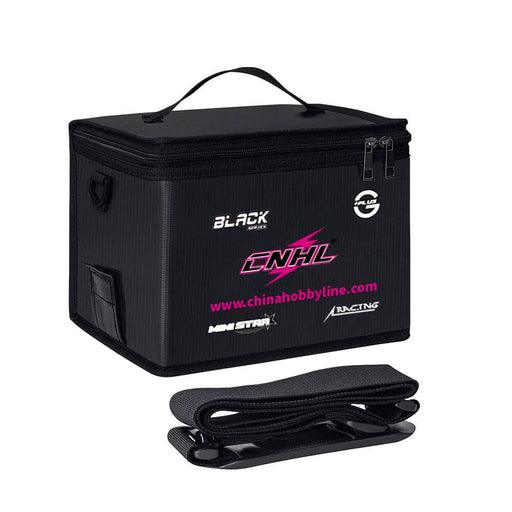
The CNHL LiPo Battery Bag is designed for safer LiPo charging, transport, and storage at home or at the field. It adds a practical layer of protect...
View full detailsQuick Fit Check The 2 Packs CNHL Speedy Pizza Series Pro 1350mAh 6S 150C LiPo Battery with XT60 Plug is built for 5-inch FPV pilots who want a ...
View full details

The CNHL Long Range Series BAK 65E 6350mAh 21700 Li-ion battery cell is built around one clear priority: maximum stored energy from a lightweight c...
View full details

The CNHL Long Range Series BAK 50D 5000mAh 21700 Li-ion battery cell is designed for custom high-energy battery packs that need a strong balance be...
View full details

The ISDT C4 EVO is a versatile smart battery charger built for AA, AAA and cylindrical rechargeable cells from compact 10440 batteries all the way ...
View full details

The CNHL Long Range Series 6350mAh 21.6V 6S1P 21700 Li-ion battery combines six BAK 65E high-energy cells into a 137.16Wh pack designed for ultra-e...
View full details

The CNHL Long Range Series 5000mAh 21.6V 6S1P 21700 Li-ion battery combines six BAK 50D cells into a compact 108Wh pack designed around long-range ...
View full details




Leave a comment