Spare Parts & Repair Support
For RC pilots, reliable spare parts support is an important part of long-term aircraft ownership. That is why CNHL provides a dedicated replacement parts range for the CNHL KAVAN Pulse 2200 V2, making it easier to repair, rebuild, and keep the glider flying after normal wear, transport damage, or harder landings.
Available support includes key replacement parts such as the fuselage, left and right wing set, horizontal stabilizer, canopy/battery hatch, linkage hardware set, 3548-750KV brushless outrunner motor, 11x8 folding prop blades, and folding prop spinner.
Whether you need to rebuild a damaged airframe section, replace worn control hardware, or restore the nose and power system after a prop strike, the dedicated Pulse 2200 V2 parts page makes it easier to find the correct components for this aircraft.
For current parts and availability, visit the CNHL KAVAN Pulse 2200 V2 spare parts collection.
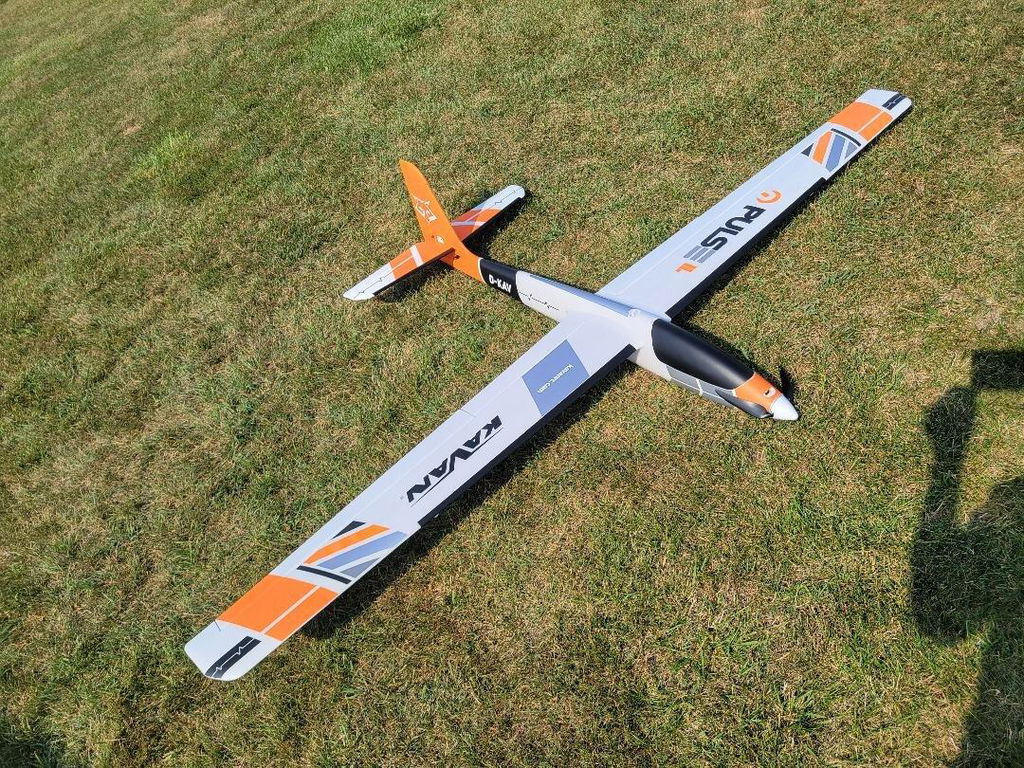
The KAVAN Pulse 2200 V2 PNP Glider in orange is a 2206mm full-house electric sport glider for pilots who already understand aileron control, coordinated turns, energy management, and the added setup depth that comes with separate flaps. It is not intended to be a first RC airplane, but it makes a strong progression model for pilots moving beyond basic trainers and simpler powered gliders.
The Pulse 2200 V2 covers a wider flight envelope than a slow thermal-only sailplane. It can climb confidently on 4S power, search for lift, work a slope, perform fast powered passes, and handle light sport-glider aerobatics. Its large-span presence, crisp control response, effective crow braking, and distinctive sound at speed give it a more energetic personality than many conventional foam motor gliders.
Quick Fit Check
Best for: intermediate to moderately advanced pilots looking for thermal flying, slope soaring, powered sport gliding, and light aerobatics in one airframe.
Skill level: not recommended as a first RC aircraft; best for pilots already comfortable with aileron-equipped trainers, sport models, or entry-level full-house gliders.
Official battery recommendation: 4S 14.8V LiPo, 2600-4000mAh, minimum 30C, with XT60.
Radio: minimum 6 channels; a 7-channel or higher computer radio is recommended for more flexible aileron, flap, differential, and crow setup.
Needed to complete: transmitter, receiver, 4S flight battery, compatible charger, and normal modelling tools.
Important Folding Prop Brake Check
Before the first flight, verify that the folding propeller stops promptly when the throttle is fully closed. If the propeller continues to windmill, it creates additional drag and can noticeably reduce glide performance, stall-turn response, thermal efficiency, and landing control.
The installed speed controller is the KAVAN R-50SB Plus. Its factory settings list both Brake Type and Brake Force as disabled, so the brake setting should be checked before flying.
Recommended tested setup: set Brake Type to Normal and Brake Force to Medium. Medium corresponds to approximately 90% braking force in the official KAVAN Plus ESC manual.
How to Enable the Folding Prop Brake with Your Transmitter
Safety first: remove the propeller before entering ESC programming mode. Keep the aircraft secure and keep clear of the motor and propeller shaft.
- Turn on the transmitter and move the throttle stick to the full-throttle position.
- Connect the flight battery to the ESC. Wait for the ESC to enter programming mode and begin cycling through the programmable items.
- When you hear one short beep, move the throttle stick to the bottom position within three seconds. This selects Brake Type.
- The ESC will now cycle through the Brake Type values. When you hear two short beeps, move the throttle stick back to the top position. This saves Brake Type: Normal.
- The ESC will return to the programmable-item cycle. When you hear two short beeps, move the throttle stick to the bottom position within three seconds. This selects Brake Force.
- The ESC will cycle through the Brake Force values. When you hear three short beeps, move the throttle stick back to the top position. This saves Brake Force: Medium.
- Wait for the Exit signal, consisting of two long beeps followed by one short beep, and move the throttle stick to the bottom position within three seconds to exit programming mode.
- Disconnect the flight battery. Return the throttle stick to its normal bottom position before reconnecting the battery.
- With the propeller still removed, verify normal throttle operation and confirm that the motor stops promptly when the throttle is closed.
- Only reinstall the propeller after the radio and ESC settings have been confirmed. Secure the aircraft and perform a final low-power folding-prop brake check before flight.
Programming tones must be selected within the time window described above. If the wrong item or value is selected, disconnect the battery and repeat the procedure.
View the official KAVAN Plus ESC instruction manual
Battery and CG Note
Battery choice on the Pulse 2200 V2 is not only about capacity or flight time. Pack weight and position directly affect the balance and handling of the aircraft. Start within the recommended 75-85mm CG range behind the leading edge, and confirm the final CG with the exact battery you intend to fly.
Product Specifications
| Product Type |
PNP electric sport glider / motor-powered sailplane |
| Wingspan |
2206mm |
| Overall Length |
1266mm |
| Wing Area |
41.8dm² |
| Weight |
1800g |
| Flying Weight |
2100-2250g |
| Motor |
KAVAN C3548-750 brushless motor |
| ESC |
KAVAN R-50SB Plus 50A ESC with switching SBEC |
| Propeller |
11×8 folding propeller |
| Installed Servos |
6 micro servos installed: 4 × 17g and 2 × 9g |
| Control Functions |
Throttle, rudder, elevator, ailerons, and flaps |
| Recommended Battery |
4S 14.8V LiPo, 2600-4000mAh, minimum 30C, with XT60 |
| Radio Requirement |
Minimum 6 channels; 7+ channel computer radio recommended for independent flap and aileron mixing |
| CG Range |
75-85mm behind the leading edge |
| Airframe Material |
Carbon-reinforced EPO foam |
| Special Features |
Two-piece wing, detachable tailplane, folding propeller, full-house wing with flaps, magnetic canopy, and upgraded V2 servo and linkage components |
| Needed to Complete |
Receiver, transmitter, 4S LiPo battery, charger, and basic assembly tools |
| Stock Number |
KAV02.8091 |
Quick Take and Pilot Fit
The Pulse 2200 V2 sits between a relaxed foam sailplane and a more aggressive warm-liner. It still glides and searches for lift like a proper motor glider, but it carries more speed, sharper control response, and more powered-flight personality than a basic thermal platform.
It is best suited to pilots who have already flown an aileron-equipped trainer, sport airplane, or smaller electric glider. Pilots should be comfortable managing airspeed, using rudder when required, planning an approach, and checking control and radio setup before flight.
The removable two-piece wing and detachable tailplane make transport manageable, but this is still a genuine 2206mm aircraft. Buyers should plan for adequate vehicle space, home storage, and a flying area appropriate for a large and relatively fast powered glider.

What the Pulse 2200 V2 Feels Like in the Air
Once the aircraft is balanced and the radio setup is refined, the Pulse 2200 V2 tracks cleanly and responds with noticeably more precision than a slow, lightly loaded foam glider. It can cruise calmly, but it also carries energy well enough for fast passes, loops, rolls, inverted flight, stall turns, and other light sport-glider manoeuvres.
One of its most distinctive characteristics is the sound. The motor, folding propeller, and large wing create a noticeable whistle or scream during powered climbs and faster passes. Early viewers repeatedly highlighted the sound, speed, and locked-in tracking as some of the aircraft’s most memorable qualities.
The model is best understood as a sport glider with mild warm-liner character, rather than a slow thermal-only sailplane. It is still capable of relaxed soaring, but it has enough power and control authority to feel lively when the pilot wants a more energetic flight.
The installed C3548-750 brushless motor and 11×8 folding propeller provide strong climb performance on 4S without changing the aircraft into a conventional sport airplane with long wings. When the propeller brake is working correctly and the blades fold against the fuselage, the Pulse returns to a cleaner and more efficient gliding state.
Independent Flight Review Highlights
- Crisp and accurate control response with a fast sport-glider feel
- Distinctive sound during powered climbs and high-speed passes
- Stable, locked-in tracking when the model is correctly balanced and configured
- Effective crow braking for steep, controlled approaches
- Successful test flight with a lighter 4S 2200mAh battery
- Longer flight time and a more planted balance with a 4S 3200mAh battery
- Folding propeller brake should be checked before the first flight
- Visible wing flex means extreme and repeated high-G flying should be avoided
Real-World 4S Battery Choices
Our recommendation is a 4S 14.8V LiPo from 2600mAh to 4000mAh with at least a 30C discharge rating and an XT60 connector.
| Battery Size |
Expected Flight Character |
Fit and Setup Note |
| 4S 2200mAh |
Lighter and more responsive. One active mixed-flight test produced approximately eight minutes. |
Below the official capacity recommendation. Check for a rearward CG and secure the smaller pack carefully. |
| 4S 2600-3200mAh |
Balanced all-around range with more useful reserve for repeated climbs. A tested 3200mAh pack gave a more planted feel. |
A practical starting range when the individual pack dimensions and final CG are suitable. |
| 4S 3300-4000mAh |
Longer powered sessions and a heavier, steadier feel. |
Check pack length, width, height, wire exit, connector position, and CG. Packs with the same capacity can differ significantly in size. |
CG matters more than headline capacity. Confirm the actual pack dimensions, cable clearance, canopy closure, battery restraint, and final 75-85mm CG before flight.
To browse suitable options, see our battery collection for the KAVAN Pulse 2200 V2.

First-Flight Setup Notes
Treat the first flights as setup flights rather than a final judgment of the airframe. The Pulse 2200 V2 responds clearly to battery position, CG, control rates, differential, flap compensation, and folding-prop brake configuration.
Begin inside the recommended CG range, use the manufacturer’s initial control throws, verify every control direction, and confirm that the motor stops correctly at closed throttle. If the aircraft feels unusually sensitive in pitch, check battery position and CG before making major conclusions about the model.
A lighter battery may give the Pulse a more agile feel but can also move the balance rearward. A heavier pack can make the aircraft feel steadier, but excess battery weight should not be used as a substitute for correct pack placement and proper radio setup.
Before launching, also confirm:
- The folding propeller stops promptly at closed throttle
- The propeller blades fold freely against the fuselage
- The battery is securely restrained
- The canopy closes without pressing against the battery or wires
- Ailerons, flaps, elevator, and rudder move in the correct direction
- Flap and crow deployment do not create an unexpected pitch change
- The receiver and antenna installation have passed a normal range check
Radio, Flaps, and Crow Braking
A basic 6-channel radio can get the Pulse 2200 V2 flying through the included connection arrangement, but a 7-channel or higher computer transmitter is the better choice for pilots who want more independent control over the ailerons and flaps.
Additional radio flexibility makes it easier to configure aileron differential, flap-to-elevator compensation, flight modes, spoileron functions, and butterfly braking. These are not merely optional programming exercises on this aircraft. They can materially improve turning behaviour, speed control, and landing accuracy.
Butterfly, also commonly called crow braking, is particularly effective on the Pulse 2200 V2. Independent flight testing showed a steep and controllable descent while the aircraft retained useful roll authority. That makes crow valuable for shortening an approach, controlling excess energy, and placing the model more accurately on landing.
Some elevator compensation may be required when deploying flaps or crow. The exact amount depends on the final CG, control travel, radio programming, and pilot preference, so begin conservatively and refine the mix at a safe altitude.
Airframe, Transport, and Structural Limits
The carbon-reinforced EPO construction gives the Pulse 2200 V2 a more practical ownership experience than a fragile composite competition sailplane. The foam structure is suitable for regular powered climbs, soaring, grass landings, and moderate sport-glider manoeuvres.
The two-piece wing is reinforced with carbon components and joined through the fuselage with an aluminium joiner. Together with the detachable horizontal tailplane, this keeps the 2206mm airframe more manageable for transport and storage.
The V2 specification also includes stronger, faster servos and more precise ball-link style control hardware. These changes support the crisp and confident control response noted during early flights and make the V2 more than a purely cosmetic update.
The Pulse can perform loops, rolls, inverted passes, stall turns, and other light aerobatic manoeuvres, but it remains a large EPO sailplane rather than a dedicated high-G aerobatic aircraft. Visible wing flex may occur during aggressive loading. Repeated hard pull-outs, abrupt reverse-G inputs, extreme overspeed, and violent high-load manoeuvres should therefore be avoided.

What to Know Before You Buy
The Pulse 2200 V2 rewards pilots who enjoy setup as well as flying. Battery position, CG, propeller braking, flap travel, differential, and crow programming all influence the final experience. A better transmitter and a careful first-flight setup allow the airframe to show substantially more of its potential.
This is also a physically large model. Although the wing and tail can be removed, buyers should still account for assembly space, transport space, storage, and a flying site that provides enough room for fast passes and a safe approach.
The aircraft includes underside protection components that may be useful when operating from rougher, stony, or abrasive landing surfaces. Pilots flying from smooth grass may choose a different setup, but the protective parts provide an additional ownership option.
For assembly information, control settings, CG guidance, and current ESC instructions, review the KAVAN Pulse 2200 V2 instruction manual before flight.
For replacement and support items, browse our KAVAN Pulse 2200 V2 spare parts and accessories.
What Is Included in the Box
- EPO fuselage with installed brushless motor, 50A ESC, folding propeller, and servos
- EPO two-piece wing with installed servos
- EPO horizontal tailplane
- Airframe hardware and related assembly components
- Instruction manual
You Will Also Need
- Compatible receiver
- Transmitter / RC radio system
- 4S 14.8V LiPo battery with XT60
- Compatible balance charger
- Basic modelling tools such as screwdrivers, pliers, and a hobby knife
FAQ
Is the KAVAN Pulse 2200 V2 a good beginner RC plane?
No. It is better suited to intermediate or moderately advanced pilots with previous experience flying aileron-equipped trainers, sport airplanes, or electric gliders.
What battery does the Pulse 2200 V2 use?
The official recommendation is a 4S 14.8V LiPo from 2600mAh to 4000mAh, with at least a 30C discharge rating and an XT60 connector.
What battery size is a practical starting point?
A correctly sized 4S battery around 2600-3200mAh is a practical starting range for many pilots. It can provide a useful balance between flight time, battery weight, and CG adjustment. Always confirm the dimensions and final 75-85mm CG with the exact pack being used.
Can the Pulse 2200 V2 fly with a 4S 2200mAh battery?
Yes. A 4S 2200mAh 30C battery was successfully tested and produced approximately eight minutes of active mixed flying. It is below the official capacity recommendation, however, and the lighter weight may move the CG rearward.
How long can it fly with a 4S 3200mAh battery?
One independent test produced approximately fourteen and a half minutes with a 4S 3200mAh 50C battery. Flight time will vary significantly with throttle use, climb frequency, weather, battery condition, and flying style.
Why is the folding propeller brake important?
If the propeller continues to windmill after the throttle is closed, it adds drag and reduces the aircraft’s ability to glide cleanly. Proper braking allows the blades to stop and fold against the fuselage.
Does the ESC brake come correctly configured from the factory?
Factory settings can vary. Check the propeller response before the first flight and make sure any programming instructions match the installed KAVAN R-50SB Plus ESC.
Does the PNP version include the motor, ESC, and servos?
Yes. The PNP package includes the installed C3548-750 brushless motor, R-50SB Plus 50A ESC, folding propeller, and six servos.
How many radio channels are required?
A minimum 6-channel radio can get the aircraft flying, but a 7-channel or higher computer radio is recommended for more flexible independent aileron and flap programming.
What is crow braking?
Crow braking, also called butterfly braking, raises the ailerons while lowering the flaps. This creates drag and a steeper descent while retaining useful roll control, helping the pilot manage landing energy and shorten the approach.
Can the Pulse 2200 V2 perform aerobatics?
Yes. It can perform light sport-glider aerobatics such as loops, rolls, inverted passes, and stall turns. It is not designed for repeated extreme high-G or violent reverse-G manoeuvres.
Is the tail removable for transport?
Yes. The horizontal tailplane is detachable, and the two-piece wing also makes storage and transport more manageable.
What is the most important first-flight setup point?
Start with the correct CG. Confirm the aircraft balances within the recommended 75-85mm range, and also check the folding propeller brake, control directions, flap compensation, battery restraint, and receiver range before launching.
What makes the V2 version different?
The V2 specification includes stronger and faster servos together with more precise ball-link style control hardware, supporting cleaner and more confident control response.
Complete Your Setup
Best batteries for the KAVAN Pulse 2200 V2
KAVAN Pulse 2200 V2 spare parts and accessories
KAVAN Pulse 2200 V2 online instruction manual
KAVAN Plus ESC programming and instruction manual
Shop all CNHL RC planes
LiPo battery chargers