Quick Fit Check
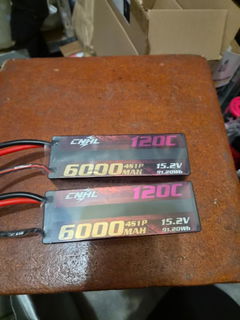
The CNHL Racing Series 5200mAh 22.2V 6S 90C LiPo Battery with QS8 Plug is a high-current 6S battery for performance RC boats, speed-run cars, large electric aircraft and other demanding systems already configured around a QS8 power connection.
Compared with the EC5 version of the same 5200mAh Racing Series battery, this QS8 version uses 8AWG output wire and a QS8 connector, making it particularly relevant to builds where connector and cable capacity are part of a high-current power system.
Before ordering, confirm that your model supports standard 6S LiPo voltage, accepts the 160 × 55 × 45mm battery dimensions and approximately 790g weight, and uses a compatible QS8 connection or properly engineered connector arrangement.
| Check Item |
Your Model Should Match |
This Battery |
| Cell Count |
Standard 6S LiPo system |
22.2V nominal / 6S1P |
| Maximum Voltage |
ESC supports a fully charged standard 6S LiPo |
25.2V fully charged |
| Battery Space |
Tray or bay accepts a full-size 6S pack |
160 × 55 × 45mm |
| Installed Weight |
Model can safely carry and balance the battery |
Approx. 790g |
| Connector |
QS8-compatible power system |
QS8 Plug |
| Power Demand |
Battery, connector and wiring suit the actual system load |
90C continuous / 180C burst |
Product Specifications
| Capacity |
5200mAh |
| Nominal Voltage |
22.2V |
| Cell Configuration |
6S |
| Nominal Energy |
115.44Wh |
| Fully Charged Voltage |
25.2V / 4.20V per Cell |
| Discharge Rate |
90C Continuous / 180C Burst |
| Maximum Charge Rate |
5C |
| Output Connector |
QS8 Plug |
| Balance Connector |
JST-XH 7-Pin |
| Dimensions (L × W × H) |
160 × 55 × 45mm |
| Approx. Weight |
790g |
| Wire Gauge |
8AWG |
| Stock Number |
520906QS8 |
Battery dimensions may vary by approximately 1–5mm, and weight tolerance is approximately ±5g.
5200mAh 6S Power with QS8 and 8AWG Wiring
The defining feature of this version of the CNHL Racing Series 5200mAh 6S 90C LiPo is its high-current connection package.
The battery combines a QS8 output connector with 8AWG power wires, making it particularly relevant to RC boats, speed-run cars and other high-output systems where large connectors and heavy-gauge wiring are already part of the electrical setup.
The 5200mAh capacity remains a useful middle ground: enough energy for serious performance use without immediately moving into the additional size and weight of 6200mAh, 8000mAh or 10000mAh-class batteries.
Why Choose This Battery?
-
5200mAh capacity: A practical balance of usable energy, size and battery weight.
-
90C continuous output: Built for demanding high-current RC applications.
-
QS8 connector: Particularly relevant to high-power boat, speed-run and custom electric systems.
-
8AWG power wires: Heavier wiring than many conventional 6S RC battery configurations.
-
Single 6S configuration: Provides 22.2V nominal power from one pack.
-
Standard LiPo chemistry: Maximum charge voltage is 25.2V; no LiHV mode is required.
A Strong 6S Battery Choice for the TFL Zonda 1133
For a 6S-capable TFL Zonda 1133 RC catamaran, the CNHL Racing Series 5200mAh 6S 90C QS8 offers a particularly relevant combination of capacity, connector type and heavy-gauge wiring.
The 5200mAh capacity provides slightly more energy than a typical 5000mAh pack while keeping the battery within a practical size class for high-performance boat installations. Its approximately 160 × 55 × 45mm dimensions should still be checked against the specific battery location and retention arrangement in the boat.
The QS8 connector and 8AWG wires make this version especially suitable for Zonda builds that have already been configured around a high-current QS8 power system. In that situation, the battery avoids introducing a smaller connector into an otherwise high-current electrical path.
TFL Zonda 1133 boats have appeared with different ESCs, motors and owner-modified power systems, so the model name alone does not establish battery compatibility. Confirm the exact voltage setup, battery space, QS8 connection, hull balance, cooling lines and wire routing before installation.
For more 6S options selected around this high-performance catamaran, explore the LiPo Batteries for the TFL Zonda 1133.
6S Battery for High-Performance RC Boats
This 5200mAh QS8 pack is particularly well suited to compatible high-power RC boats that operate on 6S and already use QS8 connectors.
Marine battery selection should consider more than voltage and capacity. Battery position affects hull trim and side-to-side balance, while cable routing must stay clear of shafts, couplers, cooling lines and other moving components.
The 90C specification provides substantial current capability, but actual current draw is determined by the motor, propeller, ESC, timing, cooling and operating conditions. Always evaluate the complete power system rather than selecting a battery solely from its C rating.
6S QS8 Battery for Speed Run Builds
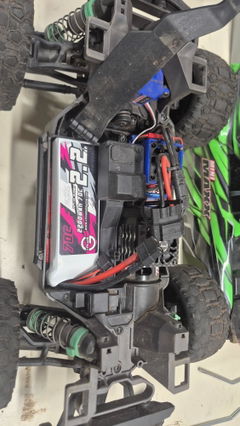
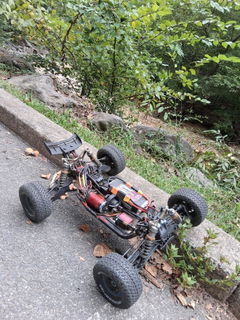
The combination of 90C discharge capability, QS8 connector and 8AWG wires also makes this battery relevant to high-current RC speed-run builds.
Speed-run cars can draw substantial current during launch and sustained high-speed acceleration, making battery condition, wiring resistance, connector quality and ESC setup especially important.
A single 6S pack can be used in a compatible 6S build, while multiple matched batteries may be incorporated into higher-voltage custom systems according to the ESC and motor configuration.
Do not assume compatibility based only on chassis name. Platforms such as ARRMA Limitless, HoBao VTE2 and other speed-run chassis are frequently modified with very different motors, ESCs, gearing and voltage arrangements.
Two 6S Packs for the Phoenix Model F4U Corsair 85″ 12S Setup
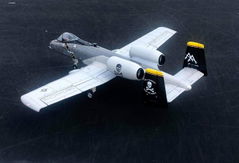
The Phoenix Model F4U Corsair 85″ electric configuration can use a 12S power system built from two matching 6S batteries connected in series.
Two CNHL Racing Series 5200mAh 6S packs connected in series create a 44.4V nominal 12S 5200mAh system. Series connection doubles voltage but does not double capacity, so the resulting setup remains 5200mAh.
| Configuration |
Nominal Voltage |
Fully Charged Voltage |
Capacity |
| 1 × 6S 5200mAh |
22.2V |
25.2V |
5200mAh |
| 2 × 6S in series |
44.4V / 12S |
50.4V |
5200mAh |
For a series setup, use two batteries of the same model, age, condition and state of charge. Both packs should also be secured so they cannot shift under takeoff, aerobatic or landing loads.
For additional matched-pack choices, see the 12S Battery Collection for the Phoenix Model F4U Corsair 85″.
QS8 vs. EC5: Which Version Should You Choose?
CNHL offers 5200mAh 6S Racing Series batteries with different output connectors because connector choice should match the complete RC power system.
| Feature |
5200mAh QS8 Version |
5200mAh EC5 Version |
| Connector |
QS8 |
EC5 |
| Output Wire |
8AWG |
10AWG |
| Primary Direction |
High-current boats, speed runs and custom builds |
EDF aircraft and EC5/IC5-equipped systems |
| Best Choice |
Model already configured for QS8 |
Model already configured for EC5 or IC5 |
Neither connector automatically makes the battery perform better in every model. The best choice is normally the connector already used by the ESC and power system, avoiding unnecessary adapters and additional connection points.
5200mAh vs. 6200mAh 6S Battery
The 5200mAh pack prioritizes a more moderate battery size and weight, while a 6200mAh battery provides additional stored energy for runtime-focused applications.
For boats and speed-run cars, the right capacity depends on battery space, hull or chassis balance and the additional mass the model can carry without compromising handling.
For aircraft, added battery mass has an even more direct effect on takeoff weight and center of gravity, so larger capacity is not automatically better.
More 6S Battery Options
For a lighter 6S setup with an EC5 connection, compare the CNHL G+Plus 5000mAh 6S 70C with EC5.
If you need more capacity, compare the CNHL Racing Series 6200mAh 6S 90C with EC5.
FAQ
What is this 5200mAh 6S QS8 battery best used for?
It is particularly well suited to compatible high-current 6S RC boats, speed-run cars and custom electric systems that already use a QS8 connection.
Is this a standard LiPo or LiHV battery?
This is a standard 6S LiPo battery. Its nominal voltage is 22.2V and its maximum balanced charge voltage is 25.2V, or 4.20V per cell.
Why does this battery use 8AWG wire?
The QS8 version is configured with heavier 8AWG output wiring for high-current applications. Actual current still depends on the motor, ESC and complete electrical system.
Can this battery be used in the TFL Zonda 1133?
It is a strong option for 6S-capable Zonda builds already configured around QS8. Because different Zonda installations can use different ESCs, motors and connectors, confirm the exact battery space, voltage setup and wiring before use.
Can two of these batteries make a 12S setup?
Yes. Two matching 6S batteries connected in series create a 12S 5200mAh system with 44.4V nominal voltage and 50.4V fully charged voltage.
Does two 5200mAh batteries in series become 10400mAh?
No. Series connection doubles the voltage while capacity remains 5200mAh.
Should I use an adapter to connect QS8 to EC5 or XT90?
A properly rated adapter can be used in some installations, but high-current systems benefit from minimizing unnecessary connection points. For demanding boat and speed-run applications, a connector configuration matched directly to the ESC is generally preferable.
Should this battery always be charged at 5C?
No. The 5C specification is the maximum charge rate, not the required routine rate. A balanced 1C charge rate is a practical everyday choice when charging time is not the priority.
Notice
- This is a standard 6S LiPo battery with a maximum charge voltage of 4.20V per cell.
- Use a compatible LiPo balance charger and select the correct six-cell setting.
- Confirm the 160 × 55 × 45mm dimensions, approximately 790g weight and QS8 connector before use.
- Do not assume a model is compatible simply because it supports 6S; battery space, connector, current demand and weight must also match.
- For series use, use batteries of the same model, age, condition and state of charge.
- Secure the battery firmly and keep output and balance wires away from shafts, couplers, propellers, gears and sharp edges.
- For RC boats, confirm hull trim, battery restraint, cooling-line clearance and hatch clearance before running.
- Never charge unattended, and do not use a swollen, punctured, damaged or overheated battery.
- Allow the pack to cool before recharging and use storage mode when the battery will not be used for an extended period.