
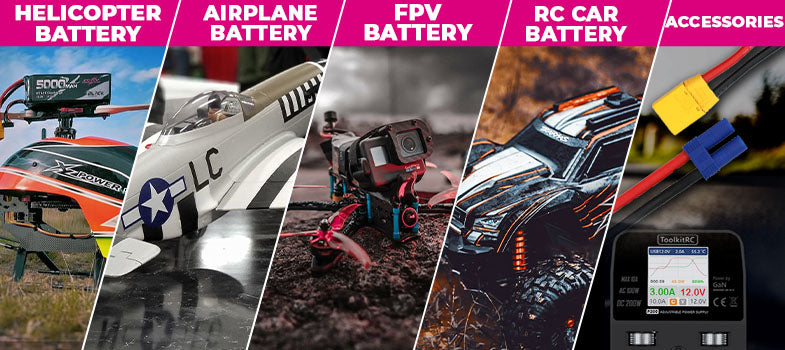
CNHL Lipo Batteries
CNHL aim at providing high-quality Li-Po batteries and RC products to all hobby enthusiasts with excellent customer services and competitive prices
The Durafly EFXtra and Eflite V900 represent one of the most appealing ideas in high-speed electric RC flight: make the airplane small, keep the mechanical layout simple, give it enough power to comfortably break the 100 MPH barrier, and let performance rather than complexity provide the excitement.
That common formula makes the two aircraft natural competitors. The EFXtra measures 975mm across the wing and uses a 3S/4S 60A power system. The V900 is slightly smaller at 900mm, also operates on 3S or 4S, and was engineered around a 60A power system capable of substantially higher performance when moving from 3S to 4S.
But comparing them only by advertised top speed misses the point. A compact speed plane has to do much more than produce one fast pass. It has to launch predictably, hold a clean line, remain visible at distance, tolerate repeated high-load maneuvers, accept practical battery sizes and eventually slow down enough to come home without turning every landing into an event.
The EFXtra and V900 solve those requirements differently, and those differences are more useful than simply declaring one aircraft the winner.

| Feature | Durafly EFXtra | Eflite V900 |
|---|---|---|
| Wingspan | 975mm | 900mm |
| Construction | Reinforced EPO foam | Composite-reinforced EPO foam |
| ESC | 60A AeroStar | 60A brushless ESC |
| Battery Voltage | 3S / 4S | 3S / 4S |
| Recommended Battery | 2200–2600mAh 3S or 1800–2400mAh 4S | 1800–2200mAh 3S or 4S |
| Published Speed | 100+ MPH on 4S | 100+ MPH on 3S / 120+ MPH on 4S |
| 3S Propeller | 8x6 | Same factory prop used for 3S/4S operation |
| 4S Propeller | 7x6.5 | Same factory prop used for 3S/4S operation |
| Typical Stabilization | Depends on receiver selected by pilot | AS3X / SAFE Select available on BNF version |
| Takeoff | Hand launch | Hand launch |
| Landing | Belly landing | Belly landing |
The simplest difference is this: the V900 pursues a higher stock speed target from a slightly smaller airframe, while the EFXtra gives pilots a little more airframe volume and battery flexibility while retaining the same lightweight hand-launch and belly-landing philosophy.
For a pilot interested only in the larger factory MPH number, the V900 has an obvious advantage. For a pilot evaluating the entire platform, however, the decision becomes much closer.
The EFXtra is especially interesting because it was not Durafly's first attempt at this type of airplane. The original EFX Racer arrived earlier, and the EFXtra developed the same basic concept rather than replacing it with an entirely different kind of aircraft.
The changes were meaningful. The EFXtra received a clipped 975mm wing, a stronger 3536-1780KV motor, a 60A ESC, increased internal battery capacity and additional structural reinforcement. Durafly also expanded what pilots could do with the airframe by including an FPV canopy and a slope-soaring nose.
That evolution matters more today than it may appear. It shows that a compact high-speed platform does not have to become dramatically larger every time performance increases. The basic dimensions and operating simplicity can remain recognizable while the power system, structure and usability continue to improve.

The V900 was engineered around the more aggressive stock speed target. Eflite advertised 100+ MPH performance on 3S and 120+ MPH on 4S, while the EFXtra's factory 4S specification places it in the 100+ MPH class.
That makes the V900 the logical choice if the comparison is reduced to published top-speed numbers. It does not, however, mean the two airplanes occupy completely different performance levels.
At these speeds, relatively small differences in setup become increasingly visible. Propeller efficiency, battery voltage under load, battery age, motor temperature, wind direction and how cleanly the airplane enters a speed pass can all affect the result. A 4S pack that maintains voltage well under load can make a noticeably different airplane from a pack that reaches the same voltage on the charger but sags heavily at full throttle.
The airframes themselves also deliver speed differently. The V900 combines its smaller size with a power system designed to extract a strong increase in performance on 4S. The EFXtra trades some of that headline speed advantage for a slightly larger 975mm platform and a power setup that deliberately uses different propellers for 3S and 4S.
For practical sport flying, both sit firmly in the same category: compact foam airplanes that become very small very quickly, retain energy well and require the pilot to stay ahead of them. The V900 has the higher factory speed ceiling; the EFXtra remains close enough in overall performance that battery setup, handling preference and simplicity become legitimate reasons to choose it instead.
Both aircraft support 3S and 4S, but the way they manage the extra voltage is not identical.
The EFXtra uses an 8x6 propeller on 3S and a smaller 7x6.5 propeller on 4S. That is an important piece of engineering rather than an inconvenience.
Increasing battery voltage allows the motor to reach a higher unloaded RPM. If propeller load remains too high, current and motor temperature can rise rapidly. Durafly therefore matched a different propeller to each standard battery configuration instead of treating 3S and 4S as interchangeable battery choices.
The recommended battery range is also relatively broad:
This gives EFXtra pilots room to decide whether they prefer a lighter setup, additional runtime or a particular CG position while remaining within the intended voltage range.
The V900 takes a more plug-and-fly approach to the voltage change. Eflite designed the stock power system so pilots could move between 1800–2200mAh 3S and 4S batteries without a required propeller swap.
That simplicity is one of the V900's strongest features. A pilot can use 3S for a slightly more approachable introduction to the airframe and move to 4S when ready for the full performance envelope without rebuilding the power setup.
Capacity is only one part of battery selection in a compact speed plane.
A high-speed model can place substantial demand on a relatively small LiPo. The battery has to fit the compartment, maintain voltage under load and position correctly without forcing the aircraft outside its intended CG range.
Important checks include:
For Durafly owners, CNHL groups suitable 3S and 4S options for both platforms in the Durafly EFXtra and EFX Racer battery collection.
The EFXtra and current EFX Racer share a closely related power and battery-fitment direction, so grouping the battery choices also makes it easier to compare capacity, C rating and physical size without treating every pack as aircraft-specific.
The V900 and EFXtra also reflect two different electronics philosophies.
The V900 BNF platform combines the airframe with Spektrum stabilization. AS3X can help reduce the effect of turbulence and small disturbances, which becomes increasingly valuable as a compact airplane accelerates and moves farther away from the pilot.
The EFXtra PNF approach leaves receiver choice to the owner. That means an EFXtra may be flown without stabilization, with a conventional gyro receiver or with another stabilization system entirely.
This difference makes simplistic claims about which airframe “tracks better” difficult to defend. Stabilization can make an already good airframe appear exceptionally locked in, while a well-designed unstabilized airplane may communicate more of its natural aerodynamic behavior to the pilot.
What matters is that both platforms earned their reputation as more than one-dimensional speed machines. They can hold clean lines, perform large aerobatics and come back to manageable approach speeds rather than requiring full commitment from launch until touchdown.
One of the easiest mistakes when designing a faster RC airplane is assuming that every increase in performance also requires an increase in complexity.
The EFXtra and V900 demonstrate the opposite.
Neither needs retractable landing gear. Neither needs a large multi-piece wing. Neither requires a huge 6S battery simply to provide entertaining performance. They are compact enough to transport easily, fast to assemble at the field and mechanically simple compared with larger high-performance sport aircraft.
Hand launching also removes a substantial amount of hardware from the airframe. There are no retract units to maintain, no landing-gear doors, no wheels creating additional drag and fewer components to damage during a less-than-perfect arrival.
Belly landing obviously has its own tradeoffs, but for a lightweight speed-focused model it is not merely a cost-saving measure. It is part of the design philosophy.
Compact speed planes naturally invite experimentation. When an airplane already flies at more than 100 MPH, the temptation is always to search for another propeller, more pitch, more voltage or a larger ESC.
That is also where a well-balanced stock power system can quickly become unbalanced.
Increasing propeller diameter or pitch raises motor load. A combination that produces an impressive first pass may also produce excessive current and heat. The result can be lower efficiency, reduced motor life or an ESC operating too close to its thermal limit.
This is why the EFXtra's different 3S and 4S propeller specifications are worth paying attention to. The higher-voltage configuration does not simply add another cell while leaving everything else unchanged.
Once compact 4S foam racers reached the 100–120 MPH range, it was inevitable that enthusiasts would start exploring what came next.
The V900 in particular became a platform for higher-power experiments, including 6S conversions using upgraded electronics. Similar high-voltage experimentation has appeared around other compact speed models as well.
Those builds are interesting because they demonstrate that there is enthusiasm for substantially more performance from a small airframe. But they also expose the weakness in the idea of treating 6S as a simple battery upgrade.
A model originally engineered around 3S/4S has already made decisions about motor KV, ESC voltage limits, propeller loading, cooling, battery space, airframe reinforcement, control linkages and expected aerodynamic loads.
Changing the battery can change all of those assumptions at once.
So the more useful question is not:
“Can an EFXtra or V900 be modified to run 6S?”
It is:
“What would this type of airplane become if 6S were part of the original design target?”

This may be the more interesting direction for the compact speed-plane category.
Moving from 4S to 6S does not automatically require a larger airplane. It is possible to imagine retaining roughly the same compact 975mm-class dimensions that make the EFXtra easy to transport and operate while redesigning the electronics and structure around higher voltage from the beginning.
The important distinction is purpose-built.
A proper 6S development would require more than replacing the battery. It would need a motor KV chosen specifically for 6S, an appropriately rated ESC, a matched propeller, sufficient cooling and a battery compartment planned around the target pack rather than whatever can be squeezed into an existing space.
The airframe would also have to account for the additional performance. Higher speed can rapidly increase aerodynamic loads, so wing reinforcement, control-surface stiffness, hinges, pushrods and servo performance become part of the power-system discussion.
A compact 6S racer would therefore need to solve several requirements together:
The value of 6S is not simply that a larger voltage number sounds faster.
Electrical power is the product of voltage and current. Raising system voltage gives the designer another way to reach a required power level without relying entirely on very high current.
That can be particularly attractive in a compact speed plane where space for heavy wire, oversized connectors, large ESCs and excessive cooling is limited.
The design could also choose to use some of that additional voltage for more total power rather than only reducing current. The balance depends on the target speed, propeller, motor efficiency, airframe drag and desired flight time.
Either way, 6S becomes valuable when it is part of the system architecture—not when it is treated as a shortcut around the original 4S limitations.
The Eflite V1200 provides the obvious modern reference point because it demonstrates what a factory-developed 6S foam speed aircraft can deliver. The current 1.2m platform uses a 100A ESC, supports 4S through 6S batteries and is rated for 140+ MPH level-flight performance on 6S.
But the V1200 solves the problem by moving into a substantially different aircraft class.
At 1200mm, it is considerably larger than the 975mm EFXtra and 900mm V900. It also includes retractable landing gear, flaps, six installed servos and support for much larger 3200–7000mAh batteries.
Those features broaden what the V1200 can do, but they also make it a different ownership proposition.
| Design Direction | Durafly EFXtra | Compact Purpose-Built 6S Concept | Eflite V1200 |
|---|---|---|---|
| Wingspan | 975mm | Approx. 975mm-class | 1200mm |
| Battery System | 3S / 4S | 6S | 4S / 5S / 6S |
| ESC | 60A | Matched specifically to target 6S system | 100A |
| Battery Capacity | 1800–2600mAh depending on cell count | To be optimized around size and weight | 3200–7000mAh |
| Takeoff | Hand launch | Potentially hand launch | Runway takeoff |
| Landing | Belly landing | Potentially belly landing | Retractable landing gear |
| Flaps | No | Not necessarily | Yes |
| Primary Philosophy | Compact 3S/4S speed | Compact lightweight 6S speed | Larger, feature-rich 6S performance |
The hypothetical middle column is not an existing production model. It simply illustrates that there is more than one possible way to build a 6S high-speed foam airplane.
A compact design would not need to beat the V1200 at its own game to justify its existence.
Its advantage could instead be being smaller, easier to transport, mechanically simpler and more focused on power-to-weight performance.

The V1200's retracts and flaps make sense for the aircraft Eflite designed. At its size and weight, runway operation is a natural choice, and flaps help extend the usable flight envelope.
But those features are not automatically requirements for every 6S speed plane.
For a smaller aircraft, removing the landing gear can reduce weight, drag, mechanical complexity and maintenance. A hand-launched airplane also requires less runway infrastructure and can be flown from fields where a retract-equipped model would be less convenient.
This is one of the strongest lessons from the EFXtra and V900. Their simplicity is not separate from their performance—it contributes to it.
A future compact speedster could therefore become faster and stronger without necessarily becoming more complicated.
The V900 remains impressive because of how aggressively Eflite pushed performance within a 900mm platform. A factory 120+ MPH 4S claim from a compact foam aircraft is still a strong benchmark, and AS3X integration gave the BNF version another layer of confidence at high speed.
The EFXtra has aged well for a different reason.
Its design is extremely easy to understand: reinforced foam airframe, hand launch, belly landing, replaceable receiver, 3S/4S power and enough battery flexibility to let pilots tune the airplane around their preferred balance of weight and runtime.
It also sits in an interesting evolutionary position. The EFXtra was already the next step after the original EFX Racer, proving that the platform could gain power, reinforcement and battery capacity without losing its basic character.
That may be the more relevant lesson for whatever comes after the current generation of compact 4S speed planes.
If the priority is the strongest factory speed specification from the smallest airframe, the Eflite V900 has the clearer advantage.
If the priority is a flexible, mechanically simple high-speed platform with a broader 3S/4S battery range and a slightly larger 975mm airframe, the Durafly EFXtra remains extremely attractive.
Neither answer fully explains why these airplanes matter, though.
The bigger achievement is that both proved a high-speed foam RC plane does not need to become large, expensive or mechanically complicated to be exciting.
And that raises the question the next generation may eventually need to answer:
Can the same compact formula move to purpose-built 6S power without losing the lightness and simplicity that made the EFXtra and V900 so appealing in the first place?
The V900 has the higher published stock speed specification. Eflite rated it for 120+ MPH on 4S, while Durafly places the EFXtra in the 100+ MPH category on 4S. Actual performance can vary with battery condition, propeller setup, weather and individual aircraft setup.
The standard EFXtra setup uses 2200–2600mAh 3S or 1800–2400mAh 4S high-discharge LiPo batteries. Durafly specifies an 8x6 propeller for 3S and a 7x6.5 propeller for 4S.
Eflite specifies 1800–2200mAh 3S or 4S LiPo batteries for the V900. The stock power system was designed to operate on either voltage without requiring a propeller change.
CNHL groups suitable battery options in the Durafly EFXtra and EFX Racer battery collection. Check pack dimensions, connector requirements, installed weight and CG before choosing a battery.
The current factory EFXtra should be treated as a 3S/4S platform. Historical discussions of higher-voltage modifications should not be confused with the normal stock specification. Running 6S safely requires much more than changing battery voltage.
The stock V900 was designed for 3S and 4S operation. Modified 6S examples have existed, but those are custom power-system projects rather than factory-supported V900 configurations.
It could if the aircraft were designed around 6S from the beginning. Motor KV, ESC rating, propeller, battery size, cooling, structural reinforcement, control system and target flying weight would all need to be considered together.
The V1200 is a larger 1.2-meter aircraft with retracts, flaps, a 100A ESC and support for much larger batteries. A compact 975mm-class 6S racer could instead prioritize low weight, easy transport, hand launching, belly landing and a simpler mechanical layout.
The EFXtra and V900 showed how much performance is possible from a small 3S/4S foam airframe. The V1200 shows what a larger factory 6S platform can do.
But if a new speed racer stayed around the compact 900–1000mm size and was designed around 6S from the start, what would matter most to you?
For this category, the most interesting next step may not simply be more speed. It may be finding out how much performance can be added without giving up the compact size and simplicity that made these airplanes fun in the first place.
CNHL aim at providing high-quality Li-Po batteries and RC products to all hobby enthusiasts with excellent customer services and competitive prices

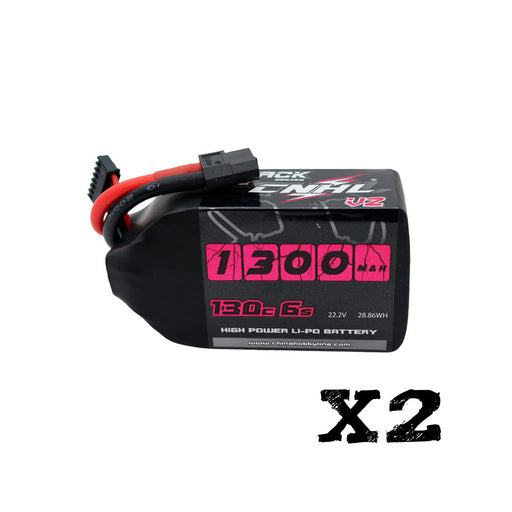
Quick Fit Check The 2 Packs CNHL Black Series V2.0 1300mAh 22.2V 6S 130C LiPo Battery with XT60 Plug is a strong fit for FPV pilots who want a prov...
View full detailsSpare Parts & Long-Term Support We know that for RC pilots, reliable spare parts support is an important part of keeping an aircraft fl...
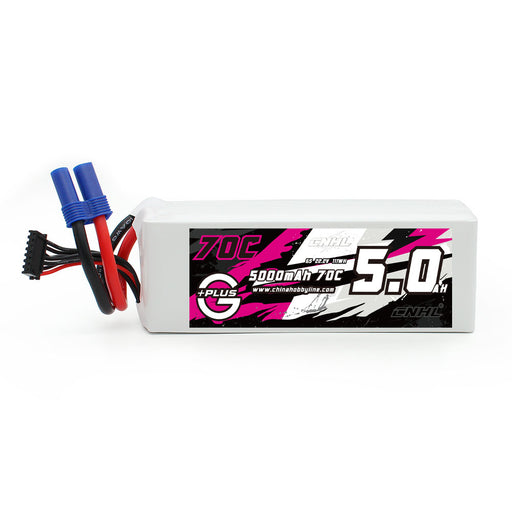
View full detailsSpecifications: Stock Number: 500706EC5 Capacity: 5000mAh Voltage: 22.2V / 6-Cell / 6S1P Discharge Rate: 70C Continual / 140C Burst Charge Rate: ...
View full details
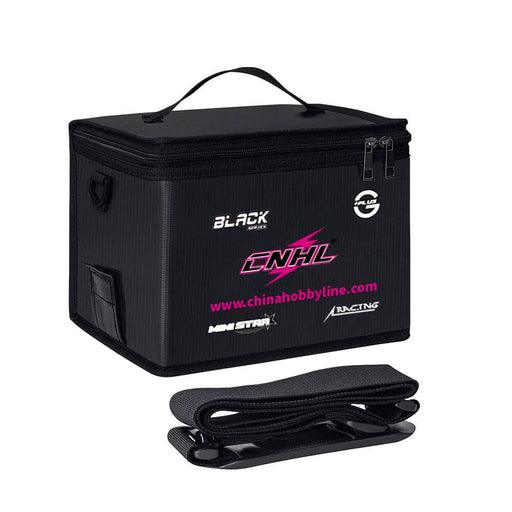
The CNHL LiPo Battery Bag is designed for safer LiPo charging, transport, and storage at home or at the field. It adds a practical layer of protect...
View full details

Quick Fit Check The 2 Packs CNHL Speedy Pizza Series Pro 1350mAh 6S 150C LiPo Battery with XT60 Plug is built for 5-inch FPV pilots who want a ...
View full details

Quick Fit Check The CNHL Speedy Pizza Series 2200mAh 22.2V 6S 120C LiPo Battery with XT60 Plug combines the familiar 2200mAh 6S format with a ligh...
View full details

Quick Fit Check The CNHL Speedy Pizza Series 2200mAh 14.8V 4S 120C LiPo Battery with XT60 Plug combines a widely used 2200mAh 4S format with a sli...
View full details

Quick Fit Check The CNHL Speedy Pizza Series 2200mAh 11.1V 3S 120C LiPo Battery with XT60 Plug takes the familiar 3S 2200mAh aircraft battery form...
View full detailsThe CNHL Long Range Series BAK 65E 6350mAh 21700 Li-ion battery cell is built around one clear priority: maximum stored energy from a lightweight c...
View full details

The CNHL Long Range Series BAK 50D 5000mAh 21700 Li-ion battery cell is designed for custom high-energy battery packs that need a strong balance be...
View full details




Leave a comment