




What Battery Does the Hangar 9 Carbon Cub 15cc EP PNP Use?
The updated Carbon Cub 15cc EP PNP is a large wooden STOL and scale aircraft with a 90-inch (2286mm) wingspan, functional flaps, and a factory-installed Spektrum Avian 5065-450Kv motor paired with a 100A Avian Smart ESC. The electric PNP version uses one standard 6S LiPo battery. The manufacturer's stated capacity range is 4000–7000mAh, with 5000mAh given as a recommended motor-battery size. This gives pilots meaningful room to choose a pack around their preferred flight style rather than assuming that maximum capacity is always best.
| Aircraft | Hangar 9 Carbon Cub 15cc EP PNP (HAN-3448) |
| Wingspan | 90 in / 2286mm (2.3m class) |
| Battery configuration | One 6S LiPo, 22.2V nominal / 25.2V fully charged (standard LiPo) |
| Manufacturer capacity range | 4000–7000mAh |
| Recommended starting capacity | 5000mAh |
| Battery connection | EC5 or IC5 main power connector |
| Installed power system | Spektrum Avian 5065-450Kv motor and 100A Smart ESC |
| Published CG range | 100–120mm, measured as specified in the aircraft manual |
| Also required for PNP | Compatible transmitter/receiver and 6S balance charger |
These requirements apply specifically to the electric EP PNP version, not to a separately configured gas, glow, or electric ARF build. Pack dimensions and acceptable installed mass must still be checked against your completed aircraft.
Four CNHL 6S Batteries Worth Comparing
For a practical shortlist, start with four standard-voltage 6S LiPo batteries with EC5 plugs. They span lightweight STOL flying, the manufacturer's recommended 5000mAh class, sport flying, and higher-capacity cruising. The descriptions below are selection recommendations based on the published electrical specifications, battery dimensions, and weight—not claims of completed physical fit testing in this new airframe.
| Recommended battery | Size (L × W × H) | Approx. weight | Best used for |
|---|---|---|---|
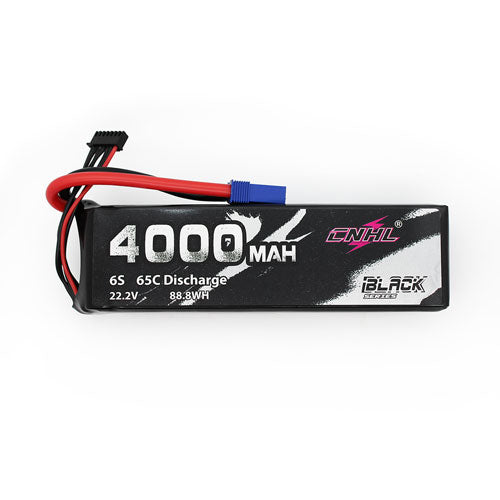
| Black Series 4000mAh 65C | 158 × 45 × 46mm | 650g | Lighter-weight STOL setup |
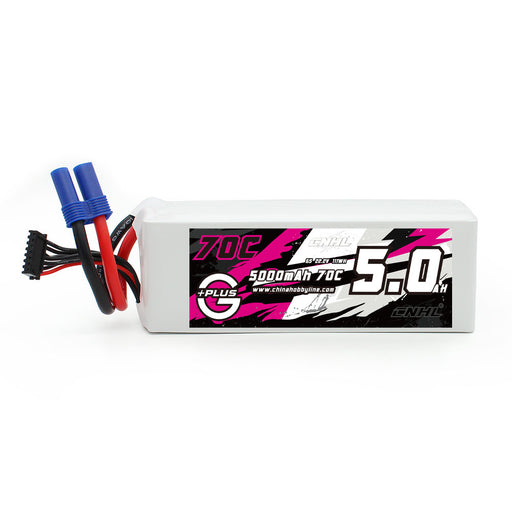
| G+Plus 5000mAh 70C | 149 × 51 × 49mm | 714g | Best overall starting point |
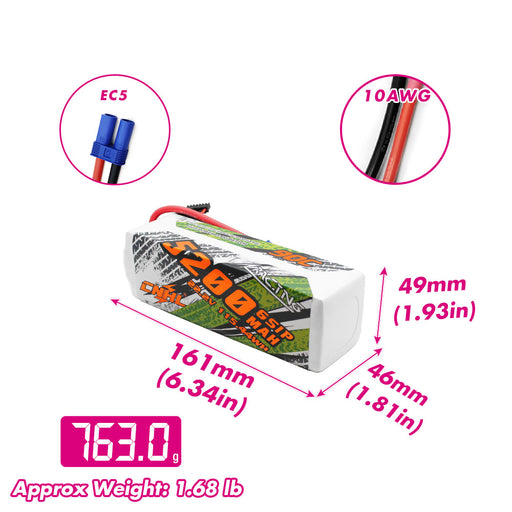
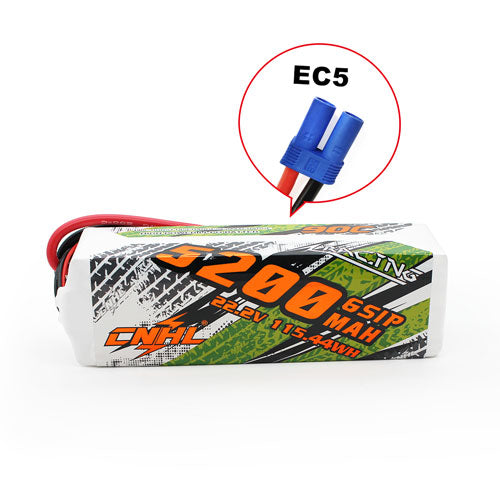
| Racing Series 5200mAh 90C | 161 × 49 × 46mm | 763g | Sport and aerobatic-oriented use |
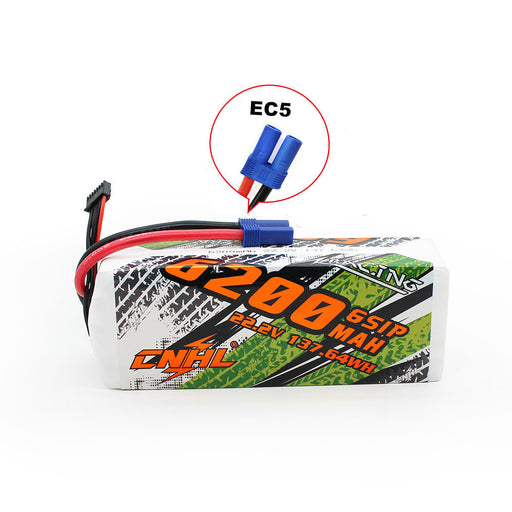
| Racing Series 6200mAh 90C | 162 × 57 × 47mm | 902g | Extra energy capacity |
Dimensions are pack-body measurements; allow additional space for wires, connector position, straps, and manufacturing tolerances. All four listed options use an EC5 output plug.
1. CNHL Black Series 4000mAh 6S 65C — Lightweight STOL Choice
At approximately 650g, this 4000mAh pack is the lightest of the four picks and sits at the lower end of the manufacturer's battery-capacity range. Reducing carried battery mass can be appealing when the priority is gentle approaches, short-field practice, or minimizing unnecessary wing loading. A lighter pack is not automatically a better-balanced pack: its mounting position must still establish the correct CG. The trade-off is a smaller energy reserve than the 5000mAh and higher-capacity alternatives. View CNHL Black Series 4000mAh 6S 65C EC5 battery.
2. CNHL G+Plus 5000mAh 6S 70C — Best Overall Starting Point
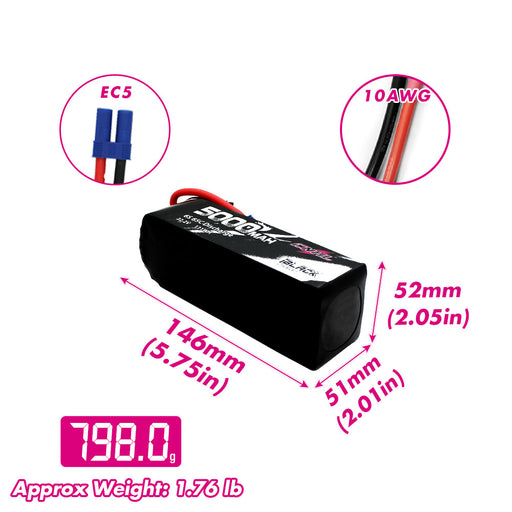
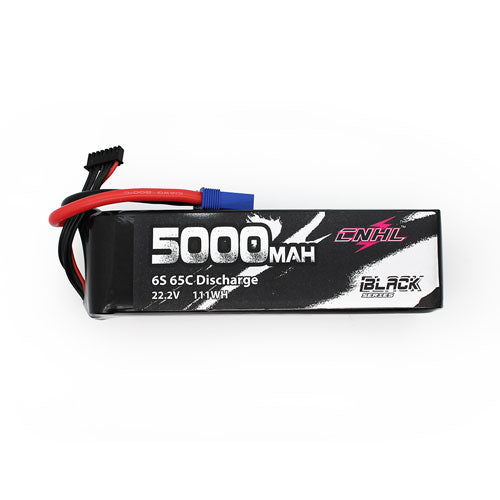
The 5000mAh capacity corresponds to the aircraft manufacturer's recommended battery size, making it a natural place to begin. This particular G+Plus pack weighs approximately 714g and measures 149 × 51 × 49mm. Compared with the CNHL Black Series 5000mAh 65C pack, it offers the same stated capacity at roughly 84g less pack weight. For pilots who want comfortable everyday scale flying, circuits, coordinated turns, flap approaches, and occasional sport maneuvers, this is our first comparison pick. View CNHL G+Plus 5000mAh 6S 70C EC5 battery.
3. CNHL Racing Series 5200mAh 6S 90C — Sport Flying Option
At approximately 763g, this 5200mAh pack adds a modest amount of capacity over the G+Plus 5000mAh without taking a major step into heavier high-capacity batteries. Its 90C rating can be useful in demanding 6S applications, although the installed motor, propeller, ESC and real current draw ultimately determine the performance required from any pack. Pick it if you prefer a little more energy reserve and an output-focused battery without immediately moving to 6000mAh-plus. View CNHL Racing Series 5200mAh 6S 90C EC5 battery.
4. CNHL Racing Series 6200mAh 6S 90C — Higher-Capacity Choice
The 6200mAh pack stays within the stated 4000–7000mAh range and supplies more stored energy than the other three picks. At roughly 902g and 162 × 57 × 47mm, however, it is both heavier and wider. That changes the fitment and balance decision considerably. Consider it for longer, measured cruising sessions only when the battery bay, mounting straps, connector clearance, and final center of gravity all permit it. Higher capacity does not guarantee a proportional increase in airborne minutes. View CNHL Racing Series 6200mAh 6S 90C EC5 battery.
4000mAh vs. 5000mAh vs. 6200mAh: Which Should You Choose?
The Carbon Cub is built for a mix of scale flying, short takeoffs and landings, smooth low-speed handling, and sport aerobatics. Those different uses favor slightly different batteries. For repeated STOL approaches and landing practice, unnecessary weight is worth avoiding. For mixed everyday flying, a 5000mAh pack provides a straightforward baseline. For relaxed cruising, the energy reserve of a larger 6S pack may be attractive—but only after checking its dimensions and the CG.
Do not judge the choice by capacity alone. Among these CNHL packs, the 5000mAh G+Plus is lighter than certain other 5000mAh models. Likewise, a 5200mAh pack can weigh less than another pack with a nominally smaller capacity. Series construction, packaging, and dimensions matter. A practical process is to start with your intended flying style, compare real pack weights, check the battery bay, and then balance the fully assembled model.
Battery Bay, Top Hatch, and CG: Fit Matters More Than Capacity Alone
One useful upgrade on the new Carbon Cub 15cc is battery access. The EP PNP version has a convenient upper windshield hatch rather than the more involved battery-tray routine associated with the original yellow-and-silver version. The new arrangement makes it easier to remove a pack between flights, secure another pack with hook-and-loop straps, and inspect the main power connection.
There is an important detail around the ESC's mounted battery connector: a particular pack's wire exit, lead length, connector orientation, and placement may influence where the pack can be positioned. The available fore-aft movement is not unlimited. A setup that balances with a 5000mAh pack does not prove that a substantially heavier 6200mAh pack—or a taller pack with the same capacity—will balance in the same position.
Check the current Hangar 9 manual for the exact CG measurement procedure and use its stated 100–120mm range as the reference. Perform the balance check with the propeller, receiver, flight battery, and other intended equipment installed. Move the pack in small increments while making sure the straps hold it securely and no wires are stretched, crushed, or in contact with moving parts. If you cannot establish the proper CG with safe battery placement, choose a different pack rather than forcing the installation.
EC5 vs. IC5: Do You Need a Smart Battery?
The EP PNP calls for an EC5 or IC5 battery connection. The standard EC5 power connector on the featured CNHL packs is designed for the same main power connection format used by compatible IC5 systems. Check polarity, connector condition, and physical engagement before powering the aircraft. Do not force damaged or mismatched housings together.
A battery does not have to be a Spektrum Smart battery to power this aircraft. The installed Avian Smart ESC can provide supported power-system telemetry through a compatible receiver and transmitter, including when using non-Smart batteries. The exact data displayed depends on the receiver and radio configuration. A CNHL battery's EC5 connector supplies power; it should not be described as adding Smart-battery-specific features of its own.
What Flight Time Can You Expect?
Flight time depends on throttle use, propeller load, flap use, wind, flying weight, and how much reserve you leave in the battery. A scale circuit at partial throttle and an aggressive aerobatic session can return very different results using the same 5000mAh pack. Larger capacity may extend flying time, but the added mass can also change the average power needed for some maneuvers.
For the first flights, use a conservative transmitter timer, land with a sensible reserve, and review consumed mAh from your charger or suitable telemetry after the pack cools. Adjust the timer based on your own measured use instead of relying on a fixed number of minutes from another aircraft or pilot. The objective is repeatable, predictable flights with a healthy battery reserve.
Charging and Preflight Battery Checklist
A suitable balance charger is required because the EP PNP package does not include a flight battery or charger. Use the appropriate 6S battery chemistry setting, connect the main lead and balance lead as required by your charger, and check the cell voltages before charging. Follow the battery maker's allowed charge rate; for routine battery care, a conservative 1C charge is a sensible starting point.
- Confirm a standard 6S LiPo configuration and the correct EC5/IC5 power connection.
- Measure the pack and allow room for straps, lead routing, and the battery hatch to close fully.
- Secure the pack so it cannot slide during takeoff, aerobatics, or landing.
- Check center of gravity and control-surface operation before each flying session.
- Inspect the pack for swelling, damage, or abnormal cell voltage; never charge a damaged pack.
- Charge with supervision in a suitable fire-conscious location and return unused packs to storage voltage.
For charger options, browse CNHL LiPo battery chargers. For balancing, charging modes, and storage practices, see our LiPo Battery Charging Guide.
Hangar 9 Carbon Cub 15cc Battery FAQ
Is the Hangar 9 Carbon Cub 15cc EP PNP a 6S plane?
Yes. The factory-installed electric motor and ESC are specified for a single 6S LiPo flight battery. The stated capacity range is 4000–7000mAh.
What is the best 6S battery capacity to start with?
5000mAh is the manufacturer's recommended capacity and our preferred starting point. The CNHL G+Plus 5000mAh 70C EC5 pack offers a practical capacity-to-weight combination, subject to the final physical fit and CG check.
Can I use a 4000mAh 6S battery for STOL flying?
Yes, 4000mAh falls inside the manufacturer's range. It is a sensible option when keeping battery mass down is a priority, provided the model balances correctly and the pack meets the actual power demand.
Can I use a 6200mAh battery?
6200mAh is within the published capacity window. A larger pack requires more careful checks for width, weight, mounting clearance, and center of gravity. The Racing Series 6200mAh EC5 pack weighs approximately 902g.
Will an EC5 battery connect to the IC5-equipped aircraft?
EC5 and IC5 share a compatible main power connector format in appropriate configurations. Inspect polarity and seating before connecting. An EC5 battery is not automatically a Smart battery.
Does a higher C rating make the Carbon Cub faster?
Not automatically. A C rating indicates a battery's stated discharge capability; the motor, propeller, ESC and real operating load still determine how much current is drawn. Higher ratings cannot be treated as a guaranteed top-speed or flight-time upgrade.
Can I use a 7200mAh or larger CNHL battery?
Those capacities exceed Hangar 9's stated 7000mAh upper recommendation for the EP PNP version. They should not be assumed compatible merely because they are 6S, and their added size and weight would need independent verification.
Do I need a Spektrum Smart battery?
No. A compatible conventional 6S battery can power the aircraft. The Avian ESC may supply supported telemetry through the appropriate receiver and Spektrum transmitter, but Smart-battery-specific functions are separate from basic battery compatibility.
Explore More 6S Batteries and STOL Aircraft
Need a different pack size or discharge rating? Browse the wider CNHL 6S 22.2V LiPo battery collection and compare actual dimensions before ordering.
If you are still choosing a bush plane rather than a battery, the CNHL Bison XT STOL 1750mm PNP is another 6S high-wing option, with a smaller EPO foam airframe and a different recommended battery range (3300–5000mAh). Its battery fit and CG requirements should be checked separately from those of the 90-inch wooden Carbon Cub.