
CNHL Lipo Batteries
CNHL aim at providing high-quality Li-Po batteries and RC products to all hobby enthusiasts with excellent customer services and competitive prices
The iFlight Defender 20 Lite X O4 2S HD is best understood as a correction of the original Defender 20 Lite rather than a completely new drone. iFlight has kept the compact 2-inch airframe, 1103 14000KV motors, pusher layout and well-isolated camera pod that already worked, then changed the two areas that had the biggest effect on everyday ownership: the camera system and the battery system.
The result is a much easier drone to understand. DJI O4 Wide gives the Lite X the immersive field of view that a proximity-focused FPV model should have, while the switch from a proprietary slide-in battery to a conventional 2S XT30 setup finally lets pilots choose batteries by weight, capacity and flying style instead of being tied to one dedicated pack.
Those changes do not turn the Lite X into a miniature freestyle monster, and they do not solve every compromise that comes with putting a powerful digital video system on a roughly 75g airframe. What they do is make the Defender concept substantially more practical. The Lite X is smooth, quiet, easy to carry, surprisingly capable on 2S and much better suited to the kind of close-range HD flying the Defender line was always trying to deliver.

The Defender 20 Lite X is a compact 2-inch digital FPV drone built around a simple idea: carry a full DJI O4 Wide imaging system in an aircraft small enough for indoor flying, backyard cruising and low-altitude proximity work without needing an external action camera.
iFlight officially introduced the Lite X in July 2026. The platform uses an 87mm wheelbase, Defender 16 1103 14000KV motors, 2020 tri-blade propellers, a Borg F7 AIO flight controller and the DJI O4 Wide Air Unit.
The drone itself is listed at approximately 75±3g. With a 520mAh battery installed, takeoff weight is approximately 110±3g. That weight matters because almost every strength and weakness of the Lite X comes from the same design decision: iFlight is asking a very small 2S aircraft to carry a serious digital camera system while remaining light enough to feel like a micro FPV quad.
| Model | iFlight Defender 20 Lite X O4 2S HD |
| Wheelbase | 87mm |
| Video System | DJI O4 Wide Air Unit |
| Camera FOV | 159° |
| Motor | Defender 16 1103 14000KV |
| Propeller | Defender 20 Lite 2020 × 3 |
| Drone Weight | 75±3g |
| Takeoff Weight | Approx. 110±3g with 520mAh battery |
| Battery System | 2S with XT30-style connection |
| Reference Battery | 520mAh 2S |
| Maximum Speed | 75km/h in Manual Mode |
| GNSS | Not equipped |
The easiest mistake to make with the Lite X is to assume the “X” means iFlight rebuilt the Defender 20 Lite from scratch. It did not.
The basic architecture is still recognizably Defender 20 Lite: the same general frame concept, the same 2-inch pusher arrangement, the same 1103 14000KV motor class and the same philosophy of placing the camera on a soft isolated pod instead of rigidly attaching it to the rest of the frame.
That continuity is actually a strength. The original airframe already had good flight manners and unusually effective camera isolation for such a small digital FPV model. Replacing everything would have added risk without necessarily improving the parts that mattered.
Instead, the Lite X concentrates its changes in two places.
First, the camera becomes DJI O4 Wide. The 159° field of view is far better suited to proximity FPV than the narrower presentation of the previous system. For a drone designed to move through gates, under structures, around trees and inside buildings, peripheral awareness matters as much as raw image resolution.
Second, the proprietary battery system is gone. The original slide-in battery looked clean, but it treated the battery more like a consumer-drone accessory than a normal FPV component. The Lite X returns to a conventional XT30-style 2S setup, and that single decision makes the platform much easier to own over time.

| Feature | Defender 20 Lite | Defender 20 Lite X |
|---|---|---|
| Video Direction | Narrower O4 view | DJI O4 Wide, 159° FOV |
| Battery Design | Dedicated slide-in battery | Conventional compact 2S battery |
| Power Connection | Proprietary system | XT30-style connection |
| Reference Capacity | About 600mAh | 520mAh |
| Battery Choice | Mostly tied to the original battery format | Much easier to tune capacity and weight |
So the Lite X is not really about adding more features everywhere. It is about removing two compromises that had become increasingly obvious as the micro-HD market evolved.
The O4 Wide system is the visual upgrade, but its importance goes beyond the headline specification of 4K/60fps.
A 159° field of view changes the character of a small FPV drone. On a fast long-range platform, the center of the image often matters most. On a 2-inch proximity machine, the pilot is constantly judging walls, branches, door frames, gates and other objects that sit near the edges of the view. A wider image makes the aircraft easier to place precisely in those environments.
The Lite X also benefits from one of the smartest parts of the original Defender design: the camera is physically isolated from the main airframe through a very soft three-point damping structure.
That isolation is doing real work. The 1103 motors and small high-RPM propellers generate plenty of high-frequency vibration, yet the recorded footage remains notably clean. The system is not simply relying on RockSteady or Gyroflow to hide a noisy airframe; the mechanical mount prevents much of that vibration from reaching the camera gyro in the first place.
This is important because digital stabilization can only correct clean gyro data reliably. A badly mounted camera can produce excellent-looking raw video at first glance and still create stabilization artifacts later. The Lite X avoids much of that problem by solving vibration mechanically before software has to deal with it.
iFlight has also added small retention pieces around the soft camera mounts. They are easy to overlook, but they make sense. A very soft damper can isolate vibration well precisely because it is not tightly constrained; the downside is that a hard impact can pull it out of its seat. The retaining pieces give the mount additional crash security without turning it into a rigid connection.
The new camera improves the image but creates a new physical compromise. The O4 Wide glass lens projects farther forward than the previous camera assembly, while the basic front-end geometry of the Defender has not moved forward with it.
That means the lens is now closer to becoming the first hard part of the aircraft to meet an obstacle during a frontal impact.
This is not a reason to avoid the Lite X, but it changes how we would set one up. On a drone intended for proximity flying, a UV protector is no longer just an optical accessory. It is inexpensive mechanical insurance for a lens that is both exposed and relatively expensive to replace.
The effect becomes even more important in open-prop mode, where the aircraft encourages more aggressive flying and is more likely to contact hard surfaces.

The removable prop guards are one of the Lite X's most marketable features, but we would not look at the two configurations as equally important.
The guarded configuration is the native personality of this aircraft.
With the guards installed, the Lite X is better protected around furniture, gates, walls and vegetation. More importantly, the airframe feels settled and predictable. That fits the O4 Wide camera, the soft camera mount and the overall purpose of the Defender platform much better than trying to turn it into a dedicated freestyle machine.
The guards are especially valuable because the Lite X uses a pusher configuration. Its propellers sit low on the underside of the aircraft. Remove the guards and the props become much easier to touch against the ground or an obstacle, even in situations that would be harmless on a conventional top-mounted open-prop quad.
Removing four screws does make the Lite X noticeably more agile. There is less surrounding plastic, and the aircraft feels more willing to change direction. The motors also have enough power to perform rolls, flips and basic freestyle maneuvers.
But more agile does not automatically mean better.
The open-prop setup can expose slightly more wobble, does not completely remove the Lite X's mild low-throttle gliding behavior, and sacrifices much of the protection that makes such a small O4 aircraft useful around obstacles.
For that reason, we see open-prop mode as a useful second personality rather than the main reason to buy the drone. It is good to have, and it broadens the aircraft's range, but most owners who bought the Lite X for smooth HD proximity flying will probably get more value from leaving the guards installed.
The Lite X feels more mature than its size suggests.
Its strongest characteristic is not raw speed or explosive recovery power. It is smoothness. The aircraft carries momentum predictably, the camera pod stays remarkably calm, and the combination of 2S power with a roughly 110g ready-to-fly weight gives it enough authority to move quickly without becoming nervous.
That balance makes it well suited to:
The Lite X is also relatively quiet for a digital FPV aircraft. It still produces the high-pitched sound expected from small fast-spinning props, but the noise footprint is much less intrusive than a larger cinewhoop. That fits the same close-proximity role as its small physical footprint.
Where the limitations appear is when the environment starts demanding more authority than the platform can comfortably provide.
Strong wind can move the Lite X around. That should not be surprising: the aircraft has significant frontal area from the guards and camera system but very little mass. A heavier 4S freestyle quad can use both power and inertia to hold a line through gusts; a roughly 110g 2S Defender cannot cheat physics the same way.
The stock tune also appears deliberately biased toward smoothness rather than a hard, locked-in freestyle feel. In fast turns or turbulent air, the aircraft may need a little more throttle management than a pilot coming directly from a more aggressive 4S or 6S platform expects.
There is also a mild gliding tendency during some zero-throttle descents. The aircraft can continue to descend more slowly than expected rather than dropping immediately. In ordinary forward flight this is not a major problem, but it is another sign that the Lite X should be flown as a smooth micro-HD platform rather than judged against a dedicated freestyle tune.
Our view: the Defender 20 Lite X can freestyle, but freestyle is not what makes it good. Its real advantage is putting clean O4 Wide footage into places where a larger, louder and heavier FPV drone is less comfortable.

If there is one area where the Lite X deserves extra operating discipline, it is heat management.
The O4 Wide system is installed low in the aircraft and surrounded by a protective lower structure. That keeps the electronics safer from direct contact, but the same structure also limits natural airflow when the drone is sitting still.
In warm conditions, the difference between flying and sitting powered on can be dramatic. Once the aircraft is moving forward, air passes through and around the frame. On the ground, the video system is generating heat with almost none of that cooling airflow available.
This makes the Lite X a poor candidate for the common FPV habit of plugging in a battery and then spending several minutes adjusting goggles, radio settings or camera parameters.
We would use a very simple workflow:
The cooling issue does not mean the Lite X is unusable in summer, nor does it mean the O4 Wide will overheat during every flight. It means this particular combination of a powerful HD system, compact plastic protection and very small airframe has less passive thermal margin than some more open designs.
That is probably the biggest compromise iFlight accepted in order to keep the Defender compact and protected.
O4 Wide is what makes the Lite X easy to advertise. The new battery system is what makes it easier to own.
The original Defender 20 Lite used a dedicated approximately 600mAh slide-in battery. It was tidy, but it also meant that a wear item with a finite cycle life was tied closely to one aircraft and one battery format.
The Lite X changes that completely. Power now comes through a conventional XT30-style connector, and the airframe provides both shaped battery support and strap-mounting capability.
That puts battery choice back into familiar FPV territory. Instead of asking, “Where can I find the special Defender battery?”, the more useful questions become:
iFlight's 520mAh reference pack gives us a sensible center point. Actual examples of this battery have measured roughly 33–34g, and complete aircraft weights around 109–110.5g line up closely with iFlight's own approximately 110g takeoff figure.
That tells us something important: a suitable Lite X battery should stay close to this weight and capacity class rather than simply chasing the largest 2S pack that can be strapped to the frame.
| Capacity Direction | How We See It | Main Trade-Off |
|---|---|---|
| 450mAh 2S | Lightweight choice for keeping the aircraft responsive | Less energy than the 520mAh reference setup |
| 520mAh 2S | The baseline around which iFlight developed the Lite X | Balanced rather than optimized toward minimum weight or maximum capacity |
| 550mAh 2S | Closest CNHL capacity direction to the 520mAh reference | Dimensions and installed weight still need to remain sensible |
For pilots who want to stay close to the stock capacity range, CNHL currently offers compact 450mAh and 550mAh choices for this type of setup. See our dedicated iFlight Defender 20 Lite X battery collection for the current selection.
If you use other iFlight models, browse the wider iFlight FPV drone batteries collection. For batteries across cinewhoops, freestyle quads and other FPV platforms, see our full FPV drone battery collection.
Capacity is only one part of fitment. On a small aircraft like this, battery dimensions, total installed weight, XT30 polarity, wire routing and retention all matter. A battery that technically powers the aircraft can still be a poor choice if it shifts the balance too far or allows the power lead to move toward the props.
iFlight rates the Defender 20 Lite X at approximately six minutes of maximum hover time with a 520mAh battery.
That number is actually realistic for the platform rather than being only an idealized hover figure. Mixed flying with a 520mAh-class pack can land in roughly the 5.5-to-6-minute range when the aircraft is used for a combination of cruising and moderate maneuvering.
That does not mean every pilot will get six minutes. Fast direction changes, repeated climbs, strong wind and more aggressive freestyle all increase current demand. Slow indoor cruising can move in the opposite direction because the aircraft spends less energy fighting wind and making large throttle corrections.
The more useful way to think about the Lite X is therefore:
520mAh is a balanced six-minute-class setup, not a guaranteed six-minute timer.
A 450mAh pack trades some energy for lower capacity and potentially lower installed mass. A 550mAh option moves slightly toward endurance while staying close to the stock battery class. Moving much farther upward in capacity starts to work against the lightweight character that makes the Lite X attractive in the first place.
The Lite X is a 2S platform, and the 520mAh batteries used around the aircraft include LiHV versions. That makes both standard 2S LiPo and suitable 2S LiHV packs relevant when dimensions, weight and connector requirements match.
The important difference is charging voltage.
A standard LiPo should not exceed 4.20V per cell. A LiHV battery may be charged to a higher full voltage only when using a charger with a dedicated LiHV mode, with a maximum of 4.35V per cell.
If using an alternative LiHV battery, verify the intended charge voltage and aircraft requirements rather than assuming that every 2S pack should automatically be charged to the maximum LiHV voltage. Battery chemistry, charger mode and aircraft setup all need to agree.
One issue worth knowing about is that the Lite X can occasionally display battery information that does not make sense for the pack that is actually connected.
The most obvious example is a 2S battery being interpreted as if the aircraft were seeing a different cell count, which can make the per-cell calculation in the OSD look alarming even when the pack itself is not actually at that voltage.
If the displayed voltage looks impossible, the correct response is not to assume the battery has instantly failed. Verify the pack voltage separately, check the detected cell count and confirm Betaflight voltage calibration.
Any real low-voltage condition should still be taken seriously, but an obviously inconsistent OSD value needs to be diagnosed as a measurement or configuration issue before conclusions are drawn about the battery itself.
The small O4 Wide category is already crowded enough that being new is not a competitive advantage by itself.
There are lighter 1S whoop-style platforms, open-prop micro builds, highly optimized freestyle designs and other compact cinewhoops using the same general generation of DJI imaging hardware.
The Defender 20 Lite X occupies a useful middle ground.
Compared with a lighter 1S whoop, the 2S power system gives it more reserve for outdoor flying and faster recovery. Compared with a dedicated open-prop freestyle quad, it offers much better physical protection and a calmer shooting-oriented personality. Compared with a larger cinewhoop, it is easier to carry, quieter and less intimidating in tight environments.
That middle-ground positioning is also why we would not buy the Lite X purely because it has O4 Wide. The camera hardware can appear on many different airframes. What makes the Defender interesting is the way iFlight combines that camera with removable guards, a pusher layout, effective camera isolation and now a normal battery ecosystem.
It is the package that matters, not the camera alone.
The Lite X makes the most sense for pilots who want a compact HD aircraft that can be flown in spaces where a larger FPV drone becomes awkward.
It is especially well matched to pilots who value:
It is less convincing for pilots whose first priority is aggressive freestyle, maximum crash durability in open-prop configuration or strong-wind performance. Those jobs reward a different frame shape, tune and power-to-weight philosophy.
The Defender 20 Lite X is not impressive because iFlight changed everything. It is impressive because iFlight mostly knew what not to change.
The original platform already had a good 2-inch airframe, useful prop protection, a surprisingly capable 2S power system and one of the better vibration-isolated camera arrangements in this size class.
The Lite X keeps those strengths and addresses the two parts that were increasingly holding the original model back.
O4 Wide makes the visual experience far more appropriate for indoor and proximity FPV. The XT30 battery conversion removes the proprietary battery dependency and gives pilots control over capacity, weight and battery sourcing again.
There are still compromises. A roughly 110g O4 aircraft will never hold a line in strong wind like a larger freestyle quad. The stock tune is smoother than it is aggressive. The O4 Wide system needs airflow, and the more exposed glass lens deserves protection.
But those limitations make sense in the context of what the aircraft is trying to be.
The Lite X is not a shrunken 5-inch freestyle drone. It is not a pure indoor whoop either. It sits between those categories as a small, quiet, protected 2S HD platform built to put high-quality wide-angle footage into tight spaces.
That is also why the battery redesign matters so much. Once the proprietary pack disappears, the Lite X stops feeling like a closed specialty product and starts behaving like a normal FPV platform that owners can tune around their own priorities.
If the original Defender 20 Lite already made sense to you but the narrow camera view and proprietary battery did not, the Lite X is the version that finally completes the idea.
iFlight introduced the Defender 20 Lite X O4 2S HD in July 2026, making it a new-generation update to the earlier Defender 20 Lite.
The two most important changes are the DJI O4 Wide camera system and the switch from a proprietary battery format to a conventional 2S XT30-style battery system. The underlying airframe concept remains closely related to the original model.
Yes. It uses the DJI O4 Wide Air Unit with a 159° field of view and supports onboard recording up to 4K/60fps.
The Lite X is a 2S platform using an XT30-style power connection. iFlight uses a 520mAh 2S battery as the main reference setup.
Approximately 5.5 to 6 minutes is a realistic range for mixed flying with a healthy 520mAh-class battery. Aggressive flying and strong wind shorten runtime, while slower indoor cruising may extend it.
Those capacities sit close to the 520mAh reference range and can be practical directions when voltage, dimensions, weight, XT30 connection, polarity and mounting requirements all match. A 450mAh pack favors lower capacity and potentially lower mass, while 550mAh stays closer to the stock capacity with slightly more energy.
Yes. The guards can be removed with four screws. The Lite X becomes more agile in open-prop form, but the low pusher propellers also become substantially more vulnerable to ground contact and crashes.
It has enough 2S power for rolls, flips and casual freestyle, but we see freestyle as a secondary capability. Its smooth tune, protected layout and O4 Wide camera make controlled proximity flying a better match for the airframe.
Yes. Small size, prop protection, relatively low noise and predictable flight behavior make indoor and close-proximity flying some of the Lite X's strongest use cases.
Moderate outdoor flying is well within its role, but strong wind can push the Lite X off line because it combines very low mass with a relatively large guarded frontal area. It should not be expected to resist gusts like a heavier 4S or 6S freestyle platform.
The O4 Wide system can become hot quickly when the aircraft is powered but stationary, particularly in warm conditions with limited airflow. Prepare your goggles and radio before connecting the flight battery and avoid unnecessary powered-on ground time.
Yes, especially for proximity or open-prop flying. The Wide glass lens extends farther forward than the previous camera system, so a suitable UV or protective filter is a sensible precaution.
No. The BNF package does not include the flight battery, radio transmitter, goggles or charger, so those items need to be selected separately.
CNHL aim at providing high-quality Li-Po batteries and RC products to all hobby enthusiasts with excellent customer services and competitive prices
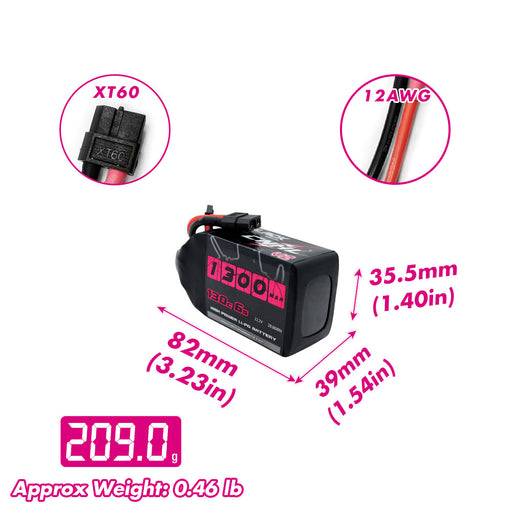
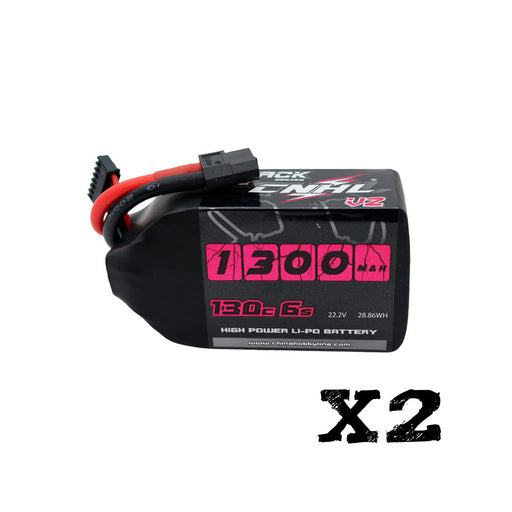
Quick Fit Check The 2 Packs CNHL Black Series V2.0 1300mAh 22.2V 6S 130C LiPo Battery with XT60 Plug is a strong fit for FPV pilots who want a prov...
View full detailsHstar D43-01Q 911 Style is a mini 1/43 alloy drift RC car designed for indoor tabletop fun and realistic drifting. It features full proportional ...
View full details

Spare Parts & Long-Term Support We know that for RC pilots, reliable spare parts support is an important part of keeping an aircraft fl...
View full details
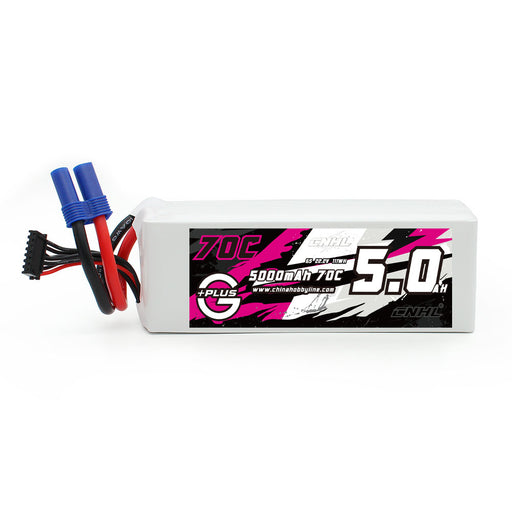
Specifications: Stock Number: 500706EC5 Capacity: 5000mAh Voltage: 22.2V / 6-Cell / 6S1P Discharge Rate: 70C Continual / 140C Burst Charge Rate: ...
View full details
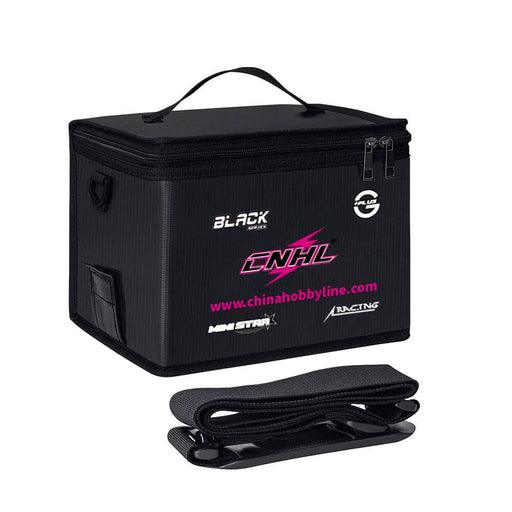
The CNHL LiPo Battery Bag is designed for safer LiPo charging, transport, and storage at home or at the field. It adds a practical layer of protect...
View full details

The Hobbywing EZRUN MAX4 HV is a high-voltage, high-current brushless ESC built for 1/5-scale off-road vehicles and heavy-load RC trucks. With sup...
View full details

The Hobbywing QUICRUN Fusion Pro 2300KV combines a brushless crawler motor and electronic speed controller inside one compact 540-spec power unit. ...
View full details

Quick Fit Check The CNHL Racing Series 6000mAh 15.2V 4S2P 130C LiHV Shorty Hardcase LiPo Battery with 5mm Bullet Sockets is a true 4S shorty LiPo b...
View full details

The CNHL 2 Pairs 5mm Heatsink Bullet Plug Grips with Bullet Connectors are designed for RC racers who need a clean, secure and easy-to-handle conne...
View full details

The Hobbywing Multifunction LCD Program Box PRO G3 is an advanced ESC programming device for compatible Hobbywing brushless ESCs. Compared with a...
View full details

Leave a comment