
CNHL Lipo Batteries
CNHL aim at providing high-quality Li-Po batteries and RC products to all hobby enthusiasts with excellent customer services and competitive prices
A 2S LiPo battery contains two lithium-polymer cells connected in series. A standard 2S LiPo is rated at 7.4V nominal and reaches approximately 8.4V when fully charged. It is one of the most widely used battery formats in RC cars, crawlers, drift cars, touring cars, smaller boats and many compact RC airplanes.
What makes 2S especially popular is its balance between usable power, manageable weight and relatively moderate stress on motors, ESCs and drivetrains. But “2S” only tells you the battery voltage class. Capacity, physical size, discharge capability, connector, case style and charging requirements still need to match the RC model.

| Cell Count | 2 cells connected in series |
| Standard Nominal Voltage | 7.4V |
| Approx. Full Voltage | 8.4V total / 4.20V per cell |
| Typical Storage Range | About 7.6–7.7V total, depending on charger target |
| Common Applications | RC cars, crawlers, drift cars, touring cars, boats and aircraft |
| Common Case Styles | Hardcase, softcase and shorty hardcase |
| Typical Charging Mode | LiPo Balance Charge |
The letter S means the cells are connected in series. A 2S battery therefore contains two series-connected cell groups.
In a series connection, voltage adds together while the battery capacity in amp-hours does not simply double.
A standard LiPo cell has a nominal voltage of approximately 3.7V:
3.7V + 3.7V = 7.4V nominal for a 2S LiPo
At full charge, each standard LiPo cell approaches approximately 4.20V:
4.20V × 2 = approximately 8.40V fully charged
This is why the same battery can be described as both a 2S LiPo and a 7.4V LiPo battery.
For the complete voltage system from 1S through 8S, read the LiPo Battery Voltage Guide: 1S to 8S Explained for RC Models.
| Battery State | Approx. Per Cell | Approx. 2S Pack Voltage |
|---|---|---|
| Fully charged | 4.20V | 8.40V |
| Nominal rating | 3.70V | 7.40V |
| Typical storage target | About 3.80–3.85V | About 7.60–7.70V |
Do not treat these figures as a complete discharge guide. Voltage changes under load, and the correct low-voltage cutoff depends on the complete RC setup, ESC behavior and battery condition.

2S is one of the most versatile RC battery voltage classes because it offers more power than 1S without the larger jump in voltage and drivetrain load that comes with 3S or higher.
2S is extremely common in 1/10-scale RC cars and is also widely used in smaller vehicles. Common applications include:
Compared with 3S, a 2S setup is often easier to manage because throttle response is less aggressive and drivetrain stress is generally lower when all other variables are similar.
2S remains useful in crawlers where smooth low-speed control can matter more than maximum wheel speed. However, many modern crawler systems also support 3S, so always follow the ESC and motor specifications rather than assuming one voltage is universally better.
Hardcase 2S packs are especially common in drift, touring and race-oriented chassis. Shorty packs are also popular where chassis layout, weight distribution and battery placement are important.
Smaller airplanes, park flyers and some scale models use 2S packs where lightweight construction and moderate power demand are priorities. Aircraft applications generally favor softcase packs because weight matters more than impact protection.
Some smaller boats use 2S batteries, particularly where the ESC and motor are designed around lower voltage. Larger or faster boats commonly move to higher-S systems.
The correct case style depends largely on how the battery is installed and how much physical protection the application requires.
| Feature | 2S Hardcase | 2S Softcase |
|---|---|---|
| Protection | Higher external impact protection | Less rigid external protection |
| Weight | Usually heavier | Usually lighter |
| Common Use | RC cars, racing and surface models | Aircraft, some boats and weight-sensitive models |
| Chassis Fit | Often designed around standardized tray dimensions | More shape flexibility, but dimensions still matter |
A hardcase battery is not automatically electrically better than a softcase battery. Case construction mainly changes mechanical protection, size, weight and installation suitability.
A 2S Shorty is a compact hardcase battery format commonly used in RC racing, buggy, touring, drift and specialized chassis layouts.
Compared with a conventional full-length 2S hardcase, a Shorty pack is physically shorter and often lighter. This can help with:
The word Shorty describes the physical battery format, not the voltage. A 2S Shorty is still a 2S battery electrically.
The S count determines voltage. Capacity determines how much electrical charge the battery stores.
Common 2S capacities can range from small packs for lightweight models to high-capacity packs for RC cars and extended-runtime applications.
For example:
A larger-capacity battery can provide more potential runtime, but it also usually becomes larger and heavier. Runtime therefore cannot be predicted from mAh alone because motor load, gearing, driving style, vehicle weight and efficiency all matter.
Battery energy can also be estimated in watt-hours:
Watt-hours ≈ nominal voltage × capacity in Ah
A 2S 5000mAh standard LiPo is approximately:
7.4V × 5Ah = 37Wh
This helps explain why batteries with the same mAh but different S counts do not store the same total energy.
The discharge C rating describes the manufacturer’s specified discharge capability relative to battery capacity. It should not be confused with the battery’s S count.
For example, two batteries can both be 2S 5000mAh but have different:
A higher C number does not change a 2S battery from 7.4V into a higher-voltage battery. Voltage class and discharge capability are separate specifications.
This distinction is important because both batteries may be described as “2S,” but their charging voltage is not necessarily the same.
| Specification | Standard 2S LiPo | 2S LiHV |
|---|---|---|
| Typical Nominal Voltage | 7.4V | 7.6V |
| Typical Full Voltage | 8.4V | Up to approximately 8.7V when specified |
| Charger Mode | LiPo | LiHV |
Do not charge a standard 7.4V LiPo to a LiHV full voltage. Likewise, do not assume a model rated for standard 2S automatically benefits from the higher fully charged voltage of a LiHV pack.
Confirm both the battery specification and the electronics before using LiHV mode.
A conventional 2S LiPo normally uses a balance charger with both the main power lead and balance lead connected.
The general process is:
Approximately 1C is a conservative general starting point unless the battery specifies another charging rate.
| 2S Battery | Approx. 1C Charge Current |
|---|---|
| 2200mAh | 2.2A |
| 5000mAh | 5A |
| 6000mAh | 6A |
| 8000mAh | 8A |
For the complete charging framework, read the LiPo Battery Charging Guide.
At 1C, a 2S battery generally does not require very high charger wattage because its voltage is relatively low.
For example, a 2S 5000mAh battery at 1C requires approximately:
8.4V × 5A ≈ 42W near full voltage
A charger with about 60W or more available to the active channel therefore provides useful operating headroom for one common 2S 5000mAh pack.
However, very high-capacity 2S packs can reach the charger’s current limit before reaching its wattage limit. An 8000mAh battery at approximately 1C requires 8A, so both charger amps and watts matter.
There is no single “2S connector.” Connector choice depends on the intended model, current demand and manufacturer.
Common examples include:
The connector must match the model electrically and mechanically. Avoid unnecessary adapter chains, particularly on higher-current RC car setups.
For a complete overview, read the RC Battery Connector Guide.
A 1S standard LiPo is approximately 3.7V nominal, while a 2S pack is approximately 7.4V nominal.
Moving from 1S to 2S therefore roughly doubles the nominal pack voltage. That can dramatically change motor speed and electronic stress if the model was not designed for 2S.
Never replace 1S with 2S simply because the connector fits.
For the dedicated comparison, read What Is the Difference Between 1S and 2S LiPo?.
A standard 2S LiPo is 7.4V nominal. A 3S LiPo is 11.1V nominal.
That additional voltage can increase motor speed and performance potential, but it can also increase heat and mechanical stress. Whether 3S is an upgrade depends on the complete RC platform.
| Feature | 2S LiPo | 3S LiPo |
|---|---|---|
| Nominal voltage | 7.4V | 11.1V |
| Full voltage | 8.4V | 12.6V |
| General character | Smoother and easier to manage | Higher performance potential |
| System requirement | Model must support 2S | ESC, motor and drivetrain must support 3S |
Read 2S vs 3S LiPo Battery: Which Is Better for RC Cars, Planes, and Crawlers? before changing voltage classes.
Sometimes, but only when the ESC, motor and model support operation at the lower voltage.
If the system supports both 2S and 3S, changing from 3S to 2S will generally reduce available motor speed and performance. The model may feel smoother and less aggressive.
However, some electronics require a minimum operating voltage, and some models are designed around a specific battery size and weight. Check the manufacturer specifications.
Do not assume so. A 3S battery raises nominal voltage from 7.4V to 11.1V and full voltage from 8.4V to 12.6V.
If the ESC, motor, servo system or other electronics are rated only for 2S, using 3S can exceed their voltage limits.
Only use 3S when the complete power system explicitly supports it.
A label such as 2S1P describes the internal cell arrangement:
For most conventional RC packs, users mainly need to understand the S count because that determines voltage compatibility with the model and charger.
A higher P configuration can change total capacity and current capability, but it does not change the series voltage unless the S count also changes.
Start with voltage compatibility, then check the physical and electrical requirements of the model.
Browse the CNHL 2S LiPo Battery collection to compare standard 7.4V packs, 2S LiHV options, capacities, case styles and connectors.
2S means the battery contains two lithium-polymer cell groups connected in series.
A standard 2S LiPo is rated at 7.4V nominal and reaches approximately 8.4V when fully charged.
Both figures describe different states of the same standard battery. 7.4V is its nominal rating, while approximately 8.4V is its fully charged voltage.
Many chargers target approximately 3.8–3.85V per cell, or about 7.6–7.7V total for a standard 2S pack.
Common applications include RC cars, touring cars, drift cars, buggies, crawlers, smaller boats and lightweight airplanes.
Yes. 2S is one of the most common RC car battery formats, especially in 1/10-scale racing, touring, drift, buggy and crawler applications. The exact pack still needs to match the vehicle.
A standard 2S LiPo is typically 7.4V nominal and 8.4V fully charged. A 2S LiHV is commonly rated around 7.6V nominal and can charge to a higher voltage when the pack specifically permits it.
That depends on battery capacity and its permitted charging rate. For a 5000mAh battery, 5A corresponds to approximately 1C.
Yes, for a conventional multi-cell LiPo. The balance lead allows the charger to monitor the two individual cell groups.
Not universally. Hardcase packs provide more external protection and are common in RC cars, while softcase packs are usually lighter and often better suited to aircraft and other weight-sensitive applications.
Only if the model and electronics support 2S operation. Performance will usually be lower because the voltage is lower.
Only when the ESC, motor and complete model explicitly support 3S. Do not assume connector compatibility means voltage compatibility.
There is no universal connector. XT30, XT60, EC3, EC5, IC3, IC5, Deans, TRX and bullet-style connectors are all used depending on the application.
Choose capacity based on the model’s battery compartment, weight limit, desired runtime and current demand. A larger mAh number is not automatically a better fit.
A 2S LiPo battery is a two-cell series battery with a standard nominal voltage of 7.4V and an approximate full-charge voltage of 8.4V. It remains one of the most useful RC voltage classes because it works across a wide range of cars, crawlers, drift models, boats and aircraft.
The key is to treat 2S as the starting point, not the complete specification. After confirming voltage compatibility, match capacity, dimensions, weight, case style, connector and discharge capability to the actual model.
If you are deciding whether to stay with 2S or move to a higher-voltage setup, read 2S vs 3S LiPo Battery. For the full voltage system, return to the LiPo Battery Voltage Guide: 1S to 8S Explained for RC Models.
CNHL aim at providing high-quality Li-Po batteries and RC products to all hobby enthusiasts with excellent customer services and competitive prices

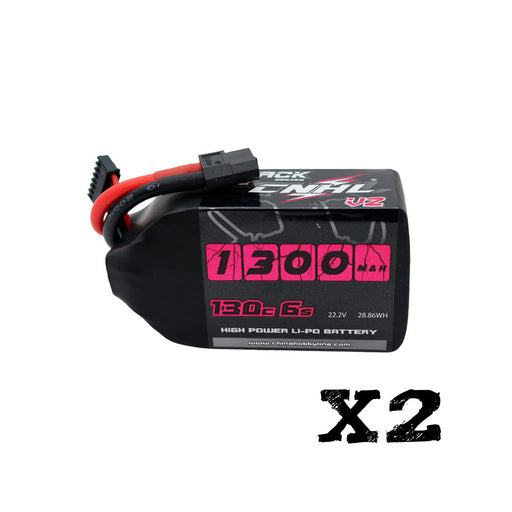
Quick Fit Check The 2 Packs CNHL Black Series V2.0 1300mAh 22.2V 6S 130C LiPo Battery with XT60 Plug is a strong fit for FPV pilots who want a prov...
View full detailsSpare Parts & Long-Term Support We know that for RC pilots, reliable spare parts support is an important part of keeping an aircraft fl...
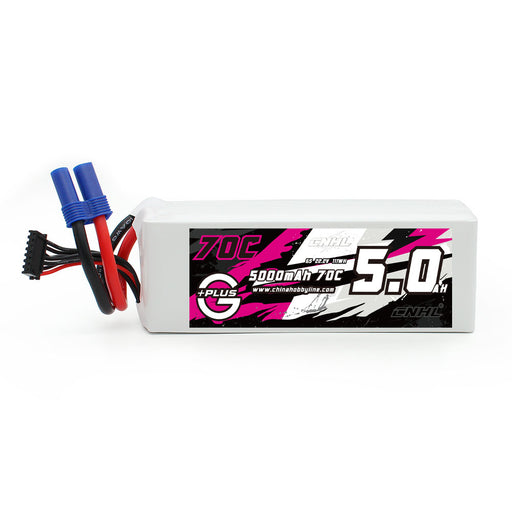
View full detailsSpecifications: Stock Number: 500706EC5 Capacity: 5000mAh Voltage: 22.2V / 6-Cell / 6S1P Discharge Rate: 70C Continual / 140C Burst Charge Rate: ...
View full details
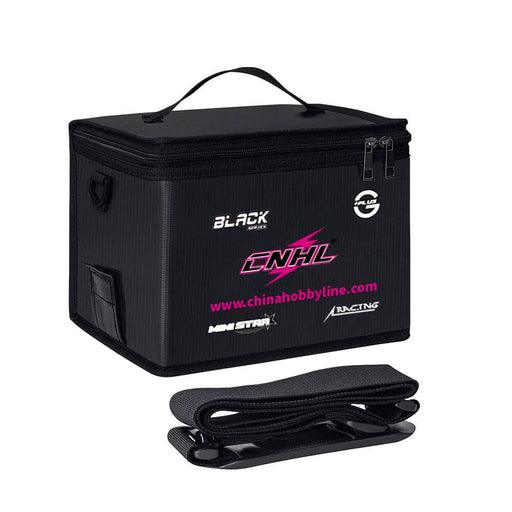
The CNHL LiPo Battery Bag is designed for safer LiPo charging, transport, and storage at home or at the field. It adds a practical layer of protect...
View full details

Quick Fit Check The 2 Packs CNHL Speedy Pizza Series Pro 1350mAh 6S 150C LiPo Battery with XT60 Plug is built for 5-inch FPV pilots who want a ...
View full details

Quick Fit Check The CNHL Speedy Pizza Series 2200mAh 22.2V 6S 120C LiPo Battery with XT60 Plug combines the familiar 2200mAh 6S format with a ligh...
View full details

Quick Fit Check The CNHL Speedy Pizza Series 2200mAh 14.8V 4S 120C LiPo Battery with XT60 Plug combines a widely used 2200mAh 4S format with a sli...
View full details

Quick Fit Check The CNHL Speedy Pizza Series 2200mAh 11.1V 3S 120C LiPo Battery with XT60 Plug takes the familiar 3S 2200mAh aircraft battery form...
View full detailsThe CNHL Long Range Series BAK 65E 6350mAh 21700 Li-ion battery cell is built around one clear priority: maximum stored energy from a lightweight c...
View full details

The CNHL Long Range Series BAK 50D 5000mAh 21700 Li-ion battery cell is designed for custom high-energy battery packs that need a strong balance be...
View full details




Leave a comment