

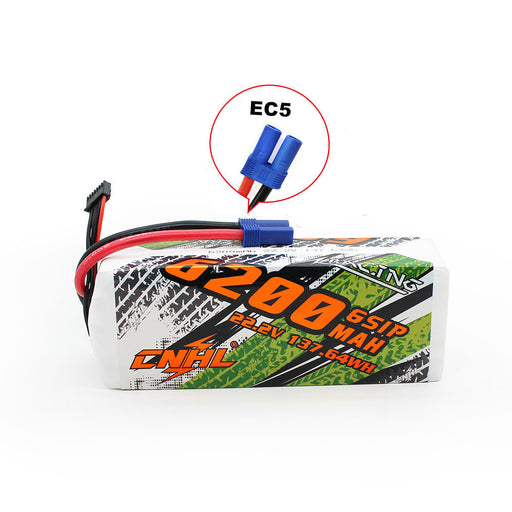


Best 6S and 8S LiPo Batteries for the Freewing Avanti S 90mm
The Freewing Avanti S 90mm EDF Sport Jet combines a larger 1380mm wingspan, a 12-blade 90mm ducted fan and the familiar precision of the Avanti sport-jet platform. Available with separate 6S and 8S power systems, the aircraft gives pilots two ways to enjoy fast passes, smooth aerobatics and controlled landings.
A good battery for the Avanti S needs more than the correct voltage. It must supply the current required by the EDF system, fit securely inside the fuselage and allow the airplane to balance correctly. The right combination of battery capacity, weight and discharge performance can influence everything from throttle response to approach speed.
CNHL offers a broad selection of 6S 22.2V and 8S 29.6V LiPo batteries, including conventional LiPo and Lightning LiHV packs. For most pilots, the 5000–5200mAh class is the best place to begin. Higher-capacity packs, especially the 6700mAh Lightning LiHV options, are worth considering when additional energy is desirable without automatically moving to the heaviest battery available.
Freewing Avanti S 90mm: 6S vs 8S Battery Compatibility
The Freewing Avanti S 90mm is offered with two factory power configurations. Both use a 90mm 12-blade EDF and 120A ESC, but the motors are different. The 6S version uses a 3668-1960KV inrunner, while the 8S Ultra Performance version uses a 4075-1350KV inrunner.
| Aircraft version | 6S PNP / 8S Ultra Performance PNP |
|---|---|
| Battery system | 6S: 22.2V LiPo / 8S: 29.6V LiPo |
| Factory motor | 6S: 3668-1960KV / 8S: 4075-1350KV |
| EDF and ESC | 90mm 12-blade EDF / 120A ESC |
| Starting capacity | 5000–5200mAh |
| Higher-capacity options | 6000–8500mAh, subject to fit and balance |
| Battery bay | 280 × 83 × 70mm |
| Recommended CG | 148–153mm behind the wing leading edge at the fuselage |
Why Choose the 6S Avanti S?
The 6S Avanti S delivers energetic EDF sport performance without requiring an 8S power setup. The larger airframe tracks smoothly through turns, rolls and fast passes, while the functional flaps help manage slower approaches. It is an especially practical choice for pilots who already own high-quality 6S flight packs and charging equipment.
Why Choose the 8S Ultra Performance Version?
The 8S model adds higher-voltage power with a dedicated 4075-1350KV motor. Its factory configuration is rated for approximately 4700g of static thrust and a top speed of around 200km/h under suitable conditions. This makes it attractive to pilots interested in strong acceleration, high-energy passes and vertical performance.
The 8S version is not simply the 6S aircraft with a different battery installed. Each version must use the cell count supported by its own motor and ESC configuration. Never connect an 8S battery to a stock 6S aircraft.
Top 4 Recommended CNHL Batteries for the Avanti S 90mm
For a straightforward buying decision, we recommend starting with four CNHL options: one standard-capacity battery and one higher-capacity upgrade for each voltage configuration. Other batteries in this collection offer additional choices for different weight, capacity and flying preferences.
6S PICK 1 | STANDARD SPORT FLYING
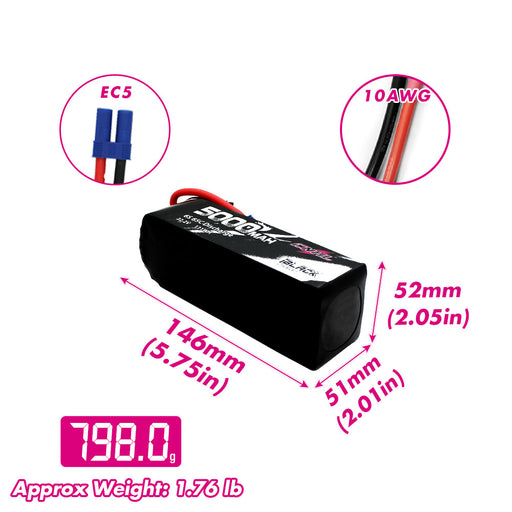
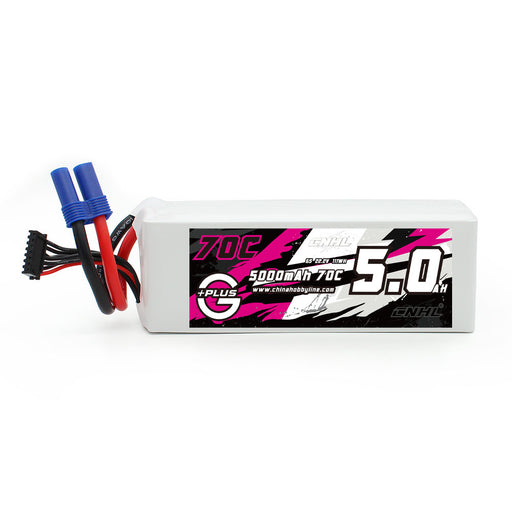
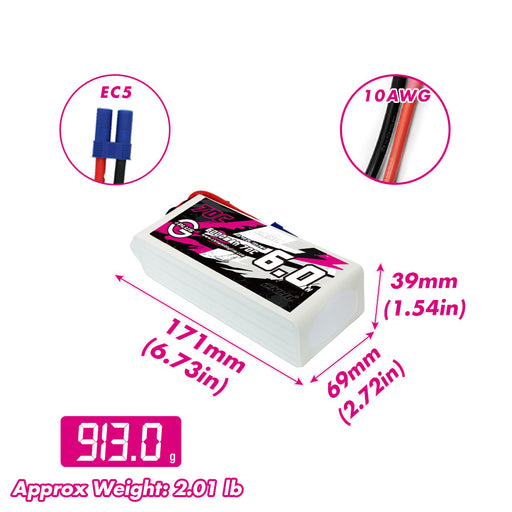
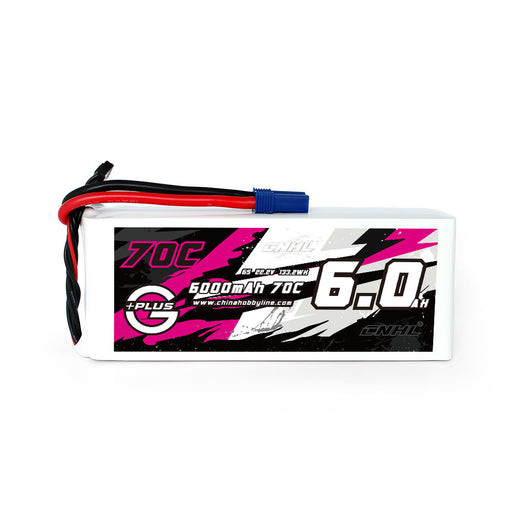
CNHL G+Plus 5000mAh 6S 100C LiPo Battery with EC5 Plug
A practical starting point for the 6S Avanti S. The 5000mAh capacity offers a familiar balance of energy and weight, while the 100C rating is designed for demanding current loads. Its EC5 connector matches the commonly used Avanti power connector format.
Choose this pack if you prioritize responsive sport flying, fast passes and a conventional 6S LiPo setup rather than maximum capacity.
Specifications: 22.2V / 6S / 5000mAh / 100C / EC5
Dimensions: 146 × 48 × 53mm
Approx. weight: 812g
6S PICK 2 | HIGH-CAPACITY LIGHTNING UPGRADE
CNHL Lightning LiHV 6700mAh 6S 120C Battery with EC5 Plug
This is one of the most interesting alternatives for the 6S Avanti S. With 6700mAh capacity and an approximate weight of just 758g, the Lightning pack provides 34% more rated capacity than a 5000mAh battery while remaining exceptionally competitive on weight.
It is particularly attractive for pilots who want additional energy for mixed-throttle sport flying without automatically accepting a heavier battery installation. Check the final CG and use a charging voltage supported by the aircraft's power system.
Specifications: 22.8V / 6S LiHV / 6700mAh / 120C / EC5
Dimensions: 150 × 49 × 51mm
Approx. weight: 758g
8S PICK 1 | STANDARD ULTRA PERFORMANCE
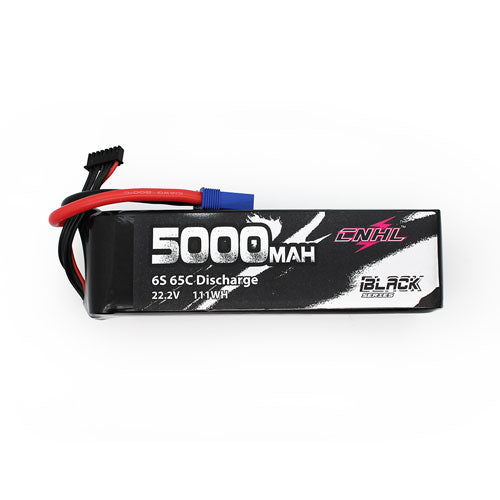
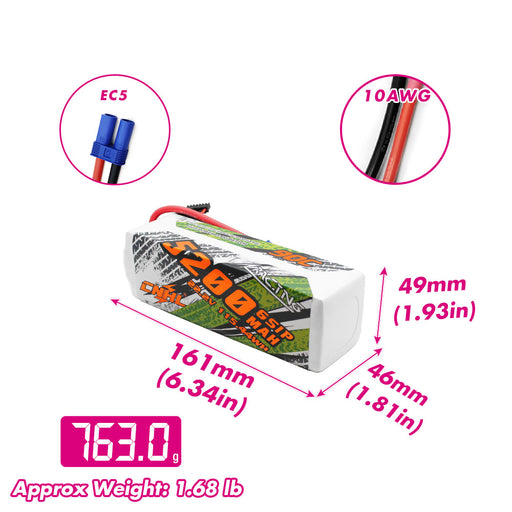
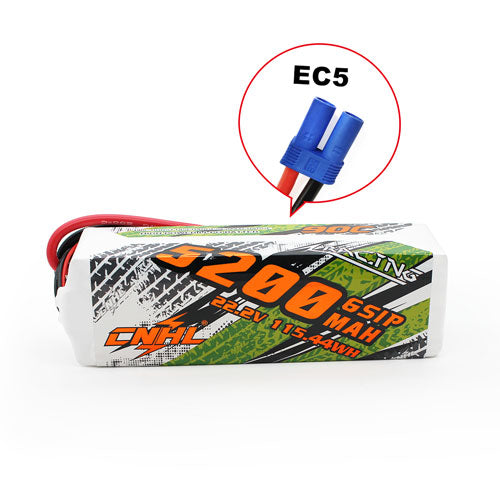
CNHL Racing Series 5200mAh 8S 90C LiPo Battery with QS8 Plug
For the 8S Ultra Performance Avanti S, this 5200mAh Racing pack offers a capacity close to the factory 5000mAh recommendation. Its single-pack 8S configuration avoids the need to combine two separate 4S batteries and simplifies battery handling inside the fuselage.
The 90C discharge rating makes it a performance-oriented option for EDF acceleration and high-power flight. The QS8 connector requires a correctly rated connection solution when used with the factory EC5 power lead.
Specifications: 29.6V / 8S / 5200mAh / 90C / QS8
Dimensions: 162 × 66 × 46mm
Approx. weight: 1040g
8S PICK 2 | HIGH-CAPACITY LIGHTNING UPGRADE
CNHL Lightning LiHV 6700mAh 8S 120C Battery with QS8 Plug
The 6700mAh Lightning LiHV is a compelling high-capacity choice for the 8S Avanti S. Despite offering approximately 29% more rated capacity than the Racing 5200mAh pack, it has a published weight of around 1024g, slightly less than the Racing battery's approximately 1040g.
That capacity-to-weight balance is particularly appealing in an EDF jet, where unnecessary weight can influence takeoff and landing behavior. Its compact 151 × 51 × 65mm dimensions also make it worth considering for the Avanti S battery compartment. Check battery positioning, the connector arrangement and the ESC's supported voltage before flying.
Specifications: 30.4V / 8S LiHV / 6700mAh / 120C / QS8
Dimensions: 151 × 51 × 65mm
Approx. weight: 1024g
Compare Our Featured Avanti S 90mm Batteries
The most important differences are not limited to capacity. Battery mass, dimensions and connector type can make a major difference to installation and aircraft balance. Here is a direct comparison of the four recommended packs.
| CNHL Battery | Capacity | Discharge | Weight | Plug |
|---|---|---|---|---|
| G+Plus 6S | 5000mAh | 100C | ≈812g | EC5 |
| Lightning 6S LiHV | 6700mAh | 120C | ≈758g | EC5 |
| Racing 8S | 5200mAh | 90C | ≈1040g | QS8 |
| Lightning 8S LiHV | 6700mAh | 120C | ≈1024g | QS8 |
Published dimensions and weights are approximate. Verify current product specifications and final aircraft balance. LiHV energy capacity and usable flight time also depend on the selected charging voltage and operating conditions.
Why the 6700mAh Lightning Packs Deserve Attention
Bigger-capacity batteries are often assumed to be heavier, but the Lightning options challenge that assumption. The 6S 6700mAh pack is listed at approximately 758g, while the 8S 6700mAh version is listed at approximately 1024g. Both offer attractive rated capacity relative to their published weight.
This does not automatically make them the best choice for every installation. CG position, pack shape, wiring and charging requirements still matter. But for pilots comparing standard and extended-capacity configurations, these Lightning batteries deserve a place on the shortlist.
What Battery Capacity Is Best for the Freewing Avanti S 90mm?
5000–5200mAh: The Practical Starting Point
Start here if you want an established capacity class that keeps the setup relatively straightforward. The 8S factory recommendation is based around 5000mAh, and a 5000–5200mAh single pack is an attractive alternative to more complicated multi-battery arrangements. For 6S owners, the same capacity range works well as a starting point for sport flying.
6000–6700mAh: Additional Energy Without Going to the Largest Pack
For pilots interested in more battery capacity, 6000–6700mAh is a particularly useful range to explore. It offers additional stored energy that may be beneficial during mixed-throttle flights, while keeping the selection focused on manageable pack sizes.
The CNHL Lightning 6700mAh packs are especially appealing because their published weight compares favorably with several lower-capacity alternatives. Check the actual CG and flying weight rather than assuming every higher-capacity pack will have the same handling characteristics.
7200–8500mAh: High-Capacity Configurations
The Avanti S has a generous battery compartment, making larger batteries worth exploring. However, 7200mAh, 7800mAh and 8500mAh packs should be selected for their complete specifications, not simply their capacity.
A heavier battery can change takeoff distance, approach speed, flare response and landing loads. An increase in rated capacity also does not guarantee a proportional increase in flight time. Larger packs are best considered by pilots who are comfortable checking the aircraft's center of gravity and evaluating the resulting flying weight.
Battery Bay Dimensions, Installation and CG Setup
The Freewing Avanti S 90mm has an approximately 280 × 83 × 70mm battery compartment, accessed through its large removable canopy hatch. This provides useful flexibility when choosing between different battery sizes and configurations.
The 280mm length does not mean that any battery shorter than 280mm is automatically suitable. Real installation depends on where the battery can be secured, the available width and height at that position, wire exit direction and the clearance needed for the canopy.
| Battery bay reference | 280 × 83 × 70mm |
|---|---|
| CG range | 148–153mm behind the wing leading edge at the fuselage |
| Installation checks | Pack dimensions, secure straps, canopy clearance and cable routing |
| Balance checks | Complete aircraft in flight-ready configuration with the selected battery installed |
How to Check the Avanti S Center of Gravity
The published CG range is 148–153mm from the wing leading edge at the fuselage. Freewing provides CG reference markings and a balancing arrangement using wooden supports for more precise setup.
- Install the selected flight battery and secure it in the intended position.
- Prepare the aircraft in its normal flight-ready configuration.
- Use the factory CG markings or supplied balancing arrangement.
- Move the battery forward or backward to achieve the recommended balance.
- Verify that the battery and wiring cannot shift in flight.
- Repeat the balance check whenever changing to a different battery pack.
The 90mm Avanti S can show a noticeable pitch change when flaps are deployed. Correct CG, suitable elevator setup and careful approach management are important, particularly when switching between batteries with different weights or center-of-mass positions.
Single 8S Battery vs Two 4S Batteries in Series
The Freewing Avanti S 90mm 8S can use an eight-cell battery system assembled from compatible individual packs. The factory recommendation includes two 4S 5000mAh LiPo batteries connected in series, or a matched 6S and 2S combination. A purpose-built single 8S LiPo pack provides another practical approach.
Single 8S LiPo: Simpler Battery Handling
A single 8S battery reduces the number of separate packs that need to be mounted and connected. It avoids a separate external series harness and gives pilots one physical pack to position for CG adjustment. The Racing 5200mAh 8S and Lightning 6700mAh 8S are examples of this approach.
The trade-offs include the need for a charger that supports 8S packs and a compatible main power connection. The CNHL packs featured here use QS8 plugs, while the factory Avanti S power connector is EC5.
Dual 4S LiPo: Flexible Battery Reuse
Two matched 4S batteries can be useful for pilots who already own suitable 4S packs or prefer charging them individually. When two 4S 5000mAh batteries are connected in series, they form an 8S 5000mAh system. Voltage adds in series, but the capacity remains 5000mAh.
For series operation, use matching batteries with the same capacity, compatible chemistry, similar age and condition, and closely matched states of charge. Confirm the wiring polarity, series harness rating and secure placement of both packs. Do not mix arbitrary batteries simply because their combined cell count equals 8S.
EC5 vs QS8: Connecting CNHL Batteries to the Avanti S
Connector compatibility matters on a high-current EDF jet. The factory Avanti S 90mm battery recommendation uses EC5 connectors. The featured CNHL 6S batteries also use EC5, while our single-pack 8S selections use QS8.
EC5 and QS8 are not directly interchangeable. If your aircraft retains its factory EC5 power lead, a QS8 battery needs an appropriately rated connection solution with correct polarity, suitable wire gauge and enough current capacity for the complete EDF system.
For a permanent connection change, use components appropriate to the aircraft's electrical requirements. Avoid loose, undersized or poorly assembled adapters that could introduce resistance, heat or connection failure.
LiPo vs LiHV Batteries: Charging Voltage and Compatibility
CNHL Lightning LiHV batteries support a maximum charge voltage of 4.35V per cell, compared with 4.20V per cell for conventional LiPo batteries. This is why the 6S Lightning battery is labeled 22.8V nominal and the 8S version is labeled 30.4V nominal.
| 6S standard LiPo full charge | 25.2V (4.20V per cell) |
|---|---|
| 6S LiHV full charge | 26.1V (4.35V per cell) |
| 8S standard LiPo full charge | 33.6V (4.20V per cell) |
| 8S LiHV full charge | 34.8V (4.35V per cell) |
CNHL Lightning LiHV batteries can be balance-charged to the conventional LiPo limit of 4.20V per cell. Only use 4.35V-per-cell LiHV charging when the installed ESC and complete power system have been confirmed compatible with the higher maximum voltage.
The ability of a battery to accept a higher charging voltage does not prove that the aircraft's stock ESC is designed for it. When in doubt, use the standard LiPo charge voltage rather than assuming all 6S or 8S power systems support LiHV full charge.
How Battery Weight, C Rating and Capacity Affect EDF Flight
Discharge Performance and Throttle Response
A 90mm EDF can demand substantial current, particularly during takeoff, vertical maneuvers and repeated full-throttle passes. A suitable high-discharge LiPo battery helps support stable power delivery when the motor is under load.
CNHL offers 70C, 90C, 100C and 120C battery options in this collection. Higher C ratings indicate greater claimed discharge capability, but they do not translate directly into higher airspeed. Real performance depends on internal resistance, voltage sag, motor characteristics, ESC limits and the complete electrical system.
Capacity, Flying Weight and Handling
Additional battery capacity can provide more available energy, but the effect on flight time depends on how the aircraft is flown. Repeated maximum-power passes consume energy much faster than relaxed cruising at partial throttle.
Battery weight also affects the aircraft's flying characteristics. The Avanti S can perform smooth rolls, inverted flight and controlled slow approaches, but an unnecessarily heavy installation may increase takeoff and landing demands. A high-capacity battery with favorable weight can be attractive, provided it maintains the correct CG.
Setting a Sensible Flight Timer
There is no universal flight-time figure for every Avanti S 90mm battery. Use a conservative initial timer, land with adequate reserve and check individual cell voltages after each flight. Review the amount of capacity returned during charging and adjust your timer based on real usage.
Keep sufficient energy available for a missed approach or go-around. That reserve is particularly important when flying from a shorter runway or dealing with gusty conditions.
Freewing Avanti S 90mm Battery FAQ
1. What battery does the Freewing Avanti S 90mm use?
The 6S Avanti S uses a 6S LiPo battery, while the 8S Ultra Performance model requires an 8S battery system. A 5000–5200mAh pack is a practical starting capacity. Check the installed motor, ESC, connector and final CG before choosing a pack.
2. Can the Freewing Avanti S 90mm use a 6700mAh battery?
A 6700mAh battery is a useful higher-capacity option. CNHL Lightning LiHV 6700mAh packs are available in both 6S and 8S configurations. Confirm the correct cell count, secure installation, final balance and charging-voltage compatibility before flying.
3. Can I use one 8S battery instead of two 4S batteries?
Yes. A suitable single 8S battery provides the required cell count without an external series connection between two 4S packs. Make sure the connector, battery dimensions, weight, charger and aircraft CG are appropriate for your installation.
4. What is the largest battery that fits the Avanti S 90mm?
The battery compartment measures approximately 280 × 83 × 70mm, and this collection includes capacities up to 8500mAh. However, maximum usable capacity cannot be determined from compartment dimensions alone. Confirm fit, secure restraint, wiring clearance, installed weight and CG before selecting a large battery.
5. Do QS8 batteries fit the factory EC5 connector?
Not directly. QS8 and EC5 use different connectors. A QS8-equipped CNHL battery requires an appropriately rated connection solution if the aircraft retains its factory EC5 power lead. Verify polarity and current-carrying capacity before use.
6. Can I charge CNHL LiHV batteries like regular LiPo batteries?
Yes. A compatible CNHL LiHV pack can be balance-charged to the normal LiPo limit of 4.20V per cell. Charging to 4.35V per cell requires confirmation that the aircraft's complete power system supports the higher voltage. Always select the correct cell count and charging mode.