


GEPRC Tern40 LR V2 Battery Guide: Choosing the Right 4S XT30 Pack
The GEPRC Tern40 LR V2 O4 Pro brings together several qualities that make 4-inch FPV drones appealing: efficient cruising, a compact airframe, responsive handling, and stabilized HD recording. Its 1404 3000KV motors and HQProp T4X2.5 bi-blade propellers provide a useful balance between efficiency and maneuverability, while the Deadcat frame keeps propellers out of the forward camera view.
Getting the most from this platform starts with selecting an appropriate battery. A larger pack may carry more energy, but it also adds weight that the motors must support throughout the flight. A smaller pack can make the drone feel more agile, although its available energy is limited. For a lightweight long-range quad, choosing the right balance matters more than simply choosing the highest capacity.
What Battery Does the GEPRC Tern40 LR V2 Use?
The Tern40 LR V2 O4 Pro uses a 4S battery system with an XT30 power connector. GEPRC specifies 660–850mAh as its recommended LiPo capacity range and also lists a 3000mAh 18650 Li-ion option for a different long-endurance setup.
| Specification | GEPRC Tern40 LR V2 O4 Pro |
|---|---|
| Battery Configuration | 4S |
| Power Connector | XT30 |
| Recommended LiPo Capacity | 660–850mAh |
| Alternative Battery | 18650 3000mAh Li-ion |
| O4 Pro PNP Weight | 178g ±5g, without battery |
| Official Flight-Time Reference | 12 minutes with 720mAh 4S LiHV, landing at 3.6V per cell |
The manufacturer's 12-minute figure is a reference for a specific battery and landing-voltage condition, not a guaranteed duration for every 4S pack. Actual flight time changes with flying speed, throttle use, wind, temperature, battery condition, and payload.
Three CNHL Battery Options for Different Flying Priorities
The following batteries share the appropriate 4S cell configuration and XT30-compatible power connection, but they serve different needs. Their weights also make a meaningful difference to the Tern40's flying characteristics.
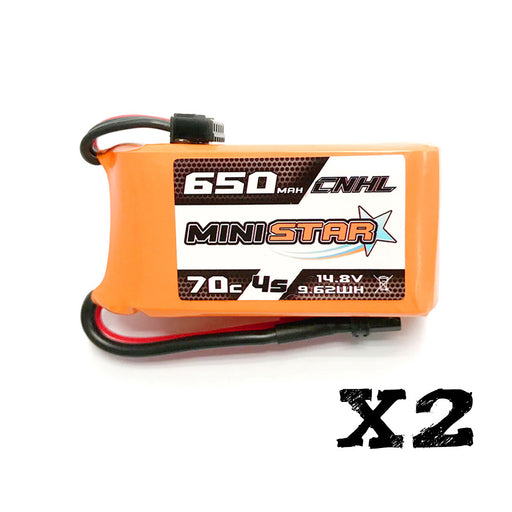
1. CNHL MiniStar HV 550mAh 4S 70C – Lightweight Flying
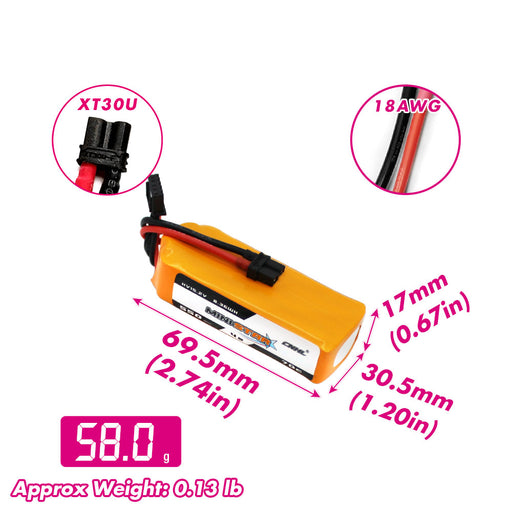
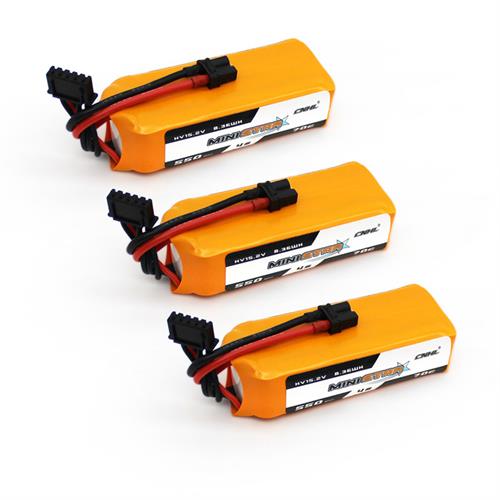
For pilots prioritizing low takeoff weight, the CNHL MiniStar HV 550mAh 15.2V 4S 70C is an interesting alternative. At approximately 58g per battery, it is the lightest of our three highlighted packs.
Combined with the manufacturer's nominal 178g O4 Pro PNP weight, the estimated total is approximately 236g before accounting for receiver differences, additional accessories, and weight tolerances. That makes the 550mAh pack a possible choice for a sub-250g build, subject to checking the actual ready-to-fly weight.
Its lower capacity means less stored energy than a 750mAh or 850mAh pack, so it is better suited to shorter flights where keeping the aircraft light is more important than maximizing endurance. The 550mAh capacity is below GEPRC's published 660–850mAh LiPo recommendation and should be treated as a lightweight alternative rather than an official recommended size.
Battery details: 550mAh | 4S LiHV | 70C | XT30U | 69.5 × 17 × 30.5mm | Approx. 58g per pack.
2. CNHL Lightning LiHV 750mAh 4S 120C – Capacity and Power Balance
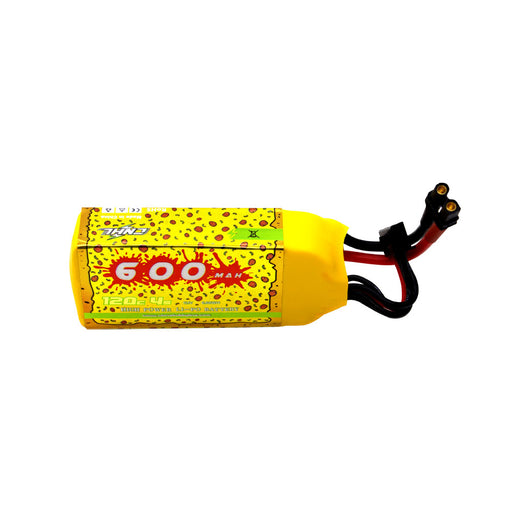
The CNHL Lightning LiHV 750mAh 15.2V 4S 120C sits comfortably within GEPRC's recommended capacity range. It combines a 750mAh energy reserve with a high advertised discharge rating, making it a compelling option for pilots who want both efficient cruising and responsive throttle control.
At approximately 79g, this pack is heavier than the 550mAh MiniStar HV but remains significantly lighter than the 850mAh MiniStar option below. Its 120C rating offers substantial specified current capability, although actual voltage stability and performance depend on the complete power system, battery condition, and operating temperature.
An important distinction: this particular 750mAh pack does not make the O4 Pro version a sub-250g setup. Its nominal battery weight plus the manufacturer's nominal PNP weight already totals approximately 257g, without additional receiver or accessory weight.
Battery details: 750mAh | 4S LiHV | 120C | XT30 | 79 × 20 × 29mm | Approx. 79g.
3. CNHL MiniStar 850mAh 4S 70C – Higher-Capacity Cruising
The CNHL MiniStar 850mAh 14.8V 4S 70C reaches the upper end of GEPRC's recommended LiPo capacity range. It offers greater nominal battery capacity than either the 550mAh or 750mAh options, making it worth considering for relaxed cruising where carrying more energy takes priority over minimizing weight.
However, capacity comes with a considerable weight trade-off. Each 850mAh MiniStar pack weighs approximately 110g, bringing the nominal combined weight of the drone and battery to approximately 288g before additional accessories. The drone may feel less nimble, and its motors must continuously support the extra load.
More capacity does not automatically guarantee a proportional increase in flight time. The best choice depends on how efficiently the aircraft carries the extra weight, along with propeller loading and flying style. This option is intended for pilots comfortable operating above the 250g threshold.
Battery details: 850mAh | 4S standard LiPo | 70C | XT30U | 62 × 33 × 30mm | Approx. 110g per pack.
GEPRC Tern40 LR V2 Battery Weight Comparison
If you're trying to decide between a smaller LiHV battery and a larger LiPo pack, comparing the total aircraft weight is a useful starting point.
| CNHL Battery | Pack Weight | Estimated Total* | Priority |
|---|---|---|---|
| 550mAh MiniStar HV | 58g | 236g | Lightweight setup |
| 750mAh Lightning LiHV | 79g | 257g | Capacity and response |
| 850mAh MiniStar | 110g | 288g | Higher capacity |
*Estimated totals use GEPRC's nominal 178g O4 Pro PNP weight plus one battery. They are not verified takeoff weights. Actual weight depends on receiver configuration, battery manufacturing tolerances, mounting accessories, and other installed equipment. Multi-pack product listings refer to separate batteries; only one pack is included in each total.
Does the GEPRC Tern40 LR V2 Need to Stay Under 250g?
The Tern40 LR V2 is appealing partly because of its lightweight design. However, the aircraft's weight without a battery should not be confused with its actual takeoff weight.
A lighter battery leaves more room within a 250g weight target. A heavier battery increases the all-up weight, potentially changing the aircraft's agility, braking behavior, and power requirements. Flying above 250g is not necessarily a technical problem for the drone, but it may affect which regulations apply in your location.
For pilots targeting sub-250g operation, weigh the complete aircraft in its normal flight configuration, including the battery and all installed equipment. Do not rely on the manufacturer's bare-aircraft weight or the battery's advertised capacity alone.
4S LiPo vs LiHV vs Li-ion: Which Makes More Sense?
Standard 4S LiPo
Standard 4S LiPo batteries have a nominal voltage of 14.8V and a fully charged voltage of 16.8V. They are a straightforward choice for everyday FPV flying, with a variety of capacities and discharge ratings available.
4S LiHV
LiHV batteries have a nominal voltage of 15.2V and can be charged up to 17.4V when the battery and equipment support the LiHV charging profile. Their higher charging voltage can provide additional available energy and stronger initial voltage under suitable conditions, although performance depends on the pack and flying load.
GEPRC's own 12-minute flight-time reference uses a 720mAh 4S LiHV battery, making LiHV relevant to this platform. Always use the appropriate charger settings and confirm voltage compatibility for your specific aircraft configuration.
4S Li-ion
Li-ion batteries are popular in long-range FPV applications because suitable cells can provide high energy capacity for sustained, relatively low-current cruising. GEPRC lists a 3000mAh 18650 battery option for the Tern40 LR V2.
That does not mean a Li-ion pack is ideal for every type of flying. Its weight, continuous discharge capability, voltage sag, and physical mounting arrangement must be considered. Li-ion configurations are generally better suited to controlled cruising than repeated aggressive throttle bursts, and a 3000mAh 18650 pack should not be assumed to meet a sub-250g weight target.
What Affects Flight Time on a 4-Inch Long-Range FPV Drone?
Battery capacity is only one part of flight endurance. Small long-range drones often achieve their best efficiency at moderate cruising speeds, where the motors provide just enough thrust to maintain smooth, controlled flight.
Several factors can make a noticeable difference:
- Flying style: Smooth cruising generally draws less power than repeated acceleration, climbing, and freestyle maneuvers.
- Battery weight: Additional capacity increases stored energy but also increases the load carried by the aircraft.
- Wind and weather: Strong wind, cold conditions, and turbulence can increase energy consumption or reduce usable battery performance.
- Propeller and motor efficiency: Changes to propeller pitch or configuration affect current draw, thrust, and cruising efficiency.
- Battery condition: Cell age, internal resistance, and temperature affect voltage sag and usable flight time.
For long-range planning, usable battery energy and the aircraft's actual consumption matter more than advertised capacity alone. Pilots should monitor battery voltage, consumed capacity, and current draw where available, and maintain an adequate reserve for the return flight.
Battery Fit and Installation Checklist
The Tern40 LR V2 has a fixed XT30 power connector and includes battery straps in different lengths. Before flying with a new pack, confirm the following:
- Use the correct 4S battery configuration.
- Confirm XT30 connector compatibility and correct polarity.
- Check pack dimensions against the available mounting area.
- Make sure the battery straps hold the pack securely without compressing or damaging it.
- Keep power and balance leads away from propellers and moving components.
- Check center of gravity and actual takeoff weight after installation.
A battery can have the correct voltage and connector while still being unsuitable because of its dimensions, weight, or mounting position. Always complete a physical fit check before the first flight.
GEPRC Tern40 LR V2 Battery FAQ
What size battery is recommended for the GEPRC Tern40 LR V2 O4 Pro?
GEPRC recommends 4S 660–850mAh LiPo batteries and also lists a 3000mAh 18650 Li-ion option. The drone uses an XT30 power connector. Actual fit and flight weight should be checked for each battery.
Can I use a 550mAh 4S battery on the Tern40 LR V2?
A 550mAh 4S pack offers the correct cell count and can be considered as a lightweight alternative if its connector, dimensions, and discharge capability meet your setup's requirements. It falls below GEPRC's recommended LiPo capacity range, so expect a smaller energy reserve and verify performance carefully.
Will a 750mAh 4S battery keep the Tern40 LR V2 under 250g?
Not with the CNHL Lightning 750mAh LiHV pack and the manufacturer's nominal O4 Pro PNP weight. The drone weighs approximately 178g without a battery, and this CNHL pack weighs approximately 79g, giving a combined estimate of 257g before additional equipment.
Is an 850mAh battery better for longer flights?
An 850mAh pack stores more nominal energy than a smaller pack of the same voltage class, but extra weight can offset some of that benefit. It is a higher-capacity option rather than a guarantee of longer flight time. The specific CNHL MiniStar 850mAh pack weighs approximately 110g.
How long can the GEPRC Tern40 LR V2 fly on a 4S LiPo?
GEPRC specifies 12 minutes with a 720mAh 4S LiHV battery when landing at 3.6V per cell. Other capacities, flying styles, and conditions may deliver different results. This figure should not be treated as a guaranteed flight time for all batteries.
Does the GEPRC Tern40 LR V2 use XT30 or XT60?
The Tern40 LR V2 uses a fixed XT30 power connector. Choose a battery with a compatible XT30 or XT30U-style connection and verify polarity before connecting. An XT60 battery is not a direct plug-in replacement.
Can I charge a 4S LiHV battery with a standard LiPo charger?
A LiHV battery can generally be balance-charged using a compatible standard 4S LiPo setting limited to 4.20V per cell, but reaching its full 4.35V-per-cell charging voltage requires an appropriate LiHV mode. Never select LiHV charging for a standard LiPo battery, and follow the battery and charger manufacturers' instructions.
Can I use a 3000mAh Li-ion battery for long-range cruising?
GEPRC lists a 3000mAh 18650 option for this model. Before using one, verify its cell configuration, power connector, continuous discharge rating, dimensions, mounting security, and total takeoff weight. It should not automatically be considered suitable for aggressive freestyle flying or sub-250g operation.
Explore More CNHL FPV Batteries and Charging Solutions
Choosing a battery for the Tern40 LR V2 is easier when you start with the aircraft's electrical requirements and then compare pack weight, capacity, and charging needs. The right battery is the one that fits your flying priorities without compromising secure installation or the aircraft's power requirements.
Explore our LiHV FPV batteries for high-voltage options across different FPV builds, or browse the broader CNHL LiPo battery collection to compare cell counts, capacities, and connectors.
For balance charging and battery care, see our RC LiPo battery chargers and select a charger that supports the cell count, chemistry, and charging requirements of your packs.