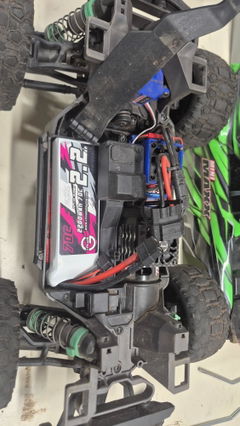










How the MCD OCTOX GT-E 4S Battery Setup Works
The MCD OCTOX GT-E uses a different battery layout from an electric GT car built around one large battery brick. For the 4S configuration covered by this collection, the useful approach is to install two identical 2S hard-case batteries and connect them in series.
With standard LiPo batteries:
- One battery: 2S / 7.4V nominal
- Two 2S batteries in series: 4S / 14.8V nominal
- Maximum voltage per 2S pack: 8.4V
- Maximum combined voltage: 16.8V
This is why a collection intended for an MCD OCTOX 4S setup can contain 2S batteries. Each battery represents one side of the complete power system, and two packs of the same specification are required for the twin-pack configuration.
If a battery is sold individually, simply select a quantity of two. Where CNHL offers a two-pack listing, that provides a convenient way to order two of the same battery but does not indicate special cell matching or a different level of OCTOX compatibility.
CNHL 2S Battery Options for an OCTOX 4S Build
The useful capacity range depends on what the car is being prepared to do. A lower-capacity pair can reduce total battery weight, while an 8000mAh or 9000mAh setup moves the priority toward extended track time.
| 2S Battery | Chemistry | Connector Options | Twin-Pack Direction | Typical Priority |
|---|---|---|---|---|
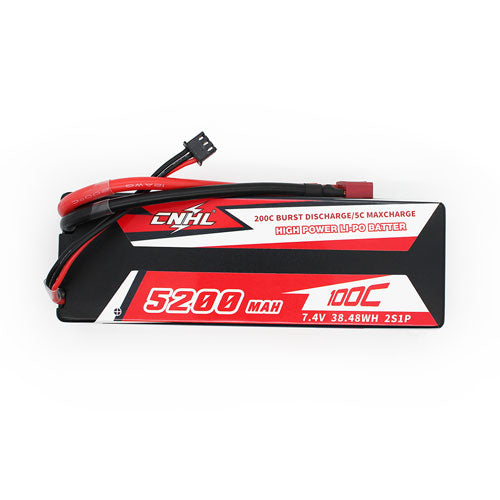
| 5200mAh 100C | 7.4V LiPo | T/Dean | Use 2 identical packs | Lower battery weight |
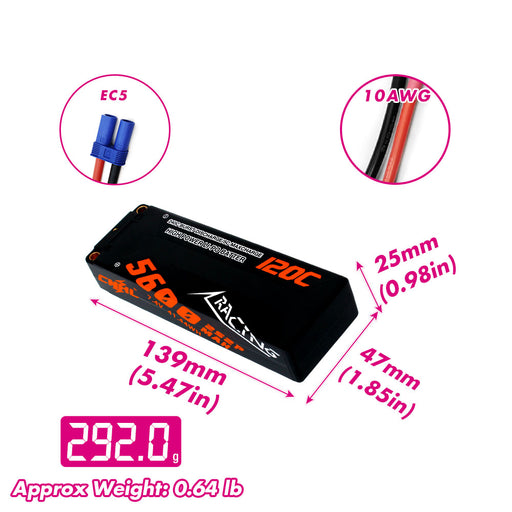
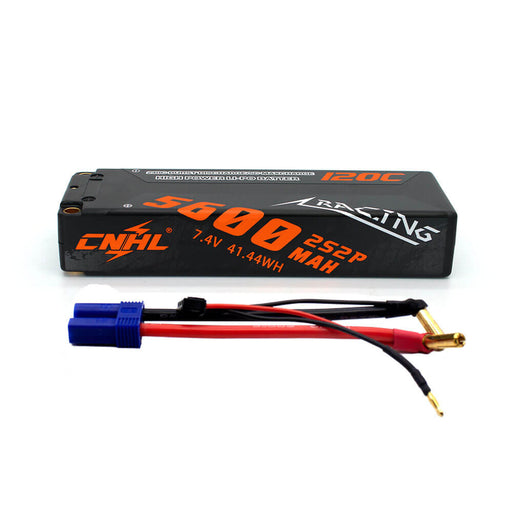
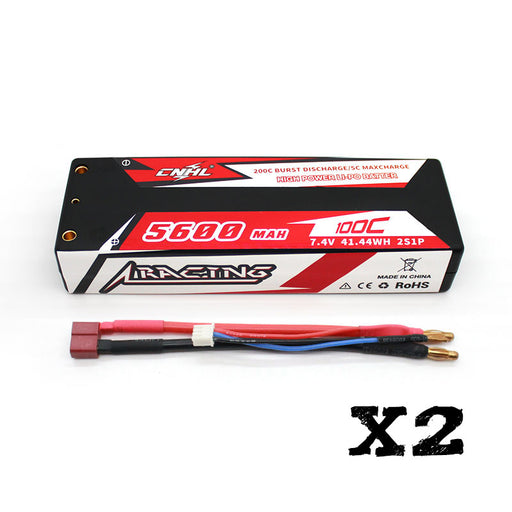
| 5600mAh 100C / 120C | 7.4V LiPo | T/Dean / EC5 | Use 2 identical packs | Race-oriented balance |
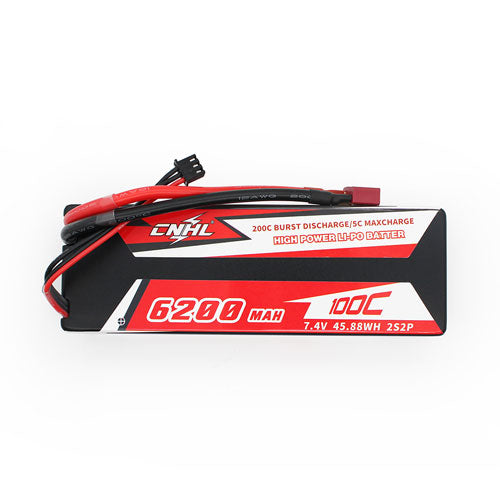
| 6200mAh 100C | 7.4V LiPo | T/Dean | Use 2 identical packs | Moderate capacity increase |
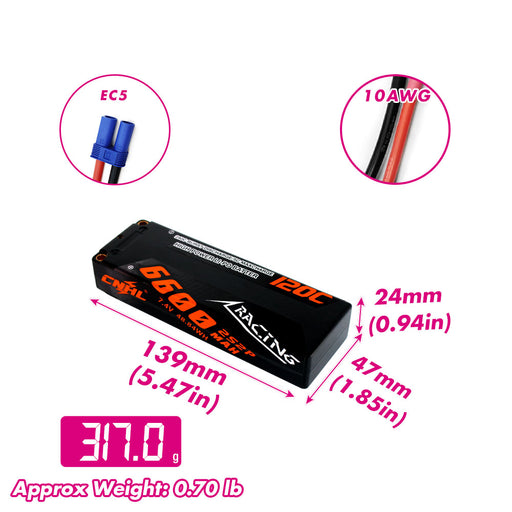
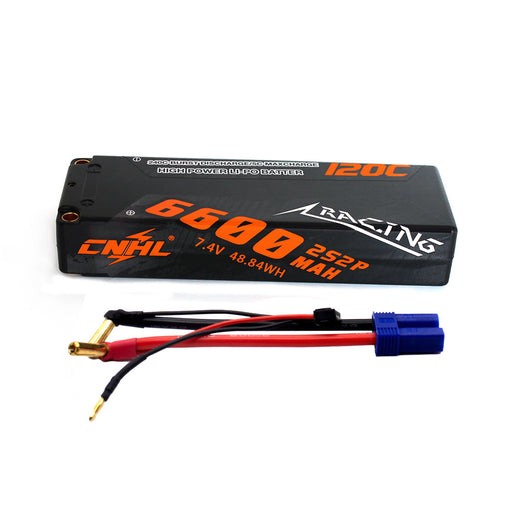
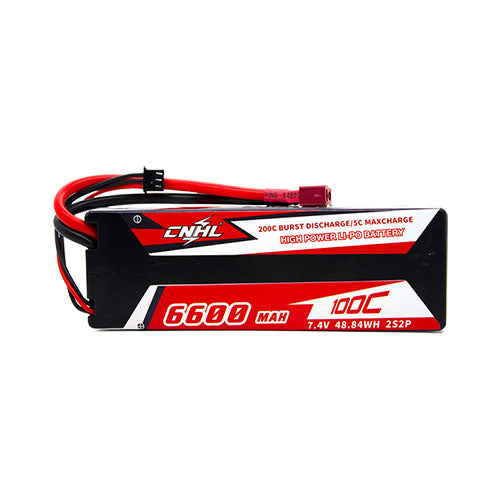
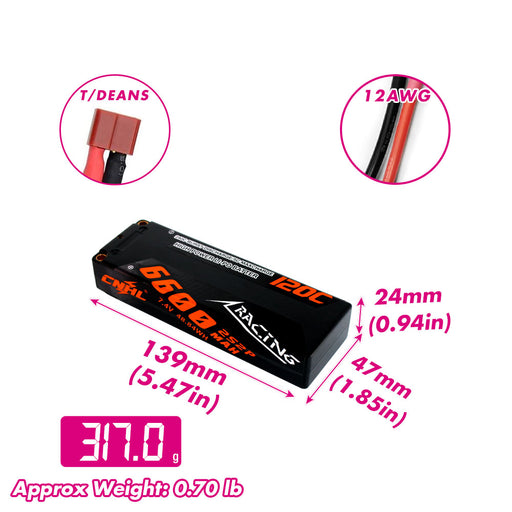
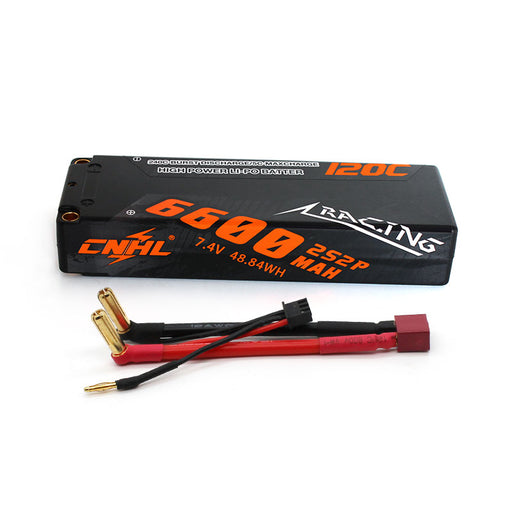
| 6600mAh 100C / 120C | 7.4V LiPo | T/Dean / EC5 | Use 2 identical packs | Performance and runtime balance |
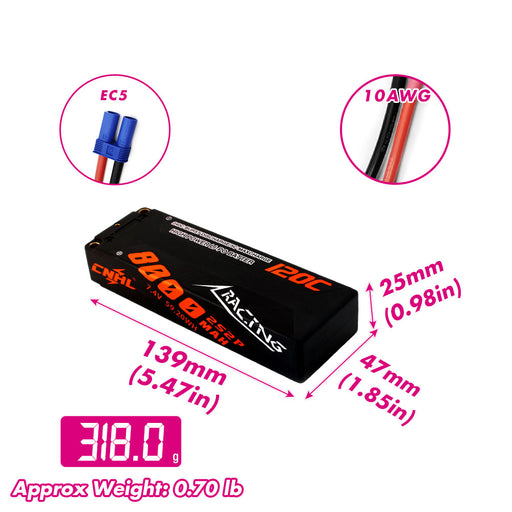
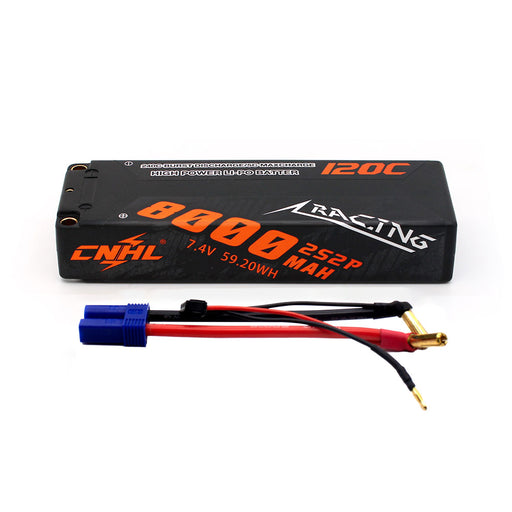
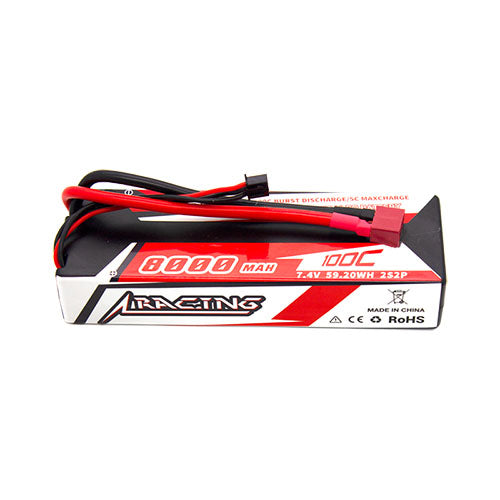
| 8000mAh 100C / 120C | 7.4V LiPo | T/Dean / EC5 | Use 2 identical packs | Long track sessions |
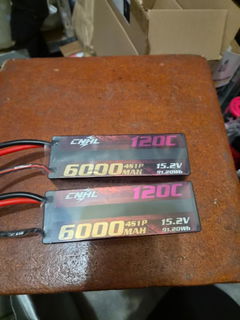
| 6000mAh 120C | 7.6V LiHV | EC5 | Use 2 identical packs | Custom LiHV setup |
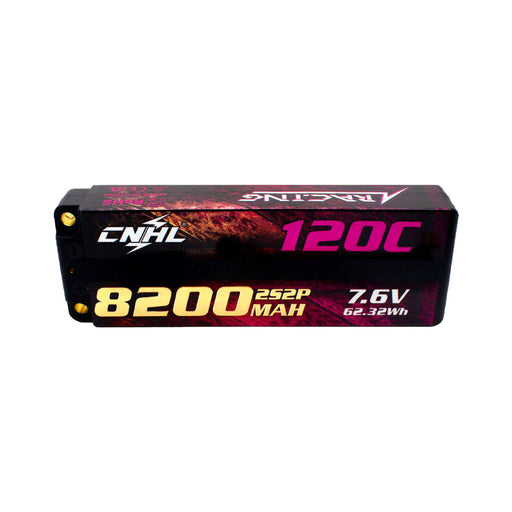
| 8200mAh 120C | 7.6V LiHV | EC5 | Use 2 identical packs | High-capacity LiHV setup |
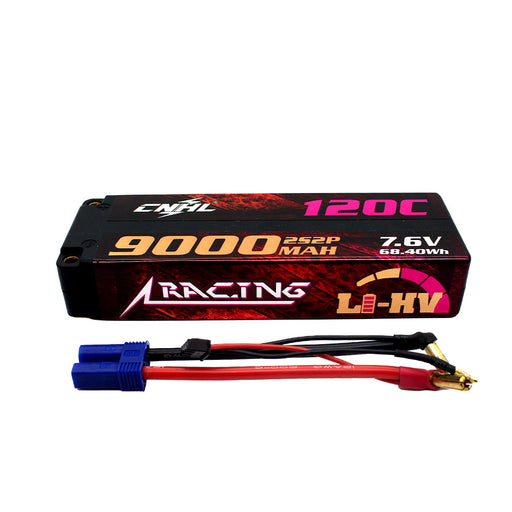
| 9000mAh 120C | 7.6V LiHV | EC5 | Use 2 identical packs | Maximum-runtime custom setup |
The table is best treated as a selection guide rather than a ranking from smallest to largest. The correct pair depends on the weight target, required runtime, ESC, connector arrangement and the race format in which the car will be used.
5200mAh and 5600mAh: A More Race-Focused Starting Point
With two batteries installed in the car, the weight difference between capacities becomes more important than it first appears. Any weight added to one battery is effectively added twice when the complete twin-pack system is considered.
That makes the 5200mAh and 5600mAh range a logical starting point when the aim is to provide sufficient race runtime without carrying considerably more battery capacity than the session requires.
The 5600mAh range is particularly flexible because CNHL offers higher-discharge Racing Series versions and different connector configurations. This allows battery capacity to remain consistent while the connector is selected around the ESC and series harness used in the car.
6200mAh and 6600mAh: More Runtime Without Going to the Largest Packs
The middle of the range is useful when a driver wants more track time while still paying attention to total battery mass. Two identical 6200mAh or 6600mAh batteries create a 4S system with the same stated capacity as one of the individual packs when they are connected in series.
For example:
2 × 2S 6600mAh in series = 4S 6600mAh
The voltage increases, but the capacity does not double.
For general GT practice and performance driving, this capacity range can provide a useful middle ground between more weight-conscious race setups and the much larger 8000mAh-plus options.
8000mAh and 9000mAh for Extended Track Time
Higher-capacity batteries are most attractive when uninterrupted running time becomes a bigger priority. That can include open practice, chassis development, tire testing, gearing work or simply spending more time driving between battery changes.
Two identical 8000mAh packs can provide a high-capacity standard LiPo 4S setup while retaining the conventional 16.8V maximum voltage of four LiPo cells.
The 9000mAh 2S LiHV EC5 sits at the extreme high-capacity end of the collection. It is particularly relevant to custom MCD 1/8 GT applications where long runtime is desired, and the battery format has already seen use within the MCD 1/8 GT category.
For the OCTOX specifically, the 9000mAh option should still be evaluated as part of the complete build. Two large batteries add significant combined weight, and the battery mounting, connector routing and electronics configuration all need to suit the chosen setup.
Why Two Identical 2S Batteries Matter
A series battery system works best when both sides of the system behave consistently. The preferred approach is therefore to use two of the same CNHL battery model rather than combining unrelated packs.
The two batteries should have the same:
- Cell count
- Capacity
- Chemistry
- Battery model and discharge specification
- Connector configuration where possible
- Similar age and usage history
- Similar state of charge before use
This does not mean the batteries have to come from a specially labelled “matched pair.” A normal single-pack listing can be used by purchasing two identical batteries and maintaining them together as one vehicle battery set.
Likewise, a CNHL two-pack listing simply makes it convenient to purchase two units. It should not be interpreted as a claim that the packs have undergone a special competition matching process unless the individual product description specifically states otherwise.
Does 2S2P Change the OCTOX 4S Setup?
Some CNHL Racing Series batteries are internally described as 2S2P. They are still 2S batteries from the vehicle's point of view and provide the normal voltage associated with a 2S pack.
Using two identical 2S2P packs in series therefore still creates a 4S system at the vehicle connection. The internal parallel cell arrangement affects how the battery itself is constructed; it does not turn an individual pack into a 4S battery.
Capacity also follows the normal rule for series wiring. Two 5600mAh packs connected in series create a 4S 5600mAh system, not 11200mAh.
T/Dean or EC5 for the MCD OCTOX?
There is no universal stock battery connector for the OCTOX GT-E because the chassis does not include an ESC. Connector choice therefore belongs to the completed electronics setup rather than to the chassis itself.
This is why both T/Dean and EC5 batteries can appear in the same OCTOX collection. Neither connector should be described as the factory OCTOX plug.
When deciding between them, consider the complete power path:
2S battery + 2S battery → series wiring → ESC
The battery connectors, series harness and ESC connection need to use the correct polarity and be appropriately rated for the current demands of the installed power system.
If the ESC already uses EC5, selecting EC5 batteries can simplify the wiring. A T/Dean setup can likewise be built around T/Dean batteries when the connector and wiring are appropriate for the application.
A properly rated adapter or connector conversion can be used where appropriate, but additional connectors add resistance, wiring length and potential failure points. A clean connector arrangement designed around the finished car is preferable to stacking unnecessary adapters in a high-performance GT setup.
Standard 2S LiPo Is the Straightforward 4S Direction
For a conventional 4S OCTOX power system, two standard 7.4V 2S LiPo batteries provide the simplest voltage reference.
Each battery reaches a maximum of 8.4V when correctly charged to 4.20V per cell. Connected in series, the complete four-cell system reaches a maximum of 16.8V.
This makes standard 2S LiPo the easier option when the ESC specification simply calls for conventional 4S LiPo operation.
Using Two 2S LiHV Batteries Requires an Extra Voltage Check
Two 2S LiHV batteries can also be used as a series pair in a suitably configured custom power system, but their maximum voltage is different from standard LiPo.
- One 2S LiHV pack: 7.6V nominal
- Two packs in series: 15.2V nominal
- LiHV maximum charge: 4.35V per cell
- Maximum voltage per 2S pack: 8.7V
- Maximum combined voltage: 17.4V
That 17.4V maximum is higher than the 16.8V maximum of an ordinary 4S LiPo battery.
Do not assume that an ESC marked for 4S automatically supports a fully charged twin-2S LiHV system. Check the actual maximum input voltage of the ESC installed in the car before using full LiHV charging.
If support for 17.4V cannot be confirmed, do not exceed the voltage limit of the electronics. When appropriate, a LiHV battery can be charged only to standard LiPo voltage using a charger and charging setup suitable for that procedure.
Battery Weight Matters Twice in a Twin-Pack GT Car
Capacity is only one part of choosing an OCTOX battery. Because the car uses two batteries in the 4S configuration covered here, pack weight deserves particular attention.
If one battery option is 80g heavier than another, choosing it adds approximately 160g when two are installed. That can be meaningful in a racing chassis where total weight and weight distribution influence the way the car changes direction, brakes and responds to setup changes.
This is why the highest-capacity battery should not automatically be treated as the best MCD OCTOX battery.
For shorter race formats, carrying only the capacity needed to complete the run can make more sense. For practice sessions, the balance may shift toward higher capacity because additional runtime reduces interruptions.
Battery Fitment: Check Both Sides Before Buying
Electrical compatibility does not guarantee physical fit. The OCTOX is a competition chassis with independently selected electronics, so the space available around the batteries can also be affected by the way the ESC, receiver and power wiring have been installed.
Before ordering two batteries, check:
- Battery length: including the position where the main leads leave the case
- Battery width: against the usable battery area on each side
- Battery height: including the battery restraint and body clearance
- Connector clearance: particularly with larger EC5 connectors and series wiring
- Wire routing: keep power leads clear of rotating drivetrain components
- Battery retention: both packs must remain secure during acceleration, braking and impact loads
- Combined battery weight: calculate the total for two packs
- ESC placement: custom electronics layouts can change practical battery clearance
Because a definitive three-dimensional battery-space specification is not published for every possible OCTOX electronics configuration, measuring the completed chassis remains the safest approach before selecting very large hard-case packs.
Series Wiring: Voltage Increases, Capacity Does Not
This is one of the most important points when choosing batteries for the OCTOX twin-pack setup.
When two identical 2S batteries are connected in series, their voltage is added while the battery capacity remains unchanged.
Examples:
- 2 × 2S 5200mAh → 4S 5200mAh
- 2 × 2S 5600mAh → 4S 5600mAh
- 2 × 2S 6600mAh → 4S 6600mAh
- 2 × 2S 8000mAh → 4S 8000mAh
Two 8000mAh batteries therefore do not create a 16000mAh 4S pack when connected in series.
Parallel wiring behaves differently and does not create 4S voltage from two 2S batteries. The wiring configuration must match the intended power-system voltage and should only be assembled with correct polarity and connectors rated for the application.
Choosing Batteries for Racing vs Practice
The OCTOX is designed around competition use, but race-day requirements and practice requirements do not always lead to the same battery choice.
For racing, the priority may be to carry enough energy for the required run while keeping battery mass under control. In that situation, 5200mAh, 5600mAh or another appropriately sized mid-capacity pair may make more sense than choosing the largest battery available.
For open practice, chassis development and longer test sessions, 6600mAh or 8000mAh packs can reduce battery changes and provide more uninterrupted driving time. A 9000mAh LiHV setup pushes that approach further when the car, electronics and voltage limits are configured accordingly.
Always check the rules used by the track or racing organization. Battery chemistry, case construction, dimensions, approval lists and total vehicle weight may be regulated independently of whether a battery physically fits the chassis.
MCD OCTOX GT-E Battery FAQ
Why does a 4S MCD OCTOX collection contain 2S batteries?
Because the 4S setup covered by this collection uses two identical 2S batteries connected in series. Each pack provides half of the complete four-cell power system.
How many batteries do I need for a 4S OCTOX setup?
You need two 2S batteries for the twin-pack 4S configuration described here. If the selected product is sold as a single battery, order a quantity of two.
Do the two batteries have to be a CNHL two-pack listing?
No. A two-pack listing is simply a convenient way to purchase two batteries. Two individually sold batteries of the same model can also be used. For a series pair, use the same battery model, capacity, chemistry and specification.
Are CNHL two-pack batteries specially matched?
Do not assume special electrical matching solely because a product is sold as a two-pack. Unless the individual product page specifically states otherwise, the two-pack format should be treated as a purchase-quantity option rather than a competition cell-matching service.
Does two 2S 6600mAh batteries make 4S 13200mAh?
No. Series wiring adds voltage, not capacity. Two 2S 6600mAh batteries connected in series create a 4S 6600mAh system.
Can I use a CNHL 2S2P battery?
Yes, a battery described as 2S2P is still a 2S pack electrically at the vehicle connection. Two identical 2S2P batteries can be used in the same twin-pack series concept when their other specifications and physical fit suit the car.
What connector does the MCD OCTOX GT-E use?
The OCTOX chassis does not have a universal factory battery connector because the ESC is supplied separately. Choose EC5, T/Dean or another appropriately rated connector according to the ESC and series wiring installed in the completed car.
Can I run two 9000mAh 2S batteries?
Two identical 9000mAh 2S packs can be considered when their dimensions, combined weight, wiring and electrical specifications suit the build. The CNHL 9000mAh LiHV EC5 is particularly relevant to high-capacity MCD 1/8 GT applications, but full LiHV voltage requires additional ESC verification.
Can I run two 2S LiHV batteries on a 4S ESC?
Only after confirming the ESC's actual maximum input voltage. Two fully charged 2S LiHV batteries reach 17.4V in series, compared with 16.8V for standard 4S LiPo, so a general 4S label alone does not confirm full-charge LiHV compatibility.
Which capacity is best for OCTOX racing?
There is no universal best capacity. Lower and mid-capacity packs can help control total battery weight, while larger packs provide additional runtime. Race duration, current draw, chassis balance and competition rules should determine the final choice.
Explore More 2S and RC Car Batteries
If your OCTOX setup requires another capacity, discharge-rate specification or connector, compare more options in the CNHL 2S LiPo battery collection. For a twin-pack 4S setup, remember to select two identical batteries when purchasing from a single-pack listing.
For batteries covering electric GT cars, touring cars, buggies, short course trucks, monster trucks and other performance RC platforms, browse the complete CNHL RC car battery collection.