


Quick Fit Check: Team Corally KAGAMA XP 6S Battery Requirements
| Vehicle | Team Corally KAGAMA XP 6S |
| Vehicle Type | 1/8 Scale 4WD Monster Truck |
| Battery Compartment | 161 × 51 × 50mm |
| Featured Power Setup | Single 6S XT90 LiPo / LiHV battery |
| Factory Connector | XT90 |
| Primary Recommendation | CNHL Lightning LiHV 8500mAh 22.8V 6S 120C XT90 |
| Stock RTR Motor | Kuron 825 2050KV Brushless |
Best Battery for Team Corally KAGAMA XP 6S: Lightning LiHV 8500mAh 120C XT90
The CNHL Lightning LiHV 8500mAh 22.8V 6S 120C HV Lipo Battery with XT90 Plug is our primary battery recommendation for the KAGAMA XP 6S. Unlike a lighter SCT or buggy, the KAGAMA has the size, chassis strength, tire diameter, and overall mass to make good use of a large-capacity 6S pack.
The attraction is not simply longer runtime. A KAGAMA asks a battery to deliver hard current while accelerating a heavy 4WD drivetrain and four large 170mm tires. A high-output pack that can maintain voltage under load helps preserve the immediate torque response that makes a 6S monster truck exciting in the first place.
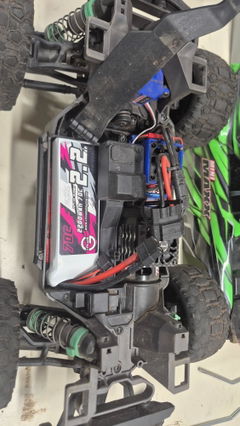
That combination has already been demonstrated in an unusually demanding KAGAMA application. A heavily modified truck weighing approximately 7.6kg was run with the Lightning 8500mAh 6S pack and still delivered very strong launch punch, aggressive acceleration, sustained performance, and extended runtime. That is particularly relevant to KAGAMA owners because it shows why the 8500mAh pack is more than a capacity-first option: it can support a very heavy 6S setup without turning the truck's power delivery into the weak point.
Why 8500mAh Makes More Sense on the KAGAMA Than on Many RC Platforms
Large batteries always add weight, so an 8500mAh pack is not automatically the best answer for every RC vehicle. The KAGAMA XP 6S is one of the exceptions where the trade-off can be much easier to justify.
First, the truck already weighs around 5.4kg before the battery is installed. The percentage increase in total vehicle mass from a larger pack is therefore less dramatic than it would be on a lightweight buggy or race-oriented platform. Second, the KAGAMA's large tires, wide stance, long-travel suspension, and monster-truck geometry are already designed around carrying significant mass over rough terrain.
Third, the type of driving suits the extra capacity. Long grass, dirt fields, gravel, repeated full-throttle pulls, high-speed open-area bashing, and extended sessions can consume energy quickly. In those situations, 8500mAh gives the driver more time between battery changes while still supporting the hard 6S punch the truck is expected to deliver.
Four CNHL Battery Directions for the KAGAMA XP 6S
| Battery | Best Use | KAGAMA Driving Character |
|---|---|---|
| Lightning LiHV 8500mAh 22.8V 6S 120C XT90 | Primary recommendation / maximum-performance long sessions | Hard punch, sustained output and maximum runtime with additional total mass |
| Lightning LiHV 5500mAh 22.8V 6S 120C XT90 | Balanced 6S bashing and repeated jumping | Strong output with less battery mass than the 8500mAh setup |
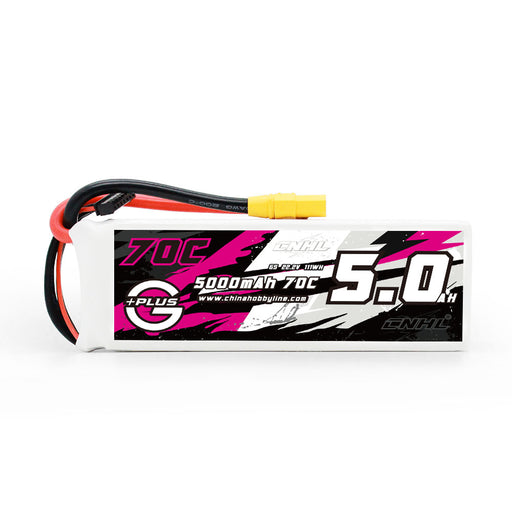
| G+Plus 5000mAh 22.2V 6S 100C XT90 | Standard high-output 6S LiPo setup | Straightforward 22.2V LiPo power and balanced weight |
| G+Plus 4000mAh 22.2V 6S 70C XT90 | Lightweight setup and shorter high-intensity sessions | Lowest battery mass and more responsive jump behavior |
Maximum Runtime and Punch: Lightning 8500mAh 6S 120C
For the driver who bought a KAGAMA because a large 6S monster truck should feel powerful, the Lightning 8500mAh setup is the most interesting option in this collection. Its large capacity extends run time, while the 120C-rated Lightning platform is designed for high-output RC applications where heavy load and repeated acceleration matter.
The KAGAMA's 2050KV motor and large tires can place considerable load on the battery when the truck launches from low speed. That is exactly where weak voltage delivery can make a heavy truck feel softer than expected. The 8500mAh Lightning pack is intended for the opposite experience: keeping the truck responsive even when vehicle mass and terrain are working against acceleration.
The other advantage appears later in the run. Large-capacity packs reduce the need to stop frequently for battery changes, making the 8500mAh option particularly attractive for large fields, open dirt areas, long grass, and locations where getting back to the car or pit area every few minutes is inconvenient.
Balanced Alternative: Lightning 5500mAh 6S 120C XT90
The CNHL Lightning LiHV 5500mAh 22.8V 6S 120C HV XT90 is the better direction for drivers who still want high-output Lightning performance but place more emphasis on jump response and lower total vehicle weight.
Compared with the 8500mAh setup, the truck carries less battery mass, which reduces landing load and makes changes of direction easier. It gives up runtime, but for repeated ramp sessions or more aggressive air-focused bashing, that can be a worthwhile trade.
Standard LiPo Choice: G+Plus 5000mAh 6S 100C XT90
The CNHL G+Plus 5000mAh 22.2V 6S 100C Lipo Battery with XT90 Plug is the cleanest conventional 6S LiPo option in the group. Its 5000mAh capacity keeps weight more moderate, while the 100C rating provides strong output capability for the KAGAMA's heavy drivetrain and large-tire load.
Choose this setup if you want strong standard 22.2V 6S performance without making LiHV charging part of your battery routine.
Lightweight Option: G+Plus 4000mAh 6S 70C XT90
The CNHL G+Plus 4000mAh 22.2V 6S 70C Lipo Battery with XT90 Plug sits at the opposite end of the strategy from the 8500mAh Lightning pack. Instead of maximizing runtime, it minimizes battery mass.
That makes it useful for shorter sessions, frequent jumping, and drivers who want the KAGAMA to carry less weight through the air. Runtime will naturally be shorter, but not every bash session needs an 8500mAh pack.
Why High Battery Output Matters on a Heavy KAGAMA
A KAGAMA at full throttle is a demanding electrical load. The battery has to accelerate a heavy chassis, four-wheel-drive system, three differentials, and large rotating tires at the same time. The demand becomes even greater once extra aluminum upgrades, reinforcement parts, larger accessories, or other modifications increase vehicle weight.
This is why the experience from a heavily modified 7.6kg KAGAMA is useful. Even at that unusually high weight, the 8500mAh Lightning pack was able to deliver the immediate acceleration and sustained output expected from a powerful 6S setup. For a stock-weight KAGAMA, that gives useful context for why a high-capacity, high-output battery can be particularly well suited to this platform.
Capacity and discharge capability should therefore be considered together. Runtime matters, but on a monster truck like this, preserving punch under load matters just as much.
Battery Weight: Why Bigger Is Not Automatically Worse
Normally, RC battery advice warns against simply fitting the biggest pack possible. That remains good general advice, but the KAGAMA deserves a more nuanced answer.
The truck is already a large, wide, heavy monster truck. For ground-focused bashing, straight-line acceleration, rough-terrain driving, and long sessions, the added mass of an 8500mAh pack may be a reasonable exchange for the extra runtime and energy reserve. The chassis and suspension are not being asked to turn a lightweight racing platform into a heavyweight machine; the KAGAMA begins as a heavyweight machine.
The trade-off becomes more noticeable when jumping. More battery mass means more energy on landing and more inertia when correcting the truck in the air. Drivers whose sessions are dominated by large ramps may therefore prefer the 5500mAh or 5000mAh options. Drivers who spend more time charging across fields and rough ground can make much stronger use of the 8500mAh pack.
Why XT90 Is the Right Connector Direction
The KAGAMA XP 6S RTR uses an XT90 battery connection, and every highlighted battery in this collection is configured with XT90. That keeps the power system simple and avoids adding unnecessary connector adapters to a high-current 6S setup.
Direct connector compatibility also keeps the battery compartment cleaner. On a truck exposed to repeated jumps, vibration, and chassis movement, fewer loose adapter leads mean fewer things to move around under the body.
KAGAMA XP 6S and SHIROI XP 6S: Same Battery Space, Different Priorities
The KAGAMA XP 6S and SHIROI XP 6S share closely related chassis architecture and the same 161 × 51 × 50mm battery compartment, so many battery dimensions overlap between the two vehicles. Their driving jobs are different, however.
The SHIROI is a short course truck with smaller SCT tires and a full body, so battery weight has a stronger relationship with body roll and high-grip handling. The KAGAMA is a wide monster truck with much larger tires, high ground clearance, and long-travel suspension. That makes maximum output and long-runtime large-capacity packs easier to justify, especially for ground-focused bashing.
If you also run Team Corally's SCT platform, see the Team Corally SHIROI XP 6S Batteries collection for battery recommendations tuned around the SHIROI's different handling priorities.
6S LiPo vs 6S LiHV for the KAGAMA XP 6S
The G+Plus 5000mAh and 4000mAh packs are standard 22.2V 6S LiPo options. They are the straightforward choice for drivers who want conventional LiPo charging and strong 6S performance.
The Lightning 5500mAh and 8500mAh packs use LiHV chemistry and are rated at 22.8V nominal. The 8500mAh pack has already demonstrated strong real-world performance in a heavily modified KAGAMA application. However, battery compatibility and full LiHV charge-voltage compatibility are two different questions.
Unless the complete ESC and electronics setup is explicitly confirmed for the higher LiHV full-charge voltage, the conservative approach is to use the LiHV pack at standard LiPo charge voltage, up to 4.20V per cell. Use a charger with the correct battery mode and always follow normal LiPo/LiHV charging and storage practices.
Which Capacity Should You Choose?
| Capacity | Choose It If... | Main Trade-Off |
|---|---|---|
| 8500mAh | You want maximum runtime, strong punch and long open-area sessions | Highest battery mass |
| 5500mAh | You want high-output LiHV performance with less mass | Less runtime than 8500mAh |
| 5000mAh | You prefer a conventional high-output 22.2V 6S LiPo setup | Balanced rather than maximum runtime |
| 4000mAh | You prioritize lower weight, jumping and shorter sessions | Shortest runtime |
FAQ: Team Corally KAGAMA XP 6S Batteries
What is the best battery for the Team Corally KAGAMA XP 6S?
For drivers who want maximum runtime and hard-hitting 6S performance, the CNHL Lightning LiHV 8500mAh 6S 120C XT90 is the primary recommendation in this collection. A 5500mAh pack is the lighter alternative for more jump-focused use.
Does an 8500mAh 6S battery work well in the KAGAMA?
Yes. The Lightning 8500mAh 6S pack is one of the strongest KAGAMA options for long-runtime and high-load use. It has also been successfully used in a heavily modified KAGAMA weighing approximately 7.6kg, where strong acceleration and sustained output were maintained despite the unusually high vehicle weight.
What is the KAGAMA XP 6S battery tray size?
The KAGAMA XP 6S battery compartment is approximately 161 × 51 × 50mm. The batteries featured in this collection have been selected around KAGAMA fitment, but wiring position and secure strap installation should still be checked during setup.
Is 8500mAh too heavy for jumping?
It depends on how you drive. The 8500mAh pack adds useful runtime but also increases landing mass and inertia. Drivers who spend most of a session on large ramps may prefer 5000–5500mAh, while ground-focused bashers can make better use of the larger pack.
Why recommend 8500mAh for the KAGAMA but not always for the SHIROI?
The two vehicles share related chassis architecture, but they have different driving priorities. The KAGAMA is a wide monster truck with much larger tires and long-travel suspension, so a heavy long-runtime battery fits its ground-bashing character better. The SHIROI's full SCT body and smaller tires make battery weight more noticeable in high-grip handling and body roll.
Does the KAGAMA XP 6S use XT90 connectors?
Yes. The RTR power system uses XT90, so the XT90-equipped batteries in this collection provide a clean connector match without requiring an additional battery adapter.
Can I use the Lightning 8500mAh LiHV pack at full LiHV voltage?
The pack itself is LiHV-capable, but full LiHV charging also requires the vehicle electronics to support the higher full-charge voltage. Unless that support is explicitly confirmed for your complete KAGAMA electronics setup, use the conservative standard-LiPo charge limit of 4.20V per cell.
Should I choose 5000mAh, 5500mAh or 8500mAh?
Choose 8500mAh for maximum runtime and ground-focused high-power bashing, 5500mAh when you want a lighter high-output setup with more emphasis on jumping, or 5000mAh if you prefer a conventional 22.2V 6S LiPo with balanced weight and runtime.
Explore More CNHL RC Car Batteries
For more 6S batteries across monster trucks, truggies, buggies and other high-power RC platforms, explore the CNHL 6S LiPo Battery Collection and the broader CNHL RC Car Batteries range.
If you also run Team Corally's short course platform, compare the dedicated Team Corally SHIROI XP 6S Batteries collection, where battery recommendations are tuned around the SHIROI's SCT-specific handling and weight priorities.