

The HobbyKing Red Arrows Hawk 105mm EDF brings one of Britain's most recognizable aviation liveries to a substantial 1500mm RC jet. Beneath the red paint is a familiar airframe: the Sports Hawk ARF+ platform, with its all-flying tail, metal retracts, functional flaps and customizable 12S EDF power system. So what has actually changed, and is the new Hawk worth choosing over the original?
For experienced EDF pilots, the answer involves more than appearance. The Red Arrows edition combines the established Hawk flying characteristics with revised landing gear details and the freedom to build a power system around a 100–105mm fan. It also retains the compromises of a large ARF+ aircraft: additional equipment costs, installation work and the need for a suitable flying site.
A Proper Red Arrows Hawk at Last
The British Aerospace Hawk is closely associated with the Royal Air Force's Red Arrows aerobatic display team. Its compact jet-trainer silhouette, swept wings, tandem cockpit and distinctive tail make it instantly recognizable, particularly in the team's vivid red, white and blue scheme.
That visual identity is central to the new HobbyKing model. The bright red fuselage features a sweeping white side stripe, RAF roundels, Royal Air Force lettering and a red, white and blue tail. These details give the aircraft a more traditional scale appearance than the original Sports Hawk's motorsport-inspired finish.

The result feels particularly appropriate for the Hawk airframe. Unlike an imaginary racing scheme, the Red Arrows finish connects the RC model directly to the aircraft's best-known real-world role.
It is also a meaningful improvement in visual orientation. Red wings, white detailing and contrasting tail markings make the jet's attitude easier to interpret in many flying conditions. That does not eliminate the challenges of tracking a fast EDF aircraft against a difficult sky, but the strong color contrast is useful as well as attractive.
Avios Red Arrows Hawk vs Sports Hawk: What's Actually Different?
The most important thing to understand is that the Red Arrows Hawk is not an entirely new EDF design. It continues the established Sports Hawk architecture. The wingspan, general dimensions, ARF+ format, control arrangement and 12S propulsion concept remain substantially the same.
| Feature | Sports Hawk | Red Arrows Hawk |
|---|---|---|
| Wingspan | 1500mm | 1500mm |
| Airframe | EPO foam | EPO foam |
| Assembly format | ARF+ | ARF+ |
| EDF installation | Approx. 100–110mm class | 100–105mm recommended |
| Power system | 12S | 12S |
| Horizontal stabilizers | All-flying | All-flying |
| Landing gear | Metal electric retracts | Revised retract/strut setup |
| Flaps and lighting | Included | Included |
| Color scheme | Motorsport-inspired | RAF Red Arrows |
The Biggest Change Is Visual
The original Sports Hawk offered a bold, unconventional appearance that suited its aerobatic character but was not an authentic RAF display scheme. The Red Arrows version takes the opposite approach, prioritizing a recognizable military demonstration aircraft aesthetic.
For pilots who already own the original model, this is the clearest reason to consider the newer edition. It provides a different flying presentation rather than an entirely different flying platform.
The Landing Gear Has Been Refined
There is, however, a mechanical distinction worth noting. The Red Arrows version features adjustments to the retract and oleo-strut arrangement, intended to improve suspension behavior and produce a more scale-like stance on the ground.
The original Sports Hawk already used substantial metal retracts and shock-absorbing struts. Early development also involved changes to the nose gear geometry and wheel arrangement. The new model builds on that established design rather than replacing it with a fundamentally different system.
These revisions are particularly relevant because a 7kg-class EDF aircraft places significant demands on its landing gear, especially when operating from grass.
Airframe Design: More Than a Large Foam Jet
With a 1500mm wingspan and approximately 1750mm overall length, the Red Arrows Hawk has the physical presence expected from a serious large EDF model. Its flying weight is around 7kg depending on the propulsion system, batteries and additional equipment.
The EPO construction keeps the airframe relatively manageable for its dimensions, while removable components make transportation more practical.

An All-Flying Horizontal Tail
One of the Hawk's most distinctive features is its all-flying horizontal stabilizer. Instead of moving a separate elevator surface behind a fixed stabilizer, the horizontal tail surfaces themselves rotate to provide pitch control.
This arrangement closely follows the aerodynamic layout of the full-size Hawk and gives the model a more authentic mechanical design than a conventional fixed stabilizer with hinged elevators.
A substantial centrally mounted servo drives the tail through a bellcrank mechanism. Because pitch control is so important on a fast EDF jet, precise linkage geometry, minimal free play and reliable servo performance deserve special attention during setup.

Functional Flaps and Sequenced Retracts
The Hawk features a full control arrangement with ailerons, rudder, pitch control, flaps and retractable landing gear. Gear doors operate through a sequencer, adding realism during takeoff and landing.
Flaps are especially important on an aircraft of this size. They allow the pilot to establish distinct configurations for takeoff and landing, helping manage approach speed and aircraft attitude.
With a properly adjusted flap-to-elevator relationship, configuration changes can be smooth, without requiring large pitch corrections. Flight testing should establish the correct compensation rather than assuming a universal setting.
Lighting That Adds Real Functionality
The supplied lighting system includes navigation LEDs and a prominent forward-facing nose light. Beyond improving the scale appearance on the runway, these lights help communicate the aircraft's orientation during approaches and distant passes.

Flying Characteristics: Fast When You Want, Composed When You Need
The Hawk's appeal is not simply that it can fly quickly. Its broader strength is the combination of powerful EDF performance, recognizable jet-trainer handling and relatively composed lower-speed behavior.
A properly configured 12S power system gives the aircraft enough energy for steep climbs, fast passes, loops and rolling aerobatics. The swept-wing airframe also presents a convincing full-scale jet silhouette during larger, flowing maneuvers.
Takeoff and Climb
Takeoff technique matters with any aircraft approaching 7kg. A well-maintained grass runway, carefully chosen flap setting and gradual throttle application allow the pilot to build speed before rotation.
The Hawk rewards a controlled takeoff rather than an abrupt pull on the elevator. Once airborne and safely climbing, retracting the landing gear reduces drag and improves the aircraft's overall aerodynamic efficiency.
Speed and Vertical Performance
With a suitable 100–105mm EDF, the Hawk can transition from smooth cruising flight into energetic high-speed passes and substantial vertical climbs.
There is an important distinction between fan diameter and actual performance. A 100mm EDF with an efficient rotor, appropriate motor and well-designed inlet can perform extremely well, while a larger fan is not automatically faster or more powerful.
Installed thrust, current draw, fan efficiency and airframe drag all contribute to the result. Selecting a fan based only on its nominal diameter is rarely the best approach for a model in this class.
Low-Speed Control and Stall Behavior
The Hawk is also capable of slowing down substantially for approach and scale-style flying. The combination of functioning flaps, an effective pitch-control system and a carefully managed landing attitude makes the aircraft more versatile than its aggressive appearance might suggest.
However, predictable low-speed behavior should not be confused with beginner-friendly handling. A large EDF jet still carries considerable momentum and requires deliberate energy management.
At low speed, excessive elevator input can induce a stall. Recovery depends on maintaining adequate altitude, reducing the angle of attack and allowing the aircraft to regain flying speed. Pilots should establish the aircraft's behavior at a safe height before attempting demanding low-altitude maneuvers.
Can the Red Arrows Hawk Really Fly from Grass?
Grass-field operation is one of the more practical attractions of the Hawk. Large metal retracts, oleo struts and a steerable nose wheel give it the equipment required for conventional runway handling.

The important word is suitable. Grass length, ground firmness, wheel size and runway smoothness all influence rolling resistance. A short, level grass strip can be considerably easier than a rough field with soft patches or hidden ruts.
Particular attention should be given to the nose wheel. A relatively small front wheel may encounter more resistance on uneven grass, while the redesigned strut arrangement improves the suspension geometry rather than eliminating the effect of surface conditions.
Before each flight, inspect the nose-wheel steering, retract locks, strut movement, wheels and gear-door clearance. A retract system that works perfectly on the workbench may behave differently under the loads experienced during touchdown.
The model's steerable nose gear also offers useful ground control during taxiing. Wheel brakes are not part of the standard configuration described here, making runway length and landing speed especially important.
A Better Landing Starts Before Final Approach
For a large EDF Hawk, a consistent landing routine is more valuable than an exceptionally slow touchdown. Establish the landing configuration early, maintain a stable descent and avoid large last-second pitch corrections.
Approach with enough power to maintain control authority, then progressively reduce thrust as the aircraft settles toward the runway. Aim for a smooth main-wheel touchdown while keeping the nose wheel clear until the airspeed decreases.
This technique helps protect the nose gear and reduces the likelihood of bouncing or digging into grass.
ARF+ Explained: What Comes with the Hawk?
ARF+ sits between a basic airframe kit and a more complete PNP aircraft. Much of the airframe work is already done, including installation of the servos, retract system and scale lighting.
However, the builder still needs to select and install important components of the propulsion and radio system.
Included with ARF+
EPO airframe, major flying surfaces, preinstalled servos, metal retracts and struts, gear-door sequencer, LED lighting and the supplied assembly hardware.
Complete the Installation
EDF fan and motor, high-voltage ESC, flight batteries, suitable charger, compatible transmitter and receiver, plus an appropriate receiver-power arrangement.
This flexibility is one of the main reasons to buy an ARF+ Hawk. Rather than accepting a fixed factory power system, experienced builders can choose their preferred fan, ESC and battery arrangement.
It also means the total cost should be calculated before buying the aircraft. The price of the airframe alone does not represent the price of a complete flying setup.
Choosing a 100–105mm EDF Power System
A large EDF installation needs careful attention to fan diameter, motor characteristics, mounting geometry and airflow.
The original Sports Hawk platform has accommodated a JP 105mm EDF, while another successful configuration uses a Wemotec 100mm fan with an appropriate bellmouth. These two arrangements demonstrate the advantages of an open ARF+ platform.
A properly shaped inlet bellmouth can improve airflow into the fan and help reduce inlet losses. However, the complete intake and exhaust arrangement still determines how the fan performs once installed inside the aircraft.
Builders considering alternative 105mm or 110mm units should check the mounting diameter, fan housing dimensions, motor length, wiring clearance and available ducting. A fan being close to the nominal size does not guarantee a direct installation.
What About a Turbine Conversion?
The Hawk's dimensions and scale appearance make it an interesting subject for experienced modelers considering more ambitious propulsion projects.
However, a turbine installation is not a simple substitute for an EDF unit. It changes the aircraft's thermal requirements, structural loads, fuel arrangements, system layout and operational safety considerations.
The standard EPO ARF+ aircraft should therefore be treated as an electric EDF platform unless a properly engineered conversion has been developed and validated for the specific airframe.
ESC Selection for a 12S Hawk EDF Build
Choosing the correct ESC is just as important as choosing the fan. HobbyKing's general recommendation places the aircraft in the approximately 130–160A HV ESC class, but the final ESC must be selected according to the installed motor and measured electrical load.
For pilots building around a high-power 12S EDF system, the Hobbywing SkyWalker 160A HV 14S OPTO V2 ESC is a relevant candidate. It supports 6–14S LiPo input and offers a 160A continuous-current rating, making it suitable for consideration in this class of electric aircraft.
A lower-current alternative is the Hobbywing SkyWalker 130A HV 14S OPTO V2, provided that the selected EDF system stays within its operating limits with adequate thermal headroom.
Neither option should be selected on the aircraft's name alone. Verify the EDF manufacturer's motor specifications, current demand, motor timing requirements and installation airflow. Full-throttle current should be checked with appropriate measuring equipment before committing to flight.
For other high-voltage aircraft applications, explore the CNHL RC Airplane ESC collection or the dedicated Hobbywing SkyWalker ESC range.
Receiver Power: Don't Overlook the BEC
High-voltage OPTO ESCs typically do not include an integrated receiver BEC. That means the aircraft's radio system and servos need their own properly configured power supply.
The Hawk's eleven-servo arrangement makes receiver power planning particularly important. Builders should account for the combined demands of flight-control servos, nose-wheel steering, gear doors and any connected accessories.
Depending on the package and production version, a Hawk installation may already include a suitable UBEC. Confirm the actual kit contents and electrical specifications before buying another unit.
For a custom installation requiring a separate regulator, the Hobbywing UBEC 25A HV External BEC is an option to evaluate. Its output setting and current capability must be matched to the receiver and servos, with appropriate power-distribution and wiring arrangements.
12S Batteries: Balancing Power, Weight and Flight Time
The Hawk uses two matching 6S packs connected in series to create its 12S propulsion system. This gives builders flexibility in capacity, chemistry and connector choice without requiring a single unusually large 12S battery.
For standard LiPo, 12S provides a nominal voltage of 44.4V. A fully charged conventional pack pair reaches 50.4V. With LiHV packs, a fully charged 12S system can reach 52.2V when charged to 4.35V per cell, so motor and ESC voltage limits must be checked.
The aircraft has operated with conventional 6200mAh packs as well as larger 7500mAh LiHV packs, illustrating the range of battery configurations possible with appropriate weight and balance.
A Practical Battery Range for the Hawk
For pilots seeking a relatively restrained installation, 5000–5500mAh batteries are a useful starting point. Larger 6000–7200mAh packs increase available energy, while lightweight high-capacity LiHV designs can extend the options further.
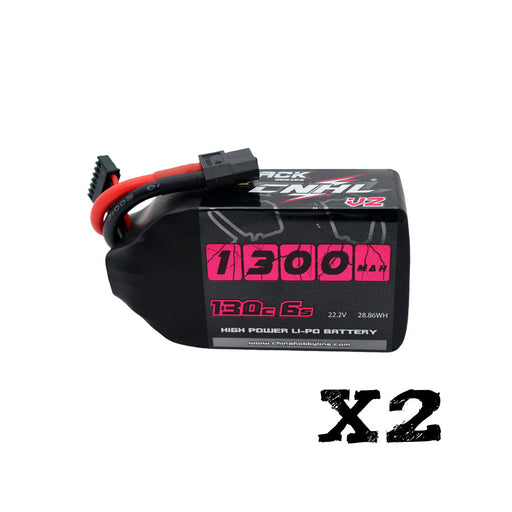
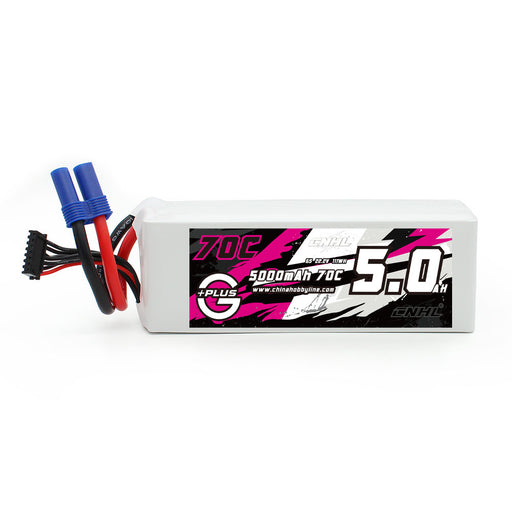
CNHL offers compatible 6S battery choices across several capacity and connector combinations, including the Racing 5200mAh 90C XT90, Lightning LiHV 7200mAh 120C EC5 and Lightning LiHV 8500mAh 120C QS8.
The larger Lightning batteries are particularly interesting for builds where energy reserve is a priority. However, higher capacity does not automatically guarantee proportionally longer flights: added weight, throttle behavior and propulsion efficiency influence the final result.
For the full range of options, visit our LiPo Battery Collection for HobbyKing Sports Hawk & Red Arrows Hawk 105mm EDF Jets.
The collection includes XT90, EC5 and QS8 connector variants for different ESC wiring arrangements. Always use a matched, adequately rated connector and series harness rather than relying on loosely fitting or improvised connections.
How Long Can the Hawk Fly?
Flight endurance depends heavily on the EDF, throttle management, installed battery capacity and flying style.
A 6200mAh Sports Hawk configuration has demonstrated efficient cruising and the potential for flights approaching seven minutes under favorable conditions. More conservative flying sessions of around four minutes or slightly longer are also realistic starting points for larger EDF operations.
These figures are not universal performance guarantees. A pilot flying repeated full-power vertical maneuvers will use energy much faster than someone combining moderate-speed cruising with occasional aerobatics.
The best approach is to begin with a conservative timer, land with a healthy reserve and gradually refine the schedule using telemetry and recorded battery consumption.
Charging Two Large 6S Packs
A dual-channel balance charger is a practical companion for a 12S EDF aircraft because the two 6S flight packs can be charged independently after disconnecting the series harness.
The ISDT K4 8S Dual Smart Charger offers high charging power for larger packs, especially when paired with a suitable DC power source. Another option is the ISDT K2 ZIP Dual Smart Charger, which provides independent charging channels in a more compact format.
Both conventional LiPo and LiHV packs require the correct chemistry setting, cell count and charging limits. Always disconnect batteries from the aircraft and series harness before individual charging, and follow the battery and charger manufacturers' safety instructions.
Additional options are available in the CNHL ISDT Charger collection.
Preflight Setup: What Deserves Extra Attention?
The Hawk is not unusually complicated for an advanced ARF+ EDF jet, but careful preparation is essential. The key objective is to make every control, power connection and moving mechanism predictable before the aircraft leaves the runway.
Check Flap Servo Movement Before First Power-Up
Follow the model's flap initialization instructions and verify the required transmitter position before connecting power. Check that each flap moves freely through retracted, intermediate and full positions without binding or servo strain.
Unusual buzzing, excessive current draw or visible linkage distortion can indicate an incorrect setup. Disconnect power and resolve the issue before continuing.
Set the Center of Gravity with the Actual Flight Batteries
The published CG reference is approximately 175–180mm behind the wing-root leading edge. Confirm the applicable manual and measurement method for your production aircraft.
Battery capacity and mounting position can noticeably affect balance. Every change between smaller and larger packs should be followed by a fresh CG check, along with verification that the batteries are securely retained.
Check Retracts, Gear Doors and Steering
Run the full retract sequence with the aircraft safely supported. Confirm that the gear doors clear the wheels and struts, the nose-wheel steering is correctly centered and the mechanisms reach their intended locked positions.
Check the manufacturer's instructions for any restrictions on simultaneous steering and retract operation. Avoid repeatedly cycling the retract system with inadequate receiver power.
Verify the Complete Electrical System
Confirm the motor's rotation direction, ESC programming, receiver power, servo directions, control throws, failsafe settings and throttle cutoff. Secure all wiring away from the EDF rotor and moving control linkages.
Perform the required radio range check and establish a reliable means of monitoring battery voltage or consumed capacity during flight.
Is the Red Arrows Hawk Worth the Money?
This is where the Red Arrows Hawk becomes a more personal purchasing decision.
Compared with smaller PNP EDF jets, its ARF+ configuration requires additional spending on propulsion equipment, batteries and radio gear. A complete build can therefore cost substantially more than the airframe price suggests.
On the other hand, the Hawk offers an unusually appealing combination of size, scale appearance, retract detail and power-system flexibility. A 1500mm, approximately 7kg EDF aircraft occupies a different operating category from a compact 70mm or 80mm foam jet.
What About the Freewing F-35 110mm?
The Freewing F-35C 110mm is a relevant comparison for buyers shopping in the large EDF category, but the aircraft represent different priorities.

The F-35 emphasizes modern fighter styling and its own integrated airframe design, while the Hawk emphasizes the classic jet-trainer silhouette, traditional runway operation and recognizable RAF display appearance. For a closer look at the F-35's design, flight characteristics and performance, explore our Freewing F-35C 110mm EDF review.
More importantly, the exact equipment supplied with each aircraft can vary by model and package. Comparing a PNP price with an ARF+ price without accounting for the missing EDF and ESC is misleading.
A fair comparison should include the complete flying configuration, replacement-parts availability, power-system flexibility and intended use.
Who Should Choose the Red Arrows Hawk?
The aircraft makes the most sense for experienced EDF pilots who value large-scale jet presentation, enjoy selecting their own propulsion equipment and have access to an adequately sized runway.
It is especially appealing to Hawk enthusiasts who prefer the authentic Red Arrows appearance over the original Sports Hawk's fictional motorsport scheme.
For pilots who already own a well-equipped Sports Hawk, however, the new model does not introduce an entirely new flying experience. The underlying aircraft remains substantially familiar.
Red Arrows Hawk 105mm EDF FAQ
Is the Red Arrows Hawk a completely new aircraft?
No. It is based on the original HobbyKing Sports Hawk 105mm EDF platform. The most obvious change is the RAF Red Arrows livery, while the landing gear setup has also received refinements.
Does the Red Arrows Hawk come with an EDF and ESC?
No. The ARF+ package includes the main airframe, installed servos, retract equipment and lighting, but the owner must supply and install a suitable EDF motor and ESC.
What size EDF fits the HobbyKing Red Arrows Hawk?
The aircraft is designed around approximately 100–105mm EDF systems. JP 105mm and Wemotec 100mm units are established examples of configurations used with the Hawk platform. Alternative fans require mechanical and electrical compatibility checks.
Can the Hawk take off and land on grass?
Yes, the retractable landing gear and oleo struts support operation from suitable short, level grass runways. Ground condition, grass length and nose-wheel clearance remain important considerations.
What battery configuration does the Hawk need?
The recommended propulsion arrangement is 12S, typically created using two matching 6S LiPo or LiHV packs connected in series. Battery capacity and charging voltage must be matched to the installed power system.
Is the Red Arrows Hawk suitable for beginners?
No. Its size, operating weight, EDF power system and landing-energy requirements make it more appropriate for experienced RC jet pilots.
Can Sports Hawk owners reuse their existing EDF equipment?
Potentially, yes. The models share the same broad ARF+ architecture and 12S propulsion concept. However, fan mounting, wiring, ESC setup, battery balance and individual production-version details should be checked before transferring components.
Final Verdict: A Familiar Hawk with a More Convincing Identity
The HobbyKing Red Arrows Hawk 105mm EDF does not need to reinvent the original Sports Hawk to justify its existence. The established airframe already offers the ingredients for an engaging large-EDF experience: meaningful size, capable retractable landing gear, effective high-speed performance, an all-flying tail and flexible 12S propulsion.
The Red Arrows edition gives that platform a visual identity more closely connected to the real aircraft, while refining some of the landing gear details. For a pilot who has always wanted a large RAF display Hawk, that combination is compelling.
It remains an advanced ARF+ project rather than an inexpensive ready-to-fly jet. The best results will come from careful EDF selection, a properly sized HV ESC, reliable receiver power, matched flight batteries and thoughtful preflight preparation.
For builders planning a Sports Hawk or Red Arrows Hawk 12S installation, CNHL provides a dedicated selection of Hawk 105mm EDF LiPo and LiHV batteries, alongside aircraft ESCs and smart LiPo chargers to help complete the power system.








Jätä kommentti