
CNHL Lipo Batteries
CNHL aim at providing high-quality Li-Po batteries and RC products to all hobby enthusiasts with excellent customer services and competitive prices
A 1S LiPo battery uses a single lithium-polymer cell, so there are no series-connected cells inside the pack. A conventional 1S LiPo is typically rated at 3.7V nominal and about 4.20V fully charged, while many modern micro-FPV batteries are 1S LiHV packs rated around 3.8V nominal and up to 4.35V fully charged when the battery specifically supports that voltage.
That sounds simple, but 1S is actually one of the most specialized battery classes in RC. It dominates ultra-light platforms where every gram matters, especially Tiny Whoops and micro FPV aircraft. At the same time, a completely different branch of the hobby uses large-capacity 1S Shorty batteries in 1/12-scale pan cars.
So “1S” does not automatically mean “tiny battery.” It describes the cell count and voltage class. Capacity, chemistry, connector, discharge capability and physical format can still vary dramatically.

| Cell Count | 1 cell |
| Standard LiPo Nominal Voltage | 3.7V |
| Standard LiPo Full Voltage | Approximately 4.20V |
| Typical 1S LiHV Rating | 3.8V nominal / up to approximately 4.35V full when specified |
| Cell-to-Cell Balancing | Not required because there is only one cell |
| Common Small-Pack Connectors | PH2.0, BT2.0 and other micro-RC connector systems |
| Typical Applications | Tiny Whoops, micro FPV, ultra-micro aircraft, small RC models and 1/12 pan cars |
The S in LiPo battery terminology refers to the number of cell groups connected in series.
A 2S battery has two series cell groups. A 4S battery has four. A 6S battery has six.
A 1S battery is different because there is only one cell group:
1 cell × 3.7V = 3.7V nominal
For a conventional LiPo:
1 cell × 4.20V = approximately 4.20V fully charged
There is nothing to add together because no second cell exists.
This is also why a conventional 1S pack normally does not need a separate balance connector. Balance charging exists to compare and correct the voltage differences between multiple series cells. A single-cell battery has no second cell to balance against.
For the full relationship between cell count and pack voltage, see the LiPo Battery Voltage Guide: 1S to 8S Explained for RC Models.
One of the most important things to understand about modern 1S batteries is that not every pack labeled “1S” uses exactly the same charging voltage.
Two common versions are:
| Specification | Standard 1S LiPo | 1S LiHV |
|---|---|---|
| Typical Nominal Voltage | 3.7V | 3.8V |
| Typical Full Voltage | 4.20V | Up to approximately 4.35V when specified |
| Correct Charger Program | LiPo | LiHV when charging to the specified HV maximum |
| Common Modern Use | General 1S RC applications | Tiny Whoops, micro FPV and performance-focused micro RC |
This distinction is particularly important in Tiny Whoops, because many current 1S micro batteries are LiHV packs.
Charging a conventional 3.7V LiPo as though it were a 4.35V LiHV battery can overcharge the cell. Always follow the chemistry and maximum voltage printed on the battery rather than assuming that every 1S pack should be charged the same way.

Tiny Whoops are one of the clearest examples of why 1S still matters.
These aircraft are extremely small. Adding another cell does not only increase voltage; it also increases battery mass. On an aircraft weighing only a few dozen grams, even a small weight increase can noticeably change flight behavior.
A good 1S setup can therefore offer:
This is why 1S remains common in approximately 65mm and 75mm-class Tiny Whoop platforms and other ultra-light micro FPV designs.
But the battery still has to match more than the voltage. A Tiny Whoop battery should also be selected by:
A heavier 1S battery can provide more stored energy but may make a small quad feel less responsive. A smaller pack may make the aircraft feel more agile but reduce flight time.
On a large high-voltage RC system, a small amount of connector resistance is only one part of a much larger electrical system. On a low-voltage 1S aircraft, the connector can have a surprisingly noticeable effect.
The reason is simple: 1S begins with very little voltage headroom.
If voltage is lost through resistance in a small connector, worn contact or thin wire, the ESC and motor see less usable voltage.
This is one reason connector condition can affect:
PH2.0 has been widely used on 1S micro-RC and Tiny Whoop batteries. Many existing aircraft and chargers still use this connector ecosystem.
BT2.0 is also common in modern performance-oriented 1S micro-FPV systems. Its popularity reflects the increasing attention paid to connector resistance and current delivery in small aircraft.
Do not choose between them only by looking at the battery specification. The battery plug must match the aircraft and charging equipment.
A physically similar connector should not be assumed to be electrically or mechanically interchangeable unless compatibility is explicitly confirmed.
Capacity describes how much electrical charge the battery stores. In Tiny Whoop applications, common 1S capacities may be only a few hundred milliamp-hours.
Examples:
A higher-capacity pack normally carries more energy, but it also tends to be larger and heavier.
For a Tiny Whoop, that trade-off matters much more than it might in a large RC truck.
A larger battery may improve potential flight time while also:
That is why the “best” capacity is usually the range the aircraft was designed around, not simply the largest pack that can physically be attached.
This is where the 1S category becomes much more interesting.
Some competition-oriented 1/12-scale pan cars, GT12 and LMP12 platforms also use 1S batteries, but these packs look nothing like Tiny Whoop batteries.
Instead of a few hundred milliamp-hours, a 1S pan-car battery can use several thousand milliamp-hours and a rigid Shorty-style hardcase format.
Why use only one cell in a race car?
Because the vehicle and racing electronics can be designed specifically around a low-voltage, high-current architecture. In this environment, 1S is not chosen because the model is tiny or underpowered. It is part of the platform design.
This illustrates an important point:
“1S” tells you the voltage architecture. It does not tell you the battery's capacity, size, current capability or intended RC category.
Normally, no.
A balance connector is used on multi-cell packs so the charger can monitor the voltage of each series cell individually.
For example, a 4S battery has four cell voltages that must remain reasonably matched.
A 1S battery has only one cell.
There is therefore no cell-to-cell imbalance to correct.
This is why many 1S batteries use only their main two-wire connector for both charging and discharging.
That does not mean a 1S battery does not need voltage control. The charger must still terminate at the correct maximum voltage for the battery chemistry.

1S charging is electrically simpler than charging a multi-cell battery, but the chemistry and voltage setting still need to be correct.
For a conventional 3.7V 1S LiPo:
For a 3.8V 1S LiHV pack:
For more on charger selection, see Is There an All-in-One Charger for 1S to 4S LiPo Batteries?.
Tiny Whoop pilots often fly several short flights in one session. That changes the charging workflow.
Instead of charging one large battery, the pilot may return with six, eight or more small 1S packs.
A dedicated multi-port 1S charger can therefore be more useful than a conventional high-power RC charger, especially when each port can be configured appropriately for the battery chemistry and charging current.
The key distinction is that multi-port 1S charging is not automatically the same thing as parallel charging.
On a charger with independent outputs, each port can monitor its own connected battery. In a true parallel setup, multiple batteries are electrically combined and must meet stricter matching requirements.
Always follow the actual charger's design and instructions rather than assuming that every six-port charging device works the same way.
The same basic charge-rate calculation used on larger batteries also applies to 1S:
1C charge current = battery capacity in amp-hours
| 1S Capacity | Approx. 1C Current |
|---|---|
| 300mAh | 0.30A |
| 350mAh | 0.35A |
| 450mAh | 0.45A |
| 500mAh | 0.50A |
| 650mAh | 0.65A |
Some batteries are rated for higher charge rates, but the battery manufacturer's specification should take priority over a generic rule.
Large 6S and 8S batteries can require hundreds of watts to charge quickly. A tiny 1S pack requires very little power.
For example, a 1S 500mAh standard LiPo charged at 1C near full voltage requires approximately:
4.2V × 0.5A ≈ 2.1W
For Tiny Whoop users, the more practical charger questions are usually:
This is very different from selecting a charger for a 6S or 8S 5000mAh battery, where output wattage becomes a primary limitation.
Moving from standard 1S to standard 2S changes nominal voltage from 3.7V to 7.4V.
| Characteristic | 1S | 2S |
|---|---|---|
| Standard Nominal Voltage | 3.7V | 7.4V |
| Standard Full Voltage | 4.2V | 8.4V |
| Cell-to-Cell Balancing | Not required | Required for conventional balance charging |
| Typical Micro-RC Character | Very light and compact | More voltage and higher performance potential |
A 2S battery is therefore not a simple drop-in “upgrade” for a 1S model.
The ESC, motor and other electronics must be designed for the additional voltage. On an ultra-light aircraft, the extra cell also changes battery weight and handling.
For the full comparison, read What Is the Difference Between 1S and 2S LiPo? A Comprehensive Guide.
Only when the electronics and model are designed to operate at 1S voltage.
A 2S model may not operate properly on 1S because the voltage may be below the intended operating range. Motors can feel extremely weak, and some electronics may not initialize correctly.
Physical connector compatibility does not prove electrical compatibility.
Do not do this unless the complete electronics system explicitly supports 2S.
A standard 1S battery reaches approximately 4.2V when full. A standard 2S pack reaches approximately 8.4V.
That is roughly twice the pack voltage.
Connecting 2S to electronics designed only for 1S can exceed their voltage limits very quickly.
You can compare current CNHL 1S 3.7V and 3.8V batteries by capacity, connector, chemistry and intended application.
A conventional 1S LiPo is typically rated at 3.7V nominal and reaches approximately 4.2V when fully charged.
Many 3.8V 1S batteries are LiHV cells designed for a higher maximum charging voltage, commonly up to approximately 4.35V when specified by the manufacturer.
For a standard LiPo, 3.7V is the nominal rating and approximately 4.2V is the fully charged voltage.
3.8V is its typical nominal rating. A compatible LiHV cell may reach approximately 4.35V when fully charged according to its specification.
No cell-to-cell balancing is required because the battery contains only one cell group. It still requires a charger with the correct chemistry and voltage termination.
Common applications include Tiny Whoops, micro FPV aircraft, ultra-micro airplanes and cars, and specialized 1/12-scale pan-car racing platforms.
PH2.0 and BT2.0 are both common, but the correct connector depends on the specific aircraft and battery system.
A normal LiPo program generally terminates at the standard LiPo voltage rather than the higher LiHV maximum. To charge a LiHV battery to its specified HV voltage, the charger must explicitly support the correct LiHV mode.
At approximately 1C, the charging current is 0.45A. Use a higher charge rate only when the battery manufacturer permits it.
Connector performance can differ, but the practical choice starts with compatibility. Use the connector system specified for the aircraft and charging setup rather than changing plugs based only on the connector name.
Only if the ESC, motor and complete electronics system explicitly support 2S. Never assume a 1S model can safely accept twice the standard battery voltage.
No. Tiny Whoop batteries are usually very small, but 1S Shorty batteries for 1/12-scale pan cars can have capacities of several thousand milliamp-hours.
1S is the simplest LiPo voltage architecture, but it is not a simplistic battery category.
A conventional 1S LiPo provides approximately 3.7V nominal and 4.2V fully charged, while modern 1S LiHV packs commonly operate around 3.8V nominal and may charge to approximately 4.35V when designed for it.
In Tiny Whoops and micro RC, 1S works because low weight and compact size matter more than chasing higher voltage. Connector resistance, battery mass and chemistry can noticeably influence how such a small aircraft performs.
At the opposite end of the 1S world, specialized pan-car racing shows that one cell does not necessarily mean a tiny or low-capacity battery.
The correct way to choose a 1S battery is therefore to start with the model's intended voltage and chemistry, then match the capacity, weight, dimensions and connector to the actual application.
Browse the CNHL 1S LiPo and LiHV battery range for current 3.7V and 3.8V options.
If you are considering stepping up in voltage, continue with What Is the Difference Between 1S and 2S LiPo?. For the complete voltage ladder, return to the LiPo Battery Voltage Guide: 1S to 8S Explained for RC Models.
CNHL aim at providing high-quality Li-Po batteries and RC products to all hobby enthusiasts with excellent customer services and competitive prices
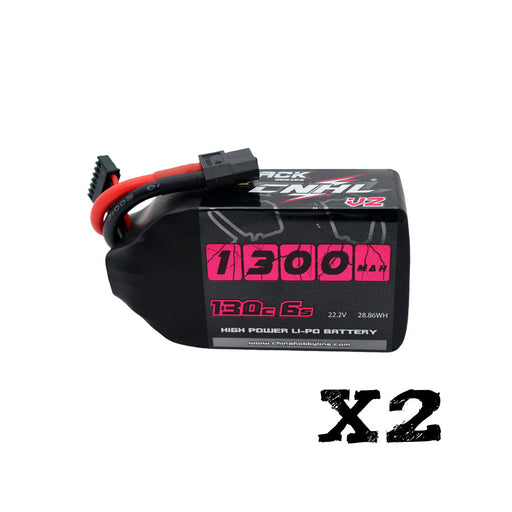
Quick Fit Check The 2 Packs CNHL Black Series V2.0 1300mAh 22.2V 6S 130C LiPo Battery with XT60 Plug is a strong fit for FPV pilots who want a prov...
View full detailsSpare Parts & Long-Term Support We know that for RC pilots, reliable spare parts support is an important part of keeping an aircraft fl...
View full details
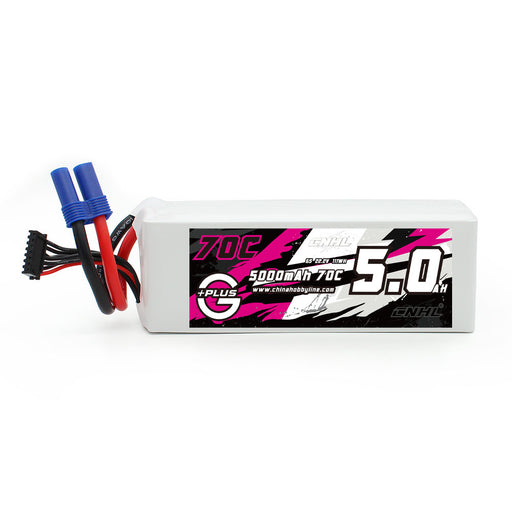
Specifications: Stock Number: 500706EC5 Capacity: 5000mAh Voltage: 22.2V / 6-Cell / 6S1P Discharge Rate: 70C Continual / 140C Burst Charge Rate: ...
View full details
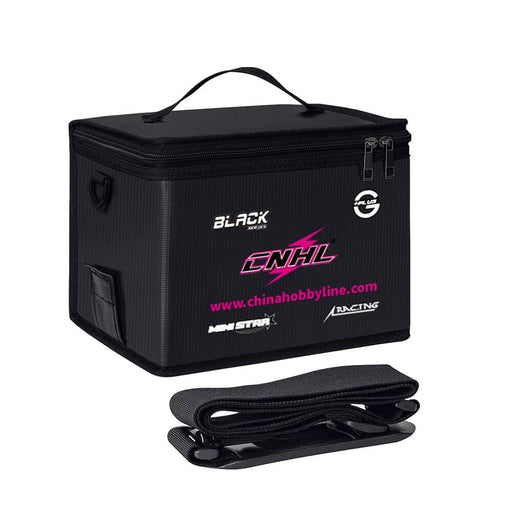
The CNHL LiPo Battery Bag is designed for safer LiPo charging, transport, and storage at home or at the field. It adds a practical layer of protect...
View full details

Quick Fit Check The 2 Packs CNHL Speedy Pizza Series Pro 1350mAh 6S 150C LiPo Battery with XT60 Plug is built for 5-inch FPV pilots who want a ...
View full details

Quick Fit Check The CNHL Speedy Pizza Series 2200mAh 22.2V 6S 120C LiPo Battery with XT60 Plug combines the familiar 2200mAh 6S format with a ligh...
View full details

Quick Fit Check The CNHL Speedy Pizza Series 2200mAh 14.8V 4S 120C LiPo Battery with XT60 Plug combines a widely used 2200mAh 4S format with a sli...
View full details

Quick Fit Check The CNHL Speedy Pizza Series 2200mAh 11.1V 3S 120C LiPo Battery with XT60 Plug takes the familiar 3S 2200mAh aircraft battery form...
View full details

The CNHL Long Range Series BAK 50D 5000mAh 21700 Li-ion battery cell is designed for custom high-energy battery packs that need a strong balance be...
View full details

The ISDT C4 EVO is a versatile smart battery charger built for AA, AAA and cylindrical rechargeable cells from compact 10440 batteries all the way ...
View full details


Leave a comment