



Choosing the Best 6S Battery for the Eflite P-51D Mustang 1.5m
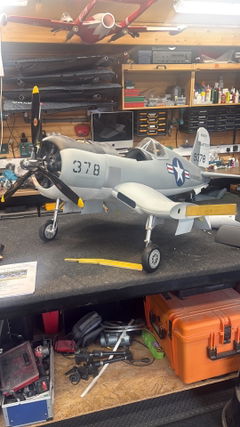
The P-51D Mustang "Big Beautiful Doll" 1.5m is a serious scale warbird with the power to deliver fast passes, impressive vertical performance, and smooth aerobatics. It also has the weight, landing characteristics, and large four-blade propeller that make a thoughtful battery setup especially worthwhile.
At CNHL, we would approach battery selection for this Mustang differently from choosing a pack for an EDF jet or an all-out speed plane. Maximum discharge rating is not the main objective. A battery that delivers dependable 6S power while keeping the airplane properly balanced is a much better starting point.
The Eflite Mustang uses a 6S brushless power system with a 100A Spektrum Avian Smart ESC and an IC5 power connector. Its broad battery capacity range leaves room for different flying preferences, from lighter 4000mAh setups to larger-capacity 7200mAh and beyond.
What makes the CNHL selection interesting is that capacity and weight do not always increase together. A well-designed 6000mAh pack can be lighter than an ordinary 5000mAh battery. That opens up more useful choices for a scale fighter where every change in battery mass deserves attention.
Four CNHL Batteries We Would Choose for This Mustang
Rather than selecting four batteries with nearly identical specifications, we have chosen four different setup directions: lighter flying weight, conventional 6S power, high capacity-to-weight efficiency, and additional energy reserve.
1. CNHL Lightning 4500mAh 6S LiHV – Our Lightweight Pick
4500mAh | 6S LiHV | 120C | EC5 | Approx. 573g
Not every Mustang pilot wants to carry the largest battery that fits. For those who prefer a lighter setup, the CNHL Lightning 4500mAh is an attractive option.
At approximately 573g, it weighs around 141g less than our featured G+Plus 5000mAh battery while sacrificing only 500mAh of rated capacity. The compact 144 × 45 × 45mm format also provides flexibility when arranging the battery on the removable tray.
Reducing battery weight can lower total flying mass and may change the airplane's feel during takeoff, maneuvering, and landing. However, the lighter pack must still be positioned correctly to achieve the required CG; a lighter battery does not automatically produce a better-balanced Mustang.
We prefer the 4500mAh version as a general lightweight recommendation because it retains a useful capacity margin. For pilots who prioritize minimum pack weight even more strongly, the Lightning 4000mAh is also available at approximately 521g.
Best for: Weight-conscious pilots who want a compact 6S battery without giving up too much rated capacity.
Shop CNHL Lightning 4500mAh 6S 120C EC5
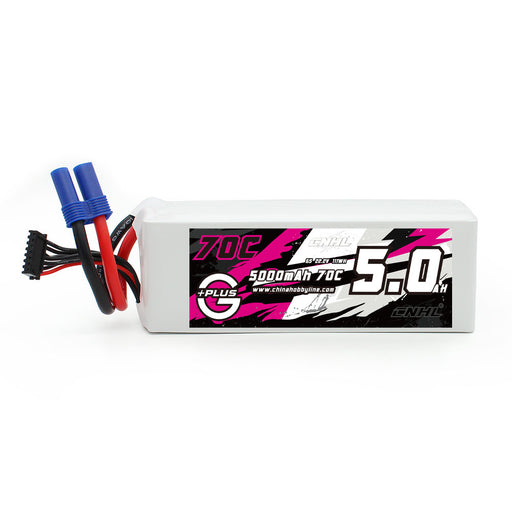
2. CNHL G+Plus 5000mAh 6S 70C – Our All-Round Starting Point
5000mAh | 6S LiPo | 70C | EC5 | Approx. 714g
If we were preparing a typical Eflite P-51D 1.5m for everyday warbird flying, a conventional 5000mAh 6S LiPo would be our baseline configuration.
The 5000mAh class offers a useful combination of capacity, weight, and predictable power delivery. It is also a familiar battery size for this airframe, making it a sensible reference point before experimenting with significantly lighter or larger packs.
The CNHL G+Plus 5000mAh 70C measures approximately 149 × 51 × 49mm and weighs about 714g. It uses standard 22.2V LiPo chemistry and an EC5 connector, keeping charging and electrical setup straightforward.
Its 70C discharge rating provides substantial advertised current capability for a stock 6S Mustang. There is no need to treat a much higher C rating as a requirement for normal operation.
Best for: Pilots who want a conventional LiPo battery, a practical everyday capacity, and a straightforward starting setup.
Shop CNHL G+Plus 5000mAh 6S 70C EC5
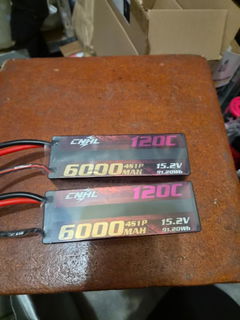
3. CNHL Lightning 6000mAh 6S LiHV – Our Capacity-to-Weight Favorite
6000mAh | 6S LiHV | 120C | EC5 | Approx. 693g
This is where the CNHL Lightning series becomes particularly compelling for the Big Beautiful Doll.
The Lightning 6000mAh offers 20% more rated capacity than the G+Plus 5000mAh, yet its published weight is approximately 693g, about 21g lighter than that conventional 5000mAh pack.
Its dimensions of 147 × 48 × 48mm are also compact for a 6000mAh 6S battery. In other words, the pilot does not automatically need to accept a heavier battery simply to move up from 5000mAh to 6000mAh.
This makes the Lightning 6000mAh one of our most interesting choices for the Mustang. It provides additional rated capacity without the weight penalty normally expected when moving up to a larger conventional pack.
The actual increase in flying time will depend on charging voltage, throttle use, flying conditions, and energy consumption. We would still check the CG carefully rather than assuming its lower weight guarantees a better setup.
Best for: Pilots looking for an excellent balance of rated capacity, compact dimensions, and low battery weight.
Shop CNHL Lightning 6000mAh 6S 120C EC5
4. CNHL Lightning 7200mAh 6S LiHV – Our Extended-Capacity Choice
7200mAh | 6S LiHV | 120C | EC5 | Approx. 800g
For pilots who enjoy longer flying sessions or want additional energy reserve, the Lightning 7200mAh is worth considering.
Its biggest advantage is the relationship between capacity and battery weight. Compared with the G+Plus 5000mAh, it provides 44% more rated capacity while weighing approximately 86g more.
The 149 × 52 × 50mm dimensions also remain relatively compact for a 7200mAh pack. This is a different proposition from using a bulky conventional high-capacity battery that may increase flying weight considerably.
Still, 800g is a meaningful battery load for a 1.5m warbird. The additional mass can affect inertia, landing energy, and the position required to achieve the correct CG. We would treat the 7200mAh as a deliberate configuration choice rather than the default recommendation for every pilot.
Best for: Experienced pilots who prioritize additional rated capacity and are comfortable optimizing the aircraft around a larger pack.
Shop CNHL Lightning 7200mAh 6S 120C EC5
Compare Our Recommended Mustang 6S Batteries
The following comparison highlights the differences that matter most when selecting a battery: rated capacity, chemistry, physical dimensions, and pack weight.
| Specification | Lightning 4500 | G+Plus 5000 | Lightning 6000 | Lightning 7200 |
| Capacity | 4500mAh | 5000mAh | 6000mAh | 7200mAh |
| Chemistry | LiHV | LiPo | LiHV | LiHV |
| Nominal Voltage | 22.8V | 22.2V | 22.8V | 22.8V |
| Discharge Rating | 120C | 70C | 120C | 120C |
| Weight | 573g | 714g | 693g | 800g |
| Size (L × W × H) | 144 × 45 × 45mm | 149 × 51 × 49mm | 147 × 48 × 48mm | 149 × 52 × 50mm |
| Main Connector | EC5 | EC5 | EC5 | EC5 |
| Our Pick For | Lighter setup | Everyday flying | Capacity / weight | Extended capacity |
All values are approximate published product specifications. LiHV batteries require special attention to the selected charging voltage. Physical installation and CG must be checked with the actual battery.
What About 4000mAh, 5200mAh, 6200mAh, and 8500mAh?
Our four featured batteries represent different flying priorities, but they are not the only useful choices in this collection.
4000mAh: The Lightning 4000mAh is a particularly light 6S option at approximately 521g. It makes sense when minimizing battery mass is a higher priority than increasing onboard energy. Its relatively low weight also makes CG verification particularly important.
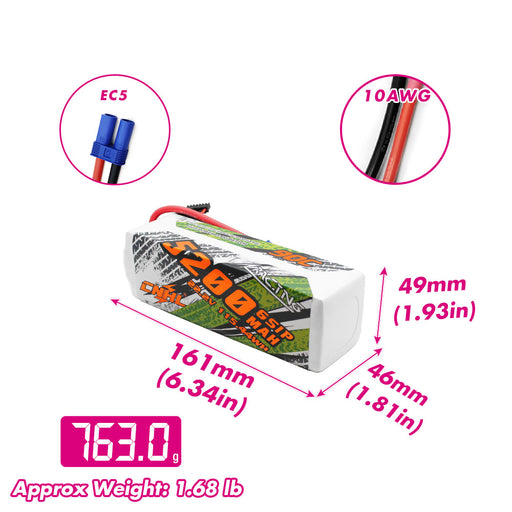
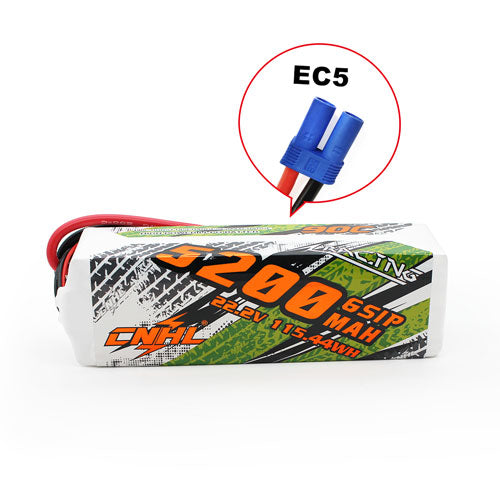
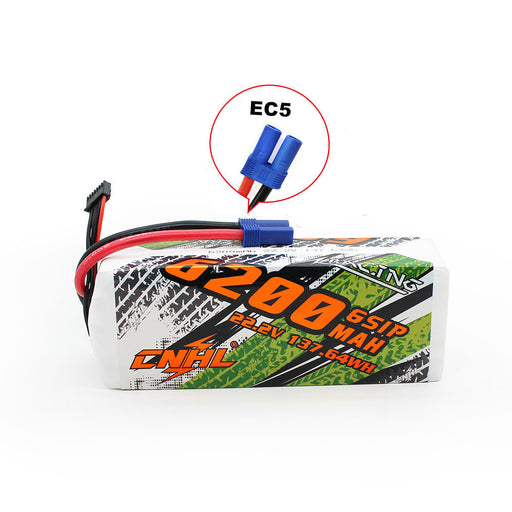
5200–6200mAh: CNHL Racing 5200mAh and 6200mAh batteries offer conventional 6S LiPo alternatives with 90C discharge ratings. The G+Plus 5000mAh 100C is another choice for pilots who prefer standard LiPo chemistry with a higher advertised discharge rating.
5500–6700mAh: These Lightning packs fill the gap between our lightweight and larger-capacity recommendations. They are worth comparing by actual weight and dimensions rather than capacity alone.
7800–8500mAh: These are larger-capacity choices for pilots deliberately configuring the Mustang around additional energy storage. Consider the complete installation, battery mounting, balance, and flying weight before choosing the largest pack available.
Battery Tray Fit: Why Dimensions Alone Are Not Enough
The P-51D Mustang 1.5m uses a removable battery tray beneath the cockpit hatch. It is a convenient system for battery changes, but the battery needs to fit with its retaining straps in place, not just when the pack is resting loosely on the tray.
A particularly useful installation detail is the option to mount a rectangular 6S pack on its narrower side. A wide, flat battery position may cause the straps to project outward and interfere with the tray rails. Rotating the pack can improve clearance and allow the tray to slide into its locked position more smoothly.
We recommend checking five things during installation:
- The battery sits securely on the tray without pressing against the fuselage or hatch.
- The retaining straps stay clear of the sliding rails and locking mechanism.
- The pack cannot shift forward, backward, or sideways during flight.
- The EC5 power lead and JST-XH balance lead are routed without being pinched.
- The tray locks fully and can be removed without pulling or damaging the wiring.
Non-slip material or additional hook-and-loop retention can help prevent battery movement. Keep any added material away from moving parts and airflow passages. Never force an oversized or poorly positioned pack into the tray.
Battery Weight and CG: Getting the Mustang Balanced
The correct battery is not necessarily the lightest pack or the one with the greatest capacity. It is the battery that allows your airplane to reach the correct center of gravity while providing the power and energy reserve you want.
The recommended CG range for the Eflite P-51D Mustang 1.5m is 124–137mm behind the wing-root leading edge, measured with the landing gear down.
Battery weight matters because it changes how much mass the airplane carries and where that mass is located. Switching from a 714g pack to a 573g battery removes approximately 141g. Moving to an 800g battery adds approximately 86g compared with the same 714g reference.
Those differences can affect takeoff behavior, maneuvering inertia, and the energy the landing gear needs to absorb. A lighter configuration may be attractive, but it should never come at the expense of an incorrectly positioned CG.
Whenever you change the battery model, capacity, or mounting orientation, balance the aircraft again with the pack secured in its intended flying position. Do not assume two batteries of similar capacity belong in the same location.
Can a CNHL EC5 Battery Connect to the Mustang's IC5 ESC?
Yes. The Eflite Mustang's factory IC5 power connection is physically compatible with the matching EC5 main power plug used on the batteries in this collection.
That means there is no need to replace the aircraft's main battery connector simply to use a properly matched CNHL EC5 pack.
A conventional EC5 battery does not contain Spektrum Smart battery electronics. However, that does not prevent the pack from delivering power through the IC5 connection. Supported voltage and power-system telemetry may still be available through the Avian ESC with an appropriately configured compatible receiver and transmitter.
The PNP version requires the pilot's own receiver, so its telemetry capabilities depend on the installed radio equipment. The BNF Basic version includes a compatible Spektrum receiver and additional factory-configured flight technologies.
Using CNHL Lightning LiHV Batteries on a Standard 6S Power System
CNHL Lightning batteries in this collection use 6S LiHV chemistry, with a nominal voltage of 22.8V. Unlike conventional 22.2V LiPo packs, LiHV batteries are designed to support a higher maximum cell voltage when charged in the appropriate LiHV mode.
A standard 6S LiPo is fully charged at 25.2V (4.20V per cell). A fully charged 6S LiHV battery can reach 26.1V (4.35V per cell).
The important distinction is that a model designed for 6S LiPo power is not automatically approved for the higher voltage of a fully charged LiHV pack.
For the stock Mustang power system, we recommend keeping LiHV packs at the standard 6S LiPo charge limit of 25.2V unless the complete power system has been explicitly confirmed to support 26.1V.
When using a LiHV pack at the standard voltage limit, do not assume you are receiving the additional high-voltage performance associated with a full LiHV charge. The advantage of a particular Lightning model may instead come from its lower pack weight, compact dimensions, or rated capacity.
Use a balance charger that supports the battery chemistry and lets you select the correct six-cell voltage limit. For a standard LiPo battery, never select a higher-voltage LiHV charge mode.
How Much Flight Time Can You Expect?
Flight time is one of the reasons pilots consider moving from a 4500mAh or 5000mAh pack to 6000mAh or 7200mAh. But a battery with 20% more rated capacity does not guarantee a 20% longer flight.
Throttle use makes a major difference. A flight built around high-speed passes, extended vertical climbs, and repeated full-power maneuvers consumes energy differently from a relaxed scale flight.
For a new battery setup, begin with a conservative flight timer and adjust it using the amount of capacity returned during charging, voltage behavior under load, and the reserve required for landing. A go-around should always remain an option.
Do not use a critical low-voltage warning as your normal landing target. Leaving a healthy reserve is especially important in a Mustang that benefits from a stable, powered final approach.
PNP and BNF Basic: Same Battery Choices, Different Radio Setup
The Big Beautiful Doll is available in PNP and BNF Basic versions, and both use the same 6S power-system configuration.
With the PNP version, you install your own compatible receiver. This is the more hands-on option, especially if you are configuring stabilization, control channels, and telemetry yourself.
The BNF Basic version includes a Spektrum AR637TA+ receiver with AS3X+, optional SAFE Select, and Smart Transmitter File support.
The receiver configuration does not change the main battery selection. An EC5-equipped CNHL 6S pack remains a suitable power-source option for either version when correctly installed and charged.
Frequently Asked Questions
What battery is best for the Eflite P-51D Mustang 1.5m?
A 6S 5000mAh LiPo with EC5 is our all-round starting choice. For a lighter configuration, consider the Lightning 4500mAh. For additional rated capacity with particularly attractive pack weight, compare the Lightning 6000mAh and 7200mAh options.
Can I use a 4000mAh 6S battery in the Big Beautiful Doll?
Yes. A suitable 4000mAh 6S battery is within the normal capacity class for this aircraft. Our Lightning 4000mAh pack weighs approximately 521g, making it an option for pilots who prioritize a lightweight setup. Check CG carefully with the lighter battery installed.
Is 4500mAh better than 5000mAh?
Neither is automatically better. A lighter 4500mAh pack can reduce flying mass, while 5000mAh gives more rated capacity. Compare actual battery weight, chemistry, balance, and flying priorities rather than using capacity alone.
Will a 6000mAh LiPo fit the Eflite Mustang battery tray?
A compact 6000mAh pack is a practical option for this airframe. The CNHL Lightning 6000mAh measures approximately 147 × 48 × 48mm. Confirm clearance with the straps installed, fully engage the tray lock, and check final CG.
Can I fly with a 7200mAh battery?
Yes, provided the installed battery fits securely and allows the airplane to balance correctly. The Lightning 7200mAh weighs approximately 800g, so it should be treated as a larger-capacity setup rather than a direct substitute requiring no adjustment.
Does the P-51D Mustang need a 100C or 120C battery?
No specific 100C or 120C rating is required simply because the aircraft has a 100A ESC. Choose a quality 6S pack capable of supporting the power system's current demand. A higher printed C rating alone does not guarantee more speed.
Are EC5 and IC5 battery connectors compatible?
Yes. A matching EC5 battery connector can be used with the Mustang's IC5 main power connection. Standard CNHL EC5 packs do not provide proprietary Spektrum Smart battery data.
Can I charge a Lightning LiHV pack in standard LiPo mode?
A 6S Lightning LiHV pack can be balance charged to the standard 25.2V LiPo limit with an appropriately configured charger. Use the full 26.1V LiHV charge limit only when the complete aircraft power system is confirmed compatible with that voltage.
Do the PNP and BNF Basic versions use different batteries?
No. Both use 6S power and an EC5/IC5 main connection. The main difference is the receiver and radio setup, not the battery type.
What is the correct CG for the Eflite P-51D Mustang Big Beautiful Doll?
The CG range is 124–137mm behind the wing-root leading edge with the landing gear down. Recheck it whenever you switch to a battery with different dimensions or weight.
Explore More CNHL 6S Batteries and Warbird Power Options
If you also fly other large electric aircraft, explore our 6S LiPo battery collection for additional capacities and connector options, or browse LiPo batteries for RC warbirds.
Interested in lightweight, high-capacity designs? Discover the complete CNHL Lightning LiHV battery series.
For battery preparation and charging, explore our LiPo balance chargers and read the LiPo Battery Charging Guide.
Another 6S scale-aircraft project? Our Eflite Pilatus PC 21 battery guide covers a different high-performance aircraft where battery capacity, weight, and CG also deserve careful consideration.
Find the right battery for your next flight. Browse the CNHL packs in this collection and select the combination of capacity, weight, and power delivery that best matches your E-flite P-51D Mustang "Big Beautiful Doll" 1.5m.