
CNHL Lipo akut
CNHL pyrkii tarjoamaan korkealaatuisia Li-Po-akkuja ja RC-tuotteita kaikille harrastajille erinomaisella asiakaspalvelulla ja kilpailukykyisillä hinnoilla
To estimate how many watts your LiPo charger needs, multiply the battery’s full-charge voltage by the intended charging current. A 4S 5000mAh LiPo charged at 1C requires approximately 16.8V × 5A, or 84W at the battery. A 6S 5000mAh pack charged at the same 5A requires approximately 126W.
Quick answer: Calculate the ideal battery-side power, then choose a charger with additional headroom. For one common 4S 5000mAh pack, a charger with about 100W or more available to the active channel is a practical starting point. For one 6S 5000mAh pack, approximately 150W per active channel is more suitable.
Do not choose a charger only by its maximum amp rating. A charger advertised as 15A cannot necessarily deliver 15A to a high-voltage LiPo because its wattage, input power or channel-sharing limit may become the real bottleneck.

| Basic Formula | Charging watts = battery charging voltage × charging current. |
| Voltage to Use | Use the battery’s approximate full-charge voltage when estimating the maximum required output. |
| Charge Current | At 1C, current in amps approximately equals capacity in amp-hours. |
| Single Channel | The charger must provide enough watts to the active channel, not only enough total advertised power. |
| Multiple Channels | Add the power required by every simultaneously active channel. |
| Input Power | The AC supply, external DC supply or field battery must provide more power than the ideal battery-side calculation. |
| Recommended Headroom | Choose practical margin for conversion losses, cooling, channel sharing and future batteries. |
Charging power in watts = charging voltage × charging current
W = V × A
For charger sizing, use the approximate full-charge voltage rather than only the nominal voltage printed prominently on the battery label. This estimates the highest power required near the end of the constant-current stage.
| Standard LiPo | Nominal Voltage | Approx. Full Voltage |
|---|---|---|
| 2S | 7.4V | 8.4V |
| 3S | 11.1V | 12.6V |
| 4S | 14.8V | 16.8V |
| 5S | 18.5V | 21.0V |
| 6S | 22.2V | 25.2V |
| 8S | 29.6V | 33.6V |
For a LiHV battery, use the full voltage specified by the battery manufacturer rather than the standard LiPo values above.
Battery capacity is normally printed in milliamp-hours. Convert it to amp-hours before calculating a C rate.
Capacity in Ah = capacity in mAh ÷ 1000
Charge current = capacity in Ah × selected charging C rate
At approximately 1C:
A higher charge rate increases required watts proportionally. A battery charged at 2C requires approximately twice the current and twice the power of the same pack at 1C.
For a complete explanation of 1C, 2C and 5C, read LiPo Charging Rates Explained.
| Battery | 1C Current | Full Voltage | Ideal Battery-Side Power | Practical Charger Class |
|---|---|---|---|---|
| 2S 5000mAh | 5A | 8.4V | 42W | 60W+ per active channel |
| 3S 2200mAh | 2.2A | 12.6V | About 28W | 50W+ per active channel |
| 3S 5000mAh | 5A | 12.6V | 63W | 80W+ per active channel |
| 4S 5000mAh | 5A | 16.8V | 84W | 100W+ per active channel |
| 4S 6000mAh | 6A | 16.8V | About 101W | 120–150W+ per active channel |
| 6S 1300mAh | 1.3A | 25.2V | About 33W | 50W+ with 6S support |
| 6S 5000mAh | 5A | 25.2V | 126W | 150W+ per active channel |
| 6S 7000mAh | 7A | 25.2V | About 176W | 200W+ per active channel |
| 8S 5000mAh | 5A | 33.6V | 168W | 200W+ with 8S support |
The practical charger classes include general operating margin but are not universal specifications. Confirm the actual battery charge limit, charger efficiency, cooling, input source and channel-power allocation.
Battery voltage rises throughout charging. A 6S standard LiPo may begin around storage voltage near 22.8–23.1V total, but it approaches 25.2V when fully charged.
If the charger attempts to hold 5A:
A 120W charger may therefore deliver close to 5A earlier in the charge and reduce current as the battery approaches full voltage.
Using full-charge voltage produces a more useful estimate of the maximum output required to maintain the target current.
A charger’s actual output current is limited by the lowest applicable limit:
Consider a charger rated for a maximum of 15A but limited to 100W on the active channel.
| Battery | Full Voltage | Approx. Maximum Current at 100W |
|---|---|---|
| 2S | 8.4V | About 11.9A, subject to the charger’s current limit |
| 3S | 12.6V | About 7.9A |
| 4S | 16.8V | About 6.0A |
| 6S | 25.2V | About 4.0A |
| 8S | 33.6V | About 3.0A |
This is why both amps and watts must be checked when selecting a charger.
The ideal battery-side calculation does not include:
It is therefore unwise to choose a charging system that exactly matches the calculated battery-side watts.
Practical examples:
The required margin becomes more important when:
For independent dual-channel charging, calculate each battery separately and add the results.
The charger must support each battery’s S count and current independently, while its total input and output power must support both tasks together.
Dual- and multi-channel charger specifications can be presented in several ways:
A charger advertised as 400W total does not necessarily deliver 400W to each channel. It may provide:
Before buying, identify:
For users charging mixed batteries, independent channels are generally easier to manage than a parallel board. Read Dual-Channel Charger vs Parallel Charging Board.
An AC/DC charger contains an internal AC power supply. Its charging electronics may be capable of more power than the internal AC supply can provide.
For example, an AC/DC charger may offer:
This does not make the AC rating misleading. It reflects two different input systems.
AC mode is convenient for:
DC mode is useful for:
For the complete comparison, read AC vs DC LiPo Chargers: Which One Should You Buy?.
A DC charger requires an external source with enough voltage, current and total wattage. The power supply should exceed the intended battery-side output because conversion is not perfectly efficient.
Required input power is greater than ideal battery-side charging power.
Suppose two 6S 5000mAh batteries require approximately 252W at the battery. The input source must also cover:
A 300W or greater input system is more appropriate than a supply rated at exactly252W.
Do not forget input voltage. Some chargers reach their maximum output only when supplied with a sufficiently high DC input voltage. A high-wattage 12V supply may not allow the same charger performance as a higher-voltage compatible source.
The ToolkitRC ADP200 200W power supply is suited to moderate DC charging systems where the combined charger load remains within its voltage, current and wattage limits.
Typical use may include:
It is not the appropriate choice when the intended charger load substantially exceeds 200W.
The ToolkitRC ADP750 750W power supply supports a higher total workbench load and multiple output devices, subject to charger input-voltage compatibility and correct power distribution.
Typical use may include:
A higher-wattage supply does not force excess power into the charger. The charger draws power according to its input requirements. However, voltage compatibility, connector rating and cable capacity must still be confirmed.
Input wattage is the product of input voltage and current:
Input power = input voltage × input current
To supply approximately 500W before accounting for losses:
Higher input voltage can reduce the current required through the input cable and connector for the same power. However, the charger must explicitly support the selected input voltage.
Never exceed the charger’s input-voltage range in an attempt to obtain more power.
For parallel charging, capacities are added while the group retains the original S count.
Four 3S 1500mAh batteries connected in parallel become:
The ideal battery-side power is:
12.6V × 6A = approximately 76W
For three 4S 5000mAh batteries connected in parallel:
The charger, board, main input lead, connectors and input source must all support the complete current and wattage.
Read How to Parallel Charge LiPo Batteries Safely before using a parallel board.
At 2C, the ideal charging power doubles compared with 1C.
| 5000mAh Battery | 2C Current | Approx. Battery-Side Power |
|---|---|---|
| 2S | 10A | 84W |
| 3S | 10A | 126W |
| 4S | 10A | 168W |
| 6S | 10A | 252W |
| 8S | 10A | 336W |
Use 2C only when the battery explicitly permits it. Charger wattage is only one requirement; the battery, power supply, leads and connectors must all support the increased load.
Balance Charge does not normally require dramatically more bulk charging power than another full-charge program using the same voltage and current. The main difference is how the charger monitors and completes the final stage.
However, balance performance is limited by a separate specification: balance current.
A charger may have:
This is why a powerful charger can still spend a long time correcting an imbalanced pack near completion.
Increasing the charger’s headline wattage does not automatically increase its balance current. Check both specifications.
No. Charging and discharging specifications are usually different.
A charger may support:
Internal discharge converts battery energy into heat inside the charger. The charger must limit power to control temperature.
As a result, a large fully charged 6S pack may take hours to reach storage voltage even though it charged in about an hour.
Do not judge discharge performance from the charging-wattage figure. Check:
| Battery Fleet | Practical Charger Output | Typical Use |
|---|---|---|
| Small 2S–3S packs | 50–100W | Compact aircraft, FPV and small RC batteries |
| 2S–4S 5000mAh packs | 100–150W per active channel | RC cars, boats and medium aircraft |
| Small 6S FPV packs | 50–100W with 6S support | 6S 1100–1500mAh batteries |
| 6S 4000–5000mAh packs | 150W+ per active channel | EDF jets, helicopters and larger aircraft |
| 6S 6000–8000mAh packs | 200–250W+ per active channel | Large aircraft, boats and high-capacity setups |
| Two large packs simultaneously | 300–500W+ total | Dual-channel high-power charging |
| Several chargers or channels | 500–750W+ input system | Permanent workbench and multi-model battery fleet |
The ToolkitRC M6D dual-channel DC charger is suitable for users who already have a compatible external DC power source and want two independent charging tasks.
The ToolkitRC M6DAC V2 AC/DC dual-channel charger represents a flexible format for users who want direct wall-power operation and access to higher output from a suitable DC source.
The ToolkitRC Q6AC quad-channel charger is designed for users who prefer independent channels over combining several batteries on a parallel board.
Always verify the current product specifications, AC and DC output limits, per-channel power and input requirements before matching a charger to a battery fleet.
Browse the CNHL LiPo battery charger collection for balance chargers, dual-channel chargers and multi-channel charging systems.
For ToolkitRC chargers and compatible power supplies, visit the ToolkitRC collection.
Before ordering, confirm:
Multiply the battery’s approximate full-charge voltage by the intended charging current. A 4S battery charged at 5A requires approximately 16.8V × 5A, or 84W.
At approximately 1C, the battery needs 5A and about 42W at full voltage. A charger with roughly 60W or more available to the active channel is a practical starting point.
At 1C, it requires approximately 2.2A and 28W. A 50W charger with 3S balance support is normally sufficient.
At 1C, it requires about 84W near full voltage. Choose approximately 100W or more per active channel for practical headroom.
At 1C, it requires approximately 126W. A charger with about 150W or more available to the active channel is a practical starting point.
It can charge the battery, but it cannot maintain a full 5A near 25.2V. The theoretical maximum is about 4A before accounting for charger losses.
Two packs at 1C require approximately 168W of ideal battery-side output. A charger system with about 200W or more usable total output provides more practical margin.
Two packs at 1C require approximately 252W of ideal battery-side output. Choose additional charger and input-power headroom beyond that figure.
Approximately yes. The current doubles, so the ideal battery-side charging power also doubles.
The charger may have reached its wattage, input-power, per-channel, total-power or thermal limit. Required power rises as battery voltage increases.
No, provided the charger allows the correct chemistry, voltage and current settings. A high-watt charger does not automatically force its maximum output into the battery.
No. The charger remains limited by its own input-voltage range, input current, channel power and total output specifications.
It can improve the bulk charging stage when output power was the limitation. Final balancing speed also depends on the charger’s balance current and battery condition.
Size it for the charging rate you realistically plan to use and that your batteries permit. A charger sized for 2C provides more flexibility, but battery specifications remain the limiting factor.
The correct charger wattage is determined by the complete charging task rather than one specification on the box. Battery cell count sets the voltage, capacity and C rate set the current, and the number of active channels determines the total load.
Calculate the ideal battery-side watts first, then select a charger and input source with enough per-channel power, total power and practical operating headroom.
For battery-specific recommendations, read How to Choose the Right Charger for 2S, 3S, 4S and 6S LiPo Batteries. For the complete Charger / Charging topic cluster, visit the CNHL LiPo Battery Charging Guide.
CNHL pyrkii tarjoamaan korkealaatuisia Li-Po-akkuja ja RC-tuotteita kaikille harrastajille erinomaisella asiakaspalvelulla ja kilpailukykyisillä hinnoilla

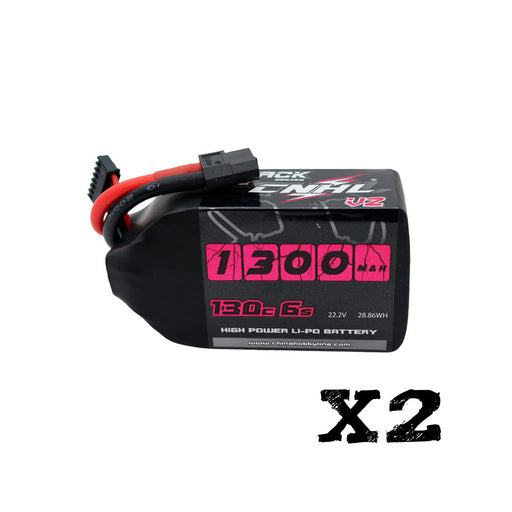
Nopea sovitustarkistus 2 Packs CNHL Black Series V2.0 1300mAh 22.2V 6S 130C LiPo-akku XT60-liittimellä sopii erinomaisesti FPV-lentäjille, jotka ha...
Näytä täydet tiedotVaraosat ja pitkäaikainen tuki Tiedämme, että RC-piloteille luotettava varaosatuki on tärkeä osa sitä, että lentokone pysyy lentokunnossa vuo...
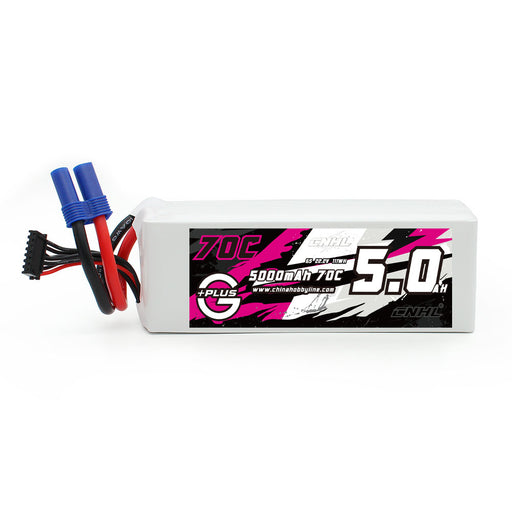
Näytä täydet tiedotTekniset tiedot: Varastonumero: 500706EC5 Kapasiteetti: 5000mAh Jännite: 22,2V / 6-kennoa / 6S1P Purkunopeus: 70C jatkuva / 140C hetkellinen Lata...
Näytä täydet tiedot
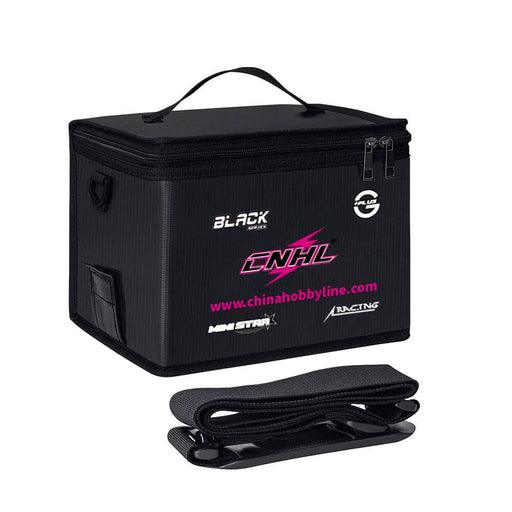
CNHL LiPo Battery Bag on suunniteltu turvallisempaan LiPo-lataukseen, kuljetukseen ja säilytykseen kotona tai kentällä. Se lisää käytännöllisen suo...
Näytä täydet tiedot

Nopea sovitustarkistus 2 paketin CNHL Speedy Pizza Series Pro 1350mAh 6S 150C LiPo -akku XT60-liittimellä on suunniteltu 5-tuuman FPV-piloteill...
Näytä täydet tiedot

Quick Fit Check The CNHL Speedy Pizza Series 2200mAh 22.2V 6S 120C LiPo Battery with XT60 Plug combines the familiar 2200mAh 6S format with a ligh...
Näytä täydet tiedot

Quick Fit Check The CNHL Speedy Pizza Series 2200mAh 14.8V 4S 120C LiPo Battery with XT60 Plug combines a widely used 2200mAh 4S format with a sli...
Näytä täydet tiedot

Quick Fit Check The CNHL Speedy Pizza Series 2200mAh 11.1V 3S 120C LiPo Battery with XT60 Plug takes the familiar 3S 2200mAh aircraft battery form...
Näytä täydet tiedotThe CNHL Long Range Series BAK 65E 6350mAh 21700 Li-ion battery cell is built around one clear priority: maximum stored energy from a lightweight c...
Näytä täydet tiedot

The CNHL Long Range Series BAK 50D 5000mAh 21700 Li-ion battery cell is designed for custom high-energy battery packs that need a strong balance be...
Näytä täydet tiedot




Jätä kommentti